

Webinar Invitation
The future of Global Mobility
Tuesday 24 November - 6:30 p.m.-8:00 p.m. CET
The KPMG Professorship in New Generation Management in association with the Cercle Magellan invites you to a webinar on the future of global mobility.
Hear from a panel of experts on a range of topics including:
- Global mobility trends
- Impact on companies’ global mobility programmes
- Impact on young talents mobility
With speakers:

- Agnès Pébarthe, HR Development Director, Saint-Gobain
- Alexandre Perrod, VP Comp&Ben and SWP, Groupe Renault
- Shona Toussaint, Head of Mobility, KPMG
- Susanna Warner, VP International Mobility, Schneider Electric
- Mike Wincott, Senior Director, AIRINC
This conference is organised by Célia Dorlhac, Director, International Mobility & Talent Management Clubs, Cercle Magellan, Martine Derdevet, International labor law expert, Groupe Renault, David Chekroun, Professor of International Business Law and KPMG Professor in New Generation Management at ESCP Business School.
Via Webinar
link details will be sent to participants prior to the event
REGISTRATION HERE
Location
Organiser: ESCP - Professorship in New Generation Management - Cercle Magellan
Paris - France
MapDate
Start date: 24/11/2020
Start time: 6:30 PM
End time: 8:00 PM
![© LSE Business Review [copyright]](/sites/default/files/styles/event_news_une/public/2020-11/Brussels.jpg)
Campuses

Prof. Michael Haenlein has been named on the annual Highly Cited Researchers™ 2020 list from Clarivate in the Economics and Business category.
The highly anticipated annual list “identifies scientists and social scientists who have demonstrated significant and broad influence, reflected in the publication of multiple papers frequently cited by their peers during the last decade.” These highly cited papers rank in the top 1% by citations for a field or fields and publication year in the Web of Science. Of the world’s population of scientists and social scientists, Highly Cited Researchers are 1 in 1,000. Their names are drawn from the publications that rank in the top 1% by citations for field and publication year in the Web of Science™ citation index.
Professor Michael Haenlein is in good company since 26 Nobel laureates, including three announced this year, also made this year’s list. “I share this honor, among others, with my friends Dhruv Grewal, Peter Verhoef and V. Kumar, as well as people such as Michael Porter, Eugene Fama, and Thomas Piketty,” commented Michael Haenlein, who is best known for his work on social media, especially the article Users of the World, Unite! co-authored with Professor Andreas Kaplan. A study conducted by Stanford University recently recognized the latter as one of the world's top 2% most-cited researchers.
The sequel to their seminal research paper, Rulers of the world, unite! The challenges and opportunities of Artificial Intelligence indicates how their research interests have evolved.
Campuses
![© Adobe Stock - naum [copyright]](/sites/default/files/styles/event_news_une/public/2020-11/Market-barriers.jpg)
ESCP researchers tried to understand how firms overcome market-based innovation barriers and achieve innovation performance using a combination of mindsets and actions. In so doing, they provided more nuanced insights into how effectuation orientation can help firms. This has important implications for innovation policy and innovation management.
“The received wisdom from the growing body of literature that addresses innovation performance has highlighted that innovation is closely associated with firms’ competitive advantages and financial performance,” PhD graduate Sebastian Szambelan and professors Yi Dragon Jiang and René Mauer explain in the European Management Journal. “Yet achieving innovation is particularly difficult for established firms because they may face market-based barriers, defined as barriers related to the external market environment the firms are confronted with.” Examples of such barriers are competitive rivalry on price, technology, product quality, reputation or brand, as well as missing market demand. Market-based barriers can be perceived as the given characteristics of a market environment to which organizations must adapt.
However, in a dynamic market many companies have difficulties in overcoming these barriers: In a 2018 survey of 270 corporate leaders in strategy, innovation, and research & development roles by KPMG and Innovation Leader (an online resource for corporate innovation teams), the inability to act on signals crucial to the future of the business was cited as one of the most important obstacles to innovation (42% of respondents). “We asked about two related barriers in our survey: how well does your company ‘pick up’ on signals of change, and how well does it act on them? Only 18% of respondents said that their companies had trouble with the former — so at most companies, there’s awareness of disruptive start-ups entering their sector, or changing customer purchase behaviours. The problem is acting on those signals,” writes Innovation Leader Co-founder and CEO Scott Kirsner in the Harvard Business Review. “Too many companies wait for the annual strategic off-site to roll around before they address the changing dynamics of their market.”
“In fact, we know relatively little about how organizations can overcome market-based barriers”, the researchers add. Recent research on the topic can be organized from two perspectives: the mindset-based view, represented by an organization’s culture and underlying values; and the action-based view, represented by certain actions taken to build leadership, management processes, or human capital. However, little research has systematically investigated how both mindsets and actions can help firms overcome these innovation barriers. “A deeper understanding of this subject could provide new insights into our knowledge of how firms can achieve this, and therefore catalysed our thinking and helped us approach the innovation phenomenon in a novel way.”
To tackle this research question empirically, they relied on a quantitative research design using survey data from 157 established organizations in Germany. Conceptually, they borrowed the effectuation orientation construct from the entrepreneurship literature. Effectuation orientation (EO) is defined as a strategic orientation that reflects a firm’s direction toward proactively shaping and designing the external environment, and creating new markets. The dimensions of this construct fall into two categories: (1) firms’ mindsets, represented by effectual control orientation (ECO); (2) firms’ actions, represented by four effectual action orientation (EAO) dimensions (affordable loss orientation, contingency orientation, means orientation, and partnership orientation).
“The results from our analyses show that EO is highly relevant for studying how firms overcome market-based innovation barriers,” they consider. “Our study further emphasizes variations in how effectual actions are related to perceived market-based innovation barriers, which in turn influence innovation performance. Specifically, it discusses ECO as a firm’s underlying effectual mindset, a mindset that triggers the remaining action-based effectuation orientation dimensions.” The findings thereby offer insights into the effectuation and innovation literature, and they hold several promising implications for practitioners:
- First, the study interprets market-based innovation barriers as socially constructed perceptions. Having such a conceptualization in mind instead of seeing innovation barriers as given and uncontrollable obstacles, which might prevent potential innovation activities from being pursued, it shows practitioners that they might be able to reduce and overcome certain innovation barriers.
- Second, ECO is introduced as a novel firm-level orientation driven by a mindset towards controlling the environment and co-creating its future. Building on this ECO, the implementation of the effectual action orientation dimensions shows promising effects on the perceived market-based innovation barriers. In particular, focusing on given means rather than inaccessible means or unavailable forecasts could yield more realistic solution spaces.
- When looking at the characteristics underlying effectual means orientation, firms could focus more on initiatives for which they have the relevant capabilities or the greatest motivation. This would at the same time help them to leverage existing knowledge and expertise in the best possible way.
- Furthermore, an openness to contingencies and their association with opportunities helps in perceiving the market more positively and thus in reducing perceived market-based innovation barriers. Specifically, this effectual dimension suggests that firms establish a firm mindset that allows them to perceive new information or setbacks as opportunities. They could then exploit contingencies effectively.
- Additionally, as other publications have already shown affordable loss orientation and partnership orientation are still worth pursuing. However, practitioners should be more aware of their possible consequences on perceived market-based innovation barriers. If these barriers are perceived as higher than before, managers might understand where such an increase originates from and could act accordingly.
“Ultimately, this study shows that lowered perceived market-based innovation barriers are positively associated with a firm’s innovation performance,” the researchers conclude. “This highlights the importance of understanding the perceived levels of innovation barriers, what they originate from, and how they can be overcome.”
Campuses
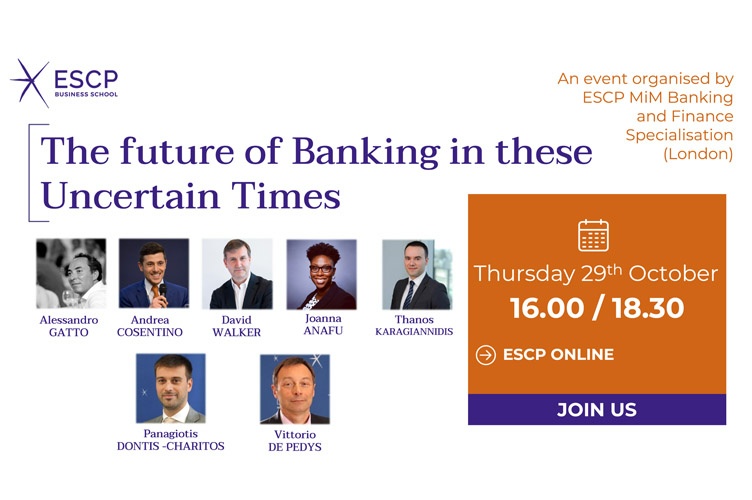
On 29th October 2020 the Banking and Finance Specialisation (Master in Management programme) at ESCP London Campus held an insightful webinar on ‘The Future of Banking in These Uncertain Times’.
It was organised with support from Professor Panagiotis Dontis Charitos, ESCP Associate Professor of Finance, and Professor Vittorio De Pedys, ESCP Affiliate Professor, and welcomed by the ESCP Finance Society.
Over 140 ESCP students joined the event representing several ESCP programmes: BSc in Management, MBA in International Management, Master in Management, MSc in Digital Transformation Management & Leadership and Executive MBA. The majority of students participated from the UK, USA, Italy, France and Germany.
A captivated audience heard from a panel of high-profile speakers, representing leading institutions that including Citibank, JP Morgan, Bloomberg and Deutsche Bank. Areas of discussion dealt with the outlook of the EU loan market and the balance sheet strength of institutions; the opportunities for cryptocurrencies and the threat they might pose to incumbents; capital markets developments; and banking risks. Students also had the opportunity to hear advice from and ask questions to HR experts on job prospects in financial services in the current environment and beyond.
Guest speakers were:
- Alessandro Gatto, Managing Director Co-Head of Structured Finance - South Europe at JP Morgan
- Andrea Cosentino, Sales & Business Development Manager at Bloomberg LP
- David Walker, MD Banking Capital Markets Advisory Group, Head of Public Sector coverage EMEA at Citi Bank
- Joanna Anafu, HR and recruitment team at Citi Bank
- Thanos Karagiannidis, VP Market Risk Data Quality and Operational Governance at Deutsche Bank UK
David Walker, MD Banking Capital Markets Advisory Group and Head of Public Sector coverage EMEA at Citi Bank shared: “It was my pleasure to participate, and I commend ESCP Business School for a well-organised, well-attended and interesting event. I thought the quality of the questions from the students was very high, suggesting strong curriculum engagement. Well done.”
Lucas Puig, ESCP MBA in International Management student commented: “Excellent event. I really enjoyed it!”
Campuses

23 Workshops, 5 Start-up Pitches: Jean Baptiste Say Institute is finding innovative ways to survive and thrive in this new virtual world we are living in.
We are joining forces to make the European Entrepreneurship Festival on the 19th of November, bringing together our entrepreneurship students and entrepreneurs from our network and beyond.
Option-E Workshops
From 2 PM onwards, Option E students from Berlin, Madrid and Paris campus will present and test their prototypes to collect feedback from the community.
All the workshops will be held online and are open to the community.
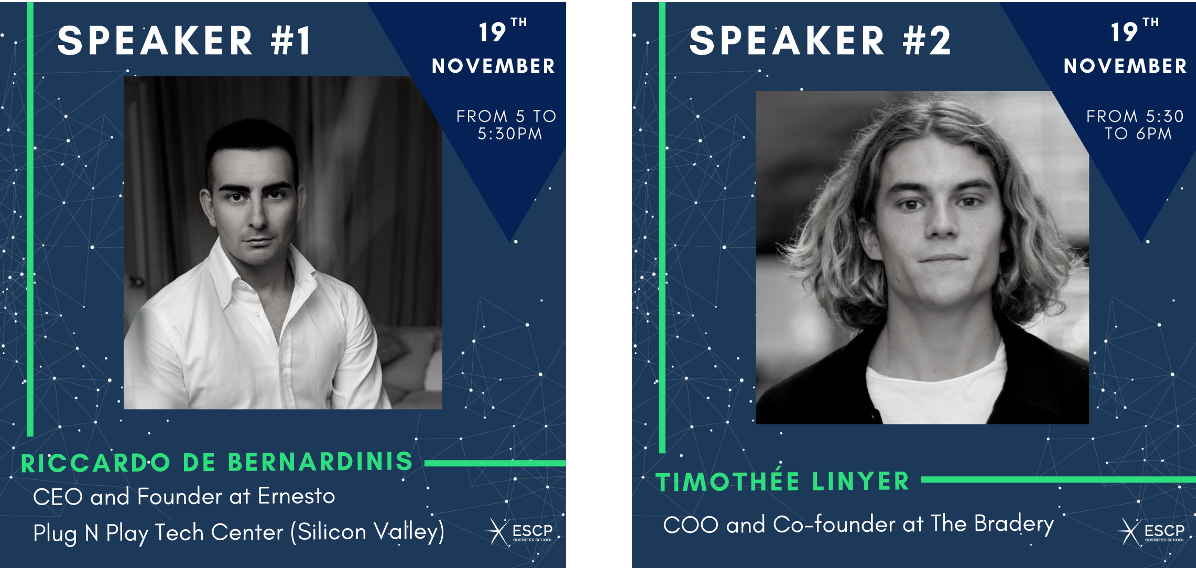
Entrepreneurs Talks
From 5 to 6 PM
Alumni Start-up Award
At 6 PM, we will present the Alumni Start-up Award to the best teams from this year's START Programme.
Alumni will get the chance to vote for the most promising teams, give back to their community of young and inspiring entrepreneurs, innovators and leaders, meet their former classmates and enjoy a special ESCP treat sent to their home.
Welcome
Prof. Dr. René Mauer, European Coordinator of the Jean-Baptiste Say Institute
Keynote
Inspiring Speech by a member of our European Start-up Network
Start-up Pitches
This year's 5 best Start-ups of the Blue Factory's START Programme will pitch their business ideas
Join us to celebrate the quintessence of entrepreneurship in uncertain times!
Registration here
Location
Organiser: ESCP Online
Berlin Madrid Paris - Germany Spain France
MapDate
Start date: 19/11/2020
Start time: 1:45 PM
End time: 8:00 PM

Webinar Replay
How to Take Your Career to the Next Level With an EMBA?
“Other people have done it successfully, so why not you?” As CEO and founder of OBK Performance, this question is at the centre of Odile Bocande-Koffi’s life and career. An Executive Business Coach who specialises in leadership development, Odile uses the knowledge she gained at the Executive MBA at ESCP Business School (Class of 2012) to help her clients leverage their strengths. In her master class “How to take your career to the next level with an EMBA”, she encourages you to push beyond your imagined limits, to ask yourself “why not me?”, and to consider the Executive MBA (EMBA) as an investment in your career that will transform your life. Here’s how.
Learning Different
Because your outlook has evolved since you started your career, the EMBA is an opportunity to learn differently. When you have a wealth of professional experience, how you learn is more efficient and yet more profound. Beyond the classroom, you will also learn from your peers and their diverse professional backgrounds, allowing you to expand your knowledge in a unique way.
Working in groups is a core feature of the EMBA experience at ESCP Business School, where Odile was a participant. In addition to learning about the latest techniques in strategy and leadership, or the foundations of economy and finance, hands-on group work allows you to discover the power of interpersonal relationships, how to motivate people working at your company, and how to be a positive influence.
A One-Shot Boost in Your Network
There’s a common thread that unites the people who decide to do an EMBA: their desire to enact positive change in their life and to empower their careers. From the first day of the programme, your network instantly grows across industries and the world. The camaraderie that comes from working together towards a common goal despite different personalities and cultures creates a solid and longlasting bond. The relationships you form throughout an EMBA push you to explore and adopt new mindsets.
Personal Development
When she joined the EMBA at ESCP Business School, Odile’s goal had been to progress in the corporate world where she had spent most of her professional life. But as she moved forward in the programme, she started to notice something interesting. While she could have chosen electives to specialise in finance or marketing, her course selection revealed a deep fascination in personal development, specifically a passion for helping people to grow. Those courses became the foundation of her current professional life. Odile left the corporate world to make the exciting leap into becoming a business owner in the personal development sector. She continues to apply skills she honed during her EMBA to ensure the success of her company where she delivers coaching services to executives and various individuals, while also organising conferences and group trainings.
As Odile says, “you have the option to choose the area where you want to develop yourself.”
There is a common misconception that you need to have a specific project to be able to get the most out of an EMBA. What Odile’s experience shows is that this programme can take you on an unexpected career path or spark a new idea that reveals a passion for something previously unknown. It is the chance to take stock of where you are now and look forward to where you can go. The EMBA can change your mindset from wondering whether something is possible, to knowing that it is and having the tools and confidence to make it a reality.
Overview of the Benefits
Career boost
- Positive and sometimes unexpected outcomes
- The knowledge to choose your career path
Salary increase
- Graduates of ESCP see an average 78% salary increase in the three years following their EMBA.
- Confidence to ask for the salary you know you deserve
Major attractiveness and Opportunities
- The EMBA is a stamp of approval, a gauge of quality.
- Headhunters recruit EMBA participants even before the end of the programme
- ESCP’s programme is ranked 7th in the world by the Financial Times
Capacity to dare
- You seek out new challenges because you have the tools to figure out how
- You can make things happen
Mindset
- You begin to think differently
- Classes and peers that push you to dig deeper
- “It’s just magic. You see yourself growing, you see yourself thinking differently, and the people around you tell you ‘You’re different’ in a good way.”
Executive MBA at ESCP Business School
For Odile, the Executive MBA at ESCP was a choice based on authenticity and mutual exchange. When she first encountered the programme at a fair, she felt that the school valued her goals and her needs. Indeed, the programme is designed to adapt to your unique career trajectory. You can personalise your curriculum on the most a granular level, be it in length, in location, or content. With over 50 electives across 5 European campuses, you will go beyond the fundamentals of business management and acquire in-depth knowledge in a variety of subjects. The unique elective structure means that throughout the programme, regardless of the campus you choose, you will meet and work closely with different participants from around the world and broaden your world-view.
[On-Demand]
Webinar
EMBA Virtual Info Session
To get to the next level of your managerial career, you need a world-renowned Executive MBA. Our International Programme Advisor and EMBA alumni answered your questions about the programme to help you determine if ESCP is the right fit for you
 |
|
Ambra |

Join our Online Info Session to get a first impression on the MSc in International Food & Beverage Management. You can interact with our recruiter and ask for more information about admissions, lessons, internships, scholarships and much more.
The MSc in International Food & Beverage Management is a 15 months specialised master programme designed for those aiming for an outstanding managerial career in the Food and Beverage industry.
The programme focuses on the F&B field with a trans-national approach, and cover all the fundamental competencies needed to succeed in this sector. You will have the chance to study across Italy and France.
The event will be held:
- in English at 4.00 pm - REGISTER HERE
- in Italian at 5.00 pm - REGISTER HERE
We are looking forward to meeting you online. Meanwhile do not hesitate to contact us for further information: msc.foodbeverage@escp.eu
Location
Organiser: ESCP Turin Campus
Online - Worldwide
MapDate
Start date: 12/01/2021
Start time: 4:00 PM
End time: 6:00 PM
Related stories

News 26/07/2019
Ranking
ESCP ranks 2nd worldwide in Eduniversal Ranking of the Best Masters in Food and Beverage Management
For its first participation in this ranking, the ESCP Master in International Food and Beverage Management programme has been ranked 1st in Europe.
Paris
Turin

News 23/06/2020
Turin News
MIM Alumnus Pietro Luigi Ghigo has key role in Italy’s F&B expansion in Asia
In recent years, Italian companies have embarked upon a process of international development aimed at tapping into new markets, especially in Asia, and many Food and Beverage firms are in the forefront of that expansion. One of the Alumni of ESCP Business School has played a key role in that growth: Pietro Luigi Ghigo, Master in Management Alumnus, Class of 2009, and Asia Regional Sales Manager at Lavazza.
Turin

News 05/05/2020
Turin News
MIM Alumnus Romolo Ganzerli recognized in the Italian #forbesunder30
Forbes Italia has released its annual “100 Under 30” list. We are delighted to see among these young disruptors ESCP Alumnus Romolo Ganzerli, cofounder of MammaPack, in the Retail category. He has been selected as one of the young leaders who are on the fast track for rethinking our relationship with e-commerce.
Turin

News 24/03/2020
Turin News
Matteo Frescobaldi is among the Italian #forbesunder30, ESCP alumnus and 30th generation of a family firm with 700 years of history
Matteo, Master in European Business alumnus, class of 2012, is the youngest member of the thirtieth generation of Marchesi de Frescobaldi, a family firm with seven hundred years of history.
Turin
Join us for the next Energy Management Centre webinar at ESCP Business School!
Mamadou-Abou Sarr, founder and President of V-Square Quantitative Management, a global investment firm headquartered in Chicago, will walk us through his journey as an international financier.
Sarr's career has led him to work across four continents and in five different cities. In his quantitative investment style, he developed a Global Positioning System (GPS) approach to investing, one that focuses on materiality, impact and profitability. He draws the parallel with his own career management and “no non-sense” leadership approach.
This event is free to join and will be hosted online. Book your place
The ESCP Energy Management Centre's Mission is to build a strong proactive partnership between energy corporations, government agencies and the academic community, in preparation for a new energy era. This will be achieved through the promotion of rigorous and objective empirical research on issues related to energy management, finance and policy, to support decision making by both government and industry.
Participants

Mamadou-Abou Sarr
Founder, President & CEO of V-Square Quantitative Management LLC
Location
Organiser: ESCP London Campus
Online - Worldwide
MapDate
Start date: 20/11/2020
Start time: 6:00 PM
End time: 8:00 PM
![© theHRDIRECTOR [copyright]](/sites/default/files/styles/event_news_une/public/2020-11/Deslandes_HR.jpg)
Campuses