
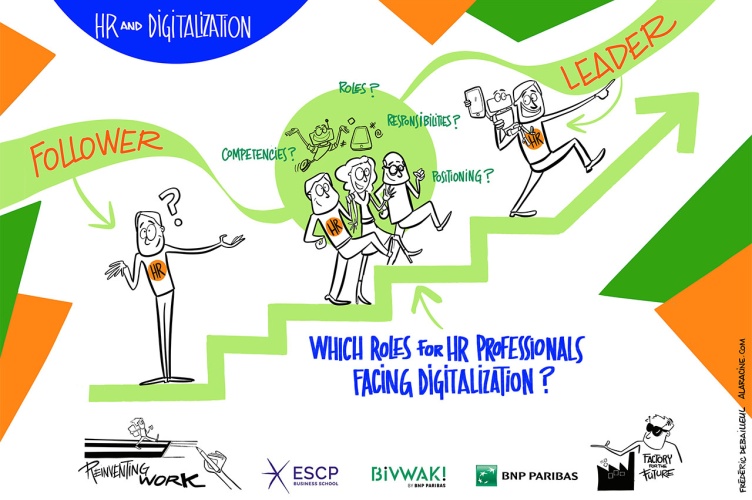
HR & Digitalisation A fascinating project launched in January 2020
Research context
Digitalisation’s impact on HR function, roles and practices has been tremendous over the past years. Research has highlighted the impact of digitalisation on operational HR objectives (reducing costs and administrative workload). However, HR also has responsibilities regarding relational goals (e.g. delivering services and supporting managers and employees) as well as transformation goals (e.g. aligning HR policy and practices with the company’s strategy). In this renewed context, digitalisation could offer the HR function the opportunity to better address relational and transformational goals, and eventually, take the lead as the success of digitalisation lies more on the employees buy-in than on the technology.
In this research, we aim to understand, in a prospectivist approach, how HR professionals view the future of their roles: will they be following the digitalisation, supporting managers or leading the transformation?
Research question
Does digitalisation make HR goals and practices evolve and, if so, with which consequences for HR professionals?
Methodology and milestones
Delphi methodology
Iterative data collection based upon experts’ points of view in order to identify consensus and differences
3 waves of data collection through questionnaires
Involving HR professionals from 2 companies
- 24 from BNP Paribas
- 13 from Safran Aircraft Engines
Research team
- Géraldine Galindo (ESCP, Paris campus)
- Emmanuelle Léon (ESCP, Paris campus)
Research keytake aways
The mastery of HR data appears to be key in the coming years for all HR professionals. However, very few of them intend to develop their competencies in this field.
Most HR practices can be digitalised in the future. Nevertheless, HR professionals highlight the risk of doing so without studying the pros and cons.
A taxonomy of HR professionals has been developed upon 2 dimensions:
- positive/negative view of digitalisation
- HR function as a leader or as a follower of digital transformation
Overall, participants to this research have a positive view of digitalisation. Within BNPP, half of the respondents consider that the HR function will lead the transformation in the years to come, whereas 2/3 of SAE HR professionals consider that it will mainly support managers, without the power nor the competencies to actually lead the digital transformation.
Attention points: HR data reliability, Data training for HR professionals, Segmentation of HR practices depending on the added value of digitalisation.
Key outcomes
Published academic papers
■ Galindo, G., & Léon, E. (2023). “Visions prospectives de la fonction RH à l’ère de la transformation digitale au travers de la méthode DELPHI”, Revue de gestion des ressources humaines (link)
■ Galindo, G. & Léon, E. (2023). “Les professionnels RH doivent s'emparer de la digitalisation de leur fonctions”, The Conversation (over 4.000 readers)(link)
Campuses
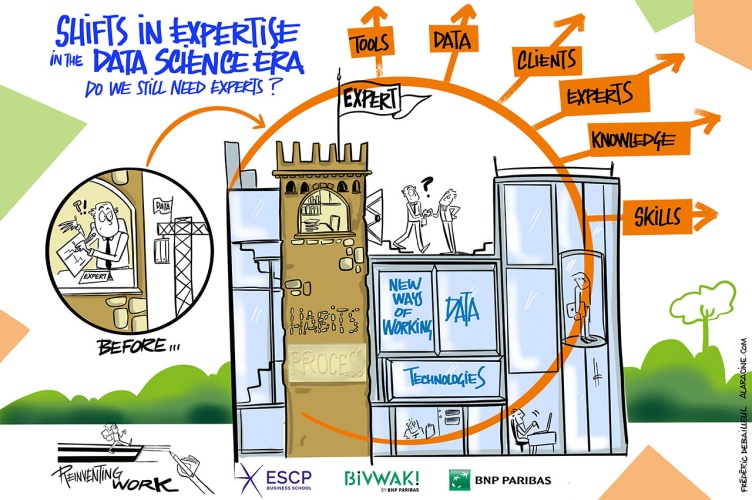
Shifts in expertise in the data science era A fascinating project launched in April 2021
Research context
Our research aims at further understanding how multiple forms of expertise are competing within the organisation, in the wake of the data science trend.
Our first phase of field work at BNPP PF revealed the centrality of scoring practices or scores, that is, mathematical models aimed at evaluating customers. These practices are historically embedded in the organisation and have relied since the 1970s on strong mathematical skills, embodied by the Risk teams and their statisticians. However, the spread of data science—through new occupations, new tools and new sets of skills— especially computer science skills— allows a new way to produce scores in the organisation.
Research question
How does the diffusion of data science challenge established forms of expertise in organisations?
Do we still need experts?
Methodology and milestones
Our research had two phases. During the first phase, we led 18 exploratory interviews with 16 Personal Finance employees and observed weekly online meetings for a data science project from June 2021 to January 2022. For the second phase of the research, we focused on Risk teams and added 26 interviews to our sample —with data scientists, scoring and business process experts, and managers.
Research team
- Valentin Mesa (ESCP, Paris campus)
- Géraldine Galindo (ESCP, Paris campus)
Research keytake aways
Data science reframes expertise in organisations, promoting expert work supported by computer science. This happens as a result of data scientists seeking legitimacy in the organisation.
This transformation may not be frictionless, as historical forms of expertise are embedded in the organisation through tools, processes and recognised skills.
Data practices emphasize the role of in-between actors - data workers who operate business software and databases - and whose knowledge and skills are key ingredients for data science.
Finally, as the data science field is still evolving, the division of expert work is still being redefined, with more emerging technologies, occupations and skills. This presents a challenge for HRM in order to adapt talent management practices to maintain the supply of expert work within the organization.
Attention points: Talent management, History-mindful innovation and change.
Key outcomes
Conference papers
■ Mesa, V. (2022). “Famous objects: Studying organizations through the lens of symbolic capital”, 38th EGOS colloquium
■ Mesa, V., & Galindo, G. (2023). “Data scientists tried to come through the window and we closed it: Understanding professional change with symbolic capital”,38th EGOS colloquium
Campuses
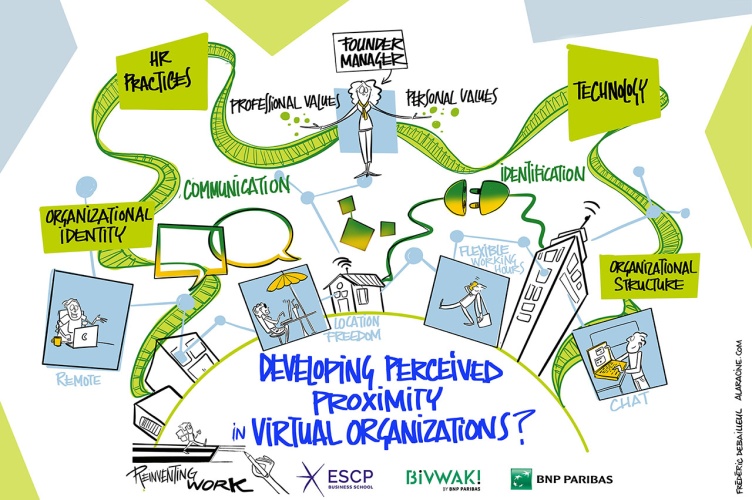
Distributed presence: designing togetherness in fully virtual organizations
A fascinating project launched in January 2021
Research context
What does it take to manage a distributed workforce? Drawing on lessons from location- independent organizations, we examine how organizational space can be created and sustained without the geographical proximity of colleagues.
Through the lens of Lefebvre’s triad of conceived, perceived, and lived space, we explore how space emerges through the beliefs of founders, the structuring efforts of managers, and the everyday interactions of employees.
Based on qualitative data from three location-independent firms and 37 interviews, we show that top-down practices such as routine meetings, shared calendars, and access to recorded work interactions foster distributed presence—a sense of responsiveness and connection akin to working in offices next to one another. This experience is supported by transparency, continuity, and responsiveness, allowing employees to stay aligned and feel embedded in a shared organizational rhythm. At the same time, employees bring space to life by initiating both work-related and informal relational ties.
Our findings offer practical insights for leaders organizing distributed work, emphasizing the importance of belief, structure, and relational effort in making virtual workspaces socially real and organizationally effective.
Research question
How is organizational space constructed and maintained when there are no walls, hallways, or offices to support it?
Methodology and milestones
We conducted 37 interviews with members of three location-independent organizations - which don’t have physical offices and where all the employees work remotely.
Research team
- Ekaterina Salovskaia-Leport (ESCP, Paris campus)
- Maral Muratbekova-Touron (ESCP, Paris campus)
Research keytake aways
1. Virtual work succeeds with a shared conviction that remote work is not a constraint but a viable way of operating. Founders and senior leaders play a crucial role in shaping this belief—not only by designing digital workflows but by consistently communicating, modeling, and embodying the legitimacy of virtual work.
2. While working remotely, we can recreate the feeling of working side by side through what we call distributed presence: the experience of responsiveness, transparency, and continuity that enables employees to stay aligned and feel embedded in a shared work rhythm. The following practices help make this possible:
- Design for responsiveness with visible rhythms and availability cues. Use shared calendars (e.g., Google Calendar), structured meeting routines (e.g., weekly team calls on Zoom or Google Meet), and real-time messaging tools (e.g., Slack) to recreate the feel of being “in the next room.” These systems allow employees to see when others are available and what they’re focused on, creating a sense of immediacy without constant check-ins.
- Foster transparency through open tools and communication norms. Make work legible by using open project boards (e.g., Trello, Notion) and shared task channels. Public Slack channels, rather than private messages, help surface information and align teams. Weekly team updates and shared KPIs further support alignment and reduce duplication of effort.
- Preserve continuity through digital memory. Invest in recording tools (e.g., Loom, Zoom recordings, Notion wikis) to document decisions, client interactions, and team processes.
- Enable informal and bottom-up interactions. Even with structure in place, virtual space only becomes alive when employees feel free to reach out, chat, and share beyond tasks. Support informal Slack channels (e.g., #random, #pets), pairing tools (e.g., Donut for weekly coffee chats), and spontaneous video calls. These small moments build trust and emotional connection that formal tools alone cannot replicate.
Attention points: Virtual organization, Location-independent organization; Organizational space; Distributed work, Distributed presence
Key outcomes
Presentation of the research at various international conferences.
■ “Developing Perceived Proximity in Virtual Organizations” - 5 th Global Conference on IHRM, New York, USA, May 2022
■ “The Role of Work Relationships in Producing Virtual Organizational Spaces” - 6 th Global Conference on IHRM, Gothenburg, Sweden, June 2024
■ “Production of Virtual Organizational Spaces: The Case of Virtual Organizations” – EGOS 2024, Milano, Italy, July 2024
■ “Navigating The Digital Realm: Constructing Organizational Space in Purely Virtual Organizations” – AGRH 2024, Barcelona, Spain, October 2024
■ “The Role of Work Relationships in Producing Virtual Organizational Spaces” - AOM Doctoral Consortium, Copenhagen, Denmark, July 2025
Published academic papers:
■ “Distributed presence: designing togetherness in fully virtual organizations” to be submitted to Academy of Management Perspectives in December 2025
Campuses
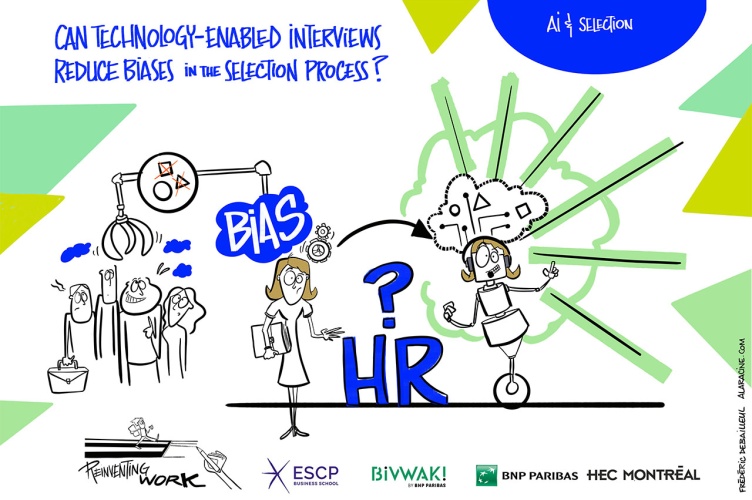
Technology-enabled interviews A fascinating project launched in Spring 2020
Research context
Launched in the Spring of 2020, this study initially sought to test whether technology-enabled interviews helped reduce selection bias. The goal was to compare selection decisions before and after the implementation of these technologies.
However, as we were unable to find companies that had actually implemented such interviews, we were forced to modify the initial research design.
We, therefore, documented the potential advantages and disadvantages of technology-enabled selection tools, such as chatbots, fit algorithms, synchronous and asynchronous videos, and digital interviewing.
Research question
What are the potential advantages and disadvantages of digital technology and artificial intelligence in staffing?
Methodology and milestones
The data collection was twofold :
After writing a literature review, we conducted interviews with two HR professionals using one of these technologies to document their experience.
We then administered an online survey to 175 candidates, in France and in Canada, in order to gather their impressions on the use of these technologies in a selection context.
Research team
- Anne Bourhis (HEC, Montréal)
- Amandine Desvergnes (HEC, Montréal)
- Emmanuelle Léon (ESCP, Paris campus)
- Marjorie Bonnet (ESCP, Paris campus)
Research keytake aways
From the HR professionals' point of view: those who use a fit algorithm report satisfaction with its ability to improve the selection process, hiring diversity and candidate experience.
From the candidates point of view: more than half of candidates have never experienced technology-enabled selection tools yet. Candidates who have this experience rated it as satisfactory, but the large majority (73 %) would rather be recruited entirely by a human being. Among the different tools presented (chatbot, fit algorithm, synchronous video interview, asynchronous video interview, digital interview), the one that arouses the least suspicion is the synchronous interview.
The effect of these technological tools on improving both candidate experience and diversity remains to be demonstrated.
Another study (developed by Marjorie Bonnet in 2021) has highlighted additional results, soon to be communicated.
Attention points: The use of these tools for staffing purposes is still in its infancy, and the rapid adoption of online technologies as a result of the COVID pandemic may quickly change these preliminary results.
Key outcomes
External ecosystem
Shared research outputs / Awards and articles
"Le numérique et l’intelligence artificielle au service du recrutement et de la sélection du personnel", Amandine Desvergnes, Master thesis, HEC Montréal
“Intelligence artificielle et recrutement: l’IA permet-elle de réduire les biais discriminatoires à l’embauche”, Marjorie Bonnet, Master thesis, ESCP Business School
Campuses
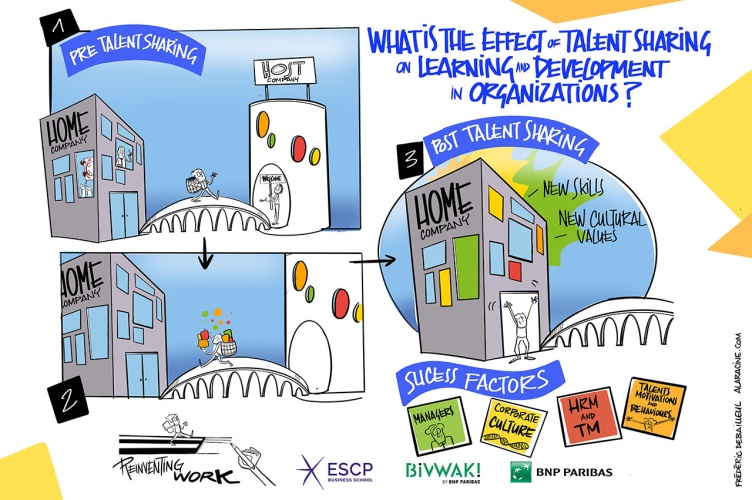
Talent sharing for organisational development A fascinating project launched in October 2020
Research context
This research has been designed at the Chair for Human Resource Management and Intercultural Management at ESCP Business School, Berlin and launched in October 2020.
It covers talents and talent experts from 9 different industries. It represents the first study on talent sharing, including its design and success factors. Thereby, it provides important recommendations for organisations on this increasingly applied approach.
Research question
What is the effect of talent sharing on learning and development in organizations?
Methodology and milestones
We followed an explorative research approach conducting 21 interviews with talents and talent experts in various organisations originating in Austria and Germany. This approach helps us to gain deep insights into outcomes and mechanisms underlying talent sharing and to pay tribute to the context-dependency of talent management.
Research team
- Marion Festing (ESCP, Berlin campus)
- Katharina Salmen (ESCP, Berlin campus)
Research keytake aways
Talent sharing has the potential to bring novel resources into organisations including new knowledge and skills as well as cultural values. This is especially valuable for organizations in dynamic contexts that are forced to reinvent themselves.
In order to capitalize on the insights gleaned from talent sharing, organisations need to consider various success factors such as the role of managers, corporate culture, HRM / TM as well as behaviours and motivations of talents.
Talents represent the lynchpin of talent sharing: they are not only important boundary spanners between host and home organizations but they are also the ones who hold strategic positions helping them to spread the insights gained from talent sharing. Therefore, it is especially important to select adequate people for talent sharing.
Key outcomes
External ecosystem
Shared research outputs / Awards and articles
Paper accepted for presentation at the 82nd Annual Meeting of the Academy of Management, Seattle/USA, August 2022
Paper presented at the 10th EIASM Workshop on Talent Management (online), Oct 2021
Campuses
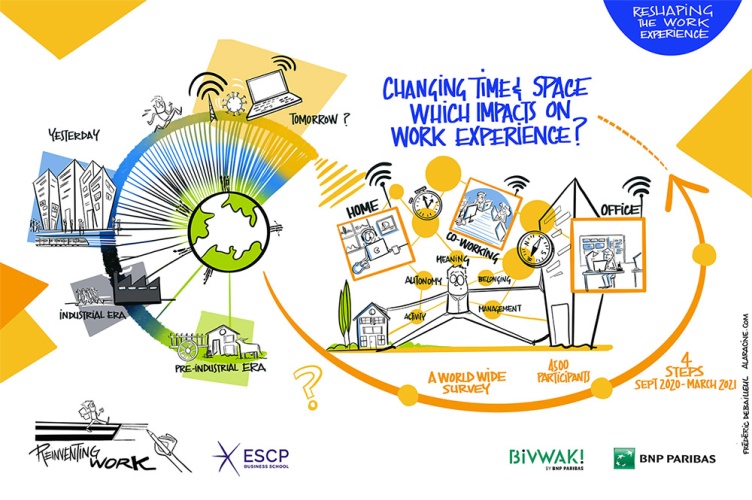
Reshaping the work experience A fascinating project launched in July 2020
Research context
This project has been designed with VPHR from different business lines in July 2020 and launched within BNP Paribas in September 2020, in order to fully understand the challenges of remote & hybrid work.
It has reached over 12.000 participants within BNP Paribas (WM, AM, RE, IRB headquarter & Bank of the West, Spain territory, over a six months period with 4 data collections from September 2020 to February 2021. Being ahead of the hybrid work trend, this research project was one of the very first to address this key issue on such a global scale and has been rewarded by a prestigious award from the Academy of Management [link?].
Research question
How does hybrid work influence employees' work experiences regarding team cohesion, performance, well-being and engagement?
Methodology and milestones
An online questionnaire was administrated 4 times (Sept & Nov 2020, Jan & Mar 2021) in 3 different languages (English, French, Spanish) with up to 4000 answers. This methodology enables to follow the changes at hand in a situation that has been evolving throughout the project. First two waves analysed in Q2 2021. In-depth analysis of the results has been performed through a partnership with Towers Watson Willis, giving BNP Paribas entities the possibility to better understand their results.
Research team
- Marie-Colombe Afota (Université de Montréal)
- Emmanuelle Léon (ESCP, Paris campus)
- Ariane Ollier-Malaterre (UQAM)
- Yannick Provost-Savard (UQAM)
Research keytake aways
Productivity is on the rise, due to reduced transportation time (often devoted to work). The number of working hours is similar when employees are on-site or remote.
One-third of the participants consider that physical presence at the office remains a signal of their engagement, which will be taken into account for their promotion.
When companies value physical presence, teleworkers try to compensate their absence by being available outside working hours. Availability off-site has replaced visibility on-site. This trend is stronger in countries where employment is less protected.
Attention points: Informal networking/ exposition, Identification of weak signals, Professional mobility.
Key outcomes
Published academic papers
■ Afota, M. C., Provost Savard, Y., Léon, E., & Ollier‐Malaterre, A. (2024). “Changes in belongingness, meaningful work, and emotional exhaustion among new high‐ intensity telecommuters: Insights from pandemic remote workers”, Journal of occupational and organizational psychology (link)
■ Afota, M. C., Provost Savard, Y., Ollier-Malaterre, A., & Léon, E. (2023). “Work-from-home adjustment in the US and Europe: the role of psychological climate for face time and perceived availability expectations”, The International Journal of Human Resource Management (link)
■ Afota, MC.; Ollier-Malaterre, A.; Leon, E.; Provost Savard, Y. (2021). “To demonstrate their commitment, teleworkers are making themselves more available than ever”, The Conversation (link)
Campuses
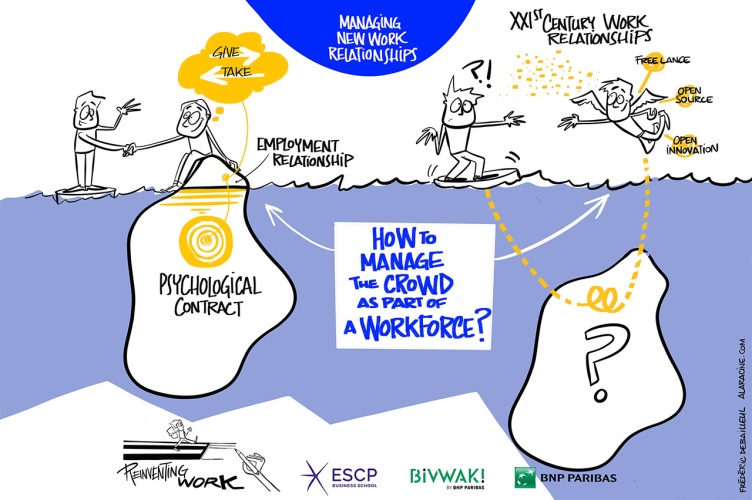
Managing new work relationships A fascinating project launched in June 2020
Research context
In today's professional world, a growing trend towards project-based work, performed by contingent and self-employed workers, is evident. For instance, 83% of executives surveyed by Oxford Economics (2020) reported increasingly using consultants, intermittent employees, or contingent workers in their operations.
Yet management theory and people management practices in organisations are still primarily oriented towards workers with employment relationships.
This project seeks to develop management theory to understand 21st century work relationships, by studying workers who are independent from the companies they contribute their work to. The project focuses on two types of independent workers: opensource software contributors and IT freelancers, providing complementary findings.
Research question
Overall question: How should workers that are external to the organisation be managed?
Initial focus - open-source contributors: Why do people contribute to open source and why do they stop?
Evolved focus – IT freelancers: How do freelancers experience and manage the tensions between insiderness and outsiderness? How do they develop a sense of insiderness? How does that influence their careers?
Methodology and milestones
This study consists of two sub-projects:
■ Open Source Contributors (2021–2022): Analysis of 159 threads from over 9,000 emails in an open-source project combining paid employees and volunteers to examine how contributors' participation evolves and ends.
■ Freelance Workers (2021–2024): Data collection included:
- Two rounds of qualitative interviews with 36 European freelancers
- A survey in three waves (three weeks apart) with 229 freelancers from Australia, New Zealand, the UK, and the US.
Reliance on psychological contract theory as the analytical lens.
Research team
Open source contributors
- Daniel Curto-Millet (University of Gothenburg)
- Almudena Cañibano (ESCP, Paris campus)
- Lukas Rojahn (ESCP, Madrid campus)
Freelancers
- Thomas Gigant (ESCP, Berlin campus)
- Kerstin Alfes (ESCP, Berlin campus)
Research keytake aways
1- Workers outside of employment relationships hold multiple psychological contracts with different actors (the project / fellow developers / users for open source contributors; the organization vs. the team for freelancers).
2- These multiple psychological contracts create tensions and contradictions than individuals must navigate and can influence the evolution of workers’ careers.
3- There is a compelling need to encourage a sense of ‘insider-ness’ of workers outside of employment relationships at the team level, rather than focusing exclusively on the organisational level.
This shift in perspective requires changes in human resource management and leadership practices, with a focus on developing a sense of belonging within teams.
4- Support from team members is crucial in this process, but its effect is mediated by social cohesion and team trust.
There should be active encouragement and support for team members (both employees and non-employees) to help colleagues and make contingent workers feel part of the in-group
Key outcomes
Published academic papers
■ Cañibano, A; Curto-Millet, D and Rojahn, L. (2022). “Sustained participation in open source: A psychological contract approach” Hawaii International Conference on System Sciences Proceedings (HICCS). T. De Vreede, D. Kong, GJ De Vreede. (Eds) Articles undergoing peer review (link)
■ Gigant, T, Alfes, K., Cañibano, A. (2024). “TeamBased Perceived Insider Status: Exploring the Drivers and Outcomes of Freelancers' Sense of Belonging to their Project Teams” Under review at Journal of Vocational Behavior
■ Gigant, T, Cañibano, A., Alfes, K. (2024). “The freelancer's paradox: mastering the tightrope walk between the insider and outsider’s worlds” Under review at Work Employment and Society
Campuses