
Episode 6
From the series “Standing together: ESCP community united against gender-based and sexual violence”
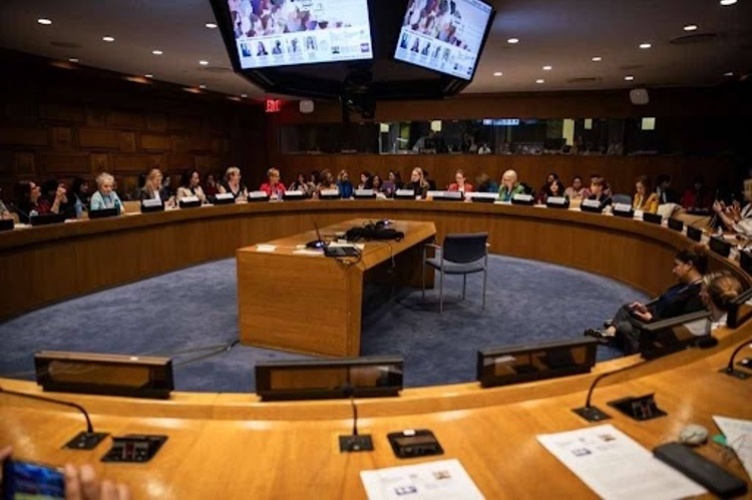
In New York last March, during the 70th session of the United Nations Commission on the Status of Women (CSW70), the French delegation led by Aurore Bergé, Minister for Equality between Women and Men and the Fight Against Discrimination, brought together committed figures from diverse backgrounds to champion the cause of equality.
Among them were several ESCP alumnae, including Sarah Barukh, founder of the association 125 et Après and the Safe Place CSR label, and Laurence Kerjean, President of the Marseille branch of the NGO Business Professional Women.
Two different paths, but one shared conviction: women’s rights can never be taken for granted, and progress depends on the continued mobilisation of society as a whole.
A responsibility as much as an honour
When Sarah Barukh learned that she would join the French delegation, her reaction was immediate: “My first reaction was a mixture of pride and awe. The French delegation is one of the largest in the world. That says a great deal about our country’s commitment to these issues.”
Laurence Kerjean also recalls the emotion she felt when she learned she would be part of the French delegation: “A mixture of pride, responsibility and urgency. Pride, because joining the French delegation at CSW70 means taking part in a forum where major global directions for gender equality are shaped. Responsibility, because I was not there in my own name: I carried with me the voices of our members, our ambassadors and the trust of our French federation. Above all, I felt a sense of urgency.”
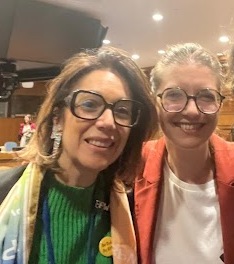
She sees that urgency every day in the field: “In Marseille in particular, I see how inequalities are formed from a very early age: through stereotypes, self-censorship, access to role models, access to justice and sometimes even access to freedom.”
A troubling global context
At the heart of CSW70 discussions, one conclusion emerged: despite decades of international mobilisation, progress remains fragile.
Sarah was particularly struck by concerns expressed by grassroots organisations regarding declining NGO funding and the concrete consequences this has for victims.
Laurence also highlights a paradox:
“The contrast between seventy years of extraordinary international mobilisation and the reality that the same obstacles persist. Whatever the country, culture or level of economic development, the same mechanisms are at work everywhere: cognitive bias, under-representation, systemic violence and barriers preventing women from accessing justice and economic, political and technological power.”
She added: “I was also deeply struck by the lack of consensus on the adoption of the final text, for the first time in CSW history. Not only did the United States oppose the first draft, it also tabled a motion in an attempt to block its adoption altogether.
The text was ultimately adopted without them. This is a powerful political signal, revealing current fractures regarding women’s rights and human rights more broadly. If there was any doubt about the scale of the global backlash, there is none now.
CSW also highlighted the growing organisation and influence of anti-rights movements, whose funding increased from $20 million in 2009 to $270 million in 2022.”
Encounters that restore strength
Sarah spoke about meeting Céline Bardet, an international lawyer specialising in war crimes, and emphasised that domestic and wartime violence share the same mechanisms of impunity.
“Céline is an international lawyer specialising in war crimes and founder of We Are Not Weapons of War, which supports survivors of sexual violence used as a weapon of conflict. Her work lies at the intersection of humanitarian, legal and political action in some of the darkest places in the world.
Domestic violence and wartime violence are not separate realities: they share the same roots, the same disregard for women’s bodies and the same systemic impunity. Céline works where states have failed. I work where civil society and businesses can step in. Our approaches differ, but our conviction is the same: we cannot wait.”
Laurence was particularly moved by the importance given to local initiatives and education, both initial and lifelong, as drivers of lasting change.
“This strongly echoed the advocacy work we are carrying out with Aix-Marseille University to make awareness of implicit cognitive bias compulsory in teacher training. At CSW, I realised that this issue is universal. Across the world, women and organisations are asking the same question:
how can we prevent stereotypes from limiting the ambitions of children and women before they even have the opportunity to dream? Equality cannot simply be decreed. It must be built collectively, concretely and from an early age.”
When business becomes a place of protection
Laurence welcomed the fact that many discussions focused on the role of the private sector in building a more equal society.
Sarah created the Safe Place Movement in 2025 to help businesses address violence against women.
“Sixty-two per cent of women who have reported violence to the authorities are in employment. I have cited this figure since the launch of the Safe Place Movement. It means that businesses, whether they like it or not, are already at the heart of the issue. The real question is not whether companies should become involved, but how.”
Sarah, why is it crucial for businesses to address domestic violence when it is often viewed as a private matter?
“For a long time, organisations responded with silence in the name of respecting privacy. ‘It’s not our role.’ ‘We are not social workers.’ I understand those positions, and they are often taken in good faith. But they are no longer tenable. A victim of domestic abuse who arrives at work on Monday morning after a sleepless night, receives threats on her work phone and fears her abusive partner may be waiting outside has not left the violence behind at the office door. The company is already involved. The question is whether it is prepared to respond. Moreover, intimate-partner violence costs European businesses €50 billion a year, around 2% of GDP. HR risks, legal risks and reputational risks mean that ignoring the issue is neither ethical nor rational.”
What does a ‘safe place’ look like in practice within an organisation?
“When a company joins the Safe Place CSR label, it does not simply introduce a hotline or put up posters. It implements a structured framework built on three pillars. First, clear internal procedures: who to contact, how confidentiality is ensured, and how working arrangements can be adapted without requiring victims to justify themselves publicly.
Practical tools, trained contacts and tailored communication resources are provided. Second, training for managers and teams: learning to identify warning signs without overstepping boundaries, knowing what to say—and what not to say—to someone who confides in you, and understanding how to direct them towards qualified professionals. The company does not replace experts; it creates the missing link between the victim and professional support.
Finally, access to the Les Veilleuses community: more than 250 trained volunteers available around the clock to listen, guide and support victims medically, legally and emotionally. Often, what truly makes a difference is a simple message from an HR contact saying: ‘I’m here, you’re not alone, and here is what we can do.’ It may not seem dramatic, but it can be life-saving.”
Since the label was launched, have you seen examples where a company genuinely changed the course of a victim’s life?
“Forty companies have joined us, from SMEs to major corporations across sectors including luxury goods, food production, energy, retail, construction, banking and the public sector. What struck me most is that in almost all of these organisations, victims came forward shortly after the programme was introduced.
Not because violence had suddenly increased, but because a space of trust had been created. These women were already there. They simply needed to know they could speak out, that someone would listen, and that it would not jeopardise their jobs. In one large industrial group, an employee was able to adjust her working hours to make her routine less predictable to an abusive partner—a simple measure that may have saved her life.
In a small business, the managing director was trained and reached out to a colleague he had seen withdrawing for weeks. In a luxury house, an HR representative trained through Safe Place recognised the warning signs and directed an employee to the appropriate support. These are not extraordinary stories. They are what happens when organisations are given the tools to play their part.”
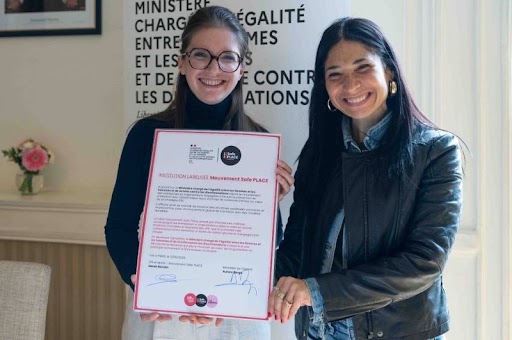
The Safe Place Movement was founded in 2025 as an extension of the 125 et Après association and the Les Veilleuses community established by Sarah Barukh. It helps companies create a protective framework for employees experiencing domestic and sexual violence.
The 125 et Après association works against domestic, family and sexual violence throughout mainland France and the French overseas territories.
Campuses
Related stories
News 20/11/2025
Interview
#1 Violence Against Women: Acting Where Pain Falls Silent
A conversation between Ghada Hatem (ESCP 11), founder of La Maison des Femmes in Saint-Denis (2016), and Louise Blin (Bachelor 2025 alumna and MSc in International Business & Diplomacy student)
News 10/12/2025
Interview
#2 How Tribunes, an ESCP student association, creates a space for students to learn, question, and commit to change
A conversation between Aurélie Dumond, Inclusion & Diversity Officer at ESCP and Ariane Bailet and Antonin Rousseau, ESCP students and members of the student society Tribunes.
News 22/01/2026
Interview
#3 The role of publishing in addressing gender-based and sexual violence
An interview where ESCP faculty member Isabelle Beyneix and alumna Marie-Pierre Gracedieu discuss publishing’s role in addressing gender-based violence, following the release of Mazan: An Anthropology of a Rape Trial—part of ESCP’s Standing Together series.
News 16/02/2026
Interview
#4 Art in action: sharing ESCP staff competencies and creativity in addressing gender-based and sexual violence
Sandrine Kiefer, Head of Internal Communications at ESCP, and Sabrina Saase, Health & Well-Being Manager at ESCP’s Berlin Campus, share their activism.
News 02/03/2026
Interview
#5 Transforming Public Policy into tangible results
Farid Medjoub (ESCP 20) asked Roxana Marcineanu (ESCP 05) to share her vision about gender-based and sexual violence