
Episode 3
From the series Standing together: ESCP community united against gender-based and sexual violence
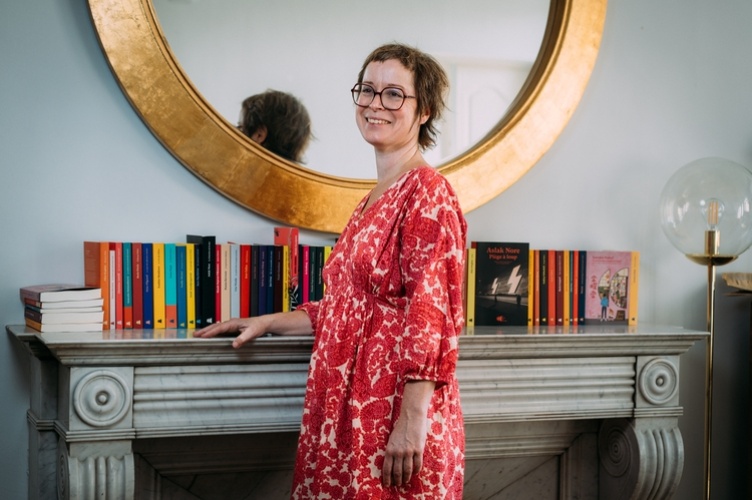
A conversation between Isabelle Beyneix, Associate Professor (HDR) in Private Law and Scientific Director of the MSc in Media at ESCP Business School, and Marie-Pierre Gracedieu (ESCP 99), co-founder & CEO, Le Bruit du Monde, who published “Mazan: an anthropology of a rape trial”.
Publishing as a space for independent and collective voices
Isabelle Beyneix: In 2021, you founded your own publishing house, Le Bruit du Monde, together with Adrien Servières, under the Editis Group, after having worked as a literary director and then as a series editor at Gallimard. Could you explain what motivated you to create your own publishing house? Did you feel that a particular voice was missing in the publishing landscape?
Marie-Pierre Gracedieu: I spent around fifteen years nurturing two remarkable collections of foreign literature, bringing forgotten classics back to light—such as works by Virginia Woolf or Stefan Zweig—while also introducing new voices like Sofi Oksanen and Anna Hope.
In 2020, a meeting with a member of the Editis Group made me realise that I now wanted to channel my energy and curiosity into a more personal project. I knew that I would continue to observe the world and the bold voices that seek to describe it, but I wanted to do so from Marseille—a city where I was certain to encounter stories different from those written in Paris.
I have had a close relationship with Marseille since my twenties and deeply appreciate both its cultural richness and its international dimension. I also wished to focus my efforts on publishing around ten titles per year. By partnering with Adrien, who had solid experience in distribution and bookselling, I knew I could rely on a strong ally to ensure that our books would reach journalists, booksellers and readers.
Isabelle: How do you work within the Editis Group (owned by Mr Daniel Křetínský since its acquisition from Vivendi in 2023)? Do you enjoy full editorial independence? What are the advantages of being affiliated with such a group?
Marie-Pierre: I have enjoyed complete editorial independence in the choice of the texts we publish since the creation of the publishing house in March 2021. Our authors often address political issues, but they do so by prioritising nuance and by avoiding clichés and oversimplifications.
Publishing “De notre monde emporté”, Christian Astolfi’s novel inspired by the closure of the shipyards in La Seyne-sur-Mer, involves both reflecting on the loss of skills and jobs and recalling the harsh working conditions endured by those workers.
The Editis Group provides us with the means to pursue our ambitions. It allows us to assume the risks inherent in publishing first novels or works of foreign literature. We benefit from the services of Interforum, a high-quality distributor, and from the support of group employees who handle the sale of subsidiary rights—paperback editions, foreign rights, film adaptations, and so on. Exchanging with these colleagues also allows us to gain perspective on our own activity. Establishing a publishing house that is open to the world, and based in Marseille, requires constant effort, and it is invaluable to draw on the experience of other publishers.
Gender-based violence, media responsibility and societal change
Isabelle: Your publishing house produces narratives and novels, and “Mazan, An Anthropology of a Rape Trial” is, to the best of my knowledge, your first collective essay dealing with a major social issue. What led you to embark on this new type of publication? Was it primarily the desire to address the Mazan rape cases? Do you envisage publishing further works on other societal issues?
Marie-Pierre: Each book is selected for its singularity. There is never any question of creating a collection or adhering to a predefined “type” of publication. We had previously been approached by journalists wishing to write about Mazan, but we declined, fearing overly immediate analyses or excessively personal viewpoints on the case.
In early January 2025, my attention was drawn to a LinkedIn post by an anthropologist from the Norbert Elias Centre, a CNRS research unit in Marseille. Lucille Florenza described the complex emotions she experienced upon returning from Avignon, where she had spent nearly two months with thirteen other anthropologists observing the Mazan trial—from inside the courthouse to café terraces and the surroundings of public institutions.
Intrigued by what appeared to be an extraordinary research experience in the social sciences, I invited her to meet me. A few weeks later, I discovered the first part of a narrative that finally enabled me to reflect on what Dominique Pélicot had inflicted on his wife, and above all on the collective and deeply intimate consequences of this case. I was struck by their ability to speak with a single voice about the unfolding of the case on the public stage of the city of Avignon, without ever sacrificing narrative tension or nuance.
I was also deeply moved by the collective voice they developed following the publication of the book, which allows us to grasp the strength of collective endeavour. I would very much like to experience similarly inspiring editorial projects in the field of social sciences. Other subjects could lend themselves to this approach, and some books might even reveal the existence of collectives engaged in missions of general interest that transform our lives. I am actively reflecting on this with several authors from the publishing house.
Isabelle: What is your assessment of the evolution of media coverage of violence against women?
Marie-Pierre: I was born at the end of the 1970s, and I therefore lived for a long time in a society that either silenced or relativised violence against women. I can only welcome the media attention these issues now receive. However, I regret the speed at which events succeed one another, with one case often eclipsing the previous one.
That is the nature of the media cycle, but I far prefer the space for reflection offered by books. It is essential to study these cases in depth and to reveal all the factors that “authorised” such violence, which often lie in the protagonists’ childhoods and education.
Isabelle: How do you explain the silence of men in relation to an exceptional case such as the Mazan affair?
Marie-Pierre: It is not easy to accept that a man could place his wife at the centre of such a system of violence, and that so many men could participate in it over so many years. I imagine that men may fear, more than women, being associated with such a figure—and yet the monster exists within each of us.
I have nevertheless observed that some men did not remain silent and that they too are searching for answers, hoping to find a way for shame to change sides.
Recognising and protecting rights: The legal response to gender-based violence in France
Marie-Pierre: Isabelle, as an Associate Professor in Private Law, I would like to get your understanding of the evolution of the treatment of Gender-Based and Sexual Violence in French Law.
Isabelle: It is a long and still unfinished process! It is a long and still unfinished process. There was a time when the killing of a woman by a man was characterised as a crime of passion, cloaked in fatal romanticism, and when street harassment was regarded as a socially acceptable form of courtship. Men’s desire was assumed to justify excess, and such conduct was not considered aberrant.
Since the #MeToo movement, gender-based violence has been defined as any harmful act committed on the grounds of sex, gender, gender identity, sexual orientation or related characteristics. Sexual violence is now understood as a form of physical assault of a sexual nature, including non-consensual sexual intercourse. While these developments are significant, they remain insufficient, as illustrated by the Council of Europe report of 16 September 2025 highlighting the persistently low rate of prosecution for sexual violence in France.
More generally, women’s rights have evolved only recently. Divorce by mutual consent dates from 1975, while the equalisation of the legal age of marriage at 18 and the inclusion of “respect” among marital duties appeared only in 2006. Legislative milestones include the Neuwirth Act of 1967 on contraception, the Veil Act of 1975 legalising abortion, the Neiertz Act of 1993 criminalising obstruction of access to abortion, and the elevation of abortion to a constitutional right in 2024.
The recognition of marital rape stems from a 1990 ruling of the Criminal Chamber of the Court of Cassation, and the explicit incorporation of the absence of consent into the definition of rape has only very recently been achieved. Criminal law reforms addressing domestic violence, sexual harassment and revenge porn further attest to substantial progress.
Nevertheless, these advances are recent and fragile. Experience shows how quickly progress may erode in times of political or social upheaval, increasing the risk of regression driven by elections, religious influence or crises. Moreover, these protections benefit only a fraction of women worldwide. Resistance persists among those who perceive gender equality as a threat to a long-established order rooted in domination rather than nature.
While many struggles remain—such as equal pay and the sharing of domestic labour—the most fundamental battle is that of attitudes. Women’s rights are not special rights but fundamental rights, and their preservation requires sustained collective commitment from both women and men. Failing this, the experience of Western women may prove to have been no more than a fleeting interlude, destined to become a myth—much like that of the Amazons.
Campuses
Related stories
News 20/11/2025
Interview
#1 Violence Against Women: Acting Where Pain Falls Silent
A conversation between Ghada Hatem (ESCP 11), founder of La Maison des Femmes in Saint-Denis (2016), and Louise Blin (Bachelor 2025 alumna and MSc in International Business & Diplomacy student)
News 10/12/2025
Interview
#2 How Tribunes, an ESCP student association, creates a space for students to learn, question, and commit to change
A conversation between Aurélie Dumond, Inclusion & Diversity Officer at ESCP and Ariane Bailet and Antonin Rousseau, ESCP students and members of the student society Tribunes.
News 16/02/2026
Interview
#4 Art in action: sharing ESCP staff competencies and creativity in addressing gender-based and sexual violence
Sandrine Kiefer, Head of Internal Communications at ESCP, and Sabrina Saase, Health & Well-Being Manager at ESCP’s Berlin Campus, share their activism.
News 02/03/2026
Interview
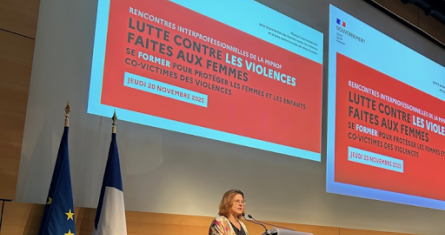
#5 Transforming Public Policy into tangible results
Farid Medjoub (ESCP 20) asked Roxana Marcineanu (ESCP 05) to share her vision about gender-based and sexual violence
News 08/06/2026
Interview
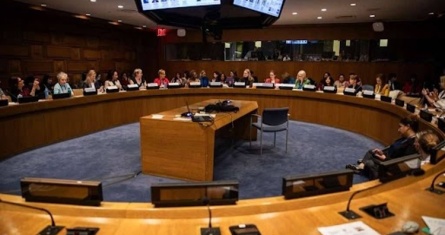
#6 At CSW70 (New York), ESCP Alumnae Championing Gender Equality
In New York last March, during the 70th session of the United Nations Commission on the Status of Women (CSW70), two alumni, joined the French Delegation led by Aurore Bergé, Minister for Equality between Women and Men and the Fight Against Discrimination