
Episode 2
From the series "Standing together: ESCP community united against gender-based and sexual violence"
A conference designed to inform and raise awareness within the ESCP community
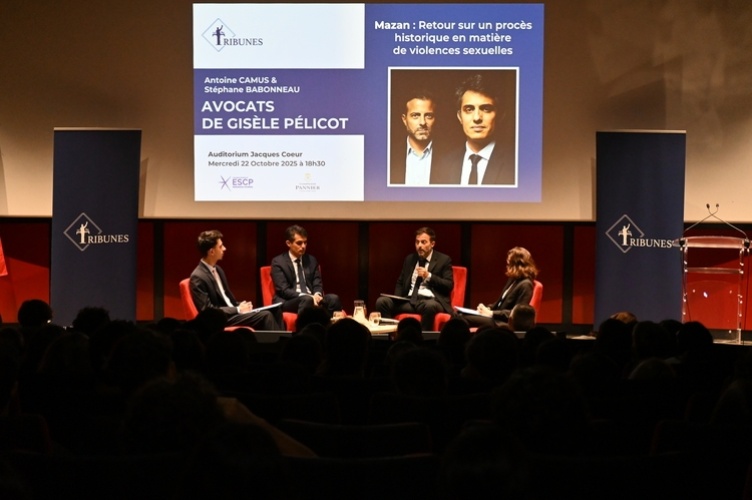
On 22 October 2025, Tribunes—ESCP’s student association dedicated to public debate—invited Maître Stéphane Babonneau and Maître Antoine Camus, the lawyers representing Gisèle Pélicot in a landmark sexual assault case, for a conference exploring its legal, human, and societal implications.
A conversation between Aurélie Dumond, Federal Head of Inclusion & Diversity at ESCP and Ariane Bailet and Antonin Rousseau, ESCP students and members of the student society Tribunes.
Aurélie: Why did you decide to invite attorneys Babonneau and Camus?
We chose to invite Maître Babonneau and Maître Camus for several reasons. First, because they played a central role in a complex and highly publicised trial, one that sheds light on a justice system that is often misunderstood and raises essential questions around consent. Their presence also allowed us to offer students a more human perspective on the work of lawyers—a profession often seen through the lens of the media, without really knowing the reality of their daily work, how they inhabit a case from the inside, or the deep relationship they develop with their clients.
We also wanted to be “at the heart of the debate,” in the literal sense of the Tribunes slogan, by placing ourselves within immediate current events: our conference took place only about ten days after the decision was handed down on appeal. The end of the judicial process was the perfect moment to revisit this exceptional case and offer an informed analysis within ESCP.
Finally, we aimed to make Tribunes a space for diverse reflection, not limited to political figures. As students aware of gender-based and sexual violence, we wanted to organise an event by and for students, to show that we are addressing these issues and feel responsible for contributing to the discussion. Welcoming Camus and Babonneau was also an opportunity to question them about their profession and better understand the French judicial system.
Aurélie: How did you prepare for the conference?
We followed a methodical and thorough preparation process. We began with a research and familiarisation phase that was essential to fully grasp the Pélicot case: understanding the facts—sometimes difficult and emotionally challenging to read—but necessary to appreciate the seriousness of the case. We also immersed ourselves in the background and public statements of our guests by watching numerous interviews and observing how they addressed legal questions. This helped us identify the key issues of the trial, whether related to procedure, closed hearings, the appeal, the role of judges and jurors, or developments in sexual violence law.
Once this solid foundation was established, each of us wrote around ten questions before pooling our proposals to build a coherent and relevant structure for the interview. Finally, as the conference approached, we refined the last details and practiced together to ensure a smooth, confident, and well-structured presentation.
Aurélie: What angle and types of questions did you prioritise?
Ariane:
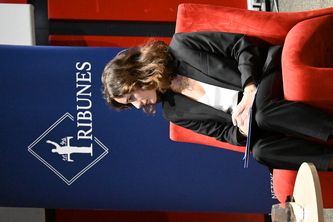
We wanted to take a legal angle and make the most of having professionals in front of us. How does a lawyer come to represent Ms Pélicot? How does a trial unfold? What does lifting a closed hearing entail? How should we approach the notion of consent? What impact will this trial have on them and their careers? We were intent on doing things properly: respecting the case without falling into sensationalism, addressing heavy topics without causing harm.
Aurélie: What do you take away from the lawyers’ interventions?
Antonin:The great precision of the words they choose. Ariane: I was very moved by the trust they place in the justice system. They acknowledge its dysfunctions but remain convinced that only justice can provide solutions.
A student community committed to equality and the prevention of violence
Aurélie: How are younger generations engaging with the fight against gender-based and sexual violence?
Antonin: We grew up—and continue to grow up—in a context where speaking out is becoming more common, where social media makes these issues visible, and where the importance of consent, respect, and equality is increasingly understood.
Young people are taking ownership of these issues because they talk about them with one another, they seek information, they react when they witness injustice, and they no longer hesitate to take a stand. What used to be normalised is no longer tolerated.
There is still progress to be made, but clearly, our generation is more attentive, more aware, and more engaged in these matters.
Ariane:
There is a much earlier and more widespread awareness of this societal issue. This is due to the media coverage of cases, the growing number of opportunities to educate young people, and, more broadly, an ongoing struggle for equality between all individuals.
Today, anyone can denounce an injustice, give their opinion on an event, and defend their ideas.
The #MeToo movement is clear evidence of this shift toward widespread empowerment and expression.
Aurélie: What role can we play individually and collectively?
Antonin:
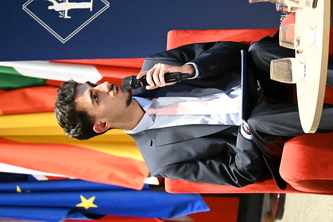
I believe we all have a role to play. Individually, we can act by staying informed, adopting respectful behaviours, and speaking up when we witness problematic situations.
Collectively, the goal is to create spaces for awareness, dialogue, and prevention, in order to build a culture of respect, consent, and equality. Everyone can contribute, at their own level, to changing mindsets.
Ariane: On a personal level, my commitment manifests through staying informed and being attentive to others.
Information first: I believe it is essential to stay updated on ongoing cases, existing debates, and to take the time to understand and analyse them. We cannot remain in ignorance, assuming that others will understand better or on our behalf.
Attention to others second: for me, this means having an attitude and disposition in daily interactions aimed at ensuring that others are always respected. It involves caring for friends and family, but also being vigilant in public spaces and on public transportation, for example. It is a gentle form of commitment, a refusal to remain passive in the face of abuse.
Collectively, this conference was one of our first forms of “public” commitment, and we are very proud of it.
At ESCP, the association Aware promotes equality for all and ensures student safety during events, such as parties.
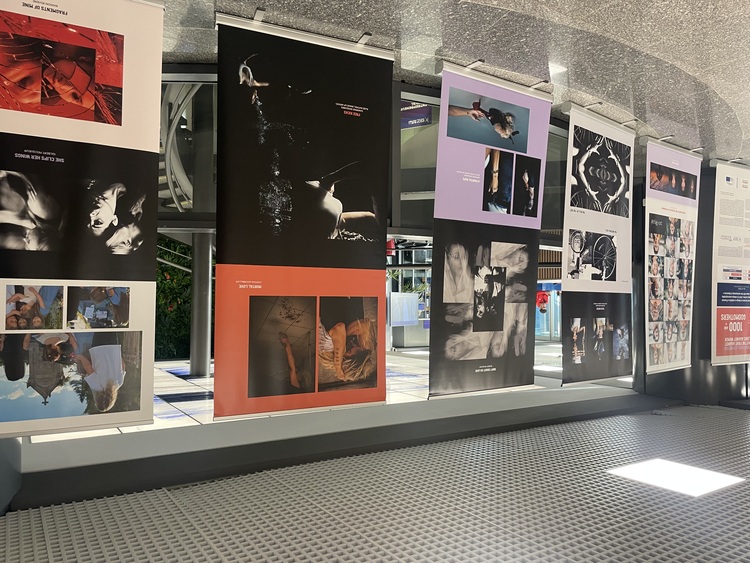
We also appreciated the travelling exhibition by the Collectif Mots et Maux de Femmes that you organised, Aurélie!
Aurélie: In line with ESCP’s humanistic European values and educational mission, the objective of the exhibition was to raise awareness and educate students about gender-based and sexual violence as well as harassment. It is essential, as these behaviours harm lives, hinder equality, and perpetuate toxic cultures.
For the past two years, Mots et Maux de Femmes has been engaging young people on campuses to address this critical issue.
ESCP is mobilising through a traveling exhibition by the Collectif Mots et Maux de Femmes. Sharing this exhibition with the ESCP community underscores the institution's strong commitment to this cause and calls for unity in ensuring that no violence against women and girls is tolerated.
The exhibition started at the ESCP campus in Paris in February, travelled to Madrid in May, to London in October, and Berlin in November. The next and last stop will be Turin.
Campuses
Related stories
News 20/11/2025
Interview
#1 Violence Against Women: Acting Where Pain Falls Silent
A conversation between Ghada Hatem (ESCP 11), founder of La Maison des Femmes in Saint-Denis (2016), and Louise Blin (Bachelor 2025 alumna and MSc in International Business & Diplomacy student)

News 22/01/2026
Interview
#3 The role of publishing in addressing gender-based and sexual violence
An interview where ESCP faculty member Isabelle Beyneix and alumna Marie-Pierre Gracedieu discuss publishing’s role in addressing gender-based violence, following the release of Mazan: An Anthropology of a Rape Trial—part of ESCP’s Standing Together series.
News 16/02/2026
Interview
#4 Art in action: sharing ESCP staff competencies and creativity in addressing gender-based and sexual violence
Sandrine Kiefer, Head of Internal Communications at ESCP, and Sabrina Saase, Health & Well-Being Manager at ESCP’s Berlin Campus, share their activism.
News 02/03/2026
Interview
#5 Transforming Public Policy into tangible results
Farid Medjoub (ESCP 20) asked Roxana Marcineanu (ESCP 05) to share her vision about gender-based and sexual violence
News 08/06/2026
Interview
#6 At CSW70 (New York), ESCP Alumnae Championing Gender Equality
In New York last March, during the 70th session of the United Nations Commission on the Status of Women (CSW70), two alumni, joined the French Delegation led by Aurore Bergé, Minister for Equality between Women and Men and the Fight Against Discrimination