
Professor Jaime Luque was invited to participate as guest speaker at an exclusive webinar (video above) organized by The Blue Circle to discuss the drivers, speed breakers, and emerging dynamics of affordable housing in India.
The Director if the ESCP Business School Institute of Real Estate Finance and Management then shared with this exclusive community of like-minded, reliable and resourceful leaders some of the successful global practices followed in affordable housing.
As the increase in demand for affordable housing is matched by the governments’ concern to provide it, we are witnessing several policy initiatives. This has created an ecosystem of demand and supply in the sector. However, many challenges remain.
Campuses
In a recent interview with HealthManagement.org, professor Hector González talked about the ‘human’ dimension of the robotics deployment in healthcare setting, covering issues such as perception and acceptance among people who encounter robots and the need for a ‘smooth’ integration of the technology.
Campuses
Are you or do you aspire to be an entrepreneur? How will an MBA enhance your skill set and increase your chances of success as a business executive?
Join this free online event to meet MBA alumna Valentina Ullrich and hear about:
- her motivations for joining the full-time MBA
- her experiences with the programme & ESCP's start-up network
- how the programme and ESCP community helped her launch her company
Find out more about ESCP's MBA in International Management in a short presentation led by programme manager Alison Masse and feel free to ask Valentina and Alison any questions you may have LIVE. Register here
[Speaker bio
From a marketing background, Valentina Ullrich was already passionate about entrepreneurship before joining the MBA in International Management, Class of 2020. Today she is CEO & Founder Loba, a sustainable FemCare startup looking to revolutionize the personal care market.
[Agenda
- 6.00pm
MBA programme presentation with Alison Masse, Programme Manager - 6.15pm
Can an MBA really help you develop your entrepreneurial skills - led by Valentina Ullrich, MBA alumna - 6.40pm
Q&A session
We look forward to seeing you there!
Participants

Valentina Ullrich
CEO & Founder, Loba & MBA Alumna (Class of 2020)

Alison Masse
MBA Programme Manager, Berlin Campus
Location
Organiser: Berlin Campus
Online - Worldwide
MapDate
Start date: 11/05/2021
Start time: 6:00 PM
End time: 7:00 PM
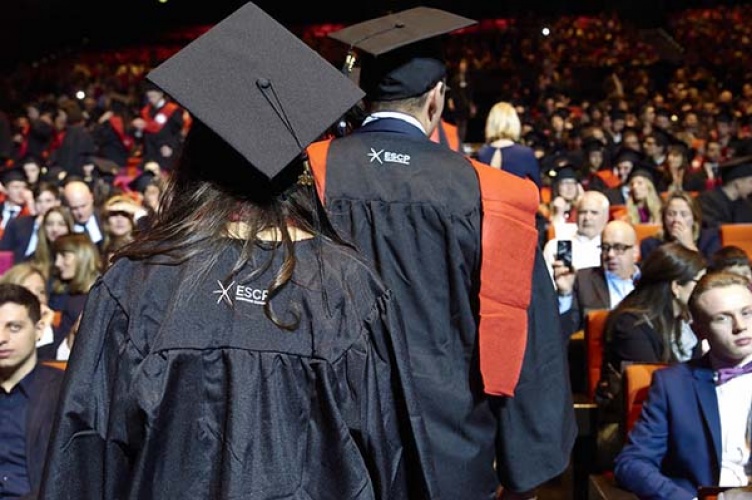
Students entering the programme from the start of the 2021 academic year will be the first to benefit from the diploma certified by the French Ministry of Higher Education, Research and Innovation.
The French commission for the evaluation of management training and diplomas (CEFDG) gives a favourable opinion to ESCP Business School's request to deliver the Advanced Studies Diploma in International Business Management (DEAMIE - master’s degree, level 7), conferring the degree of Master for a period of five years starting from the next academic year.
DEAMIE is a new programme of excellence that will bring together, as of September 2021, 19 MS and MSc specialisations from ESCP’s Paris, London, Madrid and Turin campuses.
After a rigorous selection process, students entering the programme from the start of the 2021 academic year will be the first to benefit from the diploma certified by the French Ministry of Higher Education, Research and Innovation.
The CEFDG commends the distinctive features of the programme:
- the academic rigour that stems from the previous pedagogical approach and imposes a common standard for the 19 specialisations in the first semester (led by ESCP), while leaving the management of semesters 2 and 3 to the European campuses, in accordance with the school's federal governance principles;
- the academic and professional character of the programme, which guarantees very high employability of the graduates;
- the strong and incentive-based research policy
About the programme:
It is a 12 or 15-months programme, with 4 semesters, representing 90 (or 120 depending on the entry level) ECTS credits:
- T1: 6 core courses of 30 hours each in the main management disciplines (only for students with less than 120 ECTS credits)
- T2 & 3: Specialisation (for all students)
- T4: Internship (minimum 4 months), research seminar and professional thesis
The degree is conferred until 2026 and will provide students the French Master degree with high added value and a strong international edge + 1 diploma in the chosen specialisation.
“The granting of the master's degree enables hundreds of young Europeans and international students to benefit throughout their professional lives from a master's degree awarded by France.”
Prof. Frank Bournois,
Dean of ESCP
“This programme prepares students to become functional leaders (experts). The CEFDG fully recognises the uniqueness and strengths of this programme, including its academic excellence and emphasis on the students’ professional employability and integration.”
Prof. Léon Laulusa,
Executive Vice-President and Dean for Academic and International Affairs
“Our new DEAMIE is a major step forward in our specialised training offer, of the highest academic standard, whose objectives of professionalisation are reaffirmed. It is the culmination of a profound evolution of our MS and MSc programmes.”
Prof. Philippe Thomas,
Scientific Director of the MS and MSc programmes
Dear ESCP Community,
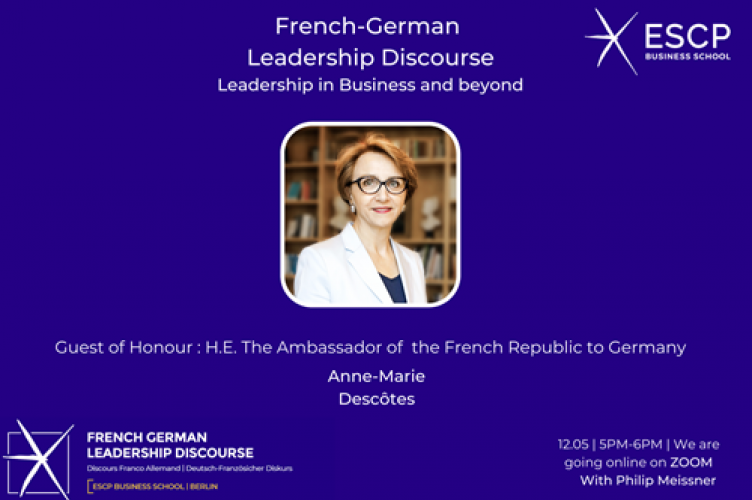
The next event from our Series, the French-German Leadership Discourse is on!
This quarter, we are thrilled to engage in a conversation on the topic of leadership in business and beyond with our guest speaker Anne-Marie Descôtes, the Ambassador of France in Germany. Learn more about Ambassador Descôtes own career path and what it takes to become a good political leader in a conversation with Professor Philip Meissner.
You can also ask your questions in an interactive Q&A at the end of the discussion.
We cordially invite you to join this event online in our Livestream via Zoom and participate in the discussion.
Please register here.
Location
Organiser: ESCP Berlin
Online - Worldwide
MapDate
Start date: 12/05/2021
Start time: 5:00 PM
End time: 6:30 PM

Structured finance transactions, including the financing of renewable energy sources, amount to trillions of pounds each year and require detailed financial modelling to support the analysis.
Where does the money come from? How is such infrastructure arranged financially?
You are invited to join us to learn how to develop a financial model of a hypothetical deal in this hands-on, online workshop. The session will be led by one of Operis’s expert trainers, Jonathan Swan.
You will also hear more about the work Operis does and the career opportunities available. No prior knowledge of project finance or financial modelling is required – just a love of numbers!
If you are interested and would like to join, please register here: https://bit.ly/3gN0F6X
Please note, this event is open to ESCP Business School students only.
Location
Organiser: ESCP London Campus
Online - Worldwide
MapDate
Start date: 29/04/2021
Start time: 2:30 PM
End date: 24/04/2021
End time: 4:00 PM
![© Adobe Stock - dragonstock [copyright]](/sites/default/files/styles/event_news_une/public/2021-04/Datanomics_0.jpg)
Every year, students put Prof. Louis-David Benyayer’s teachings into practice in a corporate context. One group helped L’Oréal define their “make or buy” model by using data and analytics.
Ever heard of Datanomics? That’s the title of the first book about the value of data (in French, sadly) co-authored by strategy consultant, ESCP alumnus and professor Louis-David Benyayer. “Data transforms the way companies create and capture value, and redefines competition. Mastering these Datanomics is paramount for all managers and entrepreneurs to sustain the competitive advantage of their firm. Datanomics and Strategy analyses these changes to support leaders in their strategic decision-making process,” he explains on his eponym blog.
When students start the MSc in Big Data and Business Analytics, their first course is “Data-driven business strategy”. The objective is to give them a global understanding of the forms and sources of value of data, and equip them with skills to design and implement projects to solve business problems using data and analytics in a corporate context. The course is built on two pillars: First, lectures on theories, research and examples of value creation opportunities with data and analytics and the mechanisms at play to turn promises into reality; Second, a company project where they prototype a solution for solving a business problem of a partner company. “The two elements complement each other: it's important students are able to apply the frameworks in a real-life situation,” the scientific co-director of the specialised master’s adds. “The company project is an opportunity to interact with business leaders on their current problems. It's also a good occasion for them to showcase their skills and to meet and work with their classmates. Reversely, our partner companies appreciate getting a fresh view on their problems and having new ideas and propositions to solve them. Frequently, the interactions between the students and the companies continue after the course to implement some of their ideas.”
Over the past four years, professor Benyayer and his students have worked with companies like La Redoute, Safran, Etalab, L'Oréal, Bouygues Construction, Catalina, Nissan and Groupe Up.
A very interesting company project for L'Oréal
For example, a group was asked to help L’Oréal – not for the first time - develop a rationale they could present internally to guide them in the definition of their “make or buy” model for technology. “We need to accelerate our product development and be much more agile in terms of manufacturing and distribution. We must make sure that we leverage data to develop new innovations and personalised beauty,” explains Operations Digital Transformation Director Cristina Monnoyeur. L’Oréal’s objective is to become more data-driven, with strategies to collect data to make objective, rather than subjective, decisions.
“In our fourth Data-driven business strategy session, we covered strategies for leveraging data assets in which Louis-David Benyayer discussed the four options for acquiring them: Make, Source, Buy and Partner. This section of the course was particularly useful to us as it was very specific to our project,” explains Cassandre Sillere, who worked on the company project with Adil Soundardjee, Christophe Sanchis and Yun Zhang. “It was nice to see that there is not just one option that you should systematically use for all parts of the value chain. ‘Make’ offers you complete customisation, but you don't benefit from the scale effect. ‘Buy’ allows for a shorter delivery time, but there is a risk with the execution of the integration.”
It was all the more interesting to them since the example Louis-David Benyayer used in class was that of L'Oréal. A general example of a make or buy situation would be software: L'Oréal could choose between making it in-house or buying it from an external supplier. There are advantages and disadvantages to both, depending entirely on the situation: Whether or not the company has the resources in-house; how much time it has; how much customisation is needed, etc. The acquisition of Beauty Tech company ModiFace when they wanted to reshape the beauty experience through augmented reality is a rather extreme case of 'buy'. ModiFace is now part of L'Oréal, and would now be considered 'make'. “All parts of the course were very useful in the project and certainly helped us come up with a solution to L'Oréal's ‘Make or Buy’ strategy, but it was a particularly memorable example for our group, as we had done some research on them and already had quite a few interviews with L'Oréal employees in which ModiFace was mentioned,” adds the student whose goal is to become a consultant specialising in data-driven business strategy.
“Currently, L’Oréal mainly buys but this is starting to change with the recruitment of more and more engineers. We clearly saw that the engineer-heavy teams try to build as much as possible, so this is helping to balance the make/buy ratio or rather, the make/partner ratio.” In general, L’Oréal works with external partners and favours open innovation, allowing them to expand the team when needed whilst keeping a level of confidentiality which is so important to them especially because most of their business is about innovation. 
The team of students had some misgivings about L’Oréal’s initial briefing and the fact that they specifically asked for a decision tree, which the students found “simplistic” and “very rough in terms of make or buy.” After meeting the BeautyTech team and several start-ups, they scrapped their initial idea of making three decision trees for the different aspects of technology - hardware, software and people. Instead, they were able to present a prototype of an app, keeping the personalisation it offered by using relative weighting coefficients for all criteria. This makes the decision trees specifically adapted to each “make or buy'' situation and should allow L'Oréal to move to a model better suited to their needs without setting a particular ratio of “make to buy”. “We had not clarified our ‘make or buy’ criteria and ordered them in a decision tree, especially with a notion of weighting,” comments L'Oréal Data & Analytics CIO François Nguyen. “We don't have an app, like the students suggested, but we can now make a decision tree for each subject when we find ourselves in this ‘make to buy’ situation.”
Campuses
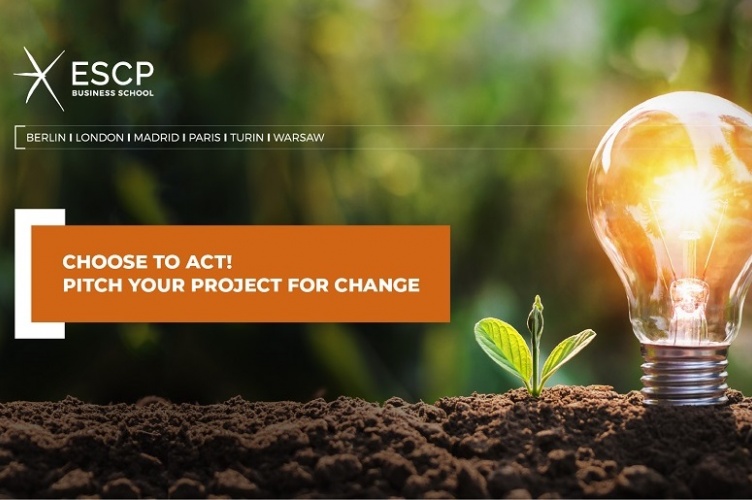
From sustainability to digital, from health to education and IT, the projects presented by ESCP students during the “Choose to act! Pitch your project for change” investigated the varied issues facing our future lives.
Since January, Impact Entrepreneurship Option-E students have followed a full immersion path to transform themselves into the new generation of entrepreneurs able to create their own business with an economic, social and environmental impact. After their intense journey of growth, the Master in Management students presented the business ideas they had developed over the semester. During the event, all the teams pitched in front of their peers and jury members on Zoom while being live-streamed on YouTube.
Alisa Sydow, Assistant Professor of Entrepreneurship & Innovation at the ESCP Turin Campus, was the event host. After the presentation of the jury members, and the welcome message by Prof. Dr René Mauer of the Jean-Baptiste Say Institute and Professor of Entrepreneurship at ESCP Berlin Campus, the students took the floor and presented their projects.
With their pitches and the enlightening answers in the Q&A session with the jury, Option-E students demonstrated, with a critical and independent mindset, their ability to create value by promoting sustainability.
While the jury was deciding the winner of the competition, Alberto Cartasegna, Founder and CEO of Miscusi, gave his inspiring and motivating keynote speech.
Prof Francesco Rattalino announced the winning team: Cloudwise, made up of Pietro Carabelli, Francesco Cundari, Giada Gatti, Caterina Nassi and Romain Van Gaver. Their project, Cloudwise, focuses on increasing the awareness of the emissions created even by digital communications, such as emails, file storage and social media. Through providing consulting and certificates to businesses, Cloudwise aims to reduce their digital footprint. The team won 500 euros, which they decided to donate to the non-profit Protect Our Winters.
The group Park-IT, whose members were Gian Nicolò Bernini, Hugo Fixot, Arianna Pricco and Ruben Rinaldi, was awarded in the "Good care" category for the excellent teamwork done during the semester. The aim of Park-IT is to develop sustainable and safe bicycle parking silos in Milan, encouraging more people to cycle to work.
Alisa Sydow was impressed not just by the results but by the process that delivered those results and by the students’ entrepreneurial mindset: “It was a very exciting journey in which I was able to see how all groups turned their initial ideas into concrete business models and convincing pitches: ready for action!”, she said after the event.
Congrats to the two winning teams for your achievement and innovative ideas!
Special thanks to all the participants and the members of the jury: Davide Cecchini, Vincenzo Macrì, Laura Orestano, Alessandro Panerai, Francesco Rattalino, and Marcello Tedeschi.
You can find here short video presentations of the six projects:
The first edition of the Impact Entrepreneurship Programme - Option-E, co-designed by ESCP Business School and Cottino Social Impact Campus, is a recently developed path to training the next generation of experts in Impact Entrepreneurship. The course is an ESCP Master in Management specialisation to acquire new strategic skills for impact management and the keys to becoming an entrepreneur of the future, building a business that will impact the world.
Campuses
Related stories
News 29/10/2020
Programmes
Option E: a new path to training the next generation of experts in Impact Entrepreneurship
ESCP Turin Campus and Cottino Social Impact Campus present a new path to training the next generation of experts in Impact Entrepreneurship, who will be capable of creating value in companies while becoming agents of change, promoting sustainability that is both economic and socially conscious.
Turin

News 06/04/2021
Turin News
Art Thinking: imagine the improbable
The ESCP Turin Campus Option-E cohort of students from the Master in Management kickstarted the semester with a disruptive workshop: the Improbable seminar, a 3-day training course based on the Art Thinking method. This flexible method, designed by Sylvain Bureau, Scientific Director of the Jean-Baptiste Say Institute and ESCP Professor, makes it possible to create the improbable with certainty.
Turin

News 23/04/2021
Turin News
ESCP Green Hackathon: shaping a more Sustainable Future
AlixPartners has challenged ESCP students with a Green Hackathon. They were invited to contribute their ideas on how to create an ecological, sustainable and green future.
Turin
Campuses