
Making ESCP's entrepreneurial impact more visible
This article was written by David Nenning and Lukas De La Trobe of the ESCP Alternative Investment Society (AIS).
The ESCP Founder Report 2025 is a consolidated, data-driven overview of ESCP-founded startups that was created by the Alternative Investment Society and the ESCP Blue Factory. It brings together a structured analysis of the school’s entrepreneurial output, including 11 ESCP-founded unicorns and more than $1.1 billion raised by ESCP alumni startups in 2025 alone.
ESCP Business School has long been a breeding ground for entrepreneurs across Europe and beyond. At a time when Europe faces an urgent need for innovation and entrepreneurial spirit, ESCP carries a particular responsibility to embrace its role as one of the continent's leading entrepreneurial business schools.
Not only was the term "entrepreneurship" defined and coined by ESCP co-founder Jean-Baptiste Say, but ESCP alumni have also gone on to found companies that operate at global scale, attract international capital, and shape entire industries.
While this legacy is substantial and internationally diverse, much of ESCP’s entrepreneurial impact has not yet been fully consolidated or presented in a structured, data-driven format. Our student society created the ESCP Founder Report 2025 with the ESCP Blue Factory to capture and further showcase the breadth and depth of entrepreneurship emerging from the ESCP community.
A student-led initiative
The initiative was launched by the Venture Capital department of the Alternative Investment Society (AIS) following a review of comparable founder ecosystem reports published by leading European institutions.
The objective was to develop ESCP's first comprehensive, data-driven founder report: a structured assessment of the school's entrepreneurial output, funding activity, and broader ecosystem impact.
From a student perspective, the report aims to provide tangible role models by highlighting founders who studied at ESCP and share a similar educational and institutional experience. By showcasing their journeys and outcomes, the report offers current and prospective students concrete insights into the entrepreneurial pathways emerging from ESCP, including direct access to job opportunities within ESCP alumni startups.
Starting a career at an ESCP-founded company enables students to learn directly from alumni founders, gain hands-on startup experience, and ultimately build the skills and mindset required to found a company themselves, widely regarded as one of the most effective pathways to successful entrepreneurship.
Strengthening a pan-European founder network
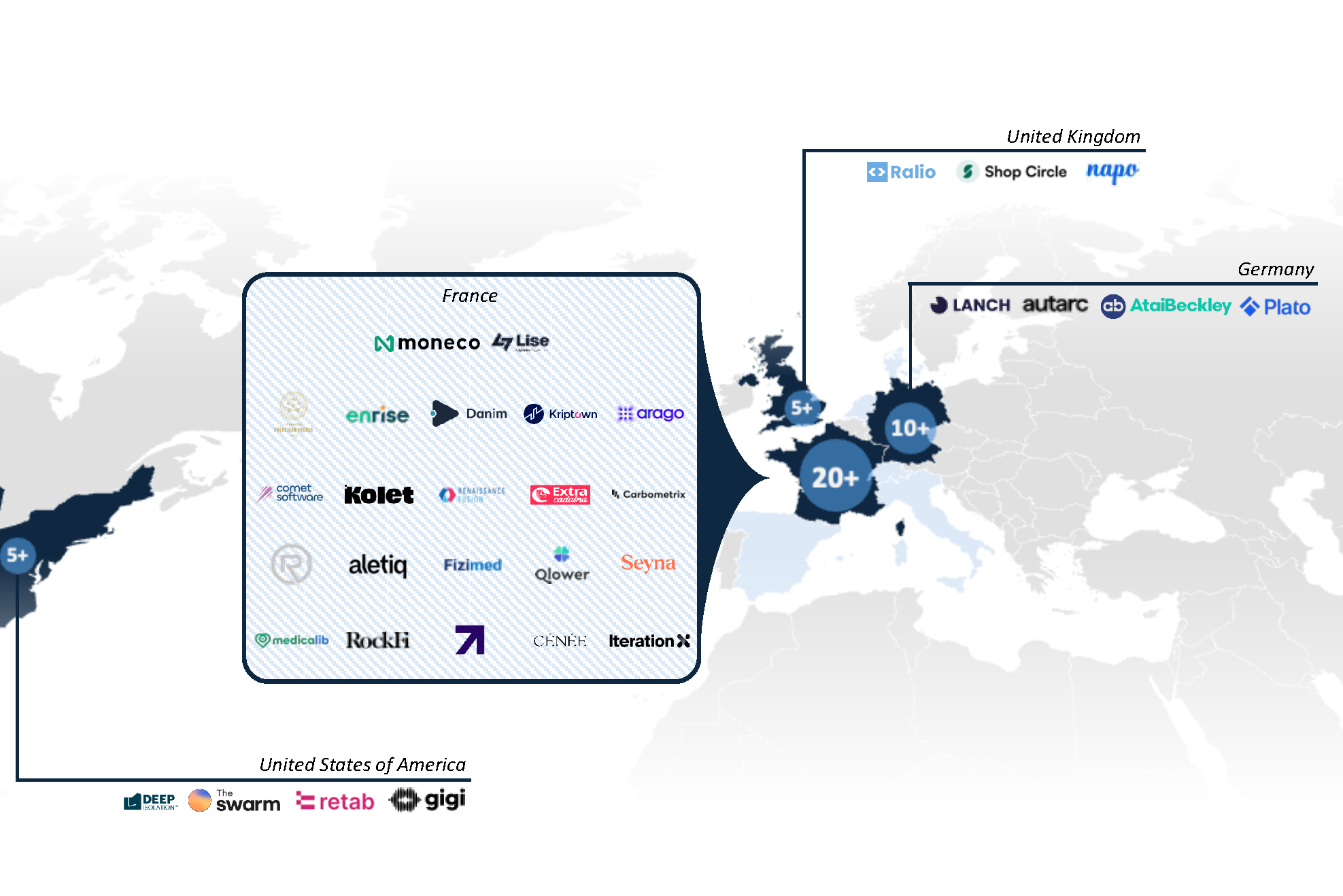
Beyond inspiration, the report is designed to serve as a connective platform between ESCP founders and alumni investors across its multi-campus European footprint. By strengthening ties within the ESCP community, the initiative seeks to reinforce an ecosystem in which founders and investors with a shared institutional background actively support one another in building the next generation of high-impact European companies.
Such founder–investor flywheel effects are foundational pillars of successful venture ecosystems, as demonstrated by dense entrepreneurial networks observed in leading global institutions.
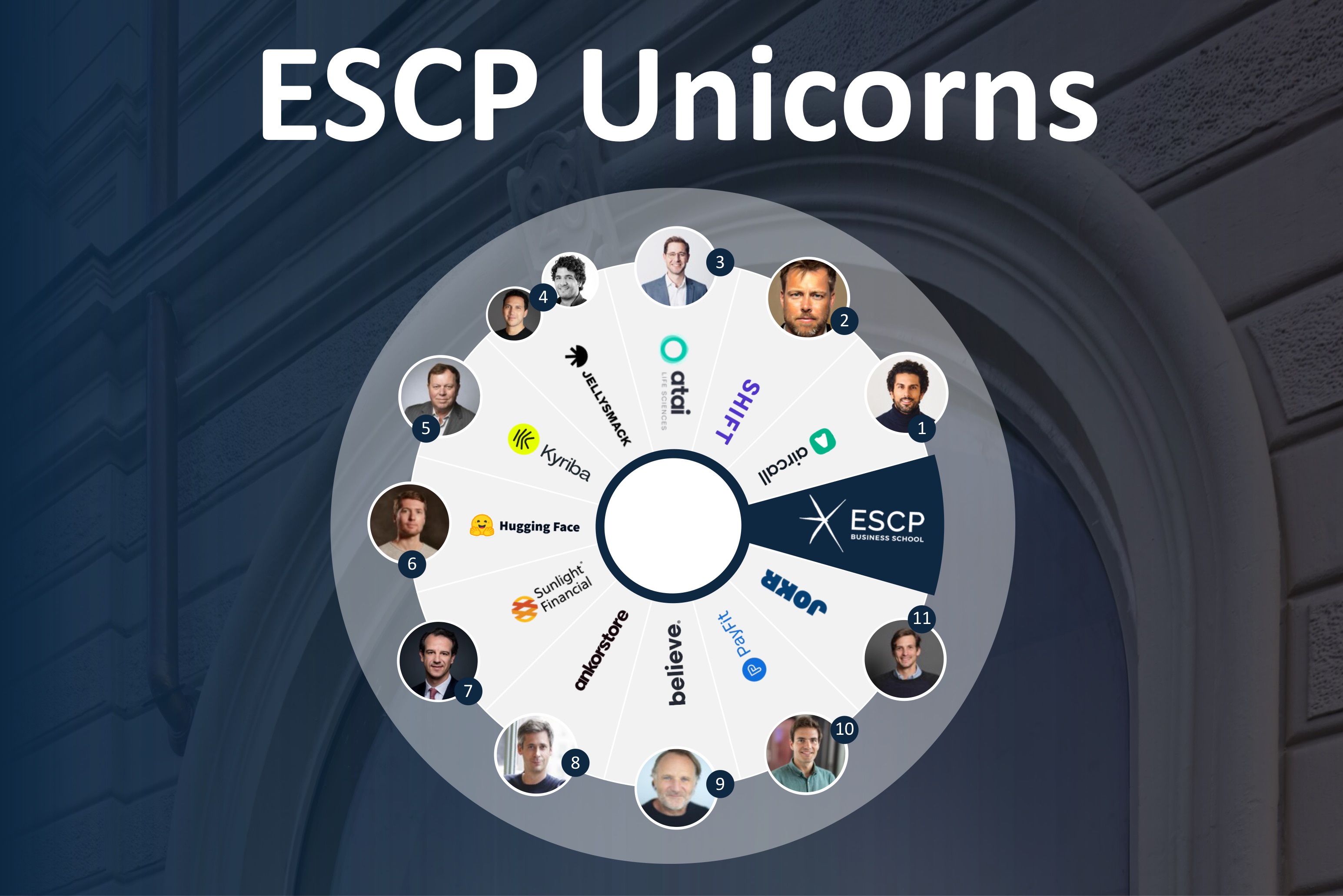
Identifying 11 ESCP-Founded Unicorns
Early-stage research quickly validated our core thesis. While previous public references mentioned six unicorn founders, the independent analysis conducted for this report identified eleven ESCP-founded unicorns.
These companies span multiple sectors, geographies, and graduation cohorts, highlighting the depth and consistency of ESCP's entrepreneurial output over time and underscoring the importance of maintaining an up-to-date and active representation of the ecosystem.
Research approach and institutional collaboration
Following the initial research phase, the student team worked in close coordination with ESCP Blue Factory and ESCP Business School to align methodology and ensure consistency with the broader institutional ecosystem.
Through this collaboration, we established a research pipeline that combined venture database analysis with direct engagement across the ecosystem. Our team conducted extensive outreach to founders and investors and held in-depth interviews to complement quantitative data with first-hand insight.
The report also features conversations with leading investors and founders, offering qualitative insights alongside quantitative analysis.
The ESCP Founder Report 2025 was developed over a four-month research period, from September through January. The work was conducted according to professional research standards, with clear methodology, verified data sources, and multiple validation layers.
2025 fundraising momentum
The report provides a detailed overview of ESCP-linked entrepreneurship, with a particular focus on recent momentum.
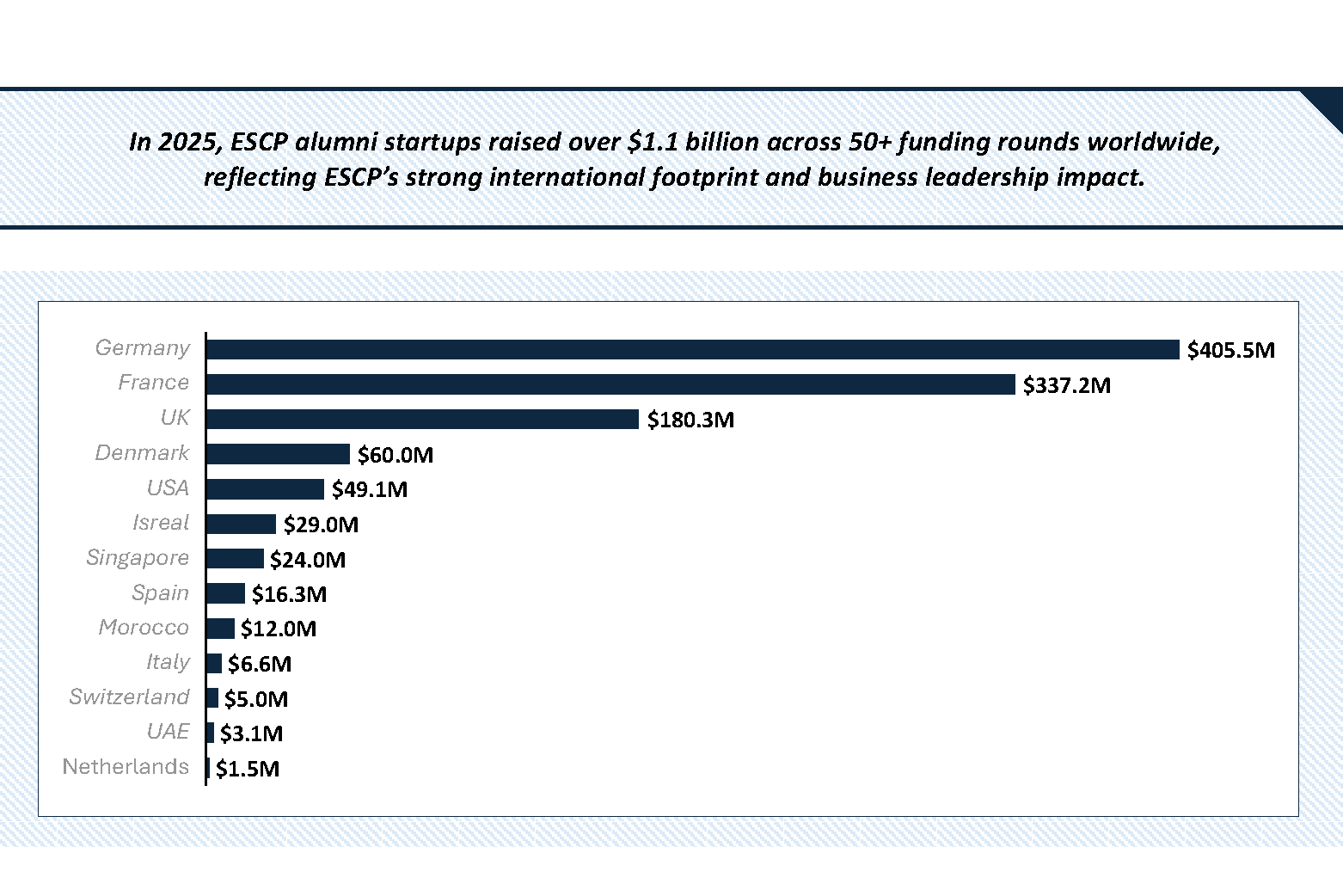
According to our research, in 2025, ESCP alumni startups raised over $1.1 billion across more than 50 funding rounds worldwide, reflecting both the scale and international reach of the ecosystem. Funding activity spans Europe, the United States, and emerging markets, reinforcing ESCP's position as a globally connected founder hub rather than a regionally concentrated one.
In line with ESCP's standards of academic excellence, the report highlights the prestigious investors and significant funding rounds raised by ESCP-founded startups, often strong indicators of product quality, team strength, and execution capability. To reinforce this signal, we deliberately include detailed information on funding round sizes and investor participation, enabling students to better understand what it means to truly excel in the venture landscape.
Beyond funding metrics: the changemakers section
Beyond fundraising metrics, the report intentionally adopts a broader definition of entrepreneurial impact. Venture capital alone does not capture all forms of success.
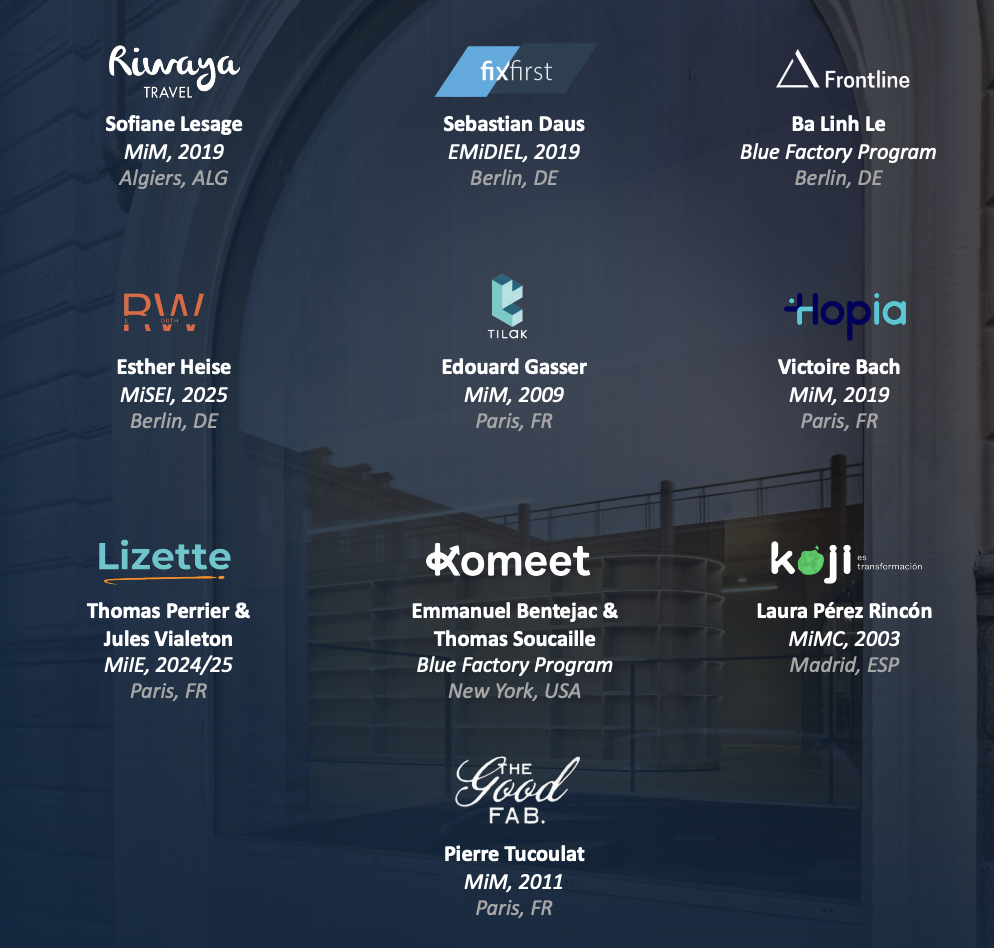
To address this, the report introduces a dedicated Changemakers section, which highlights founders whose work has generated exceptional economic, social, or political impact, even where venture funding is not the primary indicator. Inclusion in this section is based on external validation such as major awards, public funding, or large-scale institutional recognition.
Looking ahead
The report showcases ESCP's position as a leading European business school with a proven, international founder base and a growing entrepreneurial footprint. The strong engagement from students, founders, and investors following the release confirms the relevance of this work.
Building on this foundation, the Founder Report will continue as a quarterly series, with dedicated Q1, Q2, Q3, and Q4 editions, developed in partnership with ESCP and the ESCP Blue Factory.
Authors

David Nenning
ESCP Alternative Investment Society (AIS)

Lukas De La Trobe
ESCP Alternative Investment Society (AIS)
Campuses

Thanks to the MyJOB scholarship, Caterina joined ESCP’s top-ranked MSc in IFBM and discovered where she’s meant to be
What if a scholarship could open more than just a door?
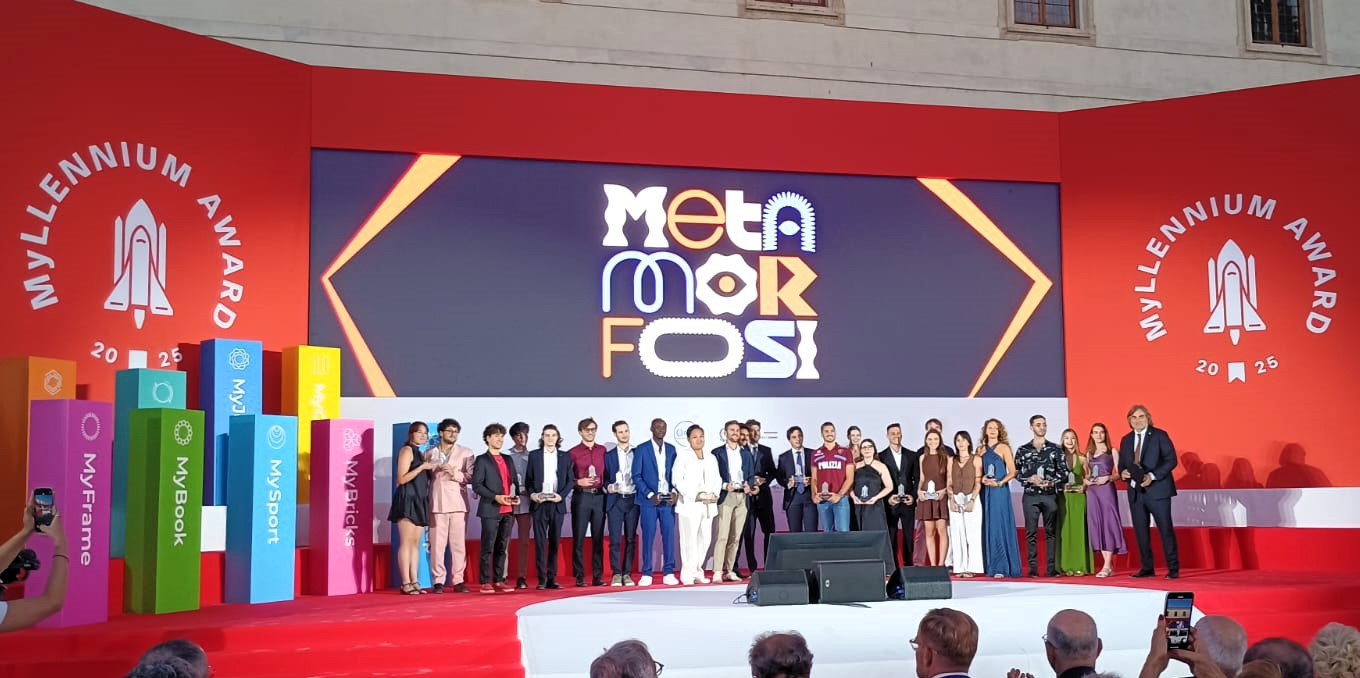
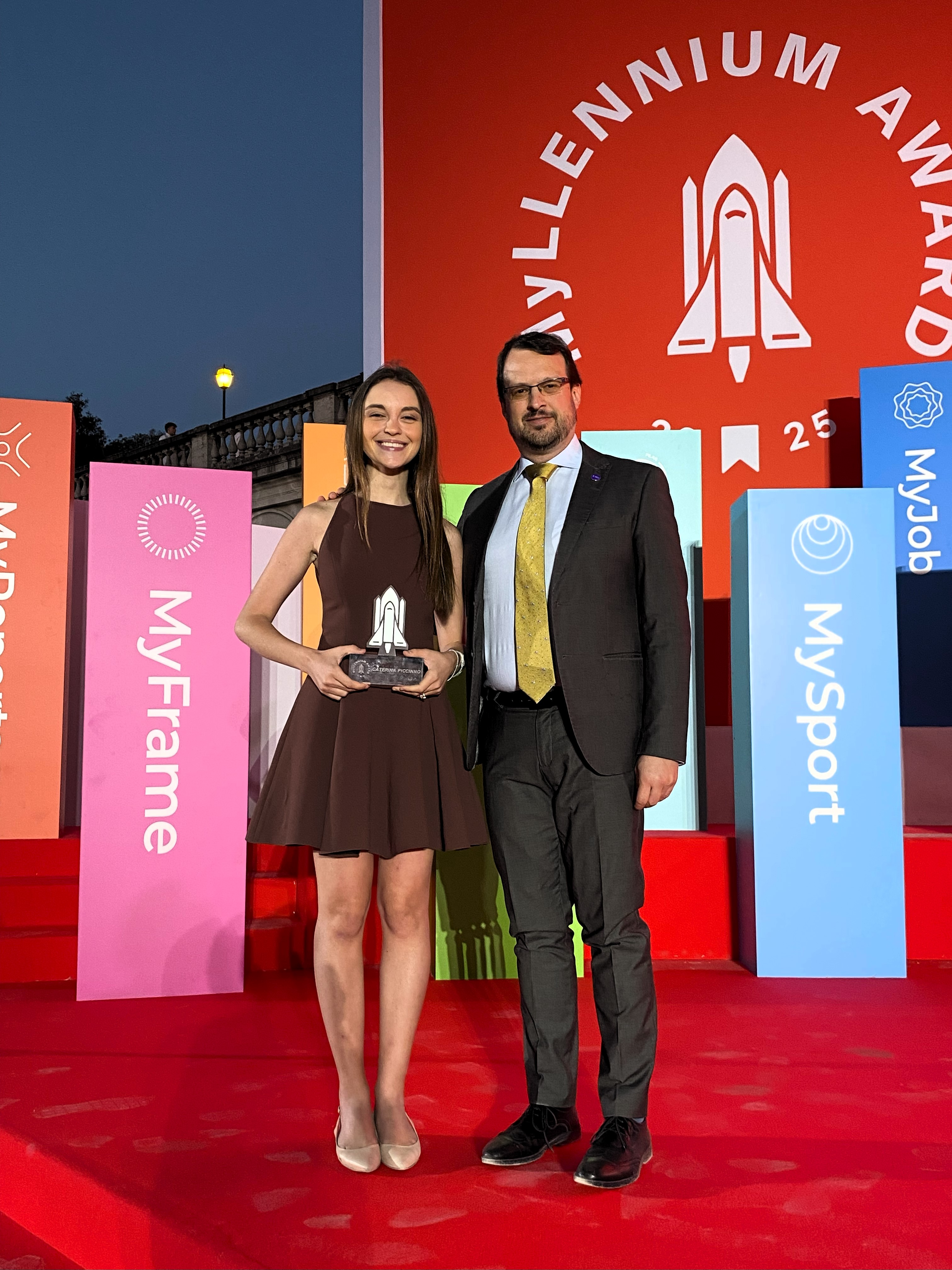
For Caterina Piccinno, winning the 2025 Myllennium Award – MyJOB section meant more than accessing funding, it meant joining the MSc in International Food & Beverage Management at ESCP Business School, the world’s #1 ranked master’s in the field (Eduniversal).
She applied with a clear goal in mind, but what she didn’t expect was the profound impact this experience would have on her confidence, her perspective, and her future in the food and beverage industry.
Now studying in Turin, Caterina reflects on what it means to be recognised, to feel seen and supported, and to be part of a programme that didn’t just educate her, it empowered her.
If you're thinking of applying for the Myllennium Award, her journey might just be the motivation you're looking for.
“I chose to try”: Owning your story, embracing the unknown
What does being a Myllennium Award winner mean to you?
Being a Myllennium Award winner is not just a label or a scholarship. It is proof that I had the courage to seize an opportunity and truly try. It means that someone believed in me, trusted my potential, and chose to listen. Feeling seen and heard, especially in an increasingly impersonal and standardised world, is what makes this recognition deeply meaningful to me.
Let’s imagine you’re speaking to your past self, the day before applying to the Myllennium Award. What would you say to her?
You know the trend “she doesn’t know it yet, but in a few months…”. I would tell her that she is about to move to Turin and meet wonderful colleagues. But above all, I would tell her to fully enjoy the last months of her bachelor’s degree, because once graduation arrives, everything moves incredibly fast. Sometimes, the “she doesn’t know it yet” part is the most thrilling moment of all.
Confidence unlocked: One win leads to many
The Myllennium Award didn’t just bring Caterina to ESCP, it changed how she sees herself. Here's how one ‘yes’ helped her say yes to even more.
How has winning the Myllennium Award changed the way you see your future?
Winning the Myllennium Award taught me to always try. It pushed me to apply for new opportunities with more confidence. Just a few weeks later, I applied for another initiative rewarding academic theses, and I won. I would not have done it without this experience. I truly learned that, as we say in Italy, “tentar non nuoce”.
Inside the MSc in IFBM: Curiosity meets transformation
Between cutting-edge coursework, real-world industry visits, and shared passion with peers, Caterina’s time at ESCP has been more than academic, it has been deeply personal.
If you could describe MSc in IFBM in three words, what would they be – and why?
Stimulating, open-minded and transformative. The programme constantly challenges you intellectually, exposes you to diverse perspectives and connects theory with real-world experiences. It does not simply add knowledge but reshapes the way you observe the food industry and your role within it.
What’s one unexpected opportunity or encounter that came your way thanks to this scholarship?
Visiting the production sites of well-known companies was an unexpected and inspiring opportunity. Seeing what truly happens behind the scenes of everyday products… It felt like fulfilling the childhood dream of stepping into the chocolate factory of Willie Wonka - a feeling I will never forget.
Belonging and belief: When everything clicks
There’s a moment during every journey where things just feel right. For Caterina, that moment was shared, and unforgettable.
Was there a moment at ESCP when you felt: “This is exactly where I’m meant to be”?
During the visit to Loacker, I saw my colleagues’ eyes sparkle, and I felt a deep sense of belonging. People from different backgrounds, united by the same passion and intuition. More than “where I am meant to be”, it felt like where we are meant to be. Sharing that experience together was truly empowering.
Your story matters
One last word to the students considering whether to apply? Be bold and be real.
What would you say to a student considering applying for the Myllennium Award today?
Show your true motivation. If you are a foodie, I am sure you have a story to tell. Maybe it starts with your grandmother’s cooking, a past career as a chef, or a dream of opening your own restaurant. There is a dream inside you: do not hide it. Authenticity is powerful: when you speak honestly about what inspires you, you allow others to see not just your skills, but your motivation and vision.
FAQ – About the Myllennium Award
What is the Myllennium Award?
It is a multidisciplinary prize created by the Fondazione Raffaele Barletta to support young Italians aged 18–30 across ten categories, including entrepreneurship, research, and education.
Who organises the Myllennium Award?
The Award is promoted and organised by the Fondazione Raffaele Barletta, in collaboration with Gruppo Barletta S.p.A., with the mission to invest in the talent and future of Italy’s next generation of leaders.
What is the MyJOB section?
MyJOB awards scholarships for specialised Master’s programmes, including the MSc in IFBM at ESCP Business School.
What is the value of the scholarship?
The scholarship awarded through the MyJOB section covers part of the tuition fees for the MSc in International Food & Beverage Management at ESCP Business School, with a total value of €12,000.
Who can apply?
Italian citizens, as well as individuals who have been residing in Italy for at least five years, are eligible to apply. Applicants must be under 30, hold (or be completing) a Bachelor’s degree, and submit a motivational video along with all required documents. Find out more.
How do I apply?
You must apply via the official portal on myllenniumaward.org Applications for the 2026 edition are now open and will close on 4 May 2026.
Campuses
Related stories

News 27/02/2025
Scholarship opportunity
Make Your Dream a Reality with the Myllennium Award: Greta Perucca’s Story
Discover how to win the scholarship for the MSc in International Food and Beverage Management and boost your career. Greta Perucca, a talented student of the MSc in International Food and Beverage Management at ESCP Business School, is a shining example of how the Myllennium Award – MyJob section can transform a career.
Turin

News 22/02/2024
Scholarship opportunity
How to win a 50% Scholarship: Insider Tips from Myllennium Award Winner Asia Galante
Once again, candidates enrolled in the MSc in International Food & Beverage Management can win a scholarship covering 50% of the tuition fees, thanks to the Myllennium Award, organised by the Fondazione Raffaele Barletta.
Turin

News 12/04/2023
Scholarship opportunity
Get a 50% scholarship with the Myllennium Award. Tips and insights from Mattia Musso, the 2022 Award winner
Once again, candidates enrolled in the MSc in International Food & Beverage Management have the chance to win a scholarship covering 50% of the tuition fees, thanks to the Myllennium Award, organised by the Fondazione Raffaele Barletta. The award offers concrete educational opportunities to young Italians under the age of 30 by financing a scholarship to attend the MSc in IFBM.
Turin
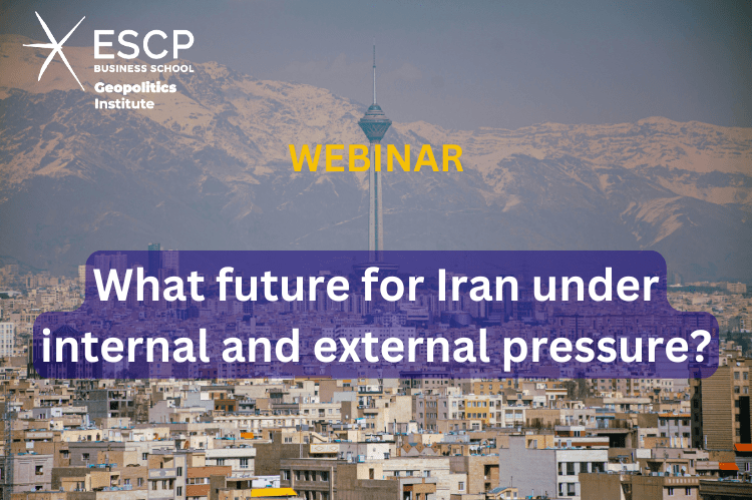
What future for Iran under internal and external pressure?
18 February | 18H00
on-line (webinar with Q&A session)
Iran is facing a deep political crisis, marked by recurring popular uprisings and increasingly harsh repression. At the same time, the United States has reiterated the possibility of direct or indirect intervention, while officially keeping the door open to negotiation.
Beyond the question of regime survival, the stakes are regional and global. A destabilisation of Iran would have major consequences for Middle Eastern security at a moment when no regional actor appears to have an interest in further instability. It also raises renewed concerns over the future of Iran’s nuclear programme, unresolved since the US withdrawal from the 2015 nuclear agreement.
Can the Iranian regime withstand internal unrest and external pressure? And what would be the implications for regional stability and nuclear security if it falters?
To address these questions, Maxime Lefebvre and Vanessa Strauss-Kahn, Co-Directors of the ESCP Institute of Geopolitics, are pleased to organise a webinar with:
- Bernard Hourcade, Geographer, Senior research fellow emeritus CNRS, Member of the Editorial board of OrientXXI, Former director of the French Institute of Iranian Studies, in Tehran (1978-1992)
- Michele Gaietta, Specialist in nuclear proliferation in the Middle East and international security; Lecturer at ESCP Turin, Catholic University of Milan, and Prague University (VŠE)
This webinar will offer a rigorous and forward-looking analysis of Iran’s internal crisis, regional security dynamics and nuclear challenges.
The webinar will be held in English. Registration is mandatory.
Location
Organiser: ESCP Business School
Online - France
MapDate
Start date: 18/02/2026
Start time: 6:00 PM
End time: 7:00 PM
How the case method sharpens judgment, sparks discussion, and prepares leaders for uncertainty
Every year on World Case Teaching Day, business schools around the globe celebrate case-based learning — a pedagogy that develops leadership skills by confronting students with ambiguity, disagreement, and real decision-making.
At ESCP Business School, the case method has long been central to how students learn to think and lead in uncertain contexts. Few people are better placed to reflect on its power and evolution than Martin Kupp, Associate Professor of Entrepreneurship at ESCP.
Over the past two decades, Kupp has written and taught award-winning cases, trained educators worldwide, and been recognised by The Case Centre for his outstanding contributions to case teaching. He recently distilled this experience intoThe Ultimate Guide to Case Teaching and Writing, a book he co-authored that provides a practical resource for educators.
We spoke with him about what the case method develops, how it is evolving, and why it matters now more than ever.
Learning to decide in times of uncertainty
For Kupp, the enduring strength of the case method lies in what it forces students to confront. “The case method uniquely develops students’ ability to deal with ambiguity, incomplete information, and competing interpretations,” he says. “It forces them to combine analysis with judgment — to articulate, defend, and revise their positions in dialogue with others.”
This mirrors the reality of managerial and entrepreneurial life, where decisions are rarely made with perfect data or in isolation. “Through discussion and social interaction, students learn that intelligent people can reasonably disagree — and that decisions still have to be made,” Kupp adds. “That cannot be meaningfully taught with lectures or slides alone.”
A pedagogical tool that evolves with its environment
While the principles of the case method remain stable, Kupp is clear that the way cases are taught cannot stand still. “The fundamentals haven’t changed: it’s still about how discussions are orchestrated, how participants are engaged, and how learning happens through interaction,” he says. “But the learning environments and the tools we use absolutely have changed.”
From multimedia cases and live simulations to new digital and hybrid formats, experimentation has become part of the method’s evolution. “It’s a flexible pedagogy,” Kupp explains. “Whatever formats or technologies help participants engage with all of their senses, we should embrace and test them.”
This flexibility places particular demands on those leading the classroom. For Kupp, great case teaching is not about performance or expertise. “It’s not about delivering expertise. It’s about orchestrating learning. The best case teachers create safety, ask great questions, and trust students to bring value. They don’t try to ‘win’ the discussion — they try to make the discussion worth having.”
What AI changes and what it doesn’t
As generative AI enters classrooms and organisations, questions naturally arise about its impact on learning. Kupp sees AI not as a threat to the case method, but as a reminder of its relevance.
“Generative AI can reinforce, rather than undermine, the value of the case method,” he says. “While AI can generate analyses or options instantly, the case method ultimately is about defending your analysis, convincing in real time, disagreement, ethical reflection, or human judgment under uncertainty.”
These are precisely the capabilities leaders need in a world where information is abundant but clarity is not. “AI may be great at solving the case, but arguing with 40 opinionated students in real time is where the true value of the case method is,” Kupp adds. “Cases increasingly shift the focus from ‘What is the answer?’ to ‘How do we get to an answer?’”
In this sense, the classroom becomes a space to practise sensemaking, responsibility, and decision-making under pressure. “The anchor of case learning is social interaction,” he says. “That’s what enables students to link their own experiences to theory and frameworks. They learn by speaking, listening, disagreeing and being challenged by their peers.”
Strengthening case-based learning at ESCP
As technology reshapes how knowledge is accessed and complexity accelerates, Kupp believes the case method is becoming more, not less, relevant. “What the case method does better than anything else is help students practise thinking,” he says. “It’s not about having all the facts. It’s about navigating complexity, asking better questions, and making sound decisions with others. That’s what the world needs more of.”
At ESCP, this conviction has increasingly been translated into institutional action. In recent years, the School has strengthened its commitment to case-based learning through the Case Project (CaP), which supports faculty across all six campuses with editorial guidance, peer review, and funding to develop high-quality teaching cases.
The result is a growing portfolio of ESCP-authored cases taught worldwide and distributed through platforms such as Harvard Business Publishing and The Case Centre. The recent launch of ESCP’s dedicated Case Collection on The Case Centre platform further consolidates this effort, making the School’s pedagogical contributions more visible to educators globally.
On World Case Teaching Day, the celebration is ultimately of a shared commitment: teaching students how to think, decide, and lead together, especially when the answers are anything but obvious.
What the case method does better than anything else is help students practise thinking. It’s not about having all the facts. It’s about navigating complexity, asking better questions, and making sound decisions with others. That’s what the world needs more of.
 Prof. Martin Kupp
Campuses
Related stories

News 05/02/2025
Case Teaching
World Case Teaching Day: ESCP's Commitment to Excellence in Case-Based Learning
Discover how ESCP Business School’s commitment to case teaching is preparing future business leaders. Learn about the Case Project (CaP), award-winning cases, and how faculty are innovating case-based learning.
News 30/10/2025
Ranking
ESCP ranks among the world's top business schools in the Case Centre's Impact Index 2025
ESCP Business School ranked 24th in the 2025 Case Centre Impact Index, a seven-place rise from the previous year and our first entry into the global top 25. This year’s ranking coincides with the official launch of ESCP’s institutional Case Collection on The Case Centre platform.
ESCP accelerates its commitment to digital transformation and artificial intelligence
ESCP reinforces its strategic leadership in digital education and responsible artificial intelligence (AI) innovation. Through its membership in the Digital Education Council (DEC) and the development of academic programmes and internal initiatives, ESCP affirms its mission to shape the future of learning and empower tomorrow’s leaders in a technology-driven world.
A strategic commitment to transforming education
Since its founding in 1819, ESCP has been dedicated to anticipating major societal shifts. With six campuses in Paris, London, Berlin, Madrid, Turin, and Warsaw, the School places innovation and digitalisation at the heart of its educational project to meet today’s evolving challenges.
Joining the Digital Education Council
ESCP recently became a member of the Digital Education Council, an international coalition of over 150 institutions across 35 countries, focused on driving sustainable innovation and responsible AI adoption in higher education and workforce development.
Through this strategic collaboration, ESCP contributes to shaping global best practices in:
- AI literacy
- Digital transformation of education
- Innovation in learning and teaching
The partnership positions ESCP within a dynamic global ecosystem and strengthens its ability to develop impactful, ethical, and inclusive approaches to digital education.
Building AI and digital expertise into the core of education
Academic programmes for AI-Driven Business Transformation
ESCP offers a growing portfolio of programmes focused on artificial intelligence and digital strategy, including:
Through this strategic collaboration, ESCP contributes to shaping global best practices in:
- Certificates in Applied AI for Business
- Executive pathways in digital transformation
- Integrated AI modules in degree and lifelong learning programmes
These programmes aim to equip students and professionals with critical skills to understand and apply AI technologies strategically and ethically in a wide range of industries.
Internal initiatives supporting responsible AI adoption
In addition to its academic offering, ESCP has launched internal initiatives to foster responsible, school-wide integration of AI. These include:
- Workshops and faculty training on generative AI tools
- Pedagogical experimentation with AI-driven technologies
- Collaborative internal projects promoting digital innovation in teaching, research, and operations
This structured and inclusive approach allows ESCP to embrace AI across all levels of the academic experience.
ESCP as a strategic hub for digital and AI leadership
Hosting the AI in Higher Education Summit 2026
ESCP will host the AI in Higher Education Summit 2026 in Paris on 17–18 March 2026, welcoming a global community of educators, researchers, and thought leaders to explore the most pressing challenges and opportunities around AI in academia.
The Summit will focus on:
- The role of AI in transforming pedagogy and research
- Ethical frameworks and governance of AI in education
- Global collaboration and responsible innovation
This major event serves as a key centre for educational AI dialogue and strengthens ESCP’s position as a leader in global academic innovation.
Driving innovation through institutional vision
As part of its new strategic plan, “Bold & United 2026–2030”, ESCP is investing in structural transformation with a clear focus on AI, technology, and sustainability.
This long-term vision includes:
- Elevating academic excellence and international research
- Developing new schools and specialisations in tech and governance
- Integrating emerging technologies across all educational levels
By aligning institutional governance with innovation, ESCP ensures its educational model remains relevant, impactful, and future-ready.
Why It Matters for Students, Companies, and Academia
Empowering the Next Generation of Leaders
Students at ESCP benefit from an education that goes beyond theory. The integration of AI into the curriculum ensures they gain the digital fluency, critical thinking, and strategic perspective needed to lead in tomorrow’s business landscape.
Supporting Companies Through Skills and Innovation
ESCP’s programmes help organisations upskill their workforce, tackle digital transformation challenges, and unlock new growth opportunities through innovation and leadership in AI.
Shaping the Future of Higher Education
As part of the Digital Education Council, ESCP collaborates in shaping a European and international framework for responsible AI education — a necessary step in preparing higher education for the future.
FAQ – Frequently Asked Questions
The Digital Education Council is a global network of higher education institutions working to promote responsible innovation in AI and digital learning. ESCP joined to contribute to this mission, share expertise, and participate in global knowledge exchange.
ESCP offers a variety of programmes focused on applied artificial intelligence, including executive certificates and modules within degree programmes, aimed at professionals and students.
AI is integrated across teaching, research, and operations via dedicated initiatives, curriculum enhancements, and faculty development programmes focused on digital pedagogy and ethical AI.
Corporate partners gain access to advanced executive education, AI-savvy talent, and collaboration opportunities in research and innovation projects aligned with business transformation goals.
Campuses

Marketing Fundamentals—Strategies, Channels, Examples
Think about your favourite brands. Whether it is Apple, Nike, or Patagonia, they all excel at one essential function: marketing. Marketing is how businesses create awareness, attract customers, and build lasting relationships that support growth.
In competitive environments where digital channels evolve constantly, understanding the fundamentals of business marketing is essential. It provides organisations with the tools to stand out, adapt to changing customer expectations, and build sustainable success. This article explains what business marketing is, how it works, the main strategies and types, and how companies apply marketing in practice.
What is marketing?
A definition of marketing
Marketing ensures that the right product or service reaches the right audience at the right time. It begins with understanding customer needs and aligning a company's offering with those needs more effectively than competitors.
The American Marketing Association defines marketing as "the activity, set of institutions, and processes for creating, communicating, delivering, and exchanging offerings that have value for customers, clients, partners, and society at large."
Key components of a marketing approach
A strong marketing approach typically rests on four core building blocks:
- Research: understanding markets, customer segments, and competitors
- Strategy: defining positioning, value propositions, and brand messaging
- Execution: activating campaigns across selected channels
- Measurement: tracking performance and optimising results
Marketing is therefore an integrated system that influences everything from product design and pricing to customer experience and retention.
Business marketing vs consumer marketing
It is important to distinguish between business marketing (B2B) and consumer marketing (B2C).
Business marketing (B2B) focuses on selling products or services to other organisations. It usually involves longer sales cycles, higher-value contracts, and decision-making by multiple stakeholders.
Consumer marketing (B2C) targets individual customers. Campaigns are often emotion-driven, with shorter purchase journeys and mass targeting through retail, e-commerce, or digital platforms.
For example, Salesforce markets CRM software to enterprises through B2B strategies, while Nike uses consumer marketing to reach individuals through storytelling around sport and lifestyle. Both approaches rely on the same fundamentals—research, communication, and value creation—but differ significantly in execution.

How business marketing works
Marketing follows patterns that reflect how people and organisations make decisions. To understand how it works in practice, it helps to examine the buyer's journey, the relationship between marketing and sales, and the role of paid versus organic channels.
The buyer's journey and the marketing funnel
The buyer's journey describes the stages customers typically go through before purchasing:
- Awareness: recognising a problem or need
- Consideration: researching possible solutions
- Decision: choosing a provider or product
The marketing funnel aligns activities with each stage. Awareness efforts focus on visibility (advertising, social media, blog content). Mid-funnel activities nurture interest (white papers, webinars, demos). Bottom-funnel actions support conversion (case studies, trials, sales calls). Using the funnel helps businesses deliver relevant messages at the right moment and avoid wasted budget.

The 4 Ps of business marketing
The marketing mix—often called the 4 Ps—remains one of the most widely used frameworks. Originally proposed by E. Jerome McCarthy in the 1960s, it outlines the key elements a company must balance to succeed: Product, Price, Place, and Promotion. While digital transformation has added complexity, these pillars remain as relevant as ever.
Product
The product or service must solve a problem or deliver value in a distinctive way. Marketers define:
- the core benefit
- features and design
- differentiation from competitors
For example, Apple's iPhone is not just a smartphone: it's positioned as a lifestyle product that combines design, functionality, and status.
Price
Pricing reflects perceived value and market positioning. Businesses may use:
- Cost-based pricing (covering production + margin).
- Value-based pricing (what customers are willing to pay).
- Competitive pricing (relative to market alternatives).
Dynamic pricing models, such as those used by airlines, show how technology enables more flexible pricing strategies.
Place
Place refers to how products are distributed and accessed, whether physical locations (stores, warehouses) or digital channels (e-commerce platforms, mobile apps).
Marketers ask:
- Where do customers expect to find the product?
- Which distribution methods maximise reach and efficiency?
For instance, Nike sells through its own website, retail partners, and flagship stores, creating multiple touchpoints to reach different customer segments.
Nike, for example, combines direct-to-consumer platforms with retail partners to maximise reach.
Promotion
Promotion includes advertising, public relations, content marketing, social media, and sales incentives. With audiences exposed to constant messaging, effective promotion depends on relevance, creativity, and authenticity. Coca-Cola's mix of global campaigns and local activations illustrates this balance.
How marketing shows up in the real world
B2B example: Hero Packaging
Hero packaging, an Australian company, sells compostable packaging solutions to e-commerce businesses. Their marketing strategy focuses on education—through blogs, webinars, and detailed guides on sustainability—positioning them as thought leaders in eco-friendly packaging. By aligning their product with clients' sustainability goals, they've built strong credibility in the B2B space.
B2C example: Transformer Table
Transformer Table, a Canadian furniture brand, demonstrates the power of viral content. Their expandable dining tables went viral on TikTok and Instagram thanks to short, visually striking videos showing the product in action. This B2C strategy combined social proof and shareability to drive rapid growth and international sales.
Community-led example: Intelligent Change
Intelligent Change, the brand behind the Five Minute Journal, leverages community marketing. They share customer testimonials, encourage user-generated content, and focus on building a lifestyle community around mindfulness and productivity. This approach blends content marketing with emotional connection, fostering loyalty well beyond the initial purchase.
Types of business marketing
Businesses use different marketing types depending on objectives, audiences, and resources.
- Business-to-consumer (B2C) marketing: emotion-drive campaigns targeting individuals
- Business-to-business (B2B) marketing: content-led strategies addressing multiple decision-makers
- Content marketing: blogs, videos, and resources that build trust over time
- Influencer and affiliate marketing: partnerships that extend reach through credibility
- Field and experiential marketing: live or interactive brand experiences
- Account-based marketing (ABM): personalised campaigns for high-value B2B accounts
- Service marketing: trust-focused strategies for intangible offerings
- Social media and email marketing: direct, high-ROI communication channels
- SEO and SEM: organic and paid visibility in search engines
- SMS and direct marketing: targeted messages delivered directly to customers
Each type plays a different role within a broader marketing strategy.
Creating a business marketing strategy
Knowing the tools is not enough. Success depends on a clear, consistent strategy.
Step 1: Know your target audience
Businesses use research, surveys, and data analysis to create buyer personas. Understanding motivations and challenges shapes messaging, channel choice, and positioning.
Step 2: Choose the right channels
Not every channel suits every business. B2B firms may prioritise LinkedIn or webinars, while B2C brands often focus on visual or experiential platforms.
Step 3: Create content that converts
Content should inform, inspire, or entertain while guiding prospects through the funnel. Effective content combines storytelling with clear calls to action.
Step 4: Measure, analyse, and optimise
KPIs such as traffic, conversion rates, acquisition cost, and ROI help teams refine strategy. Marketing evolves with customer behaviour, technology, and market conditions.
A successful marketing strategy isn't static. It evolves with customer behaviour, industry trends, and technology—making adaptability as important as planning.
Benefits and challenges of business marketing
Why marketing drives growth
Marketing builds visibility, generates leads, and supports revenue growth. It also helps organisations adapt by revealing shifts in customer behaviour and market demand.
Common pitfalls to avoid
Poor targeting, unclear messaging, over-reliance on one channel, and lack of measurement can undermine performance. Consistency and data-driven decision-making are essential.
In summary: why business marketing matters
Business marketing is not simply about promotion. It is about understanding customers, delivering value, and building relationships that support long-term performance. Organisations that master marketing are better positioned to compete, adapt, and grow in dynamic environments.
Learning business marketing at ESCP
Why marketing matters for future leaders
In a global economy where customers expect personalisation, authenticity, and innovation, tomorrow's leaders must understand not only how to manage teams but also how to connect with audiences. Studying marketing provides that dual advantage: strategic insight and practical tools.
Programmes that build real-world marketing expertise
At ESCP, students can strengthen their expertise through specialised programmes such as the MSc in Marketing & Communication, the Master of Science in Marketing & Creativity and the MSc in Marketing and Digital Media, each designed to combine strategic insight with hands-on experience.
FAQ
Marketing connects businesses with customers by creating awareness, building trust, and driving sales. It ensures products and services are positioned effectively in competitive markets.
The most effective types vary by context, but digital channels like content marketing, SEO, social media, and email consistently deliver strong ROI. Combining these with traditional approaches creates a balanced strategy.
Begin by identifying your target audience, defining clear goals, and choosing the right channels. Then create consistent content, track performance, and adjust based on data.
Popular tools include Google Analytics for insights, HubSpot or Salesforce for customer management, and platforms like Canva or Mailchimp for content and campaigns. The right mix depends on your budget and objectives.
Relevant link
Campuses
The ESCP professor is recognised among 30 emerging management thinkers shaping the future of business.
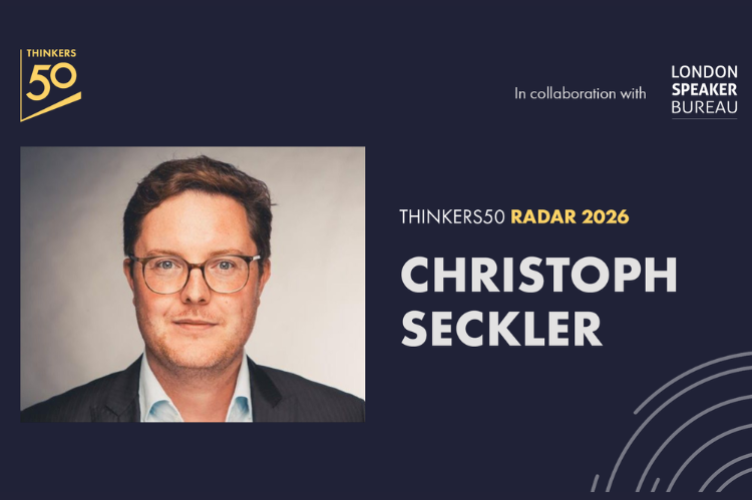
Christoph Seckler, Professor of Entrepreneurial Strategy at ESCP’s Berlin Campus, has been named to the Thinkers50 Radar List 2026, which highlights 30 emerging management thinkers whose ideas are expected to shape the future of business.
Founded in 2001, Thinkers50 is widely regarded as one of the world’s leading authorities on management thought leadership. Since 2016, its annual Radar List has spotlighted emerging voices whose research and perspectives are gaining international influence.
Being recognised on the Thinkers50 Radar List is a great honour and a humbling one. Thinkers50 highlights people who are expected to shape the future of business and management, and seeing myself through this lens prompted a moment of reflection — not so much about the recognition itself, but about how to use it well.
 Christoph Seckler
Professor of Entrepreneurial Strategy
A strong voice in entrepreneurship thought leadership
Christoph Seckler holds the Chair of Entrepreneurial Strategy at ESCP Business School and serves as Academic Director of the Executive Master in Digital Innovation and Entrepreneurial Leadership (EMDIEL). He is also Director of the Center for Design Science in Entrepreneurship (DS:E) and INSPIRE, two research centres dedicated to advancing actionable, impact-oriented scholarship.
His research focuses on leveraging adversity to foster learning, innovation, and resilience. His work has been published in leading international journals, including Entrepreneurship Theory and Practice, Journal of Management Studies, and Accounting, Organizations and Society, and has earned three Best Paper Awards from the Academy of Management.
What’s on his radar?
A central theme in Prof. Seckler’s work is the role of error culture in enabling sustainable organisational transformation . Contrary to dominant narratives around speed and constant change, he argues that stability is a key driver of organisational agility.
“One counterintuitive idea on my radar is that organisational agility and transformation are not driven by constant change, but by stability — specifically, stability at the level of mindset.”
As technological and geopolitical dynamics accelerate, organisations often push for greater flexibility and speed.
“What actually enables fast experimentation and learning is error intelligence: the shared capability to anticipate errors, surface them early, communicate them openly, and systematically learn from them. Paradoxically, it is this stable mindset of error intelligence that makes continuous change possible.”
Joining celebrated thinkers at ESCP
Prof. Seckler’s work has positioned him as a leading voice on error culture, with contributions featured in outlets such as the Financial Times, World Economic Forum, Frankfurter Allgemeine Zeitung, DIE ZEIT, and Harvard Business Manager. He also co-published the Error Culture Report for Germany in collaboration with EY Germany.
His inclusion in the Thinkers50 Radar 2026 reflects ESCP’s commitment to research and teaching that combine academic rigour with real-world relevance. As an educator, he focuses on empowering individuals to grow in thinking, doing, and being—an approach recognised with a Best Teacher Award from ESCP. He joins fellow ESCP Professors Alisa Sydow and Philip Meissner, who were named to the 2025 Thinkers50 Radar List.
Campuses

An interview with Dean Léon Laulusa on leadership, strategy and what comes next for ESCP
In a year that saw generative AI enter the classroom at ESCP in a big way, new schools added to the blueprint of an over 200-year-old institution, and ESCP named Business School of the Year by Poets & Quants, Executive President and Dean of ESCP Léon Laulusa kept his routine. He taught his annual class.
"Remaining close to our students keeps me connected to the heart of our mission," says Léon Laulusa. "It offers a valuable space for reflection and perspective."
As pressure mounted across the higher education landscape, fuelled by geopolitical and ideological tensions, he remained grounded in that mission—educating accountable, bold, and creative leaders was at the heart of a year marked by acceleration and anticipation at ESCP.
Remaining close to our students keeps me connected to the heart of our mission. It offers a valuable space for reflection and perspective.
 Léon Laulusa
Executive President and Dean of ESCP
Charting a strategic shift: Bold & United
In June 2025, ESCP unveiled Bold & United 2026-2030, its five-year strategic plan that charts the trajectory of the School’s ambitions for the years to come.
The plan outlines ESCP’s quest to become the first European University of Management, adding two new pillars to its academic architecture: the ESCP School of Technology, opening in 2027, and the ESCP School of Governance, set for 2029. Together, they will strengthen the School’s ability to respond with confidence to global transformations.
But for Professor Laulusa, the process mattered almost as much as the plan, as it was one that called on the insights and values of the entire ESCP community—something of which he is deeply proud.
“It required a worldwide consultation involving students, alumni, professors, staff, partners, and members of our governance,” he says. “By engaging all stakeholders and ensuring transparency throughout the process, we were able to build a shared and ambitious roadmap for the future.”
Beyond the launch of the new schools will be other significant investments. With a €360 million investment, ESCP will transform its campuses into innovation ecosystems. Excellence in research will be central to ESCP’s future ambitions, with ESCP’s LIGhTS research institutes bridging business, technology, and policy. To support this planned growth, the ESCP Foundation launched its first major fundraising campaign, “Rising Together”, with the goal of raising €100 million to fund scholarships, innovation, sustainability, and infrastructure.

A united ESCP, rising together
2025 was an exceptional year of milestones and achievements for the School. The Bachelor programme celebrated its 10th anniversary. ESCP rose to 4th place in the Financial Times European Business School ranking. And its Master in Finance programme was ranked the best in the world by the Financial Times for the third consecutive year. As a crowning achievement, Poets & Quants, a leading voice in management education, named ESCP Business School of the Year.
Aside from rankings and awards, the School led the charge in digital transformation, embedding AI tools and training across the entire ecosystem through partnerships with OpenAI and Hugging Face. This momentum will continue with the AI in Higher Education Summit planned for March 2026, where ESCP will host academics, innovators, and policy-makers to discuss how higher education should evolve in an AI-driven world.
AI is here to stay—and accelerate. Schools like ESCP must not only use AI, but build it, shape it, and empower our students and professors to master it with purpose.
Léon LaulusaExecutive President and Dean of ESCP
Staying grounded amid complexity and transformation
At the helm of a fast-moving and multi-campus institution, Professor Laulusa is often called to manage pressure from many fronts. “I wouldn’t point to a single, most challenging issue, because my role requires navigating complex questions every day — academic, strategic, managerial, and operational — across our six European campuses.”
What guides him is a consistent method: listening carefully, sharing openly, and bringing everyone along toward a common ambition. “I rely heavily on collective intelligence,” he shares. “Decisions are stronger when they integrate the perspectives of our students, faculty, staff, alumni, foundation, partners, and governance.”
People are also what propel and inspire him day to day. “Whenever I meet successful and fulfilled ESCP alumni around the world. Seeing them thrive across industries—and even return to inspire our students, like Clément Delangue from Hugging Face—reminds me why our mission matters.”
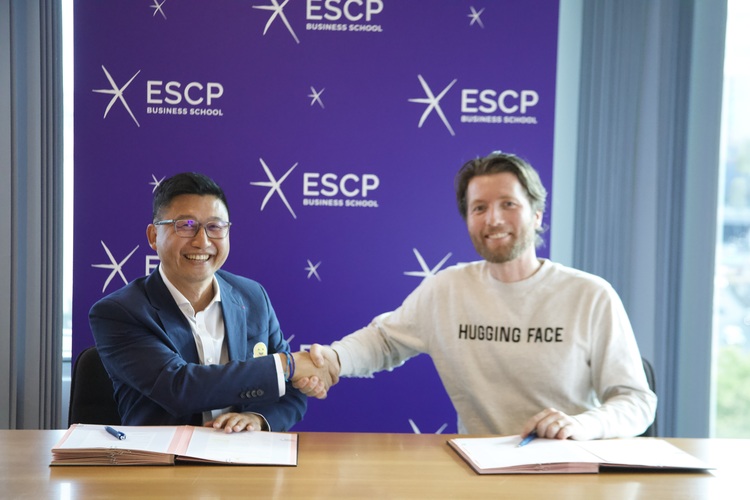
Léon Laulusa also credits the community around him for helping him stay steady during a fast-moving year. “What kept me grounded during moments of pressure or change this year was the unwavering support of the ESCP community — colleagues, students, alumni, friends, and family — and, of course, our foundation, the Paris Île-de-France Chamber of Commerce, and our Chairman, Philippe Houzé.”
How else does he stay grounded? “I practice meditation,” he shares. “It helps me restore positive energy, recenter myself, and make thoughtful decisions.”
What kept me grounded during moments of pressure or change this year was the unwavering support of the ESCP community.
Léon LaulusaExecutive President and Dean of ESCP
Hopes for the ESCP community in 2026
2025 was marked by growth and repositioning, and Dean Laulusa’s outlook for 2026 is to move ahead with clarity. His word for 2026? Lucidity. “Knowing that our mission has real meaning, and that leadership often requires bold choices and calculated risks, helped me stay focused,” he adds.
As ESCP enters the next phase of its evolution, Léon Laulusa’s focus is on helping the entire community meet the future with perspective and purpose. “I hope our students, faculty, alumni and professional staff continue to move forward with purpose and fulfilment,” he says. “Each contributing in their own way to the momentum that keeps ESCP bold and united.”
Campuses
Related stories
News 19/06/2025
Strategy
Bold & United: ESCP Launches 2026–2030 Strategic Plan
ESCP has officially unveiled Bold & United, its strategic plan for 2026–2030—an ambitious roadmap for how the School will prepare the next generation of leaders to thrive in a world defined by complexity, uncertainty and transformation.

News 22/10/2025
Awards
ESCP named 2025 Business School of the Year by Poets&Quants
The award highlights the School’s unique multi-campus model and global strategy, commitment to innovation and sustainability, and bold vision for the future.
Event 26/09/2025
AI
AI in Higher Education Summit 2026 – Paris, 17–18 March
The AI in Higher Education Summit 2026 in Paris will bring together academics, innovators, and policy-makers to discuss one central question: How should higher education evolve in an AI-driven world?

Why most of the world’s biggest R&D spenders still rely on regional markets
A new study led by ESCP Professor Régis Coeurderoy reveals that only a small share of the world’s largest corporate R&D investors generate truly global sales, with most firms still dependent on their home region.
It has long been easy for many people to assume that the companies spending the largest sums on research and development (R&D) are global giants selling everywhere at once, because they are typically large multinationals with operations in many countries. Yet a new study led by Professor Régis Coeurderoy, together with researchers Duong Nguyen and Xuejing Yang at ESCP’s Future of European Multinationals research centre, shows a very different picture of their commercial footprint. Most of these heavy R&D spenders are not global in their sales. Instead, they earn the bulk of their revenue in the region where they are based.
Published by the ESCP Geopolitics Institute, the paper shows that out of the world’s biggest corporate R&D spenders, only 17% earn at least 20% of their revenue in all three major regions of the global economy: the Americas; Europe, the Middle East and Africa; and Asia Pacific. More than two-thirds still make most of their money in the region where they are based.
The findings have direct implications for multinationals and policymakers alike
- European firms are more exposed to geopolitical risks because they depend heavily on sales outside their region.
- US and Asian firms can rely on large home markets, which makes it safer for them to grow domestically before going abroad.
- All firms now need strategies that can cope with regional differences rather than assuming the world is easy to operate across.
- Policymakers also need to understand that it is these regional rules – not a lack of ambition – that limit how global companies can be.
Only a small and exclusive group of companies achieve a genuinely global presence.
The co-authors point to examples including tech giants Apple and Meta in the US,Samsung Electronics in Asia, and industrial powerhouses Mercedes-Benz and Siemens in Europe. These corporations can run their innovation, production and sales across different regions at the same time – a capability most companies do not have.
Why Europe’s firms go global sooner
Europe has far fewer of the world’s biggest corporate R&D spenders than the US or Asia Pacific, yet its companies are more global in practice. Almost a third of European firms operate globally, roughly twice the share in the US or Asia, where about three-quarters of companies still focus mainly on selling in their home region.
The reason is structural. Europe lacks a single big market that can support large companies on its own, unlike the US or China. As a result, European firms are more prone to look beyond their region to reach scale.
Professor Coeurderoy says they expand abroad not out of choice, but because Europe’s many different rules and markets leave them little alternative.
In short, European firms internationalise early not as a strategic choice, but as a structural necessity.
 Professor Regis Coeurderoy
 Full Professor at ESCP
Why US and Asian firms can afford to stay home
The contrast with the US and Asia Pacific is sharp: European firms are pushed abroad, while American and Asian companies can scale at home. Around three-quarters of US and Asia-Pacific firms earn most of their revenue in their own region.
US firms can grow at home because they have a huge consumer market and national rules that are broadly consistent across the world’s biggest economy, supported by infrastructure that makes it easy to operate nationwide.
Asian companies benefit from large populations, rising spending power and strong local supply chains.
Professor Coeurderoy says this “home advantage” gives US and Asian firms far more room to grow before they ever need to look abroad.
“For many US and Asian firms, staying home already delivers the scale they need. Expanding abroad is useful, but not essential, and this acts as a buffer against global uncertainty and geopolitical risks.”
Where firms go when they look abroad
When firms do expand beyond their home region, they rarely try to cover the whole world.
Many concentrate on a single foreign region – often the Americas, the top choice for both European and Asian firms. Others build strong positions in two regions, a “bi-regional” strategy that offers wider reach without the headache of operating everywhere at once.
By contrast, US companies that expand abroad tend to look to Asia-Pacific, where rising incomes offer clear commercial potential.
Why some industries go global and others don’t
Industry differences matter. Sectors that sell largely the same products everywhere – like technology hardware and carmaking – can move into new regions without much difficulty. But industries such as pharmaceuticals and healthcare face strict, region-specific approval rules, which make it much harder for them to expand globally.
Professor Coeurderoy says the limits on global reach have little to do with ambition.
How far a sector can expand depends less on strategy and more on the rules it faces. Industries with common standards can spread across regions, while heavily regulated sectors tend to stay closer to home.
Professor Regis Coeurderoy Full Professor at ESCP

A report on the Global Footprint of Leading R&D Multinationals
Authors: Coeurderoy Régis, Nguyen Duong & Yang Xuejing
Campuses
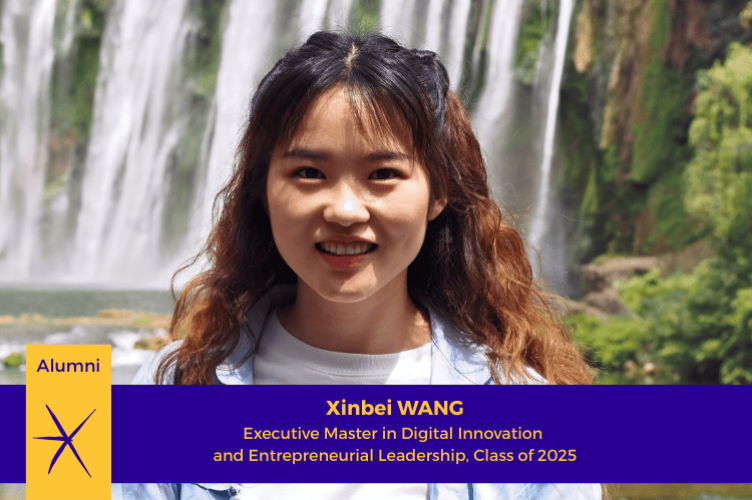
Executive Master in Digital Innovation and Entrepreneurial Leadership (EMDIEL)
Meet the Alumni: Xinbei Wang, Class of 2025
 Xinbei Wang is a digital product leader currently working as a Tech Product Owner and leading multiple cross-border digital initiatives. Operating at the intersection of technology and leadership, she brings a hands-on, execution-driven perspective shaped by complex international project environments. She joined the ESCP Executive Master in Digital Innovation and Entrepreneurial Leadership (EMDIEL) to broaden her strategic and innovation mindset beyond technical delivery. As a woman in tech, the programme has enabled her to apply new perspectives on leadership, innovation, and value creation directly within her teams — introducing more holistic, business-driven thinking into predominantly technical contexts, while exploring future possibilities in both corporate digital innovation and entrepreneurship.
What motivated you to choose the EMDIEL programme at ESCP?
Before joining EMDIEL, I was already working in technology- and product-driven, cross-border environments, leading international initiatives and delivering complex digital solutions. While this experience allowed me to grow as an execution-focused leader, I began to feel a limitation in perspective — not in how to deliver effectively, but in how to step back and assess what truly matters to pursue.
I increasingly felt the gap between technology and business, and between execution and strategy. I wanted to move beyond “doing things well” toward developing the ability to judge which problems are worth solving and why. This shift in mindset was a key driver behind my decision to pursue further education.
EMDIEL stood out to me because of its unique combination of digital innovation, leadership development, and entrepreneurial thinking. It is neither a purely technical programme nor a traditional MBA, but one that brings together diverse international perspectives and encourages critical reflection on real-world digital challenges.
Through the programme, I hoped to explore new possibilities — from driving digital innovation within large organizations as an intrapreneur, to developing a more mature leadership approach and, potentially, exploring entrepreneurial paths in the future.
What key skills or ways of thinking did you develop through the EMDIEL programme?
One of the most important shifts through EMDIEL was how I approach uncertainty and experimentation. During the San Francisco module, I was inspired by entrepreneurs and innovation practitioners who emphasized rapid testing, learning from failure, and acting without waiting for perfect conditions.
What resonated with me was realizing that this mindset is equally relevant in large organizations, where experimentation often carries less risk than expected. It encouraged me to try new approaches in my daily work and to treat experimentation as a learning process rather than a success-or-failure outcome.
At the same time, the programme strengthened my focus on identifying fundamental problems instead of optimizing existing processes. I became more inclined to question underlying assumptions and explore alternative ways of addressing recurring challenges — an approach that later shaped my master’s thesis.
Overall, EMDIEL helped me move from an execution-oriented mindset toward a more exploratory and learning-driven approach to digital leadership.
Can you share a project or assignment that significantly shaped your thinking?
My master’s thesis became a defining project in shaping how I approach digital product challenges. Rather than starting from existing processes, I focused on a recurring pain point I observed in my work: repeated rework in agile digital product delivery, particularly around UI/UX decisions.
The project, “AI-Driven UI/UX Validation to Reduce Rework in Agile Digital Product Delivery,” explored how earlier, AI-supported UX validation could improve decision quality and alignment in agile teams. Instead of treating rework as an operational issue, the research challenged when and how validation should take place.
What made the project impactful was its practical relevance. It encouraged me to rethink established ways of working and reinforced my belief that meaningful digital innovation often comes from reframing decisions and addressing uncertainty earlier.
This experience continues to influence how I lead digital initiatives, shifting my focus from optimizing solutions to asking better questions.
What about the structure of EMDIEL made the learning feel different from other programmes you’ve experienced?
What stood out to me about EMDIEL was how intentionally the programme is structured around relevance, immersion, and real-world application.
The curriculum is continuously adapted to reflect current developments in digital innovation. For example, courses on no-code platforms were closely aligned with the rapid evolution of AI, fundamentally reshaping how I approach problem-solving and solution design. In addition, the requirement for each participant to complete a substantial individual project ensured that learning was not merely theoretical. It pushed me to deliver outcomes I would not have imagined at the beginning of the programme, reinforcing a strong sense of application, ownership, and impact.
The programme’s global format also made the learning experience distinctive. Studying in locations such as London, Berlin, Shanghai, and San Francisco allowed us to engage deeply with local innovation ecosystems rather than learning about them in abstraction. Each location offered a different perspective on digital transformation, entrepreneurship, and leadership, while strong academic and administrative support made it easy to stay connected to the programme regardless of location.
Equally important was the intensive on-site format. The one-week, in-person modules created a truly immersive learning environment, particularly well-suited to professionals working full time. Stepping away from daily work and routines enabled deeper focus, reflection, and meaningful exchange with peers and faculty.
What advice would you give to someone considering the EMDIEL programme?
I would encourage future participants not to wait until everything feels clear or perfectly planned. EMDIEL is especially valuable for those who are curious, open to questioning their assumptions, and willing to explore new ways of thinking through real experimentation. The programme rewards engagement, reflection, and ownership far more than having predefined answers.
Campuses