
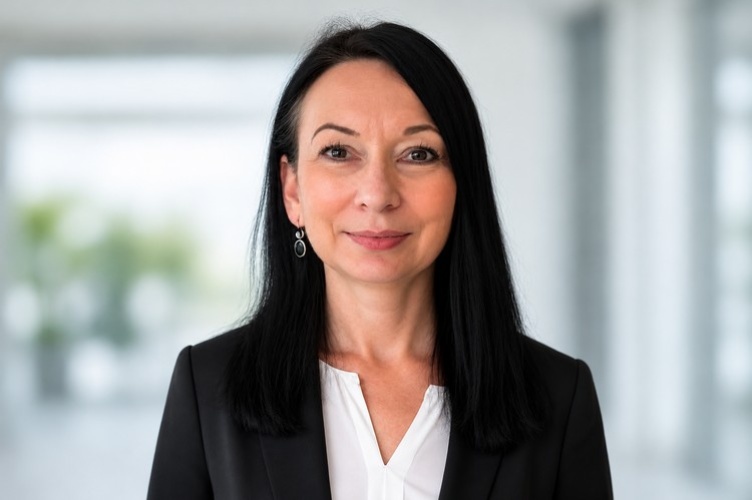
Global Executive Ph.D. graduate Brigitte Sitzberger reflects on researching hybrid work, challenging assumptions about leadership and navigating competing organisational demands
What happens when doctoral research challenges the assumptions that have guided an experienced professional’s approach to leadership?
For Brigitte Sitzberger, a graduate of the Global Executive Ph.D. at ESCP, that question centred on the future of work. Drawing on her experience as an HR leader, she examined how managers and teams navigate the tensions surrounding hybrid work, remote working and return-to-office mandates.
The Global Executive Ph.D. enables experienced professionals to investigate questions emerging from practice through rigorous academic research. For Brigitte, that process introduced her to paradox theory, a framework for understanding how competing demands can coexist and be managed over time. It challenged her assumptions about workplace flexibility and changed the way she approaches complex organisational decisions.
Having defended her doctoral dissertation on 10 July 2026, in this Q&A, she reflects on the intellectual and personal demands of the Global Executive Ph.D., what her research revealed about hybrid work and why developing a researcher’s mindset can influence how experienced professionals think and lead.
Looking back at that initial call when you were first exploring the programme, how did taking that leap end up reshaping your professional trajectory and worldview?
Pursuing a PhD had been a dream of mine for a long time. I have always been a passionate reader and very curious about research, but once you progress in your career and have family commitments, it can seem almost impossible to combine it all. That is why I was so impressed when I first learned about the Executive PhD programme. It caters exactly to working professionals in demanding careers while maintaining the rigour of a PhD programme, and you go through the journey as part of a cohort, so you are not doing it alone.
It has certainly shaped my professional trajectory. Funnily enough, my thesis and its three papers almost mirror my own professional journey: trying to make hybrid work successful, navigating return-to-office tensions, and eventually leaving corporate life and working in a work-from-anywhere arrangement myself.
Perhaps the biggest change, however, has been in how I think. As executives, we are often trained to solve problems quickly and choose between A and B. But the world, and organisational life in particular, is rarely black and white. Through my research, I was introduced to paradox theory and learned to adopt a paradox mindset: recognising and embracing competing demands rather than assuming that one side has to win.
I became much more comfortable with the idea that not every tension requires an either/or decision, and that sometimes the better approach is to ask how both sides can coexist and be navigated over time. That perspective has fundamentally changed the questions I ask, both as a researcher and as an advisor in my professional life.
Flexible working and return-to-office mandates are heavily debated in every boardroom right now. Was there a moment in your research when the data completely shattered a myth or assumption you personally held as a leader?
What surprised me most was not where people wanted to work, but how emotionally charged flexibility had become. Before the pandemic, flexibility was often treated as an HR policy or benefit. My research showed me that people attach deeply personal meanings to flexibility. It can represent autonomy and trust, but also a valued privilege, an entitlement or something people feel they have earned and want to protect. Taking flexibility away can therefore trigger strong reactions. Leaders can easily underestimate that they are no longer simply implementing a policy. They are dealing with something people care deeply about.
I saw this particularly strongly in my return-to-office research. As an HR leader, I had always appreciated the importance of line managers, but I was surprised by how personally and emotionally involved some supervisors became when implementing mandates they had not designed themselves. They were not simply communicating an organisational decision. They were balancing organisational expectations with employees’ needs, sometimes questioning the rationale themselves, and in some cases carrying a considerable emotional and moral burden in making the policy work.
That changed the way I think about flexible work. It is not simply a question of policy design or where people work. It is a deeply human and increasingly emotionally charged organisational phenomenon.
Between unpacking workplace tensions for your research and managing your own day-to-day executive responsibilities, how did you realistically keep all the plates spinning without burning out?
The honest answer is that I did not always achieve perfect balance, and I do not think an Executive PhD is possible without some trade-offs. For quite a long time, weekends and holidays were not completely work-free, and “workations” became quite normal.
I also became a real early bird. The quiet hours early in the morning, before the regular working day started, became my most productive time for reading, data analysis and writing.
What helped enormously was that I genuinely loved my research topic. Reading papers and articles was not simply another task on my to-do list. I was curious and enjoyed learning more. And I learned the value of small steps: rather than waiting for large blocks of free time that rarely appeared, I tried to consistently dedicate some time to the PhD. Slowly but steadily, those hours added up.
Of course, none of this happens without support. Having people around you who understand what you are trying to achieve and encourage you when things become difficult makes an enormous difference.
Now that your thesis is officially defended, what is the single most actionable or eye-opening takeaway from your research that leaders navigating hybrid work tensions need to know?
Much of the debate around hybrid work focuses on finding the optimal number of days people should spend in the office. My research suggests that this is the wrong place to start.
One assumption I had was that bringing people together naturally creates connection. The research showed me that this is not necessarily true. People can sit in the same office and still be disconnected, while teams with much less physical presence can build strong relationships when they are intentional about how they interact.
What stood out in my research was the high degree of intentionality required to make hybrid work successful. Hybrid work brings real challenges around coordination, communication, connection and culture, and simply mandating two, three or four office days does not solve them. Organisations and leaders need to deliberately create opportunities for connection, inclusion, collaboration and meaningful interaction, both when people are in the office and when they are working remotely.
So my practical message to leaders would be: do not just mandate presence. Design for connection.
What would be your words of encouragement to another senior leader reading this who is sitting on the fence about pursuing an Executive PhD?
Pursue the question, not the title.
I think passion for a subject and genuine curiosity about something you really want to explore should be the starting point. A PhD is a long journey, so having a topic that you truly care about makes an enormous difference. For me, flexible work was not simply an academic subject. It was something I had experienced throughout my professional life and genuinely wanted to understand better.
The journey is demanding, but it is also incredibly enriching. It teaches you to ask more questions, dig deeper, challenge your own assumptions, look for evidence and pause before jumping to an answer. I have found that these habits have influenced not only how I approach research, but also how I think and make decisions in business.
So for someone sitting on the fence, I would say: if there is a question you are genuinely curious about and cannot quite let go of, that may be exactly the reason to start.
Discover how the Global Executive Ph.D. at ESCP Business School enables experienced professionals to investigate questions rooted in their professional experience through doctoral research.
Campuses
Related stories
News 08/10/2026
Programme Spotlight
Where professional insight meets academic rigour: Tariq Ahmad’s Global Executive Ph.D. journey
ESCP Global Executive Ph.D. graduate Tariq Ahmad reflects on researching RevOps, finding new relevance in decades-old management theory and combining doctoral research with executive work.
News 09/07/2026
Programme Spotlight
Where experience meets evidence: Laure Marty reflects on her Global Executive Ph.D. journey
After recently defending her dissertation, Laure Marty reflects on her experience in the Global Executive Ph.D. programme at ESCP.