
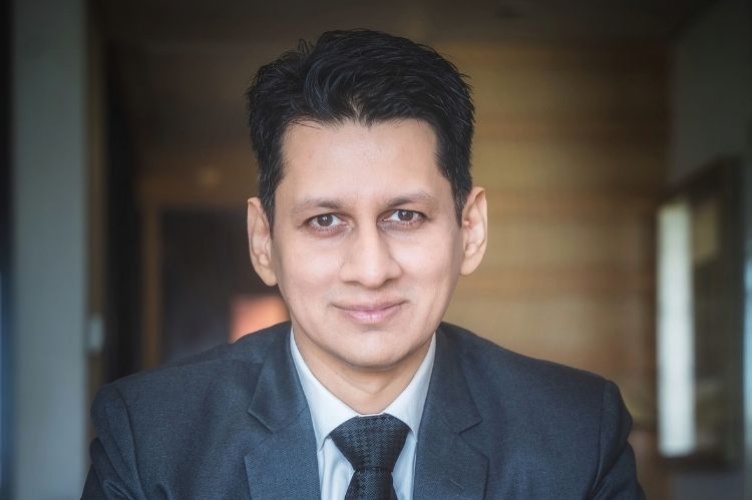
Global Executive Ph.D. graduate Tariq Ahmad reflects on researching RevOps, finding new relevance in decades-old management theory and combining doctoral research with executive work
What happens when an experienced professional takes a question from the business world and subjects it to the demands of doctoral research?
For Tariq Ahmad, that question centred on Revenue Operations (RevOps). Drawing on his professional background in sales, he set out to examine a relatively recent business phenomenon concerned with the integration of go-to-market functions. His research led him beyond contemporary practitioner thinking and into decades of management scholarship that became central to his theory-building.
The Global Executive Ph.D. gives experienced professionals the academic framework to investigate questions emerging from practice with the depth and methodological rigour of doctoral research. Tariq's work illustrates what that can involve when the subject itself is still developing: interrogating existing assumptions, finding theoretical connections beyond the immediate field and building an evidence-based understanding of a phenomenon encountered in professional life.
Having now defended his thesis, Tariq reflects on the intellectual and personal demands of the Global Executive Ph.D., what his research revealed about RevOps, and what it means to develop an academic perspective alongside an established professional career.
Do you remember that very first call or conversation when you were first exploring the programme? Looking back now, how did taking that leap end up changing your trajectory?
I was looking for an executive doctorate course for the longest time. I think I spent almost a year evaluating options, looking at the differences between a DBA, a fellow programme and an Executive Ph.D.
I finally had a conversation with ESCP in January 2021. What stood out for me was the course structure and the rigour. It wasn't easy, and I think that's one thing that resonated with me. It was very interesting that nobody was actually overselling the course, but ensuring I knew what I was getting into.
My conversation with Margot and Professor Haenlein was one of the most honest conversations I have had around investing time and resources in a programme. They clearly outlined the level of commitment required to get through the course, and now I realise why that was needed.
Looking back, the programme has delivered everything I expected of it. In addition, I have built a global network of academic contacts which I never had before. I met various scholars at conferences and exchanged ideas.
I believe my approach to work now involves a much more rigorous thought process, thanks to the programme. It's like developing another dimension to your personality and unlocking parts of your brain that lay dormant: that of an academic scholar.
Once you were deep into the research, was there a specific moment when the academic data completely contradicted what you had personally experienced in your executive role?
While researching my topic on Revenue Operations, I read a lot of literature from the present, going back to the 1960s. There was definitely a “eureka” moment while reading a paper by Harvard professors Lawrence and Lorsch that resonated with my research and formed the crux of my theory-building.
Imagine: Revenue Operations was a term coined in 2019, but its genesis was found in a paper from 1967. This completely changed my perspective on how academic literature could be used in the professional realm.
My research threw up quite a few interesting viewpoints that uncovered blind spots and deficits in the current understanding of the phenomenon.
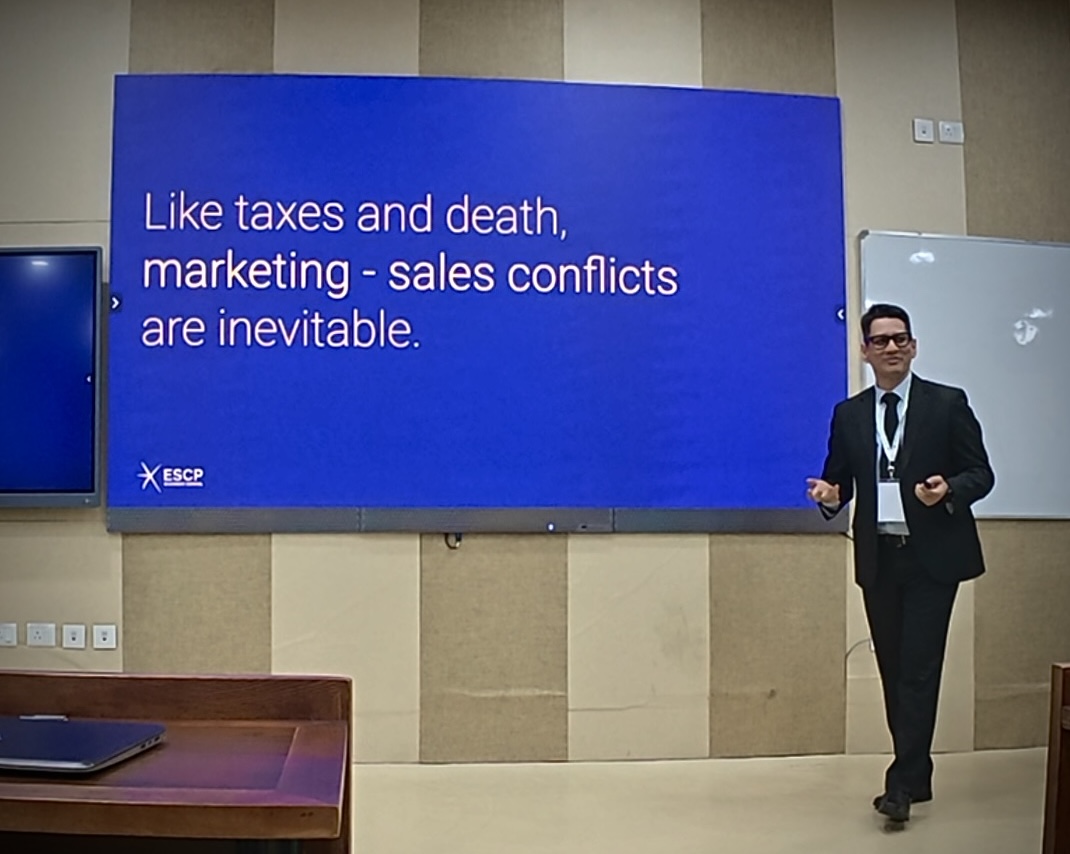
Be honest, at what point did you ask yourself, “What on earth did I sign up for?” and how did you realistically balance executive work and doctoral research without burning out?
I am sure each of my fellow participants has asked themselves this question as well. The first time I asked myself this question was when I was on a flight to the first on-site session during COVID. I was flying from India to France, and I was thinking to myself, “Why did I sign up for a Ph.D. in the middle of a pandemic?”
In the four years and seven months that it took me to complete the programme, I may have asked myself that question every four to six weeks. Luckily for me, my initial conversations, my fellow participants' WhatsApp chats and my statement of purpose were exactly what I kept going back to when I asked myself that.
To be honest, it is difficult to balance executive work and doctoral research, though not impossible. There are times when you will feel burnt out, but I think it's all about balance.
I would spend approximately 16–20 hours a week either reading, writing, or researching. This was split across two hours on weekdays and approximately another 10 hours on weekends. I would work out of a co-working space every Saturday and do deep-work sessions for at least six to eight hours.
Now that the thesis is defended, what would you say is the single most compelling or surprising insight that came out of your RevOps research?
For me, one of the most compelling and surprising insights that came out of my RevOps research was that most RevOps professionals are very strong analytical minds, and where stakeholders find the biggest gap is in the human-centred integration of the GTM functions.
This gap is one of the most interesting insights when it comes to unlocking the true potential of RevOps. This was empirically supported by a RevOps value chain that states that, without drivers, resources do not have a significant impact on the outcomes expected of RevOps.
What would be your final word of advice to any senior executive reading this who might be sitting on the fence about pursuing an Executive Ph.D.?
It is very important for you to know why you want to pursue further education. I'm assuming most senior executives are master's degree holders and are looking at an advanced degree beyond that.
You can pursue deeper professional expertise by joining a DBA or FPM. But if you want to pursue the creation of knowledge through academic rigour, there is nothing better than an Executive Ph.D.
An Executive Ph.D. is sometimes a lonely endeavour, akin to a pilgrimage where you may be surrounded by people, but your journey is deeply personal. It could be your biggest nightmare or your greatest enlightenment.
Personally, it was one of the most painful yet most rewarding experiences of my life.
Discover how the Global Executive Ph.D. at ESCP Business School enables experienced professionals to investigate questions rooted in their professional experience through doctoral research.
Campuses