
Art Thinking Network
A community launched at ESCP where artistic practice, research, education and management meet to question probable trajectories that have become unsustainable or unacceptable, and to make improbable alternatives tangible.
We bring together researchers, artists, educators, executives and cultural entrepreneurs to investigate how creation can transform the ways people learn, organize and act. The network develops research, pedagogies and public experiments grounded in Art Thinking.
15+
years of experimentation
9,780
participants worldwide
3,265
works and prototypes created
100+
artists, researchers & cultural entrepreneurs affiliated with ESCP
Developed at ESCP.
Connected worldwide.
INSTITUTIONAL ANCHOR
Developed and hosted by ESCP
Art Thinking emerged from an encounter between management research and artistic practice. Since 2011, Professor Sylvain Bureau and artist Pierre Tectin have developed the method at ESCP through seminars, research projects and collaborations with artists, scholars and cultural institutions.
The network remains anchored at ESCP while operating as an open international platform.
MODES OF ENGAGEMENT
Many ways of learning
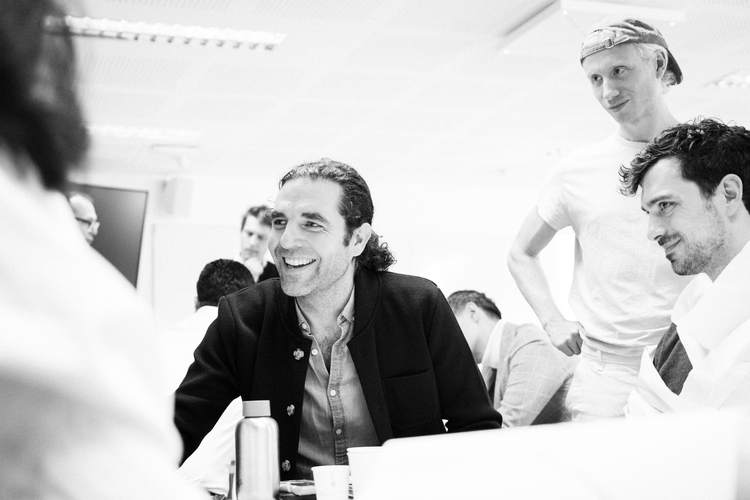
Art Thinking takes shape through executive seminars, university courses, research creation, exhibitions, workshops and field interventions. Each format turns uncertainty into a shared space for inquiry and creation.
Creating the improbable when
the probable becomes an impasse.
ARTIFICIAL INTELLIGENCE
What should humans learn when machines can generate?
Generative AI can produce answers, images and options at unprecedented speed. The challenge is no longer only to make more, but to frame better questions, exercise judgment, resist automatic solutions and create meanings that cannot be reduced to prediction.
We investigate how artistic practices help people develop these capacities and how they may complement, redirect or contest artificial intelligence.
ECOLOGICAL IMPASSE
How do we act when the most probable future is an ecological impasse?
When dominant models reproduce the conditions of crisis, optimization is insufficient. Art-based experimentation can make assumptions visible, shift perceptions and allow groups to rehearse alternatives before they become strategies.
Our work studies how collective creation can restore agency without denying uncertainty, conflict or the material limits of the present.
Investigating Artistic Intelligence.
A WORKING HYPOTHESIS
A hypothesis,
not a finished doctrine.
Artistic Intelligence is an emerging research project rather than a fixed concept or finalized framework. It examines the forms of attention, embodied knowledge, critical imagination, aesthetic judgment and collective sense-making cultivated through artistic practice.
The network studies how these capacities operate, how they can be observed and developed, and when they become useful in education, organizations and society. It also investigates their tensions and complementarities with artificial intelligence.
OPEN QUESTIONS
What are we trying to understand?
Which forms of intelligence are activated by artistic practice?
How can they be studied without reducing them to conventional skills?
How do they reshape judgment, leadership and collective action?
What becomes possible when Artistic and Artificial Intelligence meet, diverge or conflict?
This programme is deliberately open. Concepts, methods and evidence are developed through seminars, field experiments, exhibitions and collaborative research.
From one seminar to a network of practices.
An encounter between management research and artistic practice
Researchers and artists begin experimenting with a pedagogy capable of making uncertainty productive rather than eliminating it.
Improbable
The first Improbable seminars at ESCP translate this encounter into an intensive collective experience and the foundations of Art Thinking.
A growing international practice
The method circulates through universities, companies, museums and cultural institutions, generating new formats, research questions and local adaptations.
A Chair and an expanded research agenda
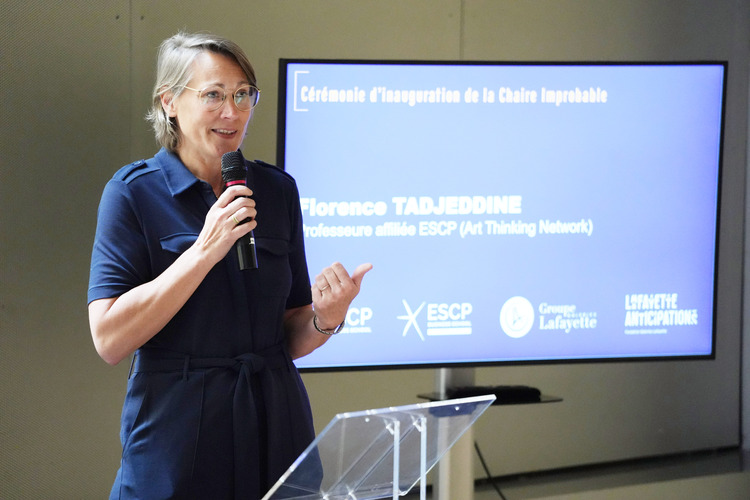
The Improbable Chair by Galeries Lafayette strengthens the network's capacity for research, teaching and public experimentation.
A distributed ecosystem
A core ESCP team, formal affiliates and project-based collaborators work across disciplines and countries while preserving a common commitment to creation as inquiry.
Art Thinking: creating the improbable with certainty.
A METHOD FOR CREATION
Art Thinking is a radical education and creation method for making improbable alternatives tangible. Rather than beginning with a problem to optimize, participants move through six practices that make room for uncertainty, rupture, embodied exploration and public encounter.
Its rigor lies not in predicting the outcome, but in designing the conditions through which something genuinely new can emerge.
When the probable becomes an impasse, creation makes room for what does not yet exist.
DONATE
Share resources and loosen ownership.
DEVIATE
Leave expected paths and resist ready-made answers.
DESTROY
Remove assumptions and forms that constrain.
DRIFT
Wander and let situations alter the question.
DIALOGUE
Expose the work to criticism and difference.
DISPLAY
Make the work public, situated and accountable.
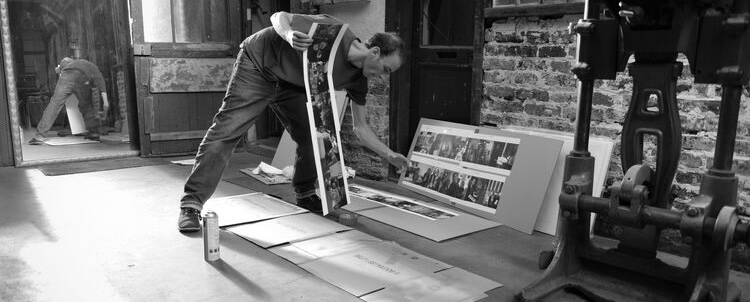
Many disciplines.
Many places.
DISCIPLINES
- Management
- Entrepreneurship
- Organization Studies
- Education
- Engineering
- Science
- Design
- Contemporary Art
SELECTED INSTITUTIONS
Examples include
- Stanford University, USA
- Bern University of Applied Sciences, Switzerland
- Ivey Business School, Canada
- University of Exeter, UK
- Stockholm School of Economics, Sweden
As well as museums and cultural institutions such as Centre Pompidou, Bétonsalon and Lafayette Anticipations.
SUPPORTED BY GROUPE GALERIES LAFAYETTE SINCE 2024
The Improbable Chair. A platform for creation.
RESEARCH / PEDAGOGY / PUBLIC EXPERIMENTATION
Connecting artists, researchers and entrepreneurs in a new way.
The Improbable Chair by Galeries Lafayette was established at ESCP to support research on creative practices and expand the Improbable pedagogy. It creates a long-term meeting point between artistic creation, scientific inquiry and organizational transformation.
Through research projects, learning programmes and public experiments, the Chair helps make creation more accessible and develops new ways to act when established frameworks no longer suffice.
Research Understanding creative practices.
Teaching Spreading the Improbable pedagogy.
Public experiments Exhibitions, encounters and residencies.
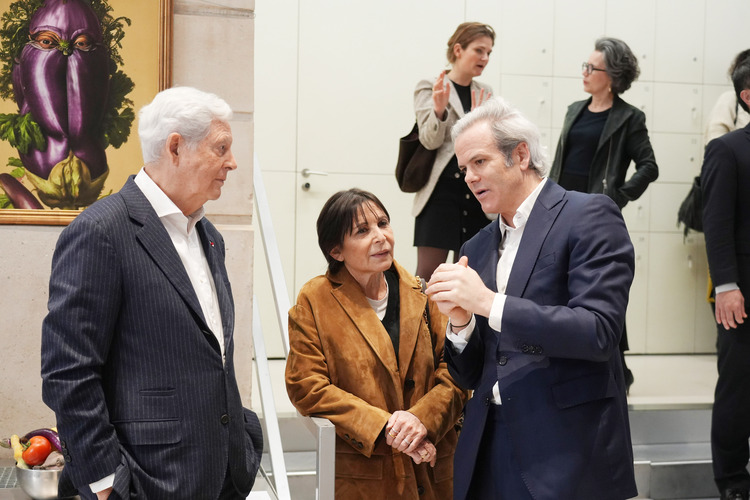
Anchored at ESCP. Built through affiliation and collaboration.
The network is organized around three complementary circles: a core ESCP team of permanent faculty and staff, formal affiliates who contribute to its research and pedagogy, and project-based collaborators invited for specific seminars, publications, exhibitions and interventions. This structure provides a strong institutional anchor while preserving the openness required for improbable work.
Beyond these formal affiliations, the network develops many project-based collaborations with researchers, artists, organizations and cultural institutions around the world.
ART THINKING NETWORK
Create the improbable.
Research, education and artistic practice for alternatives that do not yet exist.