
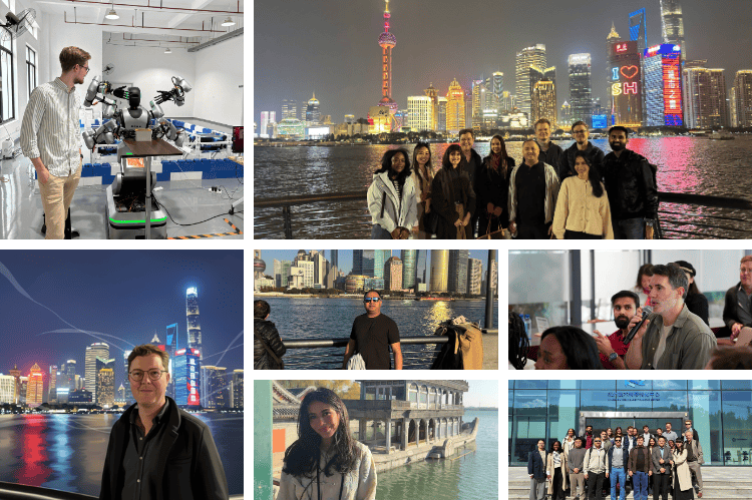
EMDIEL in China
Diving into the Heart of a Thriving Tech ecosystem
Participants and staff of ESCP’s Executive Master in Digital Innovation and Entrepreneurial Leadership (EMDIEL) embarked on their second module with a rare opportunity: to witness, up close, the speed, scale and bold experimentation that define China’s tech ecosystem.
Over the course of an intensive week, the cohort navigated a packed agenda that brought them face-to-face with pioneering companies, emerging ventures, and thought leaders shaping the future of digital business in Asia.
From exploring cutting-edge applications of AI and platform economics to gaining insight into local entrepreneurial mindsets, participants were immersed in a learning environment where innovation is not only encouraged: it's expected.
In the following answers, they reflect on what surprised them, what challenged their assumptions, and how the Shanghai experience broadened their thinking about global digital strategy and entrepreneurial opportunity. Their stories capture both the energy of the city and the transformative impact of engaging directly with one of the world’s most dynamic innovation landscapes.
ESCP: How did the pace of innovation in Shanghai challenge or change your perspective on digital transformation?
Aurélien Jagot, EMDIEL participant of 2025-26: Being in Shanghai felt like stepping into a parallel timeline where digital transformation has already happened. The quickest way to see that is by trying to pay without WeChat or AliPay. The pace is so fast that it forces you to confront how slow and cautious we can be in Europe, where we often intellectualise innovation too much. Whether it was robotics, elderly-care tech or massive data platforms, everything was built to be deployed fast. It pushes me to rethink my own relationship with speed, execution and ambition.
ESCP: What surprised you the most about China’s entrepreneurial ecosystem?
Maha Khan, EMDIEL participant of 2025-26: China managed to build an entire modern ecosystem without relying heavily on external models, and that genuinely amazed me. The ability of companies and even their society to adapt, shift direction, and reinvent themselves in such short cycles is something I’ve never seen at this scale. Their approach to order, structure, and people management is extremely different from what I’m used to, yet highly effective within their context. It opened my eyes to how many ways there are to design systems that actually work.
ESCP: Which visit made the biggest impression on you and why?
Fabian Schilling, EMDIEL participant of 2025-26: The visit that impacted me most was to a high-tech elderly care center, where technology wasn’t a buzzword but a lifeline. Seeing how thoughtfully applied digital tools could ease daily routines, enhance dignity, and create real value was eye-opening. It was a masterclass in true digitalisation—designing solutions from first principles rather than simply transferring offline processes into an online format. This experience sharpened my conviction that meaningful innovation comes from re-imagining, not replicating.
ESCP: If you could describe your experience in one word, what would it be?
Fabian Schilling, EMDIEL participant of 2025-26: One word: Igniting. The visit to Shanghai was igniting in the truest sense, sparking a surge of energy, clarity, and forward momentum. Experiencing a culture where action outweighs hesitation and where ambition is matched with execution left me charged to return to work with a sharper bias for action and a renewed determination to move ideas into reality. It reminded me that pace, courage, and momentum are choices.
ESCP: What will you take back to Europe?
Prof. Dr. Christoph Seckler, Professor of Entrepreneurship and academic director of the EMDIEL: In Europe, we talk much about becoming more entrepreneurial. In Shanghai, they simply move with results speaking for themselves. I have followed China’s development since my student days in Mannheim, even studying Chinese for several semesters. But being in Shanghai and experiencing the entrepreneurial spirit, speed and scale, provided a depth of understanding that years of studying it “by the book” can never reach. What stood out most was how digital infrastructure, talent and policies interact in a mutually reinforcing way. Ideas and innovation move quickly because the system is built to reduce friction and make experimentation routine rather than exceptional. What I take back to Europe is to encourage thinking beyond incremental optimisation and towards environments that rewards experimentation and fearless learning at scale.
ESCP: How do you see global exposure like this immersion shaping participants’ leadership approach?
Sven Scheid, Director of Executive Education at ESCP Berlin campus: The EMDIEL immersion trips shape leadership by expanding perspective and strengthening self-awareness. Being placed in unfamiliar cultural and professional contexts forces people to reflect on how they communicate, listen, and build relationships. It teaches them cultural humility, adaptability, and the importance of leading with empathy. Ultimately, global exposure helps participants to become more grounded, inclusive, and self-confident leaders.
ESCP: What key takeaways do you think you can apply in your own professional context?
Debashish Das, EMDIEL participant of 2025-26 :
- Adopt a test-and-scale mindset: Move quickly, experiment boldly, and refine based on real data.
- Strengthen cross-functional agility: Break down silos to create more fluid collaboration and faster execution.
- Embrace digital ecosystems: Think beyond standalone products toward integrated, user-centric solutions.
- Cultivate cultural openness: Encourage teams to seek inspiration from global markets and diverse ways of working.
- Prioritise speed without sacrificing purpose: Optimise for momentum while remaining aligned with your long-term vision.
The insights show how the Shanghai module delivers something rare: direct exposure to one of the world’s fastest-moving innovation ecosystems and the spark to think and act more entrepreneurially. If this inspires you to explore your own next step in digital innovation or venture creation, EMDIEL could be the catalyst you’re looking for.
Campuses
How two ESCP students turned the simple act of writing a letter into a cross-campus initiative bringing warmth and connection to those who need it most.
Sometimes, making a difference starts with something deceptively simple. For Emma Lestrade and Ladislas Labarthe, students in the Bachelor in Management (BSc) at ESCP, that something was a handwritten letter.
In their second year on the Madrid campus, the two friends launched 1 Lettre 1 Sourire at ESCP, a heartfelt initiative inviting students to write to elderly people in care homes. It began as a local project. Today, it's become a federated movement across ESCP’s campuses, reminding us that human connection is always worth the time it takes to write it down.
A shared motivation to give back
“I had known about 1 Lettre 1 Sourire for years,” Emma recalls, “but I never really understood the depth of what they did until Ladislas and I started discussing it seriously.” Ladislas had long been familiar with the French non-profit, knowing the founders well and having followed the project since the beginning.
But the idea to bring the initiative to ESCP came after Ladislas attended a dinner with the association’s founders – cousins who created the project in response to the loneliness crisis during the pandemic. “Listening to them talk gave me a spark,” Ladislas says. “I realised it was time for me to give some of my time to help others.” Together, he and Emma decided to bring 1L1S to ESCP’s Madrid Campus.
I realised it was time for me to give some of my time to help others.
ESCP BSc student

Writing, reading, reaching hearts
The idea was simple but powerful: write kind, thoughtful letters to elderly residents in care homes. With support from the School and peers, they installed letter boxes on campus, gathered messages, and organised visits to care homes.
“The first time I went to a retirement home, I wasn’t expecting to receive so much love,” shares Ladislas. “I was really moved by the warmth, the gratitude, and the smiles from the residents. That’s when I understood how meaningful all the work we do behind the scenes truly is.”
One visit stands out in Emma’s memory. “An elderly woman began to cry. She had no family and said she often felt forgotten. That exchange was a powerful reminder of the real impact the association can have on individuals’ lives.”
“To me, a letter is something tangible, a little keepsake you can hold, keep, and revisit,” Ladislas adds. “If my message brings even a bit of warmth into their day, then I’ve accomplished what I hoped for.”
Expanding the mission
While the initiative first took root on the Madrid campus, the duo didn’t stop there. Emma, who had spent eight years in Hong Kong, contacted one of her former French teachers and launched a writing event to spread the programme internationally.
They also began working on expanding the project to all ESCP campuses. “Our final and ultimate goal is to make this initiative a part of ESCP,” explains Emma. “We truly wish that other students will continue to spread letters.” The project is also now being extended to staff and professors, with the support of the ESCP internal communications and student experience teams.
Both students say the project changed them deeply. “This experience showed me that solidarity can be something very simple yet incredibly impactful,” says Ladislas. “I realised that a small gesture, like writing a letter, can create a real human connection and bring a lot of comfort.”
Emma agrees. “This experience has significantly shaped my understanding of solidarity and human connection. It has made me more conscious of the importance of supporting and valuing our elders, and of how meaningful even simple gestures can be.”
Their message to other students? Get involved, find an association, dedicate some time to people who need you. “At ESCP, we are lucky to have the flexibility to get involved,” says Emma. “Even a few hours a week can make a real impact.”
As Ladislas adds, “Anyone can make a difference, even with a little.”
This experience has significantly shaped my understanding of solidarity and human connection. It has made me more conscious of the importance of supporting and valuing our elders, and of how meaningful even simple gestures can be.
ESCP BSc student
Want to give back at ESCP?
- Drop a letter at the 1 Lettre 1 Sourire box on campus
- Join a care home visit to read letters aloud
- Collaborate with other clubs or start your own initiative
Campuses

Trump and Latin America: Revisiting the Monroe Doctrine?
Introduction
The second Trump administration is reviving a direct interventionist approach in Latin America. Migration, drug trafficking, economic pressure: Washington is stepping back into the forefront, supporting allies such as Milei and Bukele. Faced with this renewed assertiveness, how are Latin American states responding? Between alignment, resistance, and circumvention, the region is being reshaped, while the Venezuelan crisis crystallizes energy, security, and ideological stakes. This dynamic invites us to question the nature of the American comeback in its neighborhood: a refocusing of its sphere of influence, a desire to contain autonomous ambitions in response to the BRICS, or a deeper sign of concern over a relative decline in its power?
To analyze these dynamics — U.S. strategy, inter-American relations, economic levers, and security issues — Vanessa Strauss-Kahn, Co-Director of the ESCP Geopolitics Institute, and Florence Pinot, Director of CERALE, are pleased to welcome:
- Carlos Quenan, economist, university professor, Vice-President of the Institut des Amériques
- Maud Quessard, associate professor, Director of the Europe, Transatlantic Area and Russia program at IRSEM
- Thomas Posado, political scientist, associate professor in Latin American Studies at the University of Rouen, author of Venezuela: De la Révolution à l'effondrement (PUM, 2023)
Webinar will be held in French. Registration is mandatory.
Regesieration form
Location
Organiser: ESCP Business School
Online - France
MapDate
Start date: 09/12/2025
Start time: 6:00 PM
End time: 8:00 PM
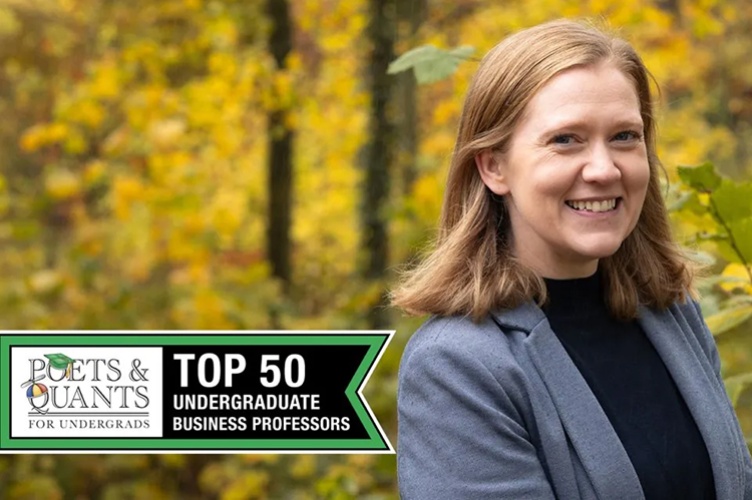
The ESCP associate professor has been recognised by Poets & Quants for outstanding teaching and impactful research.
Jessica Breaugh, Associate Professor at ESCP’s Berlin Campus, has been recognised by leading business education publication Poets & Quants as one of the 50 Best Undergraduate Business Professors of 2025.
Now in its eighth year, the list features business professors who demonstrate excellence in teaching and research. This year’s honorees were selected from more than 1,000 nominations submitted by students, alumni and peers.
"It is an honour to be recognised among so many talented professors around the world,” said Breaugh of her selection. “Being part of ESCP’s international and multicultural environment makes teaching an incredibly dynamic and rewarding experience.”
It is an honour to be recognised among so many talented professors around the world. Being part of ESCP’s international and multicultural environment makes teaching an incredibly dynamic and rewarding experience.
 Jessica Breaugh
Associate Professor
Educating with purpose and perspective
Jessica Breaugh teaches Corporate Social Responsibility and Business Ethics in the Bachelor in Management (BSc) programme at ESCP. Her multidisciplinary background, spanning psychology, political science, governance, and public affairs, informs both her teaching and research. “I see my role as making complex topics accessible by bridging theory and practice to help students see not only the academic logic of an issue but also its real-world importance,” she told Poets & Quants.
Beyond the classroom, Breaugh’s research focuses on how individuals experience organisational and societal change, with a particular interest in public management, digital transformation, and workplace wellbeing. She has published in several highly ranked journals, including Public Management Review and Government Information Quarterly, and sits on the editorial board of Public Personnel Management.
Celebrating pedagogical impact at ESCP
Breaugh’s selection as one of Poets & Quants’ 50 Best Undergraduate Business Professors reflects the calibre of forward-thinking educators who bring both academic rigour and social relevance to classrooms at ESCP.
Having taught at ESCP since 2022, she acknowledged the environment the School creates for impactful, values-driven teaching. “This award underscores ESCP’s commitment to pedagogical development aimed at preparing students and future leaders to think critically and act responsibly in a global context."
Campuses
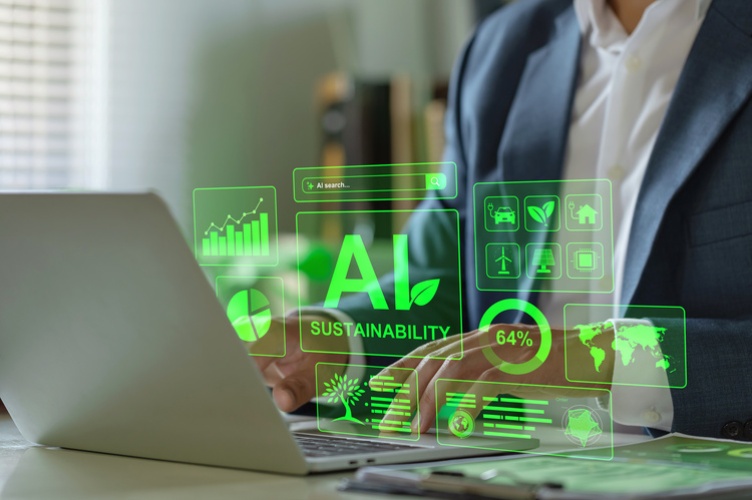
A grounded look at how organisations are adopting AI tools for early-stage innovation
ESCP’s Deeptech Entrepreneurship Research Briefings launch with a first issue dedicated to a fast-evolving question: How is Artificial Intelligence reshaping the way organisations identify and evaluate startups?
Drawing on 13 interviews with corporate innovation leaders, incubator managers, and venture capital professionals, this Research Briefing provides a grounded view of current practices and emerging models in AI-enabled startup scouting.
The findings reveal that startup scouting today remains highly fragmented and decentralised, with teams across business units and geographies operating with different methods, evaluation grids, and priorities. This lack of harmonisation makes it difficult to scale scouting or ensure consistent decision-making.
Despite the strong theoretical promise of AI, its actual adoption is still limited. Most organisations experiment at an individual level—using generative AI tools for desk research—while only a few advanced players, mainly VC firms, have developed proprietary, data-driven platforms integrating NLP and multi-source datasets. Adoption barriers include cultural resistance, low AI literacy, data quality issues, and the high cost of developing tailored solutions.
Across the interviews, one message stands out: human judgment remains central. AI can surface weak signals, expand search horizons, and process large volumes of information, but evaluating founders, strategic fit, and relational dynamics still relies on expert insight. The study points toward scalable hybrid models, where AI augments the early stages of scouting while humans retain responsibility for qualification and partnership decisions.
This first issue sets the foundation for a regular series exploring deeptech entrepreneurship and innovation practices across industries.
Related stories

Startup scouting and ai: current practices, adoption challenges, and hybrid models
Campuses

ESCP Professor Gorgi Krlev and co-authors propose a new framework redefining how researchers review knowledge in the age of AI.
Literature reviews have long been a cornerstone of academic research. They summarise what is known, identify gaps, and help shape new lines of inquiry. Yet for many scholars, they remain one of the most time-consuming and least rewarding parts of research. A new study led by Professor Gorgi Krlev (ESCP Business School), in collaboration with Timothy R. Hannigan (University of Ottawa) and André Spicer (University of London), argues that it is time to rethink how we review knowledge, and what role humans will continue to play as artificial intelligence takes on more of the work.
Published in the Academy of Management Annals, the paper analyses over 1,400 literature reviews published since the 1980s. The authors set out to understand what makes a high-quality review and how reviewing practices have evolved. Their findings reveal that there is no single standard model. Instead, literature reviews serve multiple purposes depending on the maturity of a field and the kinds of questions being asked.
Ten purposes, four directions
The team identified ten distinct purposes of review articles, which they grouped within a framework called the “Directional Space.” It helps scholars decide not just how to conduct a review, but why it is needed and where it should take a field.
The framework highlights four broad “directions” a review can take:
- Ordering – organising and consolidating scattered evidence in emerging fields;
- Renovating – challenging assumptions to refresh mature or stagnant research areas;
- Expanding – connecting fragmented or parallel conversations across disciplines;
- Reshaping – redefining the boundaries or direction of a field altogether.
This perspective shifts attention from procedures to purpose, encouraging researchers to align their method with what a field truly needs.
The changing role of the human reviewer
Artificial intelligence adds a new dimension to this conversation. Large language models can already automate much of the descriptive work involved in reviewing: collecting, sorting and summarising large bodies of literature. Yet the authors stress that such tools cannot replace human interpretation.
“The shift changes the human role from verifying sources to making sense of them, deciding what matters and where a field should go next,” the study notes.
As AI handles routine synthesis, the value of human reviewers lies increasingly in their ability to judge meaning, context and direction.
Towards more reflexive and collaborative reviewing
Krlev and his co-authors propose that future reviewing will benefit from technologically infused and collective practices. These include shared knowledge platforms, visual “evidence maps,” and ongoing, distributed collaboration among researchers. Such approaches could make reviews faster, more transparent and more relevant across disciplines.
They also highlight that diversity in review purposes strengthens a field’s resilience. Unlike disciplines that rely heavily on standardised methods, management research benefits from having multiple ways of reviewing knowledge, allowing new perspectives to emerge even as others evolve or fall out of use.
Reclaiming the purpose of the review
For Gorgi Krlev, this evolution is less about replacing old methods and more about restoring the review’s original purpose.
“In the social sciences, a good review is not just a summary of what we know. It is a form of sensemaking, an interpretation of how knowledge fits together and where it might lead next.”
The literature review is evolving. In the age of AI, its future lies not in stocktaking but in sensemaking.
Campuses

ESCP moves up one place among Europe’s top 5 business schools
For the fourth consecutive year, ESCP has earned its place among the top five business schools in Europe, climbing one position to secure 4th place in the 2025 Financial Times European Business School ranking. This ranking showcases the strength of ESCP’s unique pan-European model and human-centred approach to innovative business education.
The FT European Business School ranking reflects a cumulative score across four programme rankings: Master in Management (MiM), Executive MBA (EMBA), Executive Education (EXED), and MBA. ESCP’s continued ascent highlights the School’s exceptional performance and unique value proposition.
Inside the FT ranking: a closer look at ESCP’s top-ranked programmes
ESCP Executive MBA: #1 in Europe, #3 globally
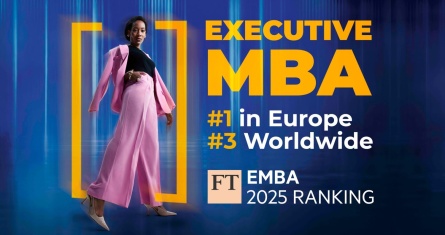
For the third year in a row, ESCP’s EMBA ranked #1 in Europe as well as #1 in every country where ESCP campuses are located: France, Germany, Italy, Poland, Spain, and the UK. Ranked third worldwide, the programme is recognised for its remarkable strength in career progression (#1), international course experience (#2) and Environmental, Social and Governance (ESG) and net zero teaching (#1).
ESCP Master in Management: #5 in Europe, #7 globally
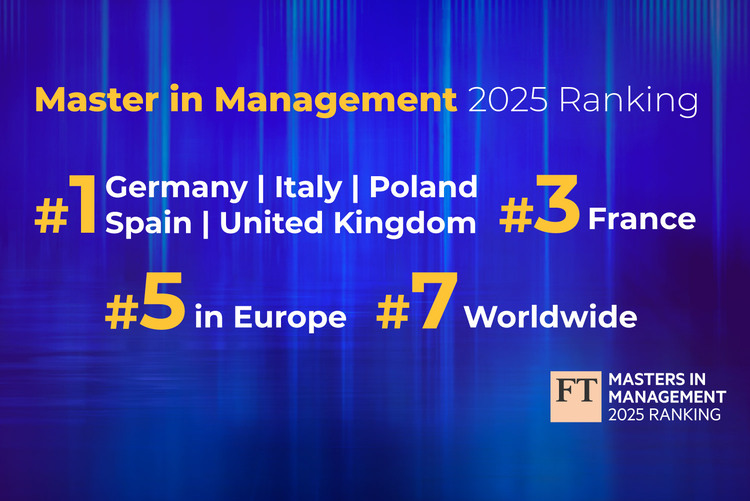
In the 2025 FT Master in Management ranking, ESCP’s flagship programme placed 5th in Europe and 7th globally, continuing a fourteen-year track record of placing among the world’s top 10. ESCP ranked first in the UK, Spain, Italy, Germany, and Poland, as well as 3rd in France, demonstrating the consistent excellence of the programme across all ESCP campus countries.
ESCP Custom Programmes enter Top 10
In Executive Education (EXED), ESCP entered the top 10 custom programme providers. Climbing one place in the 2025 FT Executive Education Custom Ranking, this result reflects ESCP’s commitment to close collaboration with international companies as they adapt to a rapidly changing world.
ESCP MBA: Top 10 in Europe with strong international outlook
This year, ESCP’s MBA programme was ranked #10 in Europe in the FT ranking, reflecting its strong international outlook and the School’s dedication to preparing leaders across borders and industries. The programme achieved excellent results worldwide, ranking #1 for international course experience and #3 for value for money, with diversity among faculty and students remaining a defining strength.
Our performance across the FT rankings demonstrates the depth and consistency of ESCP’s programmes, from early-career to executive education.
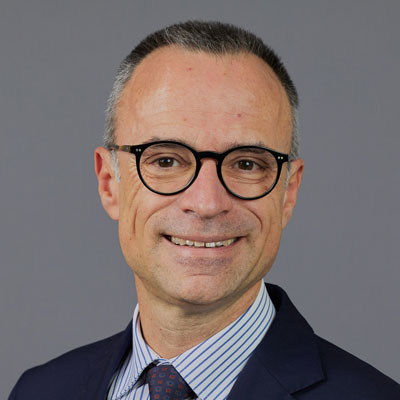 Prof. Francesco Rattalino
Executive Vice-President and Dean of Academic Affairs & Student Experience.
An exceptional year of international achievements
2025 has been an outstanding year for ESCP across global rankings and recognitions. While not included in the cumulative FT European Business School score, the 2025 FT Master in Finance ranking saw ESCP maintain its position as the global leader, earning 1st place for the third year in a row. The programme earned top positions for alumni network, career services, aims achieved (97%), and overall satisfaction (9.99/10), with 100% of graduates employed within three months of completing the programme.
Alongside these excellent results in the FT rankings, ESCP is also proud to conclude 2025 as Poets & Quants’ Business School of the Year. This recognition celebrates the School’s distinctive European multi-campus model, its emphasis on innovation and sustainability, and the transformative vision driving its new strategic plan, Bold & United.
Since our founding in 1819, ESCP has championed a distinctly European approach to business education rooted in humanism, multiculturalism, and academic excellence. Our remarkable performance this year is a powerful affirmation of these values and of the collective strength of our community across Europe and the world, reflecting both our heritage and our ambition for the future of European management education.
 Prof. Léon Laulusa
Executive President and Dean of ESCP Business School
Empowering future leaders across Europe and beyond
ESCP’s 2025 FT results affirm the School’s position as a European leader with global impact. Building on a legacy of academic excellence, international collaboration and responsible leadership, ESCP continues to empower future leaders who navigate complexity with ambition, creativity and integrity—as demonstrated by the School's strategic investment in artificial intelligence.
“Beyond academic excellence, ESCP’s position is further strengthened by our pioneering integration of Generative AI across all programmes, combined with our enduring focus on creativity, critical thinking and lateral thinking,” adds Prof. Rattalino. “Through our strategic partnerships with OpenAI and HuggingFace, we are equipping a new generation of leaders with truly transformational skills, empowering our students and alumni not only to succeed in the future job market, but to shape and lead it.”
“In a world reshaped by emerging technologies such as AI, we see it as our responsibility to harness their potential ethically and creatively, in the service of people and the common good,” Prof. Laulusa adds. “We remain committed to shaping responsible leaders and delivering an education that truly transforms careers, organisations, and society.”
Relevant Links
Related stories
News 05/09/2025
FT Ranking
ESCP Business School ranks 7th worldwide in Financial Times Master in Management ranking
Since 2010, ESCP’s Master in Management programme has ranked among the top 10 programmes worldwide in the annual Financial Times Master in Management ranking.
News 10/10/2025
FT Ranking
ESCP Executive MBA ranks 1st in Europe and 3rd worldwide in Financial Times 2025 ranking
ESCP’s Executive MBA programme ranks #1 in Europe and #3 worldwide in the 2025 Financial Times ranking of the top 100 Executive MBA programmes, with top results for career progress and ESG.

News 22/10/2025
Awards
ESCP named 2025 Business School of the Year by Poets&Quants
The award highlights the School’s unique multi-campus model and global strategy, commitment to innovation and sustainability, and bold vision for the future.
Event
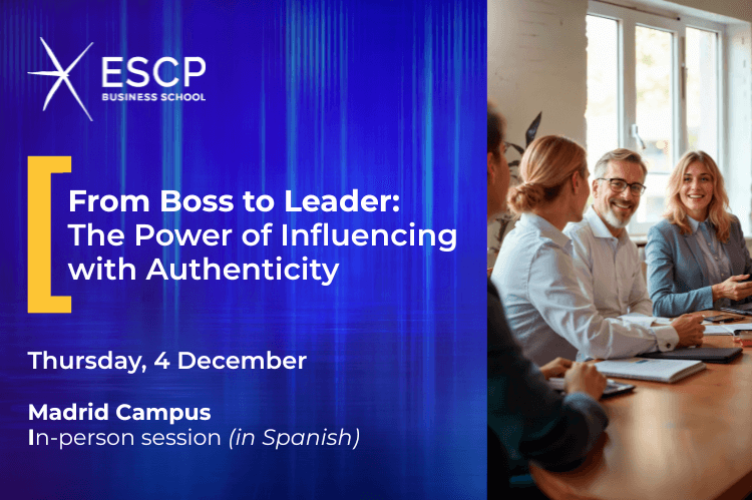
From Boss to Leader: The Power of Influencing with Authenticity
Join us for an inspiring on-campus masterclass in Madrid: “From Boss to Leader: The Power of Influencing with Authenticity.” This session is designed for professionals who want to reflect on their leadership style, gain new perspectives, and explore how to lead with greater impact and coherence.
The masterclass will be held in Spanish and will take place in person at our ESCP Business School Madrid Campus.
During the session, Marta Carballal, an ESCP professor and leadership expert, will explore how leadership is evolving and what it means to influence others from a position of authenticity.
We will also host a special panel discussion with Executive MBA (EMBA) alumni Jorge Colom, who will share his personal experience and open a rich debate on leadership, career evolution, and real-life challenges in management roles.
Places are strictly limited to ensure an exclusive format and meaningful interaction among participants.
Location
Organiser: Madrid Campus
Madrid - Spain
MapDate
Start date: 04/12/2025
Start time: 9:30 AM
End date: 06/12/2025
End time: 12:00 PM

Berlin Research News
New Bertelsmann Foundation study highlights pathways to resilient and sustainable business models
A new study by the Bertelsmann Foundation, authored by Professor Florian Lüdeke-Freund, Academic Director of the Master in Impact Entrepreneurship at ESCP Business School, sheds light on how German companies can strengthen their competitiveness and resilience amid ongoing global challenges.
Published in November 2025 under the title “Competitiveness and Resilience Despite the Crisis – Future-Proofing German Business Models”, the study explores strategies for companies to navigate a time marked by geopolitical tensions, environmental crises and rapid technological transformation.
The research introduces the concept of a “triple dividend” – combining competitiveness, resilience and sustainability – as a new guiding goal for future-proof business models. Data show that companies integrating sustainability into their strategic and operational frameworks are better equipped to adapt and succeed in turbulent environments.
Among the key findings:
- Around 60% of German companies have already made sustainability a central driver of change in their business models.
- Companies that align competitiveness with sustainability demonstrate higher resilience both now and in the face of future challenges.
- Four core capabilities – proactive stakeholder management, openness to learning, constructive interpretation of sustainability developments, and innovation driven by sustainability motivation – are critical to achieving this “triple dividend.”
The study calls for decisive action from both business leaders and policymakers. While companies should proactively shape their own transformation, political frameworks must support innovation and investment in sustainable business models.
Professor Lüdeke-Freund emphasises: “If German companies succeed in activating their transformation potential, the economy can emerge from today’s multiple crises stronger, more resilient and more sustainable.”
This research underlines the core principles taught in ESCP’s Master in Impact Entrepreneurship, which equips future leaders with the tools to create innovative, sustainable and resilient ventures.
The full study, published by the Bertelsmann Foundation, is available here (ENGLISH) and here (GERMAN).
Campuses
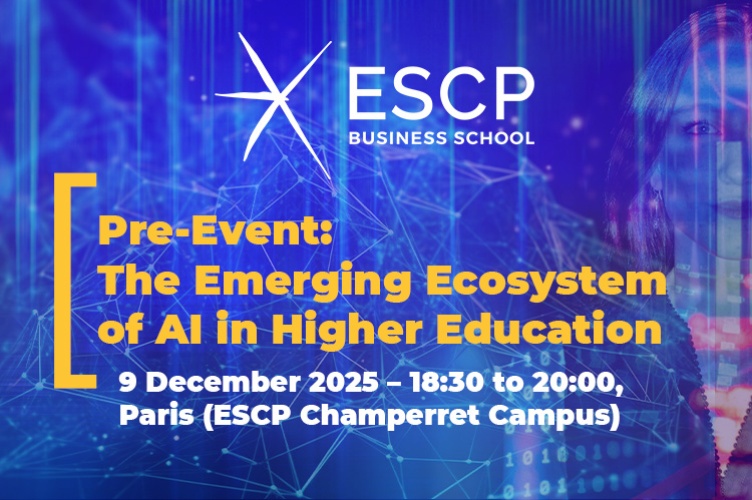
As artificial intelligence reshapes the foundations of teaching, research, and institutional strategy, new collaborations are forming across academia, startups, and investors.
This pre-event roundtable — The Emerging Ecosystem of AI in Higher Education — will explore how these actors are co-creating the next generation of learning environments and digital infrastructures. Featuring perspectives from business education, AI transformation experts and venture investment, the discussion will highlight the opportunities and challenges of building a sustainable and innovative AI ecosystem for universities.
This event is organised by ESCP TechInstitute in the context of the future AI in Higher Education summit organised in March 2026.
Join this event
Location
Organiser: ESCP Business School
Paris - France
MapDate
Start date: 09/12/2025
Start time: 6:30 PM
End time: 8:00 PM