
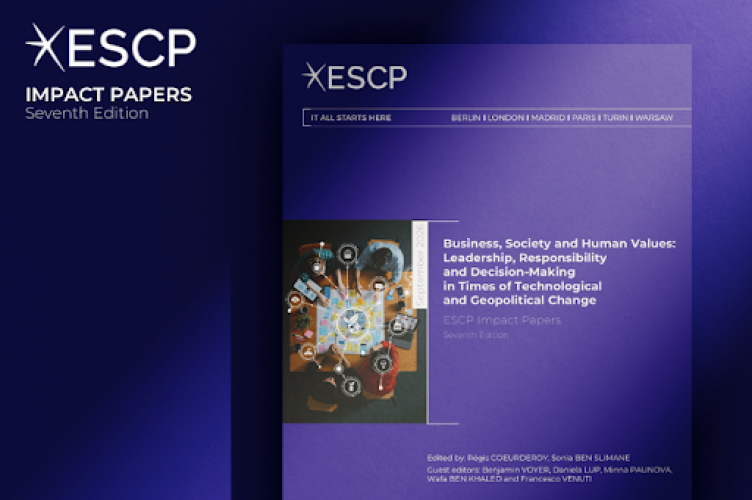
The 7th edition of the ESCP Impact Papers explores how organisations can make responsible decisions amid technological and geopolitical change.
Artificial intelligence can now perform work that until recently required years of training. Companies are reconsidering where they produce, as supply chains become entangled with geopolitics. New medicines can be designed for a single patient, even as the economics of healthcare struggle to accommodate them. And the low-carbon transition is forcing governments and businesses to revisit assumptions about growth, competitiveness and responsibility.
These developments are usually discussed separately. The seventh edition of the ESCP Impact Papers considers what they mean for the decisions organisations are making today.
Published by the ESCP Research Institute of Management (ERIM), this year's edition brings together 54 Impact Papers under the theme Business, Society and Human Values: Leadership, Responsibility and Decision-Making in Times of Technological and Geopolitical Change. The contributions span ESCP's six LIGHTS research pillars — Leadership, Innovation & Entrepreneurship, Geopolitics, Humanities, Technology and Sustainability — and draw on research from across the School's disciplines and campuses.
We bring together voices from across disciplines and sectors to explore how technology can shape, rather than simply disrupt, our global landscape. This is not about innovation for innovation’s sake. It is about uniting human, creative, and technological intelligence to forge businesses and societies that are genuinely resilient, ethical, and inspiring.
 Thomas Jeanjean
Executive President and Dean of ESCP Business School
When technology changes the decision, what happens to judgement?
Artificial intelligence runs through much of the edition. Several contributions focus on what happens as it becomes embedded in everyday organisational practice.
Louis Declee and Ghislain Deslandes ask what organisations risk losing when cognitive work is progressively delegated to machines. Their argument advances an idea that firms need to preserve the practices through which people learn to exercise judgement. If AI replaces apprenticeship, deliberation and the experience of working through difficult problems, an organisation may become more efficient while weakening its own capacity to produce and renew knowledge.
Other researchers put AI's promised gains under scrutiny. Houman Khajehpour and Gonçalo Pina compare human, AI-generated and human-AI work on the same analytical task, including the time required to correct AI output. Pedro Masi, Hao Zhong, Yuanyang Liu and Chuanren Liu examine whether companies benefit when they follow competitors in acquiring AI skills. And Lorena Blasco-Arcas and Hsin-Hsuan Meg Lee ask whether effective AI governance requires organisations to make deliberate room for doubt.
The questions extend well beyond what AI can do. They concern what organisations choose to delegate, what they need to preserve and how those choices affect the people working within them.
When business decisions become geopolitical decisions
The changing relationship between companies and states forms another thread through the edition. Ziqiao Wang and Marc Oberhauser examine companies controlling critical technological infrastructure, including semiconductors, cloud access and software, as governments increasingly use these systems to exert geopolitical pressure. Companies such as Nvidia, ASML and TSMC can become part of the machinery through which geopolitical policy is implemented, while retaining important choices over the timing, scope and sequencing of that implementation.
Fabienne Fel looks at the same changing environment from the perspective of production. Her study of 81 French companies that brought production back to France finds that reshoring remains targeted and partial. What has changed are the motivations behind it. Since the pandemic, supply security, geopolitical instability and fears of industrial dependence have gained importance alongside cost, quality and production control.
Elsewhere, contributors examine wartime fiscal policy in Ukraine, China's growing role in global drug development, Europe's difficulty scaling health-AI innovation and the growing importance of diplomacy in international management.
When innovation moves faster than the systems around it
Some of the edition's most striking questions arise when technological possibilities collide with institutions designed for a different reality.
Nicolas Roby and Frédéric Jallat examine N-of-1 therapies: medicines designed for a single person's genetic mutation. Such treatments can now be developed in months. Yet drug development, venture capital, insurance and reimbursement all assume that a medicine will ultimately have a market. What happens when that market consists of one person? Individualised treatments that have already been developed relied on philanthropic funding. The paper asks what kind of financing model could make this medicine available beyond a handful of exceptional cases.
Questions about existing assumptions also run through the edition's work on sustainability. Ivan Savin draws on survey evidence from more than 19,000 people across 13 European countries to examine the supposed conflict between economic growth and environmental protection. Nearly 60% of respondents hold pro-growth views, challenging the idea that Europeans necessarily see growth and the low-carbon transition as competing objectives.
Other contributions examine environmental policy and international competitiveness, renewable-energy storage, changing careers and the future of work. Erwan Lamy, for example, asks what becomes of the relationship between employment, social value and human dignity if AI substantially changes the role of human labour.
Research for decisions that do not have simple answers
Impact Papers were created to bring academic thinking into closer contact with the questions facing business and society. Seven editions on, they remain a space in which researchers can bring evidence, ideas and different disciplinary perspectives to debates still taking shape.
The questions in this year's edition do not lend themselves to a single prescription. They ask how organisations can use AI without losing capabilities they still need; how companies should operate when economic dependencies become geopolitical ones;
how institutions can adapt to forms of innovation they were not designed for; and how established assumptions about work, growth and responsibility hold up under changing conditions.
These are questions already shaping decisions in companies, governments and societies. The seventh edition of the ESCP Impact Papers offers 54 ways into them.
Campuses