
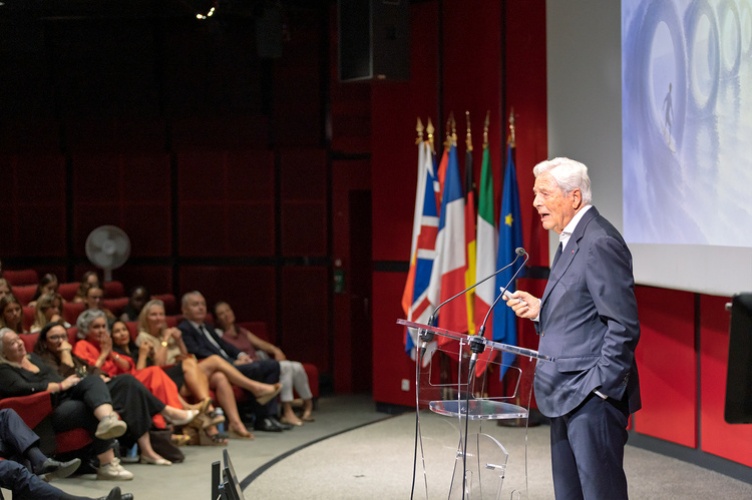
As the new academic year begins, ESCP Board Chairman Philippe Houzé draws on decades of experience in business to share nine principles on ambition, adaptability, decision-making, and responsible leadership.
Setting the tone for the new academic year, Philippe Houzé, Chairman of the ESCP Board of Directors and Executive Chairman of the Galeries Lafayette group, distils his experience as an entrepreneur and business leader into what he calls his “Entrepreneurial Credo”: nine principles for building a career, leading, and making difficult choices.
His advice ranges from learning to live with uncertainty to keeping ego under control. Running through it is a larger idea: leadership requires ambition, strong judgement, adaptability and a clear sense of what you stand for.
Set yourself ambitious goals
“In your projects, businesses and ambitions, always choose the steepest north face.”
The harder route, Houzé argues, is where resilience is built. Careers rarely progress smoothly, and setbacks are part of learning how to recover and continue.
“Along the way, you will discover resilience. It is something we have learnt to develop through one crisis after another.”
For Houzé, ambition therefore comes with an acceptance that reaching difficult goals will involve failure along the way.
Learn by doing
“You cannot learn to swim by staying on the beach.”
Houzé’s second principle is about putting knowledge into practice. Take opportunities, test ideas and accept the possibility of getting things wrong.
“Whenever the opportunity arises, you have to be prepared to get wet, get your hands dirty, put your feet in the mud and keep your head in the stars.”
He applied the same principle to artificial intelligence. Students should learn to use AI well, he argues, while remaining responsible for the judgement behind their work.
That means verifying facts and sources, questioning plausible answers and comparing different points of view. The value lies in knowing which questions to ask, which answers to challenge and how to defend your own conclusions.
Surround yourself with talented people
“Your positive advantage will come from the quality of the people around you.”
Good ideas may begin with one person, but Houzé argues that their success depends heavily on the people around them.
He sees this as part of a wider change in how organisations are led, away from “heroic leadership” and towards collective intelligence, cooperation and co-leadership.
Choosing talented people also requires self-confidence. Strong leaders need to recognise what others can do better than they can and create the conditions for those strengths to contribute.
Learn to navigate constant change
“More than ever today, you need to know how to surf the waves of change.”
When Houzé became Managing Director of Monoprix, he rallied his teams around a simple message: “Change has become our only constant.”
Geopolitics, environmental transition and changing supply chains are among the forces making adaptability increasingly important for businesses. For students beginning careers that may span several decades, Houzé’s advice is to remain curious and commit to lifelong learning.
Choose the right business model – and change it when necessary
“Invest in the right business model.”
For aspiring entrepreneurs, having an idea is only the beginning. Houzé’s test is whether you can explain why the business model behind it has a sustainable competitive advantage.
“You should always be able to explain your sustainable competitive advantage to anyone.”
That applies whether the model is low-cost, premium, digital or physical, and beyond retail to sectors such as finance and technology.
And if the model stops working, change it.
Make your own luck
“Luck never happens by chance.”
Houzé is sceptical about luck. He instead draws a distinction between how people respond when things go wrong.
“The pessimist tries, fails and says: ‘I was unlucky.’ The optimist tries, fails, tries again and eventually succeeds – and says: ‘I was lucky.’”
His point is persistence. The early careers of successful entrepreneurs are rarely straightforward, and what eventually looks like luck may have repeated attempts behind it.
Let ego be the engine, not the steering wheel
“Your ego should remain the engine. It must never become the steering wheel.”
Houzé does not argue that leaders should have no ego. Quite the opposite: he sees it as an important source of entrepreneurial energy.
The problem is what happens when it begins making the decisions.
Ambition and self-belief can provide the confidence to compete, build and take risks. Repeated success, however, can turn confidence into hubris.
Knowing the difference is part of leading well.
Know how to doubt – and still decide
“It is very important to know how to doubt a little, but always to decide.”
Houzé does not see doubt as a weakness. The problem is allowing it to prevent action.
Leaders will often have to act without perfect information. Houzé’s answer is to question assumptions, make a choice and then learn from what happens.
He describes leadership as requiring qualities that can appear contradictory: being disruptive but pragmatic, inspiring but discreet, confident enough to decide and humble enough to reconsider.
Balance business success with responsibility
“Create value without betraying your values.”
Houzé’s ninth principle puts responsibility at the centre of business.
A company exists to create wealth, he argues, but its responsibilities extend beyond its shareholders. Employees, customers, suppliers, investors, communities and the places in which companies operate all form part of the picture.
For future leaders, that means considering not only the value their decisions create, but also how that value is created and who is affected.
Houzé also encouraged students to put ESCP’s IDEM values – Inclusion, Diversity, Excellence and Merit – into practice during their time at the School and beyond.
Leadership starts with the choices you make
“From this moment on, you are the managers and leaders of your own personal enterprise.”
Houzé concludes by turning his entrepreneurial credo back on our students themselves. For their own “Me Inc.”, he encourages students to take risks, innovate and put their ambitions into practice. ESCP, he suggests, gives them plenty of opportunities to start: through their studies, international experiences, student societies, projects and the relationships they build with others.
His final challenge brings many of his nine principles together: push your talent further, believe in yourself, but retain the humility to keep learning.
Related link
Explore more stories and perspectives on leadership and careers from across the ESCP community:
Campuses