
Rethinking the future of work
At a time when artificial intelligence is reshaping how work is done, Professor Jochem Kroezen and Professor Chiara Succi explore what traditional craftsmanship can teach future managers about human expertise, judgment, and innovation.
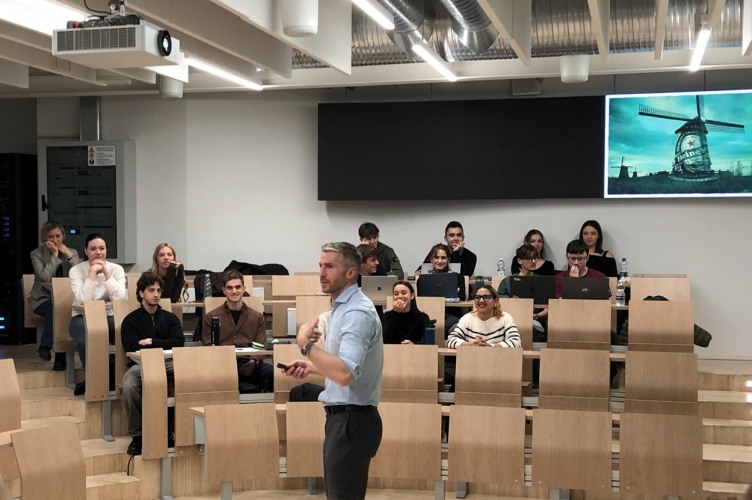
What can traditional craftsmanship teach us about work and management at a moment of profound technological change? This question was at the centre of a guest lecture by Jochem Kroezen, Associate Professor in Organisation Theory at Rotterdam School of Management, Erasmus University, at ESCP Turin Campus. Invited by Professor Chiara Succi to her Human Resources Management course, Kroezen engaged Master in Management (MiM) students in a challenge exploring how craft-based practices can offer new perspectives on management and the future of work.
What craftsmanship reveals about the future of work
Debates about the future of work are increasingly framed by the capabilities of artificial intelligence and by forecasts of which professions will be transformed or replaced. These debates tend to ask what machines can do, and less often what work actually involves. For Jochem Kroezen, craftsmanship offers a different starting point. His research explores how craft practices, often associated with traditional trades, can help us better understand expertise, professional judgement and organisational change.
During his guest lecture at ESCP Turin Campus, Kroezen invited students to look beyond narratives of automation and to consider the human dimensions of work that these narratives tend to overlook.
What is the most important lesson craftsmanship can teach today's managers?
"For me, craft provides a useful alternative lens on work and expertise. It helps us to observe and recognise where work is necessarily dependent on human touch and uniquely human forms of expertise.
Craft draws attention to how humans develop embodied expertise and judgement based on sustained, sensory interaction with the materiality of work.
Using craft as a lens allows us to reflect on how occupations may evolve in the age of artificial intelligence. For instance, if we look more closely at occupations that are often cited as examples of work that will disappear as a result of AI, such as radiologists or mathematicians, we see that, for the time being, these predictions are not panning out.
That is because we tend to underestimate the degree to which such occupations involve tasks that rely on other forms of expertise beyond the formal expertise on which we can train AI models.
The question is ultimately to what degree we, as a society, recognise this and act accordingly. For managers, it is therefore important to understand how work in their organisation depends on specifically human forms of expertise."
Judgement in an age of abundant output
As AI tools make competent output easier to produce, the critical question shifts from who can perform a task to who can tell when it has been done well. Kroezen argues that in this context, the ability to recognise quality and exercise informed judgement become a key source of professional distinction.
Learning from the workshop
"As AI may raise the floor of performance in the workplace, in the sense that it becomes easier for anyone to perform a task at a productive level, I believe that it is not digital or AI skills that will provide a source of distinction in the workplace, but precisely the uniquely human craft skills.
If anything, it becomes even more difficult to discern quality as we will be flooded by machine-powered outputs. Those who have trained judgement, built from material experiences, will stand out when making critical decisions."
How traditional craftsmanship can inspire innovation
Craftsmanship is often associated with manual skills and traditional workshops. Yet the principles behind craft practice can also offer a way to reconsider how people work, learn and innovate within organisations.
How can traditional craftsmanship inspire new approaches to innovation and organisational change?
"I think that by looking at what we can call 'traditional craftsmanship', we can encounter craft in a purer form. While craft is arguably part of any occupational field, it is often difficult to observe or appreciate. In a traditional craft workshop, we can vividly observe what craft practice truly entails and think metaphorically about how we could adopt similar approaches or practices in our own work context.
As such, through the example of traditional craft, we could reimagine our own work or our own organisation, find new sources of meaning and recognise previously underappreciated skill sets that are ultimately drivers of excellence and innovation."
Bringing craftsmanship into management education at ESCP
The connection between craftsmanship and management is also being explored through a collaboration between Jochem Kroezen and Chiara Succi, Professor at ESCP Business School.
Within Succi's Human Resources Management course, Kroezen and Bianca Nobili have contributed to a learning experience that challenges Master in Management students to observe traditional craftsmanship in real-world settings and reflect on its relevance to their future careers.
The initiative also provides a basis for academic research into how craft-based approaches can be incorporated into management education.
How are you exploring craftsmanship in your joint research with Professor Chiara Succi?
"The idea that management should be taught as a craft rather than a science has been around for decades. Mintzberg famously introduced the idea that strategy-making is best approached as a craft, just like pottery. This has real implications for how we teach business.
Mintzberg and related ideas are now being rediscovered as scholars suggest how craft can draw attention to practices and principles that are important for management in an age of major societal transitions.
However, we lack developed examples of how we can actually challenge our aspiring managers to develop themselves as managerial craftspersons.
Together with Bianca Nobili, I have contributed to Professor Succi's Human Resources Management class, where students are challenged to encounter and observe traditional craft in the real world and then reflect on what lessons they can take with them for their own work and careers. We are now working on a paper to be published in a management education journal, as well as a possible teaching case study."
Shaping technological change, not just adapting to it
For students entering a world of work undergoing several transitions at once, of which AI is among the most visible, understanding technology is only one part of their management education.
Kroezen believes that business schools have a responsibility to offer students multiple ways of interpreting technological and societal change, giving them the opportunity to develop their own perspectives on the future of work.
How can business schools help students apply the lessons of craftsmanship?
"It is key that business schools offer students a range of lenses to understand the significant societal transitions that we are dealing with at the moment, including the AI transition.
It is important that business schools give our students the space to encounter and critically reflect on alternative perspectives and then figure out how they would like to relate to these transitions.
Craft provides one such powerful perspective that can be contrasted with other perspectives that are more technology-centric. I hope business schools help students recognise that how AI is embedded in society is up to how we humans choose to design it and implement it.
The future is not set in stone but handmade."
Learning to manage in a changing world
Through guest lectures, applied challenges and research collaborations, ESCP encourages students to question established management practices and engage with emerging ideas. The collaboration between Jochem Kroezen and Chiara Succi shows how learning from traditional craftsmanship can help future managers recognise the enduring value of human expertise and approach technological change with judgement rather than determinism.
Campuses
Related stories
Event 14/12/2026
Join the webinar
Beyond the Classroom: Your Career After an ESCP Specialised Master
Join the webibar to discover career opportunities after an ESCP Specialised Master in Luxury Management or Food & Beverage Management. Meet ESCP Careers and a company recruiter to explore career paths, industries and roles in Italy and abroad.
Turin
News 11/11/2026
Careers event
ESCP Hackathon 2026: AI × Impact in Turin
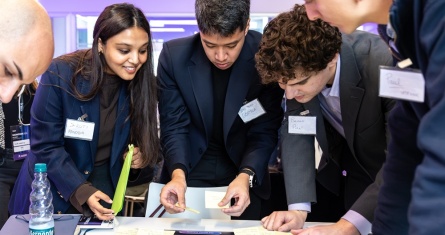
120 ESCP students joined the 2026 Hackathon in Turin to explore AI × Impact, develop innovative solutions and work alongside leading companies.
Turin