
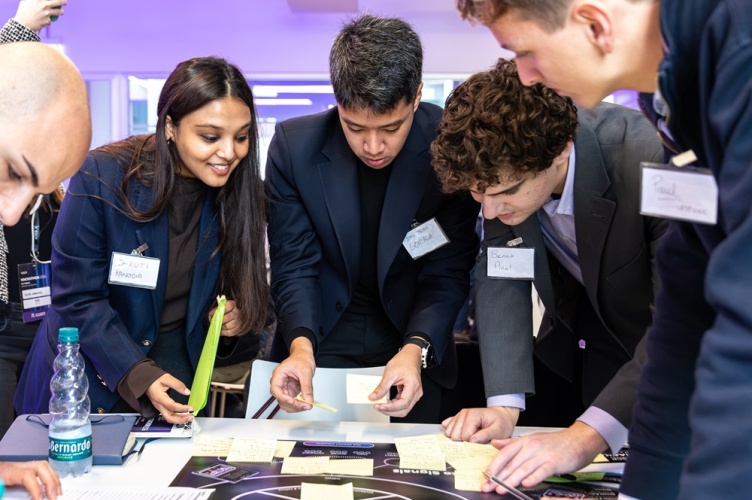
The seventh edition welcomed 120 students to explore how artificial intelligence could transform business and society, working alongside leading companies to develop solutions with potential real-world impact.
On 9 November 2026, 120 ESCP students gathered at the ESCP Turin Campus for the seventh edition of the ESCP Hackathon, an annual event organised by ESCP Careers. Under the theme “AI × Impact”, participants explored how artificial intelligence could influence the future of business and society. Working alongside corporate mentors, they developed innovative solutions to emerging challenges.
AI × Impact: exploring the future of business and society
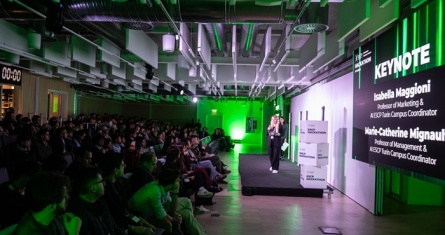
The ESCP Hackathon 2026 opened with a welcome speech by Alberta Di Giuli, Dean of ESCP Turin Campus, who officially launched the seventh edition of the event.
The opening session featured three guest speakers: Joe Pritchard (OpenAI), Camilla Brossa (CAIA Consulting) and Daniel Levis (Soraia, ESCP alumnus). They shared their perspectives on artificial intelligence, innovation and the challenges organisations face as AI becomes increasingly integrated into business activities.
This year's theme, AI × Impact, encouraged students to consider the broader implications of artificial intelligence for businesses, people and society.
Inspired by a hypothetical future in which AI advances faster than organisations and economies can adapt, the challenge invited participants to question existing business models, anticipate emerging needs and explore how technology could contribute to more desirable futures.
The focus was on identifying opportunities for AI to create value while addressing issues related to sustainability, inclusion, economic transformation and the future of work.
How 120 ESCP students tackled the AI × Impact challenge
Divided into teams, the 120 participating students worked side by side with corporate mentors throughout the day, combining their creativity and business knowledge with the experience of professionals from different industries.
Using a futures-thinking approach, teams explored possible AI-driven scenarios and developed prototypes responding to emerging business and societal needs. Their proposals considered how artificial intelligence could improve existing processes, create new business opportunities or address environmental and social challenges.
Corporate mentors supported students throughout the competition, helping them refine their ideas and assess their potential applications. HR professionals from participating companies also attended as observers, gaining first-hand insight into students' teamwork, problem-solving skills and approaches to innovation.
Impact was one of the five evaluation criteria, alongside presentation quality, futurability, desirability and innovativeness. Each proposal was assessed for its potential contribution to business, society and sustainability.
ESCP Hackathon 2026 winners: three innovative AI solutions
Three teams received awards for their ability to develop forward-looking solutions addressing different challenges in an AI-driven future.
Future Award: Pilot makes consulting more accessible
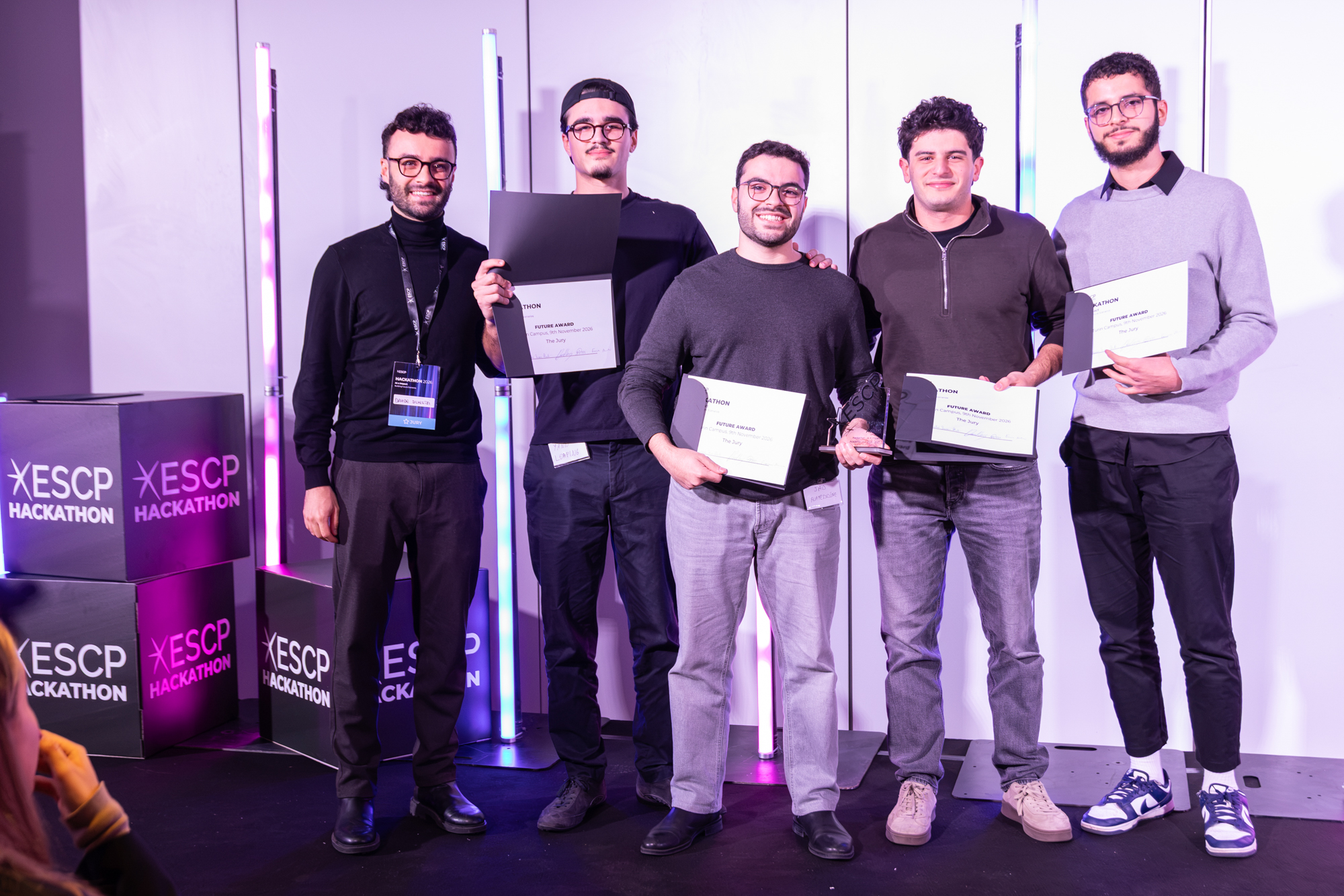
Team 3 – Pilot received the Future Award for reimagining how consulting services could operate in an AI-driven economy.
The team developed a platform prototype combining human consultants with specialised AI agents, proposing a model in which businesses pay for results rather than hours worked. The solution aims to make consulting more accessible to startups and small businesses by linking fees to the value delivered.
Winning students: Jad Alameddine, Hassan Gad, Emile Karam, Louay Kouteich and Yann Lorfing.
Impact Award: Mind The Hack reduces industrial waste
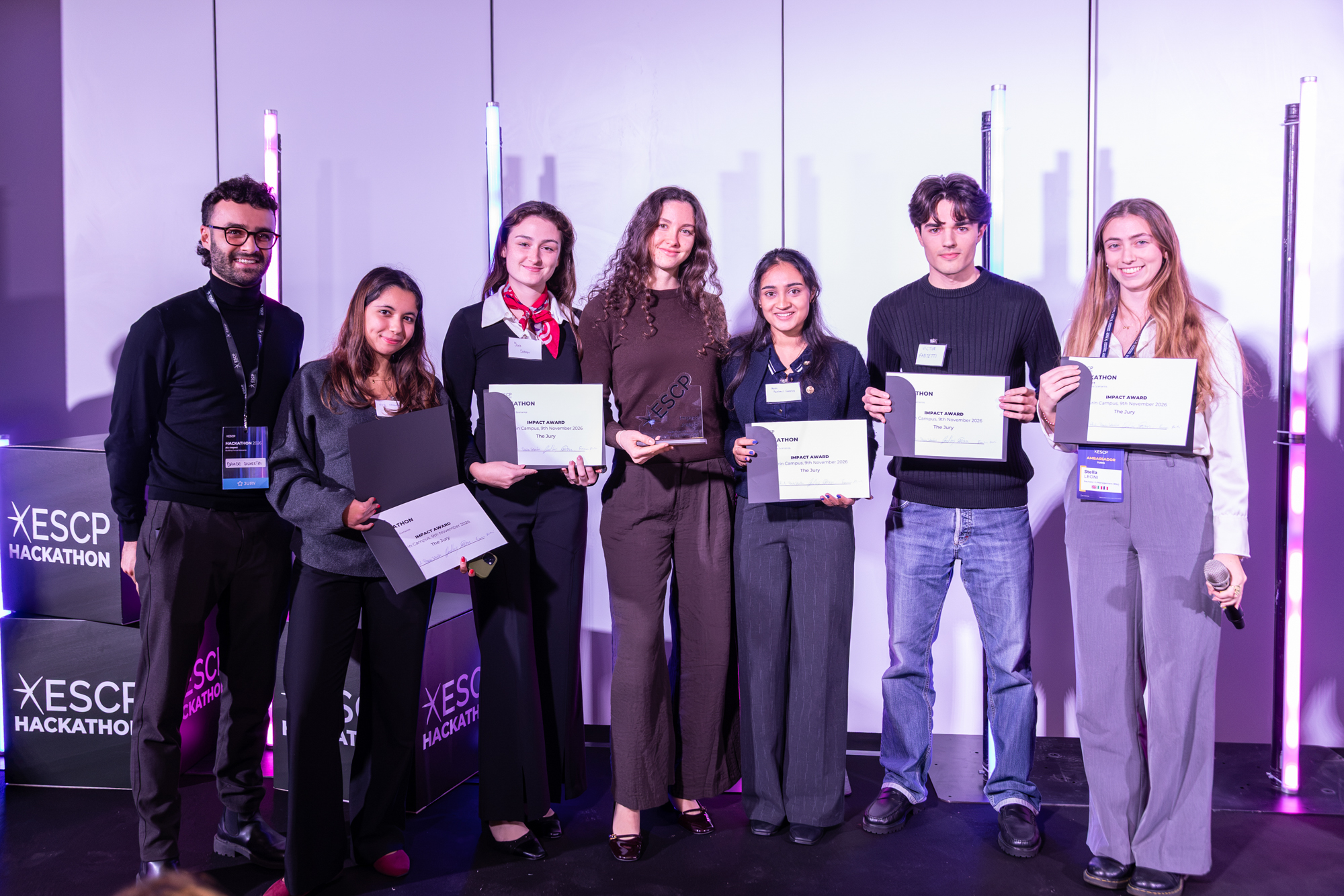
Team 8 – Mind The Hack won the Impact Award with DropWise, an AI-powered solution designed to improve the collection and regeneration of industrial lubricants.
The prototype combines smart collection stations with a digital application to monitor lubricant conditions and optimise collection processes. By supporting oil regeneration, the proposed system aims to reduce waste and emissions and contribute to more circular and resilient industrial supply chains.
Winning students: Aya Benomar, Saskia Bludzien, Victor Fantetti, Stella Leoni, Kashi Ramtohul Goreeba and Ysée Schops.
Innovation Award: Black Box develops AI-powered purchasing
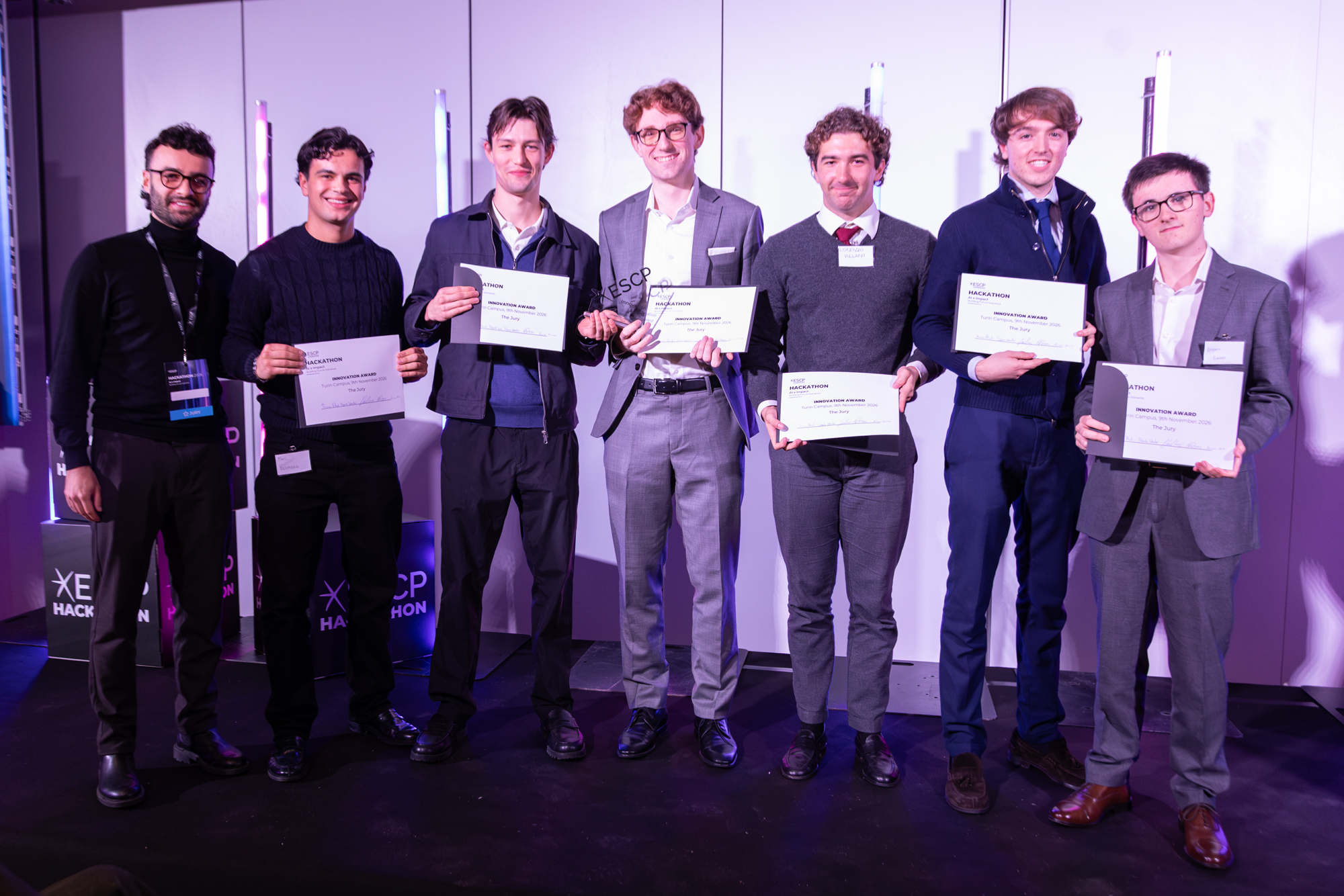
Team 12 – Black Box received the Innovation Award for exploring how AI agents could make purchases on behalf of users while maintaining human oversight.
The team developed a prototype framework allowing AI agents to operate within predefined budgets, preferences and permissions. By integrating payment safeguards and traceable transactions, the concept aims to simplify purchasing while keeping users in control of their spending. It also explores how businesses could better understand aggregate customer demand.
Winning students: Samuel Barta, Paolo Cotto, Nicolai Kauss, Benjamin Roederer, Lorenzo Villani and Marc Weismann.
The three winning teams will have the opportunity to take part in an exclusive company visit to KPMG, gaining first-hand insights into the firm's activities and professional environment.
The projects were evaluated by a jury comprising Francesca Pucciarelli, Associate Professor of Marketing and MBA Academic Director at ESCP Turin; Marie-Catherine Mignault, Assistant Professor of Management and AI Coordinator at ESCP Turin; Francesco Polacchi, Cyber Security Manager at Akkodis; and Davide Silvestri, Co-Founder & CTO at Soraia and ESCP Alumnus.
Career Mash-Up: networking with leading companies
Alongside the competition, the ESCP Hackathon offered students opportunities to interact directly with managers, recruiters and HR professionals from different industries.
In the afternoon, students, corporate mentors and HR representatives participated in Career Mash-Up, a structured networking session designed to encourage conversations and professional exchanges.
Participants used question cards to guide discussions, with each round lasting 10 minutes. At the end of each session, mentors moved to another table, allowing students to meet different professionals, share perspectives and learn about career opportunities.
The format gave students the chance to interact with company representatives beyond the competition and build on the relationships established throughout the day.
The 2026 edition welcomed representatives from AB InBev, Accenture, Amazon, Arthur D. Little, Bain & Company, BNP Paribas, Generali, Kearney, KPMG, Lavazza, Lazard, Nexi, Petronas, QSRP, TeamSystem, Textron and Venchi.
OpenAI, CAIA Consulting and Soraia also supported the event as technology sponsors.
ESCP Careers: the team behind the Hackathon
The seventh edition of the ESCP Hackathon was organised by ESCP Careers in Turin, with Erica Brignolo, Maria Turreno and Sofia Baldissera leading the project.
They were supported by Michela Caria, Camilla Pau, Marco Dell'Endice and Cassandra Mura, who contributed to the preparation and coordination of the event.
Special thanks also go to Alessandro Piperno, Adjunct Professor of Strategy, Entrepreneurship and Innovation at ESCP, and Silvia Bianchini, who developed the methodology underpinning the 2026 challenge and contributed to its organisation.
The event's rapid sell-out and the active participation of students throughout the day reflected the strong interest in practical learning experiences that connect academic knowledge with business challenges.
The ESCP Hackathon 2026 gave students the opportunity to explore how artificial intelligence could address emerging business and societal challenges. Working alongside corporate professionals, they developed prototypes with potential practical applications, gaining experience in evaluating how technological innovation could contribute to a more sustainable and inclusive future.
FAQ
What is the ESCP Hackathon?
The ESCP Hackathon is an annual student innovation event organised by ESCP Careers in Turin. Students work in teams alongside corporate mentors to address business challenges, develop innovative solutions and present their projects to a jury of academic and industry professionals.
What was the theme of the ESCP Hackathon 2026?
The theme of the seventh edition was “AI × Impact ”. Participants explored how artificial intelligence could transform business and society, developing prototypes with potential economic, social or environmental benefits.
How were teams evaluated?
Teams were evaluated by a jury of academic and industry professionals based on five criteria: presentation quality and clarity, futurability, desirability, innovativeness and impact. Particular attention was given to the potential of each solution to create positive impact on business, society and sustainability.
How do companies participate in the ESCP Hackathon?
Companies participate by providing corporate mentors who support student teams, HR professionals who observe the competition and representatives who join networking activities. The Career Mash-Up session offers students additional opportunities to interact directly with managers and recruiters from participating organisations.
How does the Hackathon support career development?
Students gained practical experience, exposure to recruiters, and access to real industry feedback — making it a career accelerator and learning opportunity.
Campuses
Related stories
News 17/12/2025
Careers Centre
ESCP Hackathon: AI edition challenges students to reshape customer experience
The ESCP Hackathon in Turin brought students and companies together to design high-impact AI solutions for the customer experience.
Turin
News 23/07/2025
Careers Centre
Linking Talent and Business: 2024–2025 Highlights in Turin
Explore ESCP Business School Careers Centre achievements at the Turin Campus for 2024–2025: mentorship programmes, career fairs, recruiting events, and strong corporate partnerships with 21 companies shaping global business leaders.
Turin