
Beware of Still Waters
See this page in:
 [FR]
[FR]
Moving corporate climate adaptation from reassurance to reliability
Corporate climate adaptation looks increasingly sophisticated. But are companies actually becoming more resilient?
Climate risks are increasingly integrated into corporate reporting, governance and risk assessment. Companies are producing more data, developing new processes and investing in sophisticated tools to understand their exposure.
On the surface, this looks reassuring.
But beneath it, physical climate risks are intensifying faster than our capacity to absorb them. Losses are rising. Insurance systems are coming under pressure. And the characteristics of climate change make some of the risks that matter most particularly difficult to anticipate, quantify and manage.
The challenge for companies is no longer simply to demonstrate preparedness. It is to become genuinely reliable under increasingly unstable conditions.
Beware of Still Waters examines the gap between apparent preparedness and actual resilience, and identifies the organizational capabilities companies need to manage physical climate risk under conditions of growing uncertainty.
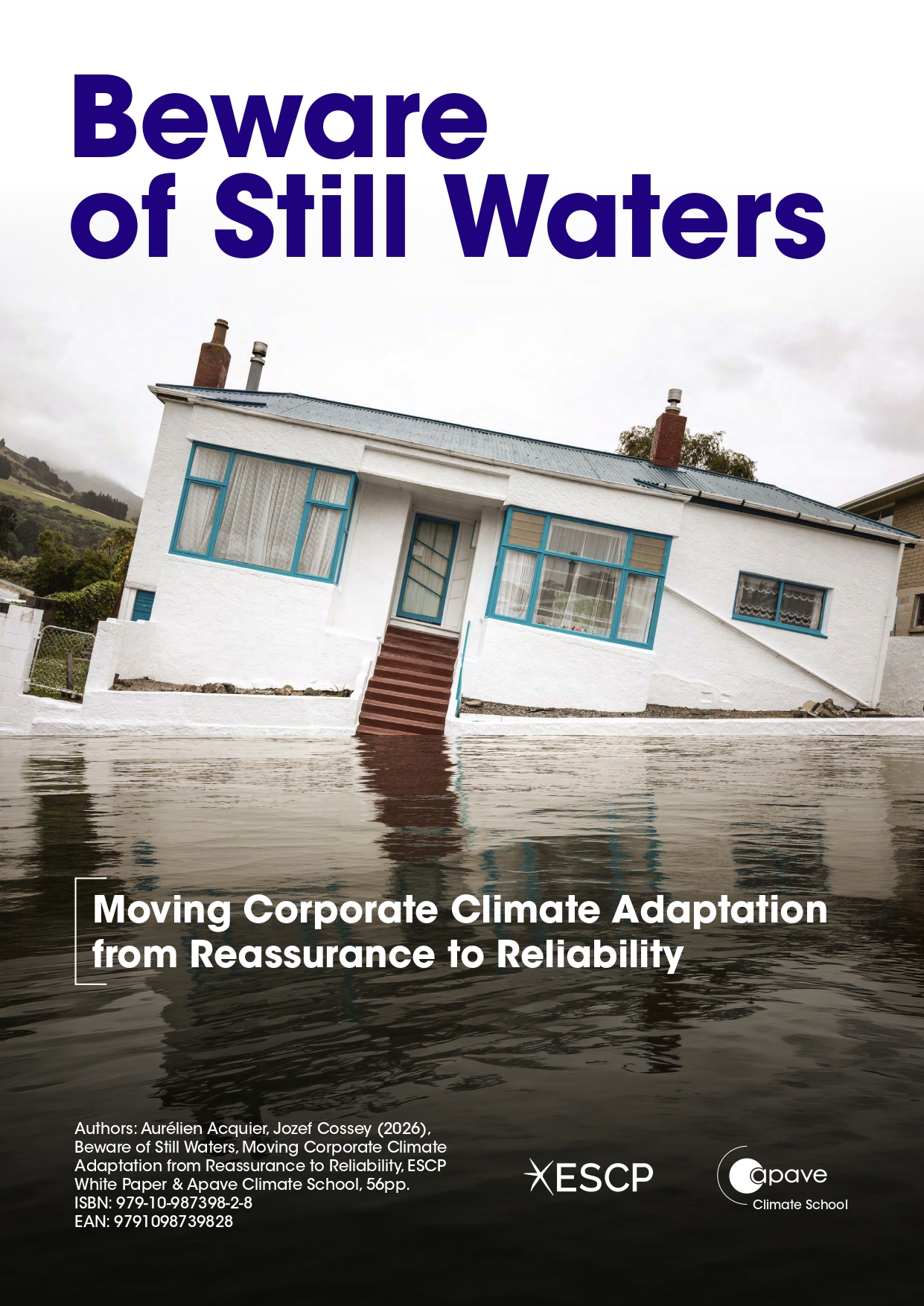
Companies are stepping up…
Physical risk is accelerating faster.
Over the past decade, climate risk assessment has become standard practice among large companies. Yet the financial consequences of physical climate change are rising faster than societies’ capacity to absorb them.
98%
of CAC 40 companies voluntarily report climate-related information to CDP
$1.5T
in annual physical climate costs projected for the world’s largest companies by the 2050s
×2
Natural catastrophe losses are growing more than twice as fast as the global economy
Climate change is pushing organizations beyond historical experience, while conventional tools favour what can be measured and managed. The result is a dangerous gap between appearing prepared and being prepared.
Beware of Still Waters examines how companies can close that gap.
The PUSH nature of climate risk
What makes climate adaptation so difficult?
Our research identifies four characteristics that distinguish physical climate risk from many conventional business risks.
P — Predetermined
Much of the climate change businesses will face over the coming decades is already locked in. Companies need to plan for continuing climate drift rather than assume a return to historical stability.
U — Unprecedented
The past is becoming a less reliable guide to the future. New extremes, thresholds and non-linear effects mean that organizations increasingly need to prepare for conditions they have never experienced before.
S — Systemic
Climate impacts do not stop at organizational boundaries. Disruptions propagate through suppliers, infrastructure, financial systems, customers and communities, making resilience a property of the wider systems on which companies depend.
H — Heterogeneous
There is no universal adaptation strategy. Climate risks and vulnerabilities differ across geographies, sectors, assets and organizations, requiring responses grounded in specific operational and ecological contexts.
PUSH creates an uncomfortable managerial reality: companies need to make consequential decisions about risks that are certain to intensify, but whose precise timing, magnitude and consequences often remain uncertain. .
This changes the question from “Can we predict exactly what will happen?” to “How do we build organizations that remain reliable across a range of possible futures?”
The future is uncertain.
Preparing for it cannot wait for certainty.
Read the full research, evidence, case studies and recommendations in:
Beware of Still Waters: Moving Corporate Climate Adaptation from Reassurance to Reliability
Download the reportAbout the research
Beware of Still Waters is based on a year-long action-research programme examining how businesses understand, organize and operationalize climate adaptation.
The research brought together seven multinational companies across banking, insurance, transport and retail, alongside 30+ interviews with corporate executives, climate experts and policymakers. It combines direct observation and collaborative workshops with analysis of corporate disclosures, academic research and datasets including the Carbon Disclosure Project.
The report is part of Programme Adaptation(s), a partnership between the ESCP Sustainability Institute, Apave Climate School and participating companies.

Aurélien Acquier
Professor of Sustainability at ESCP and Director of ESCP Sustainability Institute

Jozef Cossey
Assistant Professor of Sustainability at ESCP