
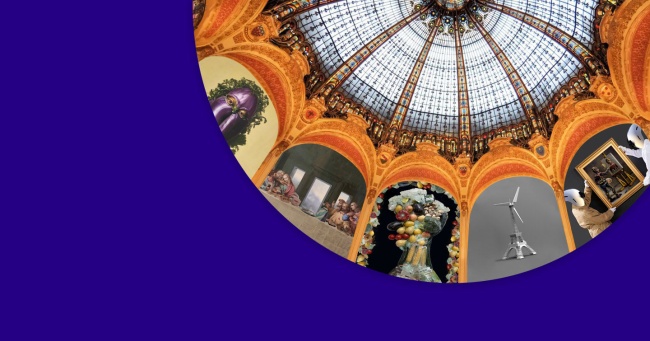
Improbable Chair by Galeries Lafayette
Improbable Chair by Galeries Lafayette Art Thinking
See this page in
 [FR]

The Improbable Chair by Galeries Lafayette is all about bringing together artists and entrepreneurs, linking art with business in a new way.
It supports creative practices by connecting artists with entrepreneurs, businesses with cultural institutions, and artistic creation with business strategy. It encourages everyone to embrace the "improbable" to think like creators. Through a unique method called "Art Thinking," developed at ESCP, the Galeries Lafayette group and ESCP offer a way to support, encourage, and spread the act of creation.

A few words from
Guillaume Houzé
Brand and Communications Director, Galeries Lafayette group
“The Improbable Chair is all about bringing together artists and entrepreneurs, linking art with business in a new way. It supports creative practices by connecting artists with entrepreneurs, businesses with cultural institutions, and artistic creation with business strategy. It encourages everyone to embrace the ‘improbable’ to think like creators. Through a unique method called ‘Art Thinking’, developed at ESCP, the Galeries Lafayette group and ESCP offer a way to support, encourage, and spread the act of creation.”
Guillaume Houzé, Brand and Communications Director, Galeries Lafayette group Photo Credit: ©Lucasziwel

A few words from
Sylvain Bureau
Professor at ESCP Business School
Scientific Director of the Improbable Chair
“Our initial belief was simple: to make creation accessible to as many people as possible. To achieve this, we developed a method called Art Thinking, which characterises how artists, entrepreneurs, and scientists go through similar steps in the creative process, such as gift-giving, deviating, destroying and drifting. For 15 years, our Art-Thinking seminars have trained thousands of students, entrepreneurs, managers, and researchers across a dozen countries and twenty universities and schools. Partnering with Galeries Lafayette group, a company with a strong entrepreneurial DNA, our chair combines theory and practice to amplify this approach and promote creators and creation in the broadest sense.”
Professor Sylvain Bureau, Scientific Director of the Improbable Chair
Objectives
The Chair has two major complementary goals:
- Support scientific research to better understand creative practices
- Teach the Art Thinking method and spread the Improbable pedagogy worldwide
Art Thinking not only helps participants unleash their innate creative potential; it also promotes collaboration, listening, leadership, negotiation, and constructive dialogue. Participants learn to question themselves, leverage failure, establish partnerships, and develop an agile approach to uncertainty.
Three areas of activity
- Scientific publications
- Doctoral theses and final dissertations
- Improbable Siesta: seminar bringing together researchers, artists, and experts in creation
- Spreading the Improbable method at ESCP and beyond
- Designing initial training in Art Thinking
- Training Art Thinking instructors
- Conferences and workshops on Art Thinking
- Exhibitions and Improbable openings
- Improbable residencies (artist/scientist/entrepreneur triads)
“This Chair is the story of an encounter between visionary creators who understood early on how future generations of students and entrepreneurs would need artistic and creative practices to prepare for the world of tomorrow. Through this collaboration, ESCP is grateful to the Galeries Lafayette group for opening up new playgrounds for unprecedented and improbable creations!”
Pascale Pernet, Director of chairs and corporate sponsorship
ppernet@escp.eu
Focus on...

Article
On Tuesday, 19th March 2024, Léon Laulusa, Dean and Executive President of ESCP, Jean-Stéphane Arcis, President of the ESCP Foundation, Philippe Houzé, Chairman of the Management Board of the Galeries Lafayette group, and Guillaume Houzé, Brand and Communications Director, Galeries Lafayette group, signed the first Chair dedicated to artistic and entrepreneurial creation.
Chapter
2011
Fonction ressources humaines
in La gestion des ressources humaines en devenir., DUPUICH F.(ed.), L'Harmattan, pp. pp. 157-181 25 p., 2011
Journal Article
2011
Forecasting the Spanish Economy with an Augmented DSGE-VAR
SPANISH ECONOMIC REVIEW, 2011
Journal Article
2011
Fratelli Carli : rimanere fedeli ai valori della famiglia nel processo di sviluppo prodotto
FAMILY OFFICE REVIEW, January 2011, vol. Vol. 26, n° 1, pp. pp. 74-79 6 p.
Journal Article
2011
Fratelli Carli: rimanere fedeli ai valori della famiglia nel processoi del sviluppo prodotto
FAMILY OFFICE REVIEW, 2011
Journal Article
2011
From joint ownership of firm-assets partnership: an analysis of the Italian legal system
IL NUOVO DIRITTO DELLE SOCIETA, 2011, pp. 39-46
Journal Article
2011
From long-term savings to instant mortgages: financial demonstrations and the role of interaction in markets
ORGANIZATION, 2011, vol. 18 (2), pp. 215-235
Book
2011
Fundamentals of management control
Pearson Education, Paris, 2011
Textbook
2011
Fundamentals of Management control: Techniques and principles
2011, Pearson Education
Book
2011
Fusions-acquisitions
Master, Paris, France, 2011
Journal Article
2011
Generalist or Specific studies for engineering entrepreneurs ? Comparison of French engineering students trajectories in two different curricula.
INTERNATIONAL JOURNAL OF ENTREPRENEURSHIP AND SMALL BUSINESS, 2011, vol. 18(2), pp. 366-383