
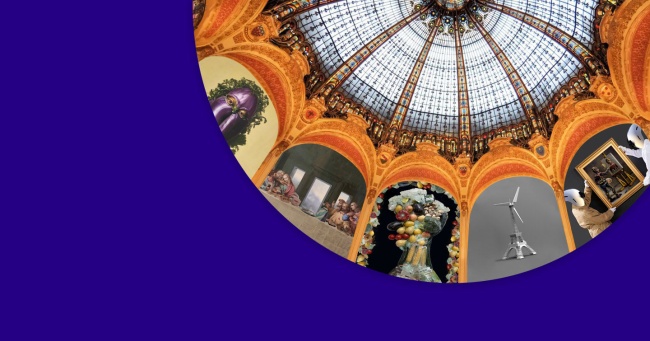
Improbable Chair by Galeries Lafayette
Improbable Chair by Galeries Lafayette Art Thinking
See this page in
 [FR]

The Improbable Chair by Galeries Lafayette is all about bringing together artists and entrepreneurs, linking art with business in a new way.
It supports creative practices by connecting artists with entrepreneurs, businesses with cultural institutions, and artistic creation with business strategy. It encourages everyone to embrace the "improbable" to think like creators. Through a unique method called "Art Thinking," developed at ESCP, the Galeries Lafayette group and ESCP offer a way to support, encourage, and spread the act of creation.

A few words from
Guillaume Houzé
Brand and Communications Director, Galeries Lafayette group
“The Improbable Chair is all about bringing together artists and entrepreneurs, linking art with business in a new way. It supports creative practices by connecting artists with entrepreneurs, businesses with cultural institutions, and artistic creation with business strategy. It encourages everyone to embrace the ‘improbable’ to think like creators. Through a unique method called ‘Art Thinking’, developed at ESCP, the Galeries Lafayette group and ESCP offer a way to support, encourage, and spread the act of creation.”
Guillaume Houzé, Brand and Communications Director, Galeries Lafayette group Photo Credit: ©Lucasziwel

A few words from
Sylvain Bureau
Professor at ESCP Business School
Scientific Director of the Improbable Chair
“Our initial belief was simple: to make creation accessible to as many people as possible. To achieve this, we developed a method called Art Thinking, which characterises how artists, entrepreneurs, and scientists go through similar steps in the creative process, such as gift-giving, deviating, destroying and drifting. For 15 years, our Art-Thinking seminars have trained thousands of students, entrepreneurs, managers, and researchers across a dozen countries and twenty universities and schools. Partnering with Galeries Lafayette group, a company with a strong entrepreneurial DNA, our chair combines theory and practice to amplify this approach and promote creators and creation in the broadest sense.”
Professor Sylvain Bureau, Scientific Director of the Improbable Chair
Objectives
The Chair has two major complementary goals:
- Support scientific research to better understand creative practices
- Teach the Art Thinking method and spread the Improbable pedagogy worldwide
Art Thinking not only helps participants unleash their innate creative potential; it also promotes collaboration, listening, leadership, negotiation, and constructive dialogue. Participants learn to question themselves, leverage failure, establish partnerships, and develop an agile approach to uncertainty.
Three areas of activity
- Scientific publications
- Doctoral theses and final dissertations
- Improbable Siesta: seminar bringing together researchers, artists, and experts in creation
- Spreading the Improbable method at ESCP and beyond
- Designing initial training in Art Thinking
- Training Art Thinking instructors
- Conferences and workshops on Art Thinking
- Exhibitions and Improbable openings
- Improbable residencies (artist/scientist/entrepreneur triads)
“This Chair is the story of an encounter between visionary creators who understood early on how future generations of students and entrepreneurs would need artistic and creative practices to prepare for the world of tomorrow. Through this collaboration, ESCP is grateful to the Galeries Lafayette group for opening up new playgrounds for unprecedented and improbable creations!”
Pascale Pernet, Director of chairs and corporate sponsorship
ppernet@escp.eu
Focus on...

Article
On Tuesday, 19th March 2024, Léon Laulusa, Dean and Executive President of ESCP, Jean-Stéphane Arcis, President of the ESCP Foundation, Philippe Houzé, Chairman of the Management Board of the Galeries Lafayette group, and Guillaume Houzé, Brand and Communications Director, Galeries Lafayette group, signed the first Chair dedicated to artistic and entrepreneurial creation.
Journal Article
2001
La place de l'Ecole dans l'économie en France
FUTURIBLES, September 2001, pp. pp 17-31 15 p
Textbook
2001
La Politique marketing du point de vente
2001, FNEGE, Paris, France
Paper presented in a Conference
2001
La prise en compte des menaces par les grandes entreprises dominante : revue de littérature et proposition d'un cadre théorique
in Actes de la 10e Conférence de l'AIMS, 2001, Québec
Paper presented in a Conference
2001
La prospective en distribution : pour un élargissement d'un cadre d'analyse hérité de la micro-économie dans une perspective dépassant la seule problématique du commerce avec ou sans magasins
in Actes de l' Atelier de prospective de la distribution, Conférence d'introduction, GVPI, IAE de Caen Basse-Normandie, 2001, Caen
Journal Article
2001
La Sentencia en el proceso laboral
CUADERNOS DE DERECHO PROCESAL LABORAL, 2001
Chapter
2001
La vente directe : Situation et perspectives
in Encyclopédie Vente et Distribution., BLOCH A., MACQUIN A. (eds), ECONOMICA, pp. pp 183-193 11 p, 2001
Book
2001
La Victoire de Luther
Biblioteca europea, Napoli, France, 2001
PhD Dissertation
2001
Le contrôle de gestion d'une organisation complexe : l'hôpital public. Une analyse par la théorie des conventions
2001, CNAM, France
Chapter
2001
Le management des ruptures technologiques
in L'Art du Management 2.0., Financial Times / Les Echos / Village Mondial, pp. pp 42-45 4 p, 2001
Chapter
2001
Le manager en action : les jugements et l'attention
in Perspectives en Management Stratégique - tome 7., DESREUMAUX A., MARCHESNAY M., PALPACUER F. (eds), Management et Société, 2001