

Many trends have changed, evolved, and accelerated during the lockdown. Not only has the working space been fully digitalised, but also our social life—at least for a while. Many felt the need to recreate social gatherings and share experiences to cope with loneliness, and a huge number of people started extending their life on digital spaces and videogames. These platforms are “helping to reshape how we connect in a future where social distancing might become the norm; video games offer a way for us to safely indulge our basic human need to connect.” (1)
Having a digital twin has never been more important and fashionable. It is not only a way to socialise in video games: it is a new way to express oneself. During the pandemic, a new version of Animal Crossing was released by Nintendo. In this game, players are allowed to craft their environments pixel by pixel, from outfits to home decor. Brands and stylists like Marc Jacobs, Prada, Valentino, GCDS and Jacquemus did not miss the chance to launch their collections and designs on Animal Crossing—and players loved it. This blend of gaming and fashion became so popular that photographer Kara Chung used Instagram to build the ‘Animal Crossing Fashion Archive’, quickly acquiring a huge following.(2) No matter the low definition of the garments or the small size of the avatars in the game, what truly matters is making sure that the positioning of fashion brands in people’s mind is still powerful and desired.
The video game industry is worth $120 billion a year, and is an undeniable part of global culture. It’s a world that stands on its own, and just like the real world: it has its own influencers and celebrities, better known as e-sports champions, that find a wide range of deals as brand ambassadors. “In late 2019, Louis Vuitton and Riot Games partnered on a capsule collection to be presented within League of Legends, an online championship which saw 100 million global e-spectators watch its finale last November. (…) More recently Gucci announced a partnership with Tennis Clash, allowing the brand’s vintage tennis logo to gain traction within the gaming world.” (1) Moschino partnered with EA sports to launch a collaboration on ‘The Sims’.
The phenomenon does not stop at creating branded digital garments, but also capsule collections and special pieces in collaboration with esports teams and champions. In a recent interview, Rekkles, one of the most famous e-sports champions worldwide, declared he is still amazed that Gucci asked to collaborate with him to design and promote a watch. For the first time in e-sports, a world-recognised brand wanted to collaborate and sponsor Rekkles’ team. He said:
“[It was] a very strange feeling, very surprising feeling, like I could very not believe that this was the case. And I told my parents about this, they were also very shocked, because it’s [an] organisation that they recognise [which] they don’t normally do when it comes to sponsors in the industry. So, it’s a very special brand, I would say, to be mentioned with.” (3)
Businesswise, considering video games as temporary entertainment is very risky because those platforms are used by millions of gamers and viewers. “The number of digital gamers in the U.S. between the ages of 25 to 34 is expected to grow from 49.3 million in 2015 to 49.6 million in 2021.” (5) Unexpectedly, the audience is heterogeneous too, varying from Gen Z to Millennials (and Boomers), and all genders.
The video games industry is a whole ecosystem with specific channels, codes and events. The lockdown clearly opened the door for a new type of performance. For instance, US rapper Travis Scott performed a live concert within the videogame ‘Fortnite’ in front of 12 million viewers. More than simply attending the show, players could also collect the artist’s avatar skin and play with his character wearing its customised pair of Nike Jordan 1s (5).
There is a huge business potential related to brand awareness, engagement with potential customers, and attracting new ones. Video games are not the only digital space or platform being currently implemented by businesses, but they are one of the most populated and the one that best resolves the basic human need to socialise and gather within meaningful communities.
REFERENCES
(1) In-Game Fashion (LS:N Global)
https://www-lsnglobal-com.revproxy.escpeurope.eu/big-ideas/article/25652/in-game-fashion
(2) Animal Crossing Fashion archive https://www.highsnobiety.com/p/animal-crossing-fashion-archive-interview/
(3) Rekkles (FNATIC e-sports team) interview
https://www.youtube.com/watch?v=ayQ7aXdQpRE
(4) Digital games in the U.S.
https://www-statista-com.revproxy.escpeurope.eu/study/29900/digital-games-in-the-us-statista-dmo-statista-dossier/
(5) Travis Scott Concert on Fortnite https://www.theguardian.com/games/2020/apr/24/travis-scott-concert-fortnite-more-than-12m-players-watch
Nicole is an MSc in Marketing & Creativity student. To follow in her footsteps, check out ESCP Business School's Marketing & Creativity programmes:
Campuses

During the health emergency brought on by Covid-19, we can observe unexpected practices and behaviours within organizations. The multiple obstacles people are facing to get their job done from home (e.g. physical distance, technological equipment, attention span, support to the community and family members, etc.) are forcing them to reinvent work activities significantly. In-depth reflection is needed to outline the managerial implications and key drivers of this phenomenon.
Despite huge human and financial losses, this crisis represents an opportunity to observe how people react to disruptive events and which capabilities are put in place, when forced out of their comfort zone. In fact, many skills have been developed by employees and managers in just a few weeks, while companies have been struggling to develop them in formal settings for years.
Associate Professor Chiara Succi, in the paper “Freedom & vulnerability: How people develop new skills in an unexpected work environment”, in particular focuses on the set of soft skills developed by people to face the many challenges on a personal, social and methodological level. Finally, conditions to sustain and perpetuate these efforts are described, such as work flexibility, agile teams and a learning culture.
This paper is part of the first series of impact papers produced by the school’s faculty on “Managing a Post-Covid19 Era”.
The ESCP Impact Papers are meant to help business and society following this unprecedented pandemic and aimed at providing insights into management knowledge that is applicable to not only practising managers, but also other stakeholders, namely the European community, students and society.
If you would like to find out more, please click here to our latest impact paper discussing the topic above in more depth.
Campuses
Related stories
News 02/06/2020
PUBLICATION
First impact papers meant to help business and society following this unprecedented pandemic
Pramuan Bunkanwanicha, Régis Coeurderoy and Sonia Ben Slimane introduce the very first series of impact papers produced by the school’s faculty on “Managing a Post-Covid19 Era”.
Berlin
London
Madrid
Paris
Turin
News 28/07/2020
Impact Paper
Two sides of the same coin: Why entrepreneurs can transform the crisis into business opportunities to create more impactful and long-lasting ventures
Professor Francesco Rattalino and Assistant Professor Alysa Sydow, authors of “Two-sides of the same coin: why entrepreneurs can transform the crisis into business opportunities to create more impactful and longlasting ventures”, explain why entrepreneurs can transform the COVID-19 crisis into business opportunities for long-lasting ventures.
Turin
News 06/08/2020
Impact Paper
Accounting Implications of the COVID-19 Outbreak for CFOs
Assistant Professor Francesco Venuti, and his co-authors Associate Professor Gladie Man Ching Lui and Associate Professor Paul Pronobis, in the paper “Accounting implications of the COVID-19 outbreak”, provides an overview of the major challenges CFOs face in the light of the current COVID-19 crisis when preparing their financial statements.
Turin

Call for Chapters: Digital Transformation and Disruption of Higher Education
Edition to be published by Cambridge University Press
Book editor: Andreas Kaplan
For some time now, (higher) education has been subject to a series of fundamental challenges, such as an increase in competition world-wide, a decrease in financial resources and (public) funding, as well as a more general questioning of its broader societal role and overall mission (Pucciarelli and Kaplan 2019; Kaplan 2014). In addition, higher education’s digital transformation is currently underway; some even speak of its digital disruption. Considering the acceleration of the sector’s digitalization due to the recent Covid-19 health crisis, this edited book intends to shed light on the digital transformation and potential disruption of higher education.
In 2012, the New York Times proclaimed the year of the MOOC (Massive Open Online Course; Kaplan 2017), explaining that online courses delivered on platforms such as Coursera, edX, and Udacity would disrupt the higher education sector (Kaplan and Haenlein 2016). So far, this has not been the case. Already back then, universities worldwide pointed to the fact that education requires far more than learning theoretical content, and referred to other activities like networking, certification, career service, and social events. Indeed, a decade ago, very few presumed that MOOCs could replace these aspects of higher education – but nobody said that they are not replaceable by other means, either. In particular, EdTech (educational technology) start-ups increasingly entered the landscape of higher education, augmenting and even replacing universities and schools in certain of the aforementioned areas.
Due to this digitalization, new teaching formats have arisen. Adaptive learning powered by artificial intelligence (AI) serves as one example. Program curricula and course content are influenced by society’s digital transformation and in consequence they may evolve toward the acquisition of competencies and skills (Kaplan 2018) as opposed to the learning of pure knowledge. The Internet has developed several ways to nurse one’s network outside of the university with, e.g., LinkedIn often said to have become any alumni association’s biggest competitor. EdTech companies are increasingly replacing universities in their role as career centres and first point-of-contact to potential employers, even challenging them in their role as sole provider of official degrees and certification bodies (Kaplan 2020). These are just some examples of how digitalization may transform, or even possibly disrupt, the higher education landscape.
This book’s intention is to bring together the analyses and insights of researchers and scientists worldwide, but practitioners are also more than welcomed as chapter authors. All types of contributions are considered, ranging from real-life case studies to best practices, conceptual papers, empirical studies, literature reviews, and the like. This book aims to analyse higher education's digital transformation from a holistic point of view and provide a balanced and critical account of the sector’s digitalization, emerging educational technology, its impact, opportunities as well as challenges, and to showcase a wide variety of opinions and viewpoints.
- Kaplan A. (2014) European Management and European Business Schools: Insights from the History of Business Schools, European Management Journal, 32(4), 529-534.
- Kaplan A. (2017) Academia Goes Social Media, MOOC, SPOC, SMOC, and SSOC: The digital transformation of Higher Education Institutions and Universities, in Bikramjit Rishi and Subir Bandyopadhyay (eds.), Contemporary Issues in Social Media Marketing, Routledge.
- Kaplan A. (2018) “A School is a Building that Has 4 Walls - with Tomorrow Inside”: Toward the Reinvention of the Business School, Business Horizons, 61(4), 599-608.
- Kaplan, A. (2020) Universities, Be Aware: Start-Ups Strip Away Your Glory; About EdTech’s potential take-over of the higher education sector; efmdglobal.org, May 11, 2020.
- Kaplan A., Haenlein M. (2016) Higher Education and the Digital Revolution: About MOOCs, SPOCs, Social Media and the Cookie Monster, Business Horizons, 59(4), 441-450.
- Pucciarelli F., Kaplan A. (2019) Competition in Higher Education, in Bang Nguyen, T C Melewar and Jane Hemsley-Brown (editors) Strategic Brand Management in Higher Education, Routledge, New York.
Tentative chapter outline:
(R)evolution of the higher education sector: In this book’s first part, chapters will give a general overview of higher education’s digitalization and the sector’s likely changes, which we will see over the next couple of years. Chapters can treat, e.g., the broader university landscape, the rise of EdTech companies, or also the increasing interest of venture capitalist in the higher education area.
Changes in teaching formats: In this section, chapters could treat advances in MOOCs, SPOCs (small private online courses), and further online formats. Moreover, several examples exist where EdTech helps to improve teaching. In the case of adaptive learning, e.g., EdTech has the potential to improve teaching directly: AI (artificial intelligence)-based online tools help to adapt the speed and level of teaching to a student’s progress. Such data, also referred to as “learning analytics,” can help professors to adjust even their offline teaching.
Changes in teaching content: Digital transformation has also had an impact on course content. Due to digitalization and advances in AI, it is quite unclear what knowledge and skills are demanded by the jobs of the future. Employees will have to show high adaptability and flexibility. How should higher education prepare students and executive education participants for this new reality? What should be taught in programs and courses? How should curricula be designed? These are questions to be potentially treated in this part of the book.
Networking and social activities: Often the best experiences at university turn on having found valuable contacts, friends, or, in some cases, a partner for life. These memories strongly influence students’ attachment to their alma mater. The Internet, however, provides more and more ways to nurse one’s network or find friends (and partners) outside of the university. Recently, specific higher education start-ups have entered higher education’s social perimeter. Chapters in this part could treat questions such as what this means for universities, if they should fight to stay as hubs for socializing activities, or how a higher education institution can provide networking possibilities when students come less and less to university and are pursuing their studies online.
Certification and diplomas: Traditional universities have been the sole providers of official degrees, which, in parts due to the sector’s digital transformation, has changed over time. Still, employers prefer to hire pre-selected students from specific universities, which display a certain profile and set of competencies. What if an EdTech company were able to pre-select students, too? Data is often proclaimed as the new oil, and EdTech companies have lots of data. Chapters in this section would analyse how far digital transformation has come in potentially changing certification and diploma delivery, how far it could go in the future, pushes for so-called micro-degrees, and lifelong learning possibilities.
Careers and professionalization: Within this part of the book, chapters should treat any professionalization services impacted by higher education’s digitalization. Recently, e.g., universities and especially business schools have started to outsource their career services to EdTech start-ups providing the same service to students. Based on their profiles, students are matched with potential employers. EdTech replaces universities in this aspect, which could be tricky since alumni are often most thankful for having found their dream job thanks to their alma mater.
Futuristic and ultramodern higher education: In this section, chapters could look at ultramodern higher education focusing on, e.g., adaptive learning technologies or pedagogical simulation games using 3D virtual reality headsets. Moreover, one could think of articles describing artificial intelligence technology using facial recognition software to observe students’ emotional states when listening to a lecture, studying, or writing an exam. This book’s last part is intended to give an outlook into higher education’s potential future.
Contributor guidelines:
If you are interested in contributing a book chapter, please send a two-pager with a proposal for your intended chapter to kaplan@escp.eu by October 31st, 2020. Each proposal will be reviewed along the following criteria: (1) Expected contribution, (2) clarity and feasibility, and (3) fit with the tentative chapter outline and further proposals submitted. You can expect a decision on whether you will be invited to submit a full chapter at the latest by November 15th, 2020.
In your chapter proposal, you should clearly state (1) the type of chapter you would like to write (e.g., case study; conceptual piece; empirical study; literature review; etc.), (2) where in the tentative chapter outline (see above) your work would fit best (e.g., changes in teaching content), and (3) what your contribution will be with respect to the edition’s intent.
If your proposal is accepted, your full chapter will be expected by February 28th, 2021. Chapters should be approximately 25-35 manuscript pages (all inclusive) and conform to APA style. All chapters will go through a review process upon final decision.
Intended readership includes the field’s research community, the leadership teams of universities and higher education institutions worldwide, investors and EdTech (educational technology) actors, teaching professionals and employees within the sector, but also the broader public interested in (higher) education’s future.
Important deadlines:
- Chapter proposals (2 pages maximum) by October 31st, 2020
- Full chapter submissions (25-35 pages) by February 28th, 2021
- Correspondence to Andreas Kaplan: kaplan@escp.eu
About the editor:
Andreas M. Kaplan has more than ten years of leadership experience in the higher education sector. He is currently Dean and Rector at ESCP Business School Berlin, a position elected by faculty, students, as well as staff representatives. Previously, he served as Provost and Dean for Academic Affairs in charge of approximately 6000 students and nearly 30 degree programs ranging from undergraduate, to Master and MBA, up to PhD programs.
Kaplan is particularly interested in the future of education as impacted by digital transformation and disruption, increased competition, and reduced (public) funding, and has published extensively in this area in academic as well as practitioner-oriented journals. Defining European management as “cross-cultural, societal management based on an interdisciplinary approach” and Europe as holding “maximum cultural diversity at minimal geographical distances,” Professor Kaplan is distinctly implicated in the European higher education landscape. He regularly acts as keynote speaker and presenter at conferences, workshops, and seminars.
European at heart, Kaplan did most of his studies and has spent his professional career alternating between France and Germany. Furthermore, he has lived and worked in Austria, Italy, Portugal, Spain, and the UK. Professor Kaplan obtained his Habilitation at the Sorbonne and his Doctorate at the University of Cologne. He holds an MPA from the École Nationale d'Administration (ENA, Class of République), an MSc from ESCP Business School, and a BSc from the Ludwig Maximilian University of Munich.
Campuses
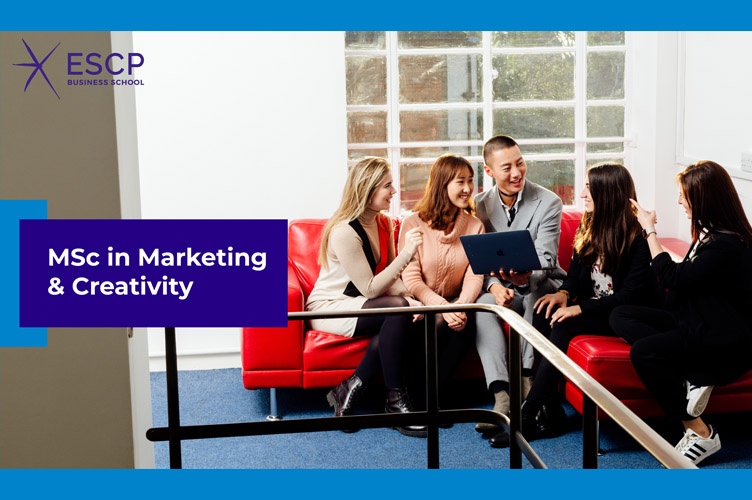
The MSc in Marketing & Creativity online information session is a great opportunity for you to learn more about the programme and discover how it may help achieve your career objectives.
Register your place now to discover:
- The unique curriculum and why it is particularly relevant to the current and, most importantly, future marketing job markets
- Projects students are working on throughout their four terms in London & Paris
- The key skills and competences you will obtain during this master
- The employment opportunities upon graduation
- What to expect on the admissions day and useful tips for your online application
- Information on fees and scholarships
Your questions are answered live by the Programme Co-Director and the recruitment team!
This event takes place on Tuesday 25th August at 4.30pm (BST). Register your place
Participants

Prof. Daniela Lup
Academic Co-Director

Viktorija Nikitina
Marketing & Recruitment Manager

Alberto Fanelli
Recruitment Executive
Location
Organiser: ESCP London Campus
Online - Worldwide
MapDate
Start date: 25/08/2020
Start time: 4:30 PM
End time: 5:30 PM
![© WeAreTheCity [copyright]](/sites/default/files/styles/event_news_une/public/2020-08/hashtag-social-media-lights.jpg)
Campuses
![© MIT Technology Review [copyright]](/sites/default/files/styles/event_news_une/public/2020-08/tse_MIT.jpg)
Campuses
![© theHRDIRECTOR [copyright]](/sites/default/files/styles/event_news_une/public/2020-08/home-office-5190504_1920.jpg)
Campuses
Campuses

On 13th March 2020, ESCP Business School’s London Campus temporarily closed its doors due to the COVID-19 crisis.
We were told that all our classes will be held online and no one knew for how long this would be. After two months of getting to know our fellow students on the MSc in Marketing & Creativity (MMK) and finally finding a rhythm to our “study and party” schedule, we were told that we may not be able to go back to campus until the Autumn semester.
Moving all our classes online was a challenge for both the students and ESCP; it required a whole other way of learning and teaching. Suddenly, we were all alone in our rooms, facing our laptops rather than in a lecture hall with our like-minded peers. The sudden change left us all feeling a sense of missing out on many opportunities.
One of my responsibilities as a student representative of the MMK is to work on enhancing the student experience. Before the pandemic outbreak, my fellow reps and I wanted to put together an MMK social event for everyone to get to know each other better. With the lockdown happening, we had to find new ways to socialise. What is more, as our online courses were progressing and the physical separation became more palpable, it became very clear that now more than ever we needed to find a way to connect and motivate our peers.
The first part of the programme is taught in London, where pub quiz nights are a must. One of our fellow classmates, Amina, pitched the idea of holding a virtual one and volunteered to be our quiz master. She put together a series of questions, which ranged from general knowledge to pop culture to marketing expertise, and the 62 MMK students were teamed by their project-work groups. The point was also to get to know the ESCP London Campus staff who coordinate our programme even better, so they also had a team of their own. We held the virtual pub quiz over Zoom and each team had to find another means of communication to confer. It was a great way to connect with everyone in a more relaxed setting. Unfortunately for the ESCP team, students won the quiz!
Another initiative by our colleague Elena was to organise a virtual tour of the Poldi Pezzoli museum in Milan, dubbed the ‘The MMK Art Party’. The event was meant to support the museum during the lockdown in Italy and help its mission to spread art and creativity all over the world. Using Google Arts and Culture Technology, a guide from the museum guided us through the different rooms, showing us the Pezzoli’s treasured collection such as the famous ‘Portrait of a Young Woman’ by Piero del Pollaiolo. It gave the students and the School another chance to come together virtually and enjoy some beautiful Italian art and history.
In the very first week of our programme, we learned about the importance of the co-creation of value. In a traditional sense, firms created value for their customers; however, nowadays companies are increasingly adopting the practice of co-creating value with their customers. This means that customers are more involved throughout a company’s value chain, which in return leads to more trust and loyalty.
I did not realise that we would be applying the learnings of our course on ourselves. By encouraging and challenging us students to always think creatively, ESCP enabled us to co-create value with them. Organising virtual get-togethers such as the pub quiz and museum tour reignited the MMK bond and helped students, staff and faculty to stay motivated.
This goes to show that the MSc in Marketing & Creativity goes beyond learning in a lecture hall to truly foster a community.
Stephanie Weinzierl is an MSc in Marketing & Creativity student. To follow in her footsteps, check out ESCP Business School's Marketing & Creativity programme:
Campuses
![© Reuters [copyright]](/sites/default/files/styles/event_news_une/public/2020-08/Troege_FT.jpg)
Campuses