
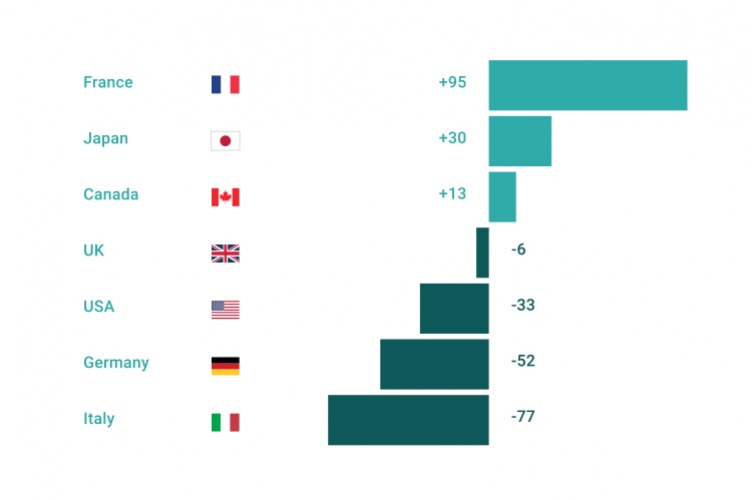
According to a new study by the European Center for Digital Competitiveness, France is the top digital riser while China gains significantly and the USA loses ground.
Digital incumbents increasingly face new and dynamic competitors from around the world. While countries such as the USA, Sweden and Singapore are often perceived as digital champions, a new study indicates that they are not necessarily dynamic “digital risers”. Only Singapore has managed to improve its relative position slightly over the past three years. In contrast, the USA and Sweden have actually lost ground over the same period. “We are in the middle of a digital revolution that is very likely being accelerated by the Covid-19 pandemic,” says ESCP Business School Professor Philip Meissner, who founded and runs the European Center for Digital Competitiveness.
Within the G7, France was able to advance the most in its relative digital competitiveness between 2017 and 2019, which makes the country the top digital riser in this group; conversely, Italy and Germany decreased the most within the G7. This is the result of the Digital Riser Report 2020, devised by ESCP Business School’s European Center for Digital Competitiveness in Berlin. Based on data from the Global Competitiveness Report issued by the World Economic Forum (WEF), the report analyses and ranks the changes that countries around the globe have seen in their digital competitiveness over the past three years.
The ranking also reveals clear dynamics regarding the two global digital superpowers. It shows that while the USA has lost out over the same time period, China has gained significantly in digital competitiveness.
The top digital risers all have one thing in common: they have followed comprehensive, swiftly-implemented plans along a long-term vision around digitisation and entrepreneurship. France’s example shows that governments that invest heavily in start-ups and employ lighthouse projects such as La French Tech can greatly increase their country's digital competitiveness in a short timeframe.
Campuses
What is the ESCP Europe Banking Trek 2020?
The ESCP Banking Trek consists of a week of virtual visits to and events with the major financial institutions' headquarters in London, including Goldman Sachs and Morgan Stanley. During this week, students get precious insights about firms and their internship opportunities.
During each visit, students attend presentations and events which help them to understand how an Investment Bank operates, while also learning about the bank's culture and values.
In addition, students meet professionals and ESCP Alumni currently working for the banks, which may be a valuable asset for their application process.
In 2019, 25 top students were selected to attend, with nine major financial institutions participating.
When does it take place?
The event will take place online from the 7th to 11th September 2020.
How to Participate
Students are selected for this event via a screening process by ESCP Alumni currently working in investment banks, supported by the ESCP Finance Society. Applications have now closed.
About the ESCP Finance Society
The ESCP Finance Society is the largest and most active student association at ESCP London Campus. It is an association committed to organising events, workshops and activities to help students improve their understanding of the banking industry. If you are interested in knowing more about the society please take a look at their website: https://financescp.net
For any questions, please contact escpfinancesociety@gmail.com.
Location
Organiser: ESCP Finance Society
Online - Worldwide
MapDate
Start date: 07/09/2020
Start time: 9:00 AM
End date: 11/09/2020
End time: 6:00 PM
![© Lars Leetaru [copyright]](/sites/default/files/styles/event_news_une/public/2020-09/42993832b_1000x500.jpg)
Campuses
Campuses
![© LSE Business Reviews [copyright]](/sites/default/files/styles/event_news_une/public/2020-08/Neurodiversity.jpg)
Campuses
![© Medium [copyright]](/sites/default/files/styles/event_news_une/public/2020-08/1%2AL7WIQdNet3JZbeQPSWU9UQ.jpeg)
Campuses

MBA students analyze companies’ business resilience as part of the ESCP Company Consultancy Projects with Löning-Human Rights & Responsible Business
A working paper that was conducted by MBA students from the ESCP Business School in Berlin for Löning-Human Rights & Responsible Business identifies trends in the reactions of businesses to cope with COVID-19 and summarizes solutions that contributed to positive continuity of business activities. It looks into key factors that help improve companies' business resilience. The working paper shows that a robust human rights due diligence is an essential factor for getting through the pandemic and to improve business resilience in the long-term.
The COVID-19 outbreak has been accompanied by economic uncertainty, factory shutdowns as disruption ripples back up supply chains, and fears for the protection of workers. While many methods are currently being deployed whose effectiveness has yet to be seen, there are certain measures an organization can adopt early in order to prepare and be resilient to external shocks and crises.
Key facts of the working paper
The research categorizes (re-)actions of businesses during the COVID-19 outbreak into five broad categories:
- transparency: communication with stakeholders,
- operational effectiveness: allows quick reactions,
- collaboration: with local organizations to support and strengthen the communities in which they operate,
- digital roadmap: allows for it to react more quickly and efficiently to evolving consumer and employee needs, as well as across the supply chain,
- ensuring health & safety of workers and employees.
Depending on the efforts made in these categories the analyzed companies were able to cope with the current situation more or less successful. These categories form the building blocks of the business-ability to continuity during a crisis. The interviews and a survey of 26 different organizations, spanning 7 industries, shows that there is a clear correlation between these three factors and successful business continuity throughout this pandemic and beyond.
CSR Strategy a driver for success
While it is still early to draw a final conclusion, there is already a clear trend in the companies that have survived the pandemic with relative ease: A correlation can be noted between companies that have a sustainability-driven culture and how prepared they were to deal with this disruptive crisis. The research suggests there could be a strong link between the “stakeholder mindset” employed by sustainability-driven companies and their successful reactions. This correlation also may exist due to the “long-term” thinking that companies with embedded CSR strategies tend to adopt. Get the full working paper here.
“I very much appreciate the opportunity to collaborate with students from the ESCP. The Company Consultancy Projects are a great way to exchange perspectives and learn from each other. This has been the second time we participated in a student consulting project with the ESCP Berlin. The results gave us meaningful insights and helps us to adapt our services to our clients’ needs. This research shows the importance of human rights due diligence, especially in times of crisis”, says Markus Löning, CEO and Senior Strategy Advisor, Löning Human Rights & Responsible Business.
Prof. Dr. Andreas Kaplan, the business school’s rector, furthermore points out that: “The Company Consultancy Projects are an essential element of ESCP’s MBA curriculum and enable students to put into practice the concepts acquired in the classroom. Together in a group of 5-6 team members coming from diverse nationalities as well as professional and educational backgrounds, students work on real consulting projects with real companies. We are more than happy to have a recurring client and partner with Löning-Human Rights & Responsible Business having given our students the chance to work on such a timely and important question.”
Likewise, the MBA students have a positive opinion about the project: “While conducting surveys and research during a global lockdown seemed initially daunting, we were pleased to see that despite the pandemic companies and individuals were still eager and available to help. Collaborating with Löning Human Rights & Responsible Business with the support of ESCP during this timely and relevant project was not only a pleasure, but was both informative and interesting. We were thrilled to be able to be part of such a project and to help organizations with our research and results”, says Gabrielle Kaufman, MBA student.
About the Company Consultancy Projects
The Company Consultancy Projects offered by ESCP Business School Berlin are an opportunity to receive new solutions by advanced graduate students. Companies benefit from a lively exchange with students, their structured research approach, creativity and fresh mindset. A Company Consultancy Project offers a platform to work content-wise with students as well as to assess potential employees based on their performance.
Campuses

Ruby Hawliczek is a Master in International Sustainability Management student in her second year. For her internship, which is a mandatory part of her programme, she relocated to Lisbon, Portugal for 3 months. The internship was supported by the Erasmus+ Programme, which offers funding for internships abroad. We talked to Ruby and asked her about her experience with living and working abroad.
- PREPARATION
Why did you decide to do your internship in Lisbon and how did you find your internship placement?
I actually did not actively look for an internship in Lisbon. I was scrolling on LinkedIn and came across this opportunity that was a perfect match with my interests. I had planned on visiting Lisbon for a long time, but never had the chance, so when I saw that it would be in Lisbon I loved the idea of moving there for a couple of months rather than just traveling there for a weekend.
How did the COVID-19 pandemic influence the relocation process?
COVID-19 was quite stressful as nobody knew what was going to happen. The company signaled me early on that I could also do the internship remotely. However, since the internship was unpaid, one of the decisive factors was the location for me. In the end I had to postpone the starting date by a month, but that actually coincided well with the extension of my thesis deadline. Other than that, COVID-19 made it a lot easier and cheaper to find a room in Lisbon, so I can’t really complain.
How do you manage your finances?
As I mentioned before, the internship is unpaid. So learning about the Erasmus+ programme was a crucial factor in the decision-making process. If it had not been for that programme I might have favoured a paid internship over this one. However, I am glad that Erasmus+ allowed me to decide more freely based on my interests and let me have a whole new experience in another country.
- WORKING ABROAD
How has working in Portugal been?
The experience has been great. Luckily, the offices reopened by the time I arrived, so I get to go to the office every day and work with my colleagues.
Do you work in an international team? Does intercultural communication play any role?
Yes! The whole team is very international and consists of people from many different countries like Denmark, Portugal, Germany, Belgium, Australia, India, Russia, Italy and Ghana. The company I work for is actually Danish, so the founders are currently located in Copenhagen. As for intercultural communication, I believe it is a highly important skill in such a diverse environment, but we have had no problems with that so far as most people on the team have had multiple experiences abroad.
- INTERCULTURAL EXPERIENCE
How was your experience abroad in general?
The beginning of my experience was a bit challenging. On the one hand, since the city was so empty, I had the unique chance to have the beautiful tourist attractions all to myself. On the other hand, meeting people and the experience of the famous, beloved “Lisbon vibe” with its vibrant street life, music and drinks was simply missing.
In fact, two weeks after my arrival the COVID-19 restrictions were increased again introducing a curfew for bars and restaurants, forbidding public drinking and limiting gatherings to 10 people following a spike in new cases. This made it more difficult to meet new people. But I was lucky enough to have great colleagues, so we still managed to make the best of it and have a great time by doing day trips and other explorations. Also, a fun coincidence was that a fellow ESCP student I had met in Paris last year moved into a room in our office with his startup.
Does language play a role in your everyday life? Do you speak Portuguese or you can manage with your English skills?
To be honest, Portuguese plays a very limited role in my everyday life. I am trying to learn a bit from my Brazilian friends, but generally people in Lisbon speak English very well so I have had no problems communicating.
What was the coolest experience you had during your internship?
One of my favourite experiences took place in Portugal’s beautiful nature. I climbed down this very steep rocky path, barefoot!, to get to an incredibly beautiful and secluded beach below. I had just fallen and injured my knee a couple of days earlier so it was really challenging and only worked thanks to my amazing friends assisting me, but so worth it! Another one of my favourite pastimes was hanging out at one of the many miradouros (viewing points) to watch the sunset and listen to people busking. I’m now looking forward to trying surfing and visit Porto and Algarve! It’s amazing how much Portugal has to offer.
Would you recommend doing an internship abroad? For other students out there, what would you say is the best way to prepare yourself for it?
I love exploring new places. I think few other situations allow one to make such a transformative experience while learning to adapt to all sorts of changes. Coming from ESCP most people will have experienced living in more than one country, but I think there is no limit to these experiences and they will be different and change you every single time.
Prepare yourself mentally: stay open and be ready for things to pan out differently than you expected. Of course, there are all those organisational things like finding housing, transportation and so on, but I think the mindset is more important. I would always recommend it to others. Lisbon is my fourth experience of working abroad and I love being able to immerse myself in the daily life of a completely foreign place.
For more information regarding Erasmus+ funding opportunities for internships, please contact Afrodita Bojadjieva, Erasmus+ Coordinator at erasmus.berlin@escp.eu.
Campuses
![© California Management Review [copyright]](/sites/default/files/styles/event_news_une/public/2020-08/2020-08-post-pandemic-privacy.jpg)
Campuses