The role of the office is being scrutinised like never before after the global pandemic caused a seismic shift to ‘working from home’. Gone are the dreaded commutes and strict working hours in favour of flexibility. However, a year after the global transformation in working patterns, the question remains - does working from home full time really offer the best long-term solution for businesses?
Campuses

ESCP Bachelor Alumna Maria Lucas Garcia has been awarded for her final thesis "Digital competencies required for entrepreneurs to successfully go through digital transformation". Her work was selected by a jury as one of the winners of the 2020 award of the Verband der Privaten Hochschulen – VPH (Germany’s Association of Private Universities).
Maria graduated with a Bachelor in Management degree from ESCP (Class of 2020). Her thesis focused on the correlation between digital competencies and entrepreneurship: “Research shows that entrepreneurs should possess deep technological knowledge and become agile to cope with market dynamics. But the appropriate correlation had not been extensively investigated”, Maria states. She successfully finished her thesis in May 2020 under the supervision of Markus Bick, Professor of Business Information Systems at ESCP Berlin campus.
VPH called for entries when offering the special award on the topic "Digitalisation as a driver of economic and social change". Markus Bick explains how Maria’s thesis immediately came to mind. “Maria’s findings are a first step towards a better understanding of the competencies that are required by future entrepreneurs”, Prof. Bick confirms. “This understanding is crucial – not least since we are developing educational programmes for (aspiring) entrepreneurs here at ESCP Business School.”
Campuses
Thursday 11 March, 96 students of 25 different nationalities and from 3 ESCP specializations (Innovation, IoT and Digital transformation) joined the Michelin Campus Innovation.
A 1-day hackathon, which aims at investigating, proposing and arguing on technical feasibility, economic viability and sustainable solution offered students a great opportunity to discover Michelin activities, products and meet top managers!
With 127 200 employees working in over 170 countries, Michelin is a leader in sustainable mobility, ranked amongst the world’s most innovative, responsible and high-performing companies.
The MICHELIN CAMPUS INNOVATION is a competition to reward the team spirit and innovation of students in higher education.
From 9:00 am to 5:00 pm organised by Anne-Sophie Greil, Employer Brand and School Relationship Manager and Lisa Crippa, Events & Attractiveness Projects have been orchestrating the challenge.
ESCP Students have been splitted into 18 groups of 5 to 6 members and had to choose one of the 2 topics to crack:
● How to maintain operators’ skills in industry on tools in perpetual evolution?
● How to measure behaviour and associated attitude in a digital transformation of an industrial population?
They have been coached by Michelin’s experts (Jean-Philippe Ollier, Manufacturing Engineering Director, Giuseppe Garaffo, Group Progress Expert and Catherine Tranchant, Jean-Christophe Delage, Clément Contour, Nicolas BENEZIT, Denis Laforest, Digital Tranformers) giving them real-life insights and a lot of inspirational perspectives.
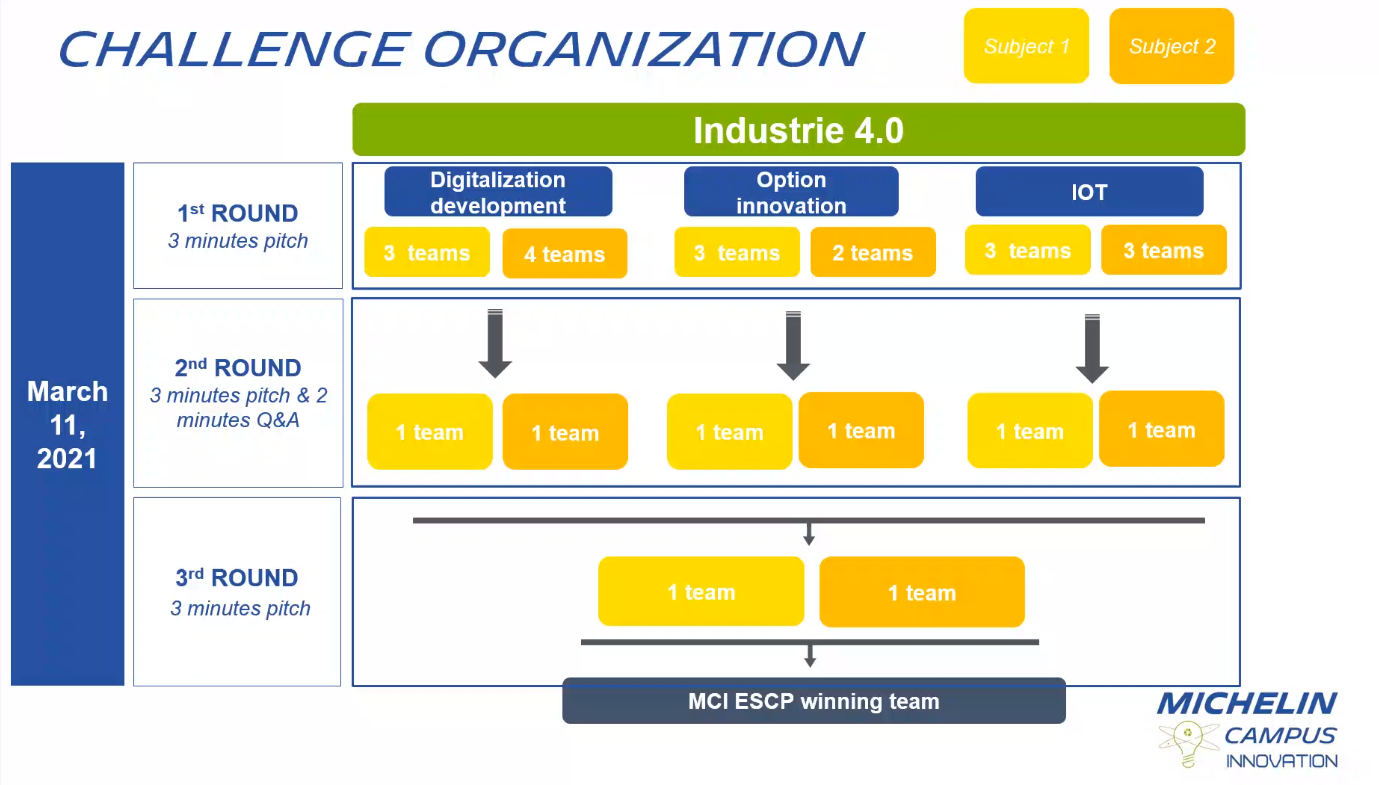
Students groups have been on boarded into a challenging schedule organisation to bring their recommendation to the next level. 3 rounds of 3-minute pitch… A very accurate but smooth-running process to get 6 of the best teams before selecting the 2 finalists and then the final winner.
Exposing students to companies’ issues is part of the ESCP pedagogy but as Professor Geraldine Galindo, Scientific Director of the Factory for the Future Chair says “I’m still very impressed how students can quickly seize and take up a topic. Moreover, they navigated through the process remotely, which is a priceless skill to develop in this particular period we are going through. Fair to say, it is also captivating to see how students from x different nationalities can bring precious ideas on the table. Valuable results have been presented to the Michelin experts and I’m looking forward to welcoming the 2022 Michelin Campus Innovation!”.
“I was amazed by the teams’ dynamism as well by the clarity of the projects they presented” says Jean-Philippe Ollier, sponsor of this project. “Considering how inspiring this Hackhaton has been, I’m convinced we should keep building bridges between business shoools and companies”.
A Jury composed of ESCP Professors and Michelin representatives have evaluated the students’ achievements (economic viability, technical innovation, potential impact, management & teamwork, wow effect).
Giuseppe Garaffo praises students’ ability in taking over non-easy topics so rapidly. “For sure, student’s outcomes will inspire us. And I would be glad to be on board next year to coach again!”
Nicolas Benezit also spent a very interesting day sharing with ESCP students. “They have been extremely efficient at rapidly understanding our industrial stakes, and very creative in the concrete and sustainable solutions they proposed”.
Catherine Tranchant who got to coach the winning team appreciated the experience as it allowed her to discuss impressive out of the box ideas with our talented students. ““Think simple, stay close to the reality (eg: as a farmer) and mostly important: let your feelings talk” were my guidelines for them. I’ve been impressed by their skills in listening, collaborative teamwork and sharing tasks to be more efficient.”
“This kind of challenge teaches us once more that the students’s fresh eye and take on concrete issues faced by companies generate new paths of progress” explains Denis Laforest. “It is an excellent exercise which prepare us to get ready to welcome the next new generations in our company, while offering them the keys to debunk a few myths of the business world”.
The 6 teams qualified in final will receive a batch of Michelin goodies (bottle, backpack and battery charger).
Congratulations to:
Anaelle Derville, Sirine Douhane, Charlotte Imbert, Nils Putz, Viktor Schaetze and Wilhelm Bingsmark, Davide Castellano, Garance Chanove, Théophile Deloingce, Yu-Ning Lee, Marvin Ulbrich, members of the ScanV team and the Michelet’s go team (students from the Digital transformation Class)
Mathilde Bourland, Elisa Dahan, Sarah Chaabane, Léopold Morin, François Schiestel and Corentine DURROUX, Estelle VU, Wenting ZHANG, members of the Never tired team and the PM group (students from the Innovation Class)
Federica ARMONE CARUSO, Lucca BOTTI, Ludovica BRAJA, Federico CACCIABUE, Ksenia KASHKAROVA and Piergiorgio Candito, Yuanxin Cui, Ludovico De Vita, Margarita Sarkisian, members of the IoTeam team and the Tirefy team (students from the IoT Class)
The Never tired team the Michelet’s go team have been selected as finalists and the members will be invited to an event organized by Michelin.
At the final step of this hard competition, Michelin praised the Michelet’s go team. Each member will have the opportunity to celebrate this achievement enjoying a dinner in a Michelin-starred restaurant.
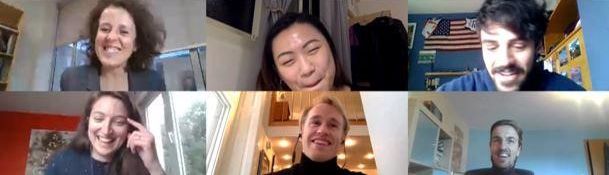
Let’s see how Wilhelm, Davide, Garance, Théophile, Yu-Ning and Marvin report from this experience!
Why did you choose the topic “How to measure behaviour and associated attitude in a digital transformation of an industrial population?”
"We are a group of students from the specialization of “Digital Transformation: Understand, Contribute, Manage” on the Paris campus this year. The main emphasis in our specialization is the importance of people within digital change, and so we wanted to work on issues related to human/ IT complementarity. We felt that this topic had the right balance between our courses taken and our personal interests, and therefore we reached a consensus quite easily and decided to take on topic 2 instead of the other one."
What did you enjoy the most and why?
"We enjoyed working on a concrete case study and growing an intuition into a concrete project. In a very short period of time, we shaped our initial idea, got insights from corporate experts and managed to oversee its potential implementation. A remote experience of project management in just one day! We managed to come together as a team, making the best out of our personal experiences and knowledge from various fields, just like in a real professional environment. Also, our team dynamic was amazing. Despite the fact that we were working under high pressure (time & content wise) we were always able to create some “loosen-up” moments and just laugh together while striving for the success of this Grand Challenge."
What was the most difficult?
"For us, it was to quickly gain a complete understanding of the problem that needed to be solved, defining the need from Michelin and the limitations we have in the scope. The given case was rather complex, and in order to propose the best solution possible, it was essential to first diagnose the case to understand the underlying challenges behind the presented problem as well as the desired outcome. Therefore, we dedicated a substantial amount of time at an early stage of the project to read, re-read and discuss the case, which in the end allowed us to present a solution with greater accuracy."
If you had 3 words to describe your experience? Which ones?
"Michelinspiring, Michelintrepreneurial, Michelinsightful"
What did you learn from this Company Projects process?
"The project provided us with experience in addressing a real business problem with a consultative approach, presenting concrete solutions within a given deadline. Due to the 3 minute “pitch” presentation format, we learned to present detailed solutions to a complex task very concisely and “to-the-point”. Additionally, having real-life feedback from the digital transformation experts from Michelin along the way was extremely helpful, through which we could see the blindspots of our ideas, and further develop and shape our proposals into what exactly Michelin is looking for."
Does this challenge give you a taste of Michelin issues, did it inspire you to consider getting a job in this area?
"The two topics presented were all “real-life” challenges that Michelin is trying to solve at the moment. Therefore, the Michelin Innovation Challenge gave us a very practical insight to what digital transformation means for a well-established company that needs to adapt to this modern phenomenon. What’s more, this experience provided us with a glimpse of the different challenges we might be facing once we enter a company which operates in this area. For sure we now have more information about this world and after graduation, some of us would definitely be interested in thinking about entering this fast-changing industry."
For Pascale Pernet, ESCP Chairs and Business Development Director, this event is a “further demonstration that French industry is not lacking in initiative! Special thanks to Michelin for its involvement at ESCP, and most of all to Jean-Philippe Ollier who supports our Chair Factory for the Future, offers grants to students in trouble due to the sanitary crisis, and provides the school with great challenges and opportunities!”
Campuses
The Deloitte Circular Economy Chair was a victim of its own success, and had to reward not one but three research theses.
The prizes for the best thesis on the circular economy and sustainable development were awarded by the Deloitte Circular Economy & Sustainable Business Models Chair to Lucie Delzant, who received the “Contemporary Societal Challenges” prize, William Bertin (MiM student), who won the “Jury's Favourite” prize and Dennis Nesemeir, who was awarded the “Deloitte Special” prize.
“We received 30 applications, compared to 10 in 2019. This is a very important sign for the school that so many students decided to do their master’s thesis on sustainability-related topics,” commented the co-directors of the chair: Professors Valentina Carbone and Aurélien Acquier, who is also the school’s Associate Dean for Sustainability. It was therefore a difficult choice for the jury, which included chair programme manager Anne France Mariacher, as well as Marie Georges and Philippe Kuch, two Deloitte experts who are very involved in the chair's activities, and other Deloitte consultants: Khai Linh Lhomme, Carole Arnal, Célia Meunier and Laura Plamondon. “Many of these were of an outstanding quality, we were struck by the students’ creativity, rigor and engagement, and really enjoyed reading the theses, but we also struggled to declare a unique winner! After long discussions, and to value and reward their work, we decided to attribute three different awards this year, each prize being of 1,500 euros.”
- Lucie Delzant’s thesis, which was supervised by Aurélien Acquier, was entitled Political CSR: an analysis of Google and Facebook’s controversies. “The thesis aims to analyse the political role of tech companies in a context of growing awareness and scepticism around them. Indeed, these tech actors, also known as GAFA, face criticisms about their political role, the lack of international regulation regarding their operations and activities and the effects of their influence,” the MSc in International Sustainability Management student explains. “The analysis is based on the concept of Political CSR and provides insights on the narratives of firms to respond to the controversies they are facing. The thesis maps the controversies and uses the response narratives as material upon which the conclusions and analytical reflections are drawn, after applying them to theoretical research frameworks.”
- The thesis of Dennis Nesemeier, which was supervised by Prof. Fabrizio Granà, was entitled Making sustainability material - exploring investors’ priorities in non-financial disclosures in the automotive industry. “The investment industry plays a vital role in the implementation of sustainable business practices, as it steers the allocation of capital and directly alters management practices,” the Master in Management student explains. “However, to incorporate environmental, social, and governance considerations into the investment decision-making process, more effective non-financial disclosure practices are required. Hence, this research investigates the claim that companies must develop more thorough non-financial disclosure practices that collocate with the special interests of the investment industry. This is accomplished via a case study of the German automotive industry.”
- William Bertin’s thesis, which was also supervised by Aurélien Acquier, was entitled What to do with collapsology: A study of the psychological processes and management strategies of sustainable development professionals faced with the problem of collapse. “This study follows up on existing research regarding the mental health consequences of climate change and environmental damage caused by human action, and is inspired by the growing popularity of collapse theories throughout the world,” the Master in Management student explains. “In the end, not only did the study deliver on its original goals, but it also found meaningful and unexpected results and suggested two new theoretical models that, if confirmed by further research, would constitute true theoretical advancements. Designed to raise awareness on a (sometimes) controversial topic, it already circulated quite a bit outside of ESCP and has been well received by all interested parties so far, including the two specialists that joined my supervisor for the oral defence in June.”
You can learn more about the students’ research by watching the video above, which was recorded during an online event organised to allow them to present their work and engage in a Q&A session with the 50+ participants (students, alumni, but also professional contacts of the chair who had been invited to join).
Campuses
Aware is a student society at ESCP promoting gender equality in higher education and business. In honor of the International Day of Women’s Rights, the association launched the first edition of TOGET’HER, a week dedicated to the intersection of gender and business. The goal of the week was to raise awareness about sexism in the professional world and to provide students, especially women, with tools and insights to overcome these problematic dynamics, both conscious and unconscious. Events throughout the week were free for the entire ESCP community: students, professors and staff members. Over the five-day span, Aware invited diverse speakers and experts to talk about various topics linked to gender equity in business, from breaking through the glass ceiling to learning how to negotiate one’s salary. Events throughout the week included seminars, roundtable discussions, workshops and training.
Here are just a few of the key takeaways from each of the events!
Women's Careers and the Glass Ceiling : fighting gender stereotypes and unconscious biases
For TOGET’HER’s opening event, Aware was proud to host Séverine Roux and Isabelle Daviaud from the Professional Women’s Network (PWN) to address the issue of the glass ceiling. Although women have higher levels of educational attainment on average than men, they are starkly underrepresented in executive roles. This gap is the glass ceiling, which is perpetuated through unconscious biases (self censorship, education, etc), sexism and gender stereotypes. Our two speakers walked participants through how to recognize, deconstruct and counteract these biases.
Responding to Sexual Harassment in the Workplace
The consulting firm EQUILIBRES joined TOGET’HER to provide training to help participants know how to better react to everyday sexism, from innapropriate jokes told during a coffee break to actual sexual harassment in the workplace. First, they taught the audience how to recognize such situations then explained the legal consequences of this type of behaviour, and finally, gave advice on how to respond in such situations - one example of which being the necessity of turning directly to HR should any suspicion of danger for an employee arise.
Talk with Najat Vallaud-Belkacem
For the third event of the week, Aware hosted an interview with Najat Vallaud-Belkacem, the former French Minister of Women’s Rights and now head of One, an NGO dedicated to international solidarity and tackling extreme poverty. She posits that patriarchal systems are the root of discrimination against all those who don’t fit into traditional social standards, including women. To put an end to such systemic discrimination, she advocates taking concrete actions to create true equality and to overcome the glass ceiling - especially by promoting the value of jobs primarily undertaken by women (care, retail jobs..), many of which were proven essential and underappreciated during the covid crisis.
Roundtable : "Meeting Women Entrepreneurs : Experiences and Careers"
Aware was honored to receive three women entrepreneurs at different stages of their careers: First, Jo Bautista, an ESCP student, told us about her social impact company SendToGive that she launched during the first lockdown. Then, Jessie Gaston spoke about her position in the board of Empow’her, an organization dedicated to helping women create their own start-ups. Finally, Catherine Barba, a pioneer in the digital sector and angel investor for many years, gave us some insight into what it’s like to be an entrepreneur. Every speaker underlined the importance of being a risk-taker and going where no one expects. They insisted on the fact that there are no differences between men and women, as pursuing our passions is the only thing that matters.
Salary Negotiation, Networking, Self-Affirmation and Self-Promotion: HR for the Promotion of Women in the Workplace”
The event’s closing speaker was Amélie Favre Guittet, an HR influencer on LinkedIn and founder of the Talent Management Group. She shared her experience and provided tools to teach students how to build a professional network, to negotiate a salary and to face sexism in the workplace. She offered some key advice; to practice self determination and to learn how to say “No”. Her motto? Humor and self affirmation are keys to success.
Gender inequalities in the workplace are still very real obstacles to overcome, but in order to do so women must start promoting themselves, supporting one another and fighting their own internalized biases.
Héloïse Rannou and Noa Elkaim are French ESCP students based in Paris and enrolled in the Master in Management Program. Héloïse is President of the student society AWARE and Noa is its Vice-President.
![© Adobe Stock - yustus [copyright]](/sites/default/files/styles/event_news_une/public/2021-03/Religious-diversity.jpg)
Campuses
![© Unsplash/Clay Banks [copyright]](/sites/default/files/styles/event_news_une/public/2021-03/Red-and-blue-states.jpg)
Campuses
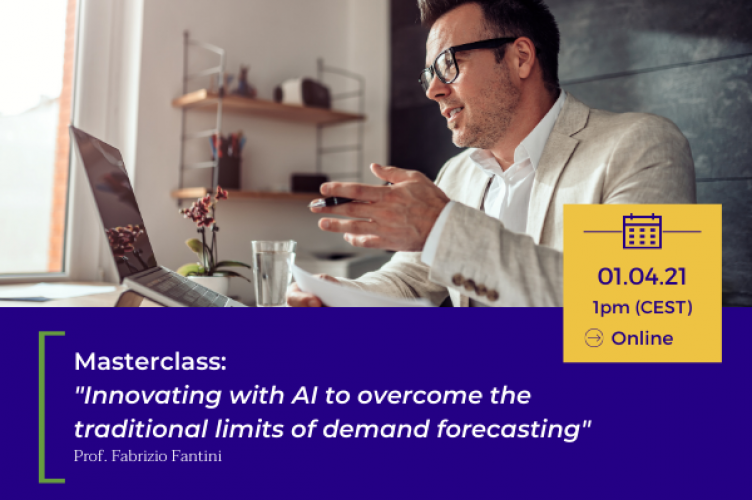
You're invited to attend our MBA Masterclass "Innovating with AI to overcome the traditional limits of demand forecasting" led by Fabrizio Fantini, CEO of Evo Pricing and ESCP Guest Lecturer, together with Veronica Polichetti, MBA Programme Manager at ESCP - Turin campus.
Abstract:
Traditional forecasting systems used for supply chain, customer segmentation and demand planning all rely on the assumption that the future is more of the same, like the past. However, our increasingly volatile world means that prediction error rates range from the 20%+ of best-in-class companies with predictable demand like Wal-Mart, up to 50% of more challenging B2B contexts.
Waste, loss of profit, less competitive agility: to address such traditional problems, a new type of adaptive Artificial Intelligence allows to change paradigm: dynamic demand discovery.
Much like stock prices reflect demand/supply information in real time, new customer data of any type – even heterogeneous and partially ‘dirty’ – provides signals and information to update expectations in real-time. These new technologies enable a radical transformation of management practice, commonly with 30%+ efficiency improvements across different domains like marketing, supply chain and demand management. However, substantial retraining is required.
This Masterclass will provide the key building blocks and language, plus bonus pointers to learn more about such fascinating disruptions to traditional management science.
Agenda:
- 1-1.10pm Welcome and Presentation by Veronica Polichetti
- 1.10-1.45pm Masterclass held by Fabrizio Fantini
- 1.45-2pm Q&A live session
Register to participate
More info: mbaturin@escp.eu
Participants

Fabrizio Fantini
CEO of Evo Pricing and ESCP Guest Lecturer

Veronica Polichetti
MBA in International Management Admissions and Programme Manager
Location
Organiser: ESCP Turin Campus
Online - Worldwide
MapDate
Start date: 01/04/2021
Start time: 1:00 PM
End time: 2:00 PM