
![© Tetiana Soares - AdobeStock [copyright]](/sites/default/files/styles/event_news_une/public/2022-01/Argyro%26Almudena_Express_0.jpg)
Putting in overtime often comes at a cost of stress, burnout and depression. But reality doesn't translate into a clear-cut “extra work = decreased well-being” equation. In certain cases, it could be the opposite! The crucial difference lies in the motivation behind the long hours, whether they stem from an inner desire or external pressures, as Profs. Argyro Avgoustaki and Almudena Cañibano show in their study picked up my several media, including The Register and L’Express (in French).
Stretched working hours, a major health issue
According to a recent World Heath Organization study, working 55 or more hours per week is associated with an estimated 35% higher risk of a stroke and a 17% higher risk of dying from ischemic heart disease, compared to working 35-40 hours a week. The Japanese have even coined a term for death from overwork: karoshi. Outside of such extreme examples, there is abundant evidence that individuals who put in long hours pay a heavy toll in terms of stress, fatigue, burn out, exhaustion, or illness.
Extensive work effort is a major concern because it is so widespread: according to the Sixth European Working Conditions Surveys, 30% of European workers regularly work more than 40 hours per week. In the UK alone, 5.3 million workers do unpaid overtime and dedicate, on average, almost 8 hours above their contracted hours to work every week, according to the Trade Unions Congress.
It seems that bankers' hours (the term seems to still reflect reality, according to innovative research co-authored by a colleague at ESCP) are becoming the norm for many types of workers. The question professors Argyro Avgoustaki and Almudena Cañibano asked themselves is, how does this impact their well-being? The answer is not straightforward. Some argue overtime work does not lead to negative employee outcomes as long as employees have control over how much they work. However, this argument is discussable when observing executives whose bodies suffer and rebel even though they are voluntary workaholics. The researchers improved the understanding of the relationship between extensive work effort and well-being by showing that outcomes in terms of well-being depend on the reasons why professionals work long hours, rather than on control.
Pressure vs. passion: distinguishing extrinsic and intrinsic motivations
To shed light on the reasons driving employees to work extensively, they used self-determination as a theoretical lens. This theory specifically distinguishes between extrinsic motivation – doing something to achieve an external objective –, and intrinsic motivation – doing something because it is inherently engaging and pleasant. Examples of the former would be financial rewards, praise or pressure; examples of the latter would be the search for self-acceptance, or the desire to perform a better job. They empirically tested their hypothesis by surveying more than 500 professionals in the Spanish division of a major international consultancy firm, an interesting setting for two reasons: consultants tend to enjoy bargaining power and autonomy, and long hours are pretty much the norm in the industry.
Extrinsically-driven work effort and well-being: peer pressure, guilt
Their first result was that extrinsically-driven work effort negatively affected well-being. “In other words when individuals put in long hours because of external factors, such as in order to obtain rewards, they are more likely to experience well-being issues, such as stress and depression”, they explain. It is not the lack of choice that seems to matter but the reasons why they voluntarily chose to work overtime. Which other types of motivational drivers of extensive work effort fall into this category? Employees may decide to put in face time (also known as presenteeism) in the hope to boost their careers. They may put in long hours out of pure mimetism, because everyone else in the office does so, or because performance is measured as a function of billable hours, or simply under threat of redundancy if they don't meet the requirements of an excessive workload.
Intrinsically-driven work effort and well-being: desire to learn, commitment...
Conversely, behaviours driven by intrinsic motivators are gratifying and therefore associated with more positive emotions, attitudes, and well-being. Profs. Argyro Avgoustaki and Almudena Cañibano’s study confirmed less negative outcomes in terms of well-being associated with internal motives for overtime. “Well-being may thus be preserved when long hours are a conscious decision based on an inclination to learn for its own sake, a desire to develop relevant knowledge and skills, or to enjoy a feeling of achievement,” they add. “Individuals, particularly knowledge workers for whom work is a part of their identity, may also throw themselves into it out of commitment toward colleagues or the organization.”
Inner motivation and external rewards reinforce each other
But what happens when both extrinsic and intrinsic motivations are part of the picture? If for example, professionals are driven to work longer hours by social contagion, will they feel so constrained to act in this way that it will reduce the extent to which they do this because of their sense of commitment? Will peer pressure “crowd out” the desire to become better at their job? Quite the contrary. Despite the prevalence of the “crowding out” theory in academic literature, they found that extrinsic and intrinsic motives in fact reinforce each other. In other words, working overtime to send signals about a desire for promotion, for example, is compatible with striving for growth. In addition, they found that the association between intrinsically-driven work effort and well-being was more positive at higher levels of overtime, whereas extrinsically-driven work effort reduces well-being no matter the amount of overtime.
“Our insights will be useful for policymakers and HR managers when exploring ways to improve well-being at work,” they conclude. “They should focus on encouraging the design of meaningful jobs in which workers would be willing to engage out of interest for the task itself and the learning it can produce, rather than just on providing new extrinsic incentives.”
Campuses

ON WEDNESDAY, FEBRUARY 9TH, JOIN THIS ONLINE MASTERCLASS AND GET AN OVERVIEW OF THE 2022 FINANCIAL MARKET AND COMPANY TRENDS.
In light of the current crisis, it is crucial to have a clear vision and anticipate the financial market trends in an uncertain and difficult context. Understanding the dynamics and challenges is imperative to succeed in the market.
Our interactive Masterclass delivered by Prof Francesco Rattalino, ESCP Business School Turin Campus Dean, and Finance Professor Vittorio de Pedys, Academic Director of the Investment Banking Specialisation, is a unique opportunity to reflect upon and discuss the new trends and will help you navigate the perilous financial markets ahead for your investments.
Make the most of this occasion by asking your questions directly to the speakers during the Q&A session.
This event promises to be a cutting-edge discussion on investments and clear forecasts on the economy and financial markets of 2022.
Participants

Francesco Rattalino
ESCP Turin Campus Dean Executive MBA professor

Vittorio de Pedys
ESCP Professor of Finance, CEFA Executive MBA professor
Location
Organiser: ESCP Turin Campus
Online - Worldwide
MapDate
Start date: 09/02/2022
Start time: 6:00 PM
End time: 7:00 PM


ESCP’s European Center for Digital Competitiveness published its new Digitalreport, which summarizes the current digital state of Germany and shows business and political leaders have high expectations for the new coalition.
Expectations for the so-called traffic light coalition of the SPD, the Green Party and the FDP are high: 82% of business and political leaders surveyed expect the new government to focus more on digitalisation in the future. This would also be highly necessary, since 94% of them see Germany continuing to lag behind in digitalisation. The population very clearly perceives the opportunities presented by digital future technologies: In the view of the vast majority, drones (59%), 3D printers (58%), and AI (56%) will be of great importance in the future, followed by technologies that enable autonomous driving (47%), better environmental protection (44%) and better support for care (37%). These are some of the results of the Digitalreport 2022 (in German) by the European Center for Digital Competitiveness at ESCP Business School (Berlin campus) and the Allensbach Institute. Published this year for the third time, it is based on a representative population survey and results from a study of around 500 top executives from business and politics.
“The new coalition must now deliver the progress they promised,” comments professor Philip Meissner, who is the Founder & Director of the European Center for Digital Competitiveness at ESCP Business School. To achieve this, he believes that the government must place greater focus on future technologies in its digital policy: “The great opportunities of new technologies, like 3-D printing, for the everyday life of every individual, but also the prosperity of the country as a whole, have to be communicated more strongly in the future.” He also thinks the promotion of start-ups and future technologies has to become a top priority and has to be the direct responsibility of the leaders of the governing parties. Above all, there needs to be significantly more growth capital and a reduction in regulation. “If Germany wants to maintain and expand its prosperity in the coming years, we must now act decisively and make the country a location for future digital technologies,” he adds.
For more infirmation, you can read the press release here.
Campuses
![© Tingey Injury Law Firm - Unsplash [copyright]](/sites/default/files/styles/event_news_une/public/2022-01/tingey-injury-law-firm-yCdPU73kGSc-unsplash.jpg)
Campuses
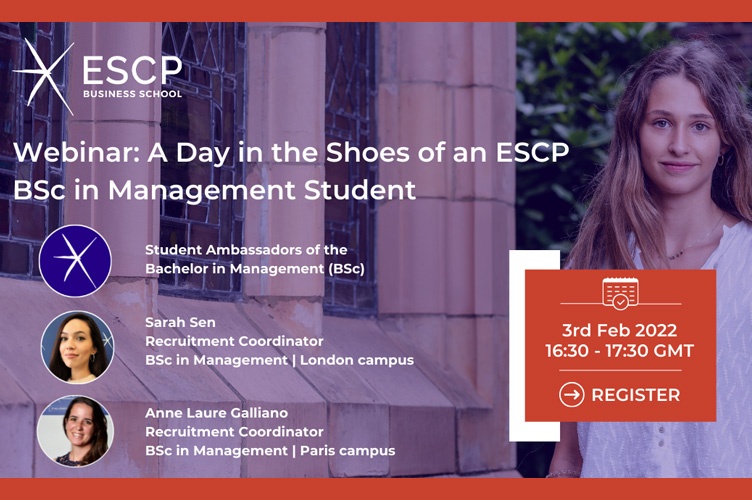
Wondering what your life will be like as an ESCP student?
Join us to meet students of the Bachelor in Management (BSc) at the London and Paris Campuses!
They will tell you everything you need to know about classes, clubs and societies, top tips on the cities they live in, and much more.
Ask them any burning questions you have, they will answer them LIVE.
This event is free to join. Book your place
Location
Organiser: ESCP London Campus
Online - Worldwide
MapDate
Start date: 03/02/2022
Start time: 4:30 PM
End time: 5:30 PM

The the GEA Sustainability ESCP team is thrilled to announce its new online event in collaboration with Bloomberg.
The event will be held on Zoom on Wednesday, 26th January 2022, at 3:30pm (GMT).
Agenda & Featured Speakers:
- Sara Dal Vecchio & Lorenzo Martini, Bloomberg LP Campus Ambassadors, Welcome and Introduction - ESCP Business School Graduates
- Bessie Norris, EMEA Graduate Recruitment at Bloomberg LP - HR presentation and Internship Opportunities
- Louis Lamaury, Equity Advanced Analyst at Bloomberg LP, Terminal ESG Demo
Bloomberg commitment to integrating sustainable finance considerations into company strategic decision making has constantly increased in the last few years. As a result, the company is now looking forward to presenting to young and motivated students its Terminal ESG Demo!
Students will have the opportunity to stand out to Bloomberg and learn about its professional opportunities during the session
So hurry up and book your place! Sign up here
After you sign up, we send you the link to join the event on Zoom.
We look forward to seeing you!
Feel free to contact us via email or our social media profiles if you have any questions.
Follow GEA to get notified of our upcoming events.
Instagram
LinkedIn
Facebook
Location
Organiser: GEA Sustainability ESCP
Online - Worldwide
MapDate
Start date: 26/01/2022
Start time: 3:30 PM
End time: 4:30 PM

Campuses
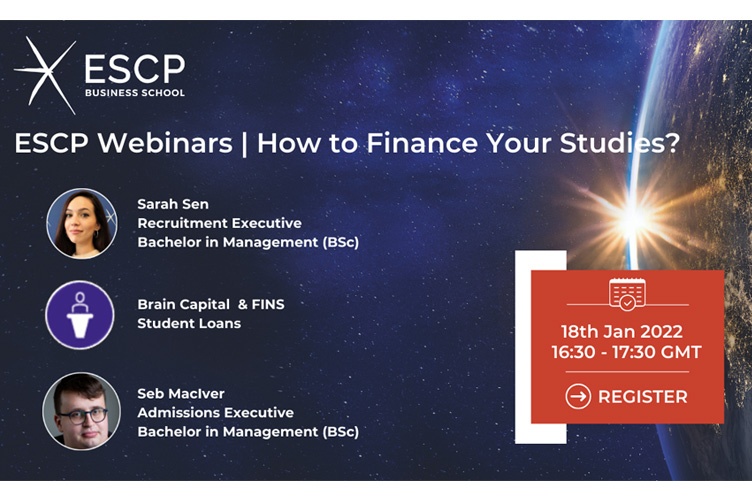
Join us on Tuesday, 18th January at 4:30pm GMT to find out different ways to finance your studies!
Our guest speakers from Brain Capital and FINS will give you an overview of your eligibility for their loans and how you can apply.
We will also be joined by a current student who will share his experience of getting a student loan and his top tips on how to start researching your options. Our team will also tell you how to start your research and what tools you can use.
Click here to register your place
Location
Organiser: ESCP London Campus
Online - Worldwide
MapDate
Start date: 18/01/2022
Start time: 4:30 PM
End time: 5:30 PM

Interested in knowing how to do the perfect pre-recorded video interview, or in finding out more about a commercial fast-track graduate programme that leads to a managerial role in less than three years at one of the world's fastest-growing companies?
We are delighted to announce that John-Paul Conway, Senior Associate at AlphaSights, will be running a workshop with ESCP London Campus students at 6pm on 19th January.
AlphaSights is the global leader in knowledge on-demand and works to connect leaders of the world's largest capital markets firms, corporations, strategy consulting firms and private equity funds with the expertise they need to navigate growth, development, innovation and turmoil.
Join JP Conway from AlphaSights' Campus Recruiting team as he introduces opportunities for ESCP graduates to join their Graduate Associate Programme this year, and also shares his thoughts on approaching pre-recorded video interviewing with absolute confidence.
If you are interested, you must register before 18th January! Book your place
Location
Organiser: ESCP London Campus
Online - Worldwide
MapDate
Start date: 19/01/2022
Start time: 6:00 PM
End time: 7:30 PM

The Energy Management Centre at ESCP is delighted to host a thought-provoking discussion on 'COP 26 – The Background and Prospects' with distinguished speaker and EMC Advisory Board Member Prof. Michael Jefferson, Former Senior Editor of the journal Energy Policy and current member of its International Advisory Board and that of Bio-Physical Economics.
Prof. Jefferson's personal experience includes attending the pre-COP INC meetings and the first seven COPs; involvement with the IPCC since 1991; and 50 years of involvement with the energy scene including ‘new’ renewables.
When: Thursday, 20 January 2022
Start time: 6pm GMT
End time: 7pm
The event will take place on Zoom. Attendance is free of charge. To secure your place, please click here.
About Our Speaker
Michael Jefferson is the first (ever) Chief Economist of the Royal Shell Group. He studied at University College, Oxford and then the London School of Economics, before going into an economics consultancy, an industrial policy body, and then becoming Chief Economist of The Royal Dutch / Shell Group.
He spent nearly 20 years at Shell in various roles, from Head of Planning in Europe to Director of Oil Supply and Trading. He then spent ten years as Deputy Secretary-General of the World Energy Council, where he began working with the Intergovernmental Panel on Climate Change as Contributing Author, Lead Author, Editorial Reviewer and Expert Reviewer, culminating in his receipt of the IPCC's certificate for his contributions to their award of the Nobel Peace Prize in December 2007.
He has also written extensively on energy policy, including contributions to various UN bodies, and was for many years involved with the World Renewable Energy Network and Congresses.
Alongside his work in business he has written several books in the fields of energy and economics; contributed to books on economic and social history; and written or co-authored many peer-reviewed papers in the energy and environmental field. He is an Affiliate Professor of Energy Policy at ESCP Business School, and a Senior Fellow of the University of Buckingham.
He is a member of the International Advisory Board, and Editor of the journal “Energy Policy”.
Participants

Prof. Michael Jefferson
Former Senior Editor of the journal Energy Policy
Location
Organiser: ESCP Energy Management Centre
Online - Worldwide
MapDate
Start date: 20/01/2022
Start time: 6:00 PM
End time: 7:00 PM