
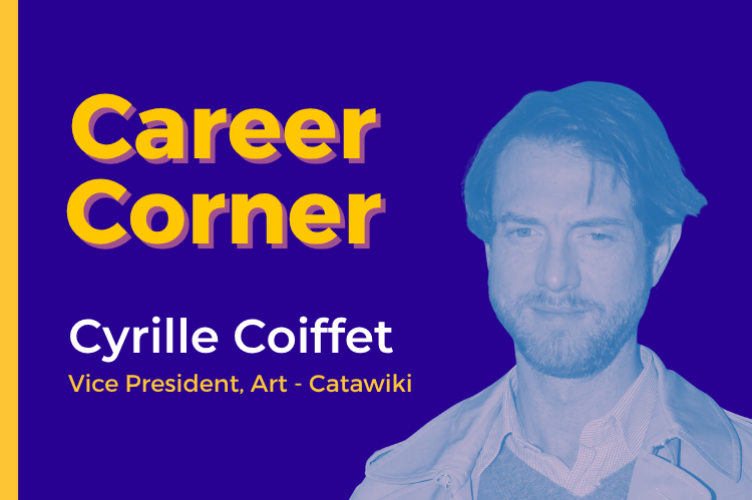
ESCP alumnus Cyrille Coiffet on trust, technology and innovation in one of the world's most traditional markets
The art and antiques market has long been defined by gatekeepers: specialist dealers, established auction houses, and buyers who knew the right people in the right cities. We spoke to Cyrille Coiffet, ESCP Master in Management alumnus and Vice President, Art at Catawiki—a curated online marketplace for special objects—about how digitalisation is transforming the market.
After more than fifteen years building and scaling digital platforms at Yahoo! and HomeAway, Coiffet arrived at Catawiki with a clear conviction. "What drew me specifically to art wasn't an abstract passion for beautiful objects," Coiffet explains. "It was the conviction that the art market was one of the last major verticals where digital platforms could fundamentally change the way supply meets demand."
While industries such as travel, media and retail had embraced digital transformation, the art world remained what Coiffet describes as "opaque, relationship-driven, and geographically constrained." Digital marketplaces, by contrast, are transparent, data-driven and borderless.
Bridging these two worlds became his professional challenge — and an opportunity to rethink how cultural value is created, communicated and exchanged.
Beyond the algorithm: building trust
Entering the space required Coiffet to unlearn some of the assumptions that govern most platform businesses. In most platform businesses, you optimise conversion funnels and unit economics. "The biggest challenge was learning to operate in a market where trust is reputational, cumulative and fragile," he says.
Convincing sellers — artists, galleries and private dealers — to embrace a digital platform requires reassurance that their work, and their standing in the industry, will not be undermined in the process.
Building that credibility took time. But a clear curatorial model, supported by expert oversight and strong marketing tools, accelerated the process significantly. “At Catawiki, every lot is reviewed by in-house experts before it goes live.”
That means every item submitted to the platform is reviewed by one of the company's 300 in-house specialists. Over 75,000 objects are offered in auction every week, each reviewed and selected by in-house experts specialised across categories including art, design, jewellery, fashion and classic cars. It is a resource-intensive model, but one that preserves the integrity on which the market depends.
"The platform's role is to amplify the expert's judgment, not to replace it," Coiffet says. In this model, growth does not come from lowering standards. It comes from applying consistent expertise across categories, geographies and price points.
Traditional gatekeepers are not disappearing, but their role is evolving. The competitive advantage no longer lies in controlling access. It lies in the quality of curation and the breadth of choice available to buyers wherever they are.
Surfacing demand across generations and borders
Digitalisation is reshaping who participates in the market at all. The rise of millennial and Gen Z buyers is fuelling significant growth online, with younger shoppers increasingly viewing antique and collectable items as both sustainable choices and expressions of individual style — a shift driven in part by a broader rejection of mass-produced goods.
For Coiffet, the other significant shift is geographic accessibility. A collector in rural Germany or a small coastal town in Spain can now bid on the same lot as someone in London or New York, with access to the same information and the same expert verification. "Digital platforms have surfaced a demand that simply wasn't visible before."
Coiffet partially credits his ESCP roots and multi-campus learning experience with the reflex to think across borders—an essential mindset when managing a collector base spanning dozens of countries, each with its own distinct tastes and legal frameworks. "You never assume one market works like another," he notes.
Enabling transparency and increasing visibility
"Value in the art market has always been a negotiation between scarcity, provenance, critical recognition, and the zeitgeist," Coiffet explains. "What's changing is who gets invited to the meal.” Data is making price formation more transparent. Platforms are giving visibility to artists and movements previously confined to local markets.
New technologies are beginning to influence how art is presented and discovered—but they remain tools, not arbiters of value. “AI is starting to influence how we describe and merchandise artworks,” shares Coiffet. “None of this replaces the subjective, emotional dimension of owning an artwork, but it widens and educates the audience.”
The future of the art market is unlikely to be defined by disruption alone, but by balance: where the rigour of data meets the weight of history. For Coiffet, the goal is extending and scaling, making trusted expertise accessible to a broader, more global audience without losing the qualities that give the market its meaning.
Relevant link
Campuses