
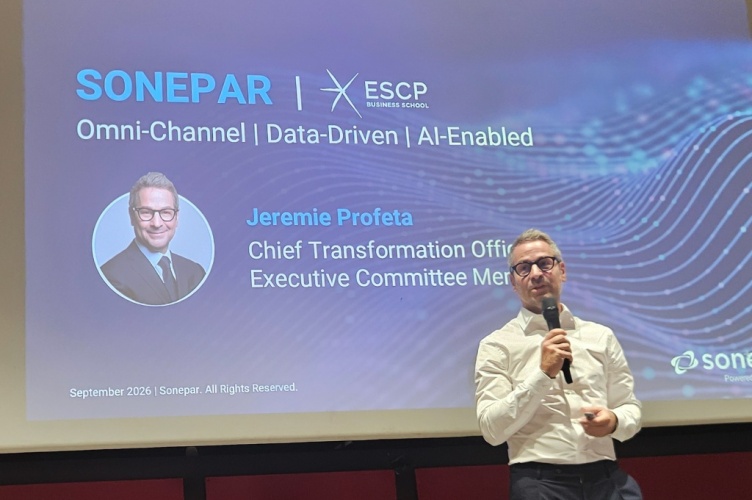
How can a global company use digital technology and artificial intelligence to transform its business while accelerating the energy transition? During ESCP’s Digital Spark seminar, Jérémie Profeta, Chief Transformation Officer and Executive Committee Member at Sonepar, shared the company’s transformation journey with Master in Management students, from reinventing the customer experience to using data and AI at scale.
Sonepar considers digital transformation a business transformation, extending far beyond an IT project. That was one of the key messages delivered by Jérémie Profeta, Chief Transformation Officer and Executive Committee Member at Sonepar, during his intervention at ESCP’s Digital Spark seminar, led by Yannick Meiller, Associate Dean of the Master in Management.
With operations in 40 countries and 46,000 employees, Sonepar is the world's largest distributor of electrical products. Its position in the electrification ecosystem gives the company a particularly important role as demand for electricity grows, driven by the energy transition, the development of data centres and the electrification of buildings, transport and industry.
For Jérémie Profeta, this context makes transformation an opportunity to create greater value for customers, employees and the wider ecosystem.
A global transformation driven by customers
Sonepar has traditionally operated through branches and sales teams, serving professional electricians and businesses with the products and services they need. But customer expectations have changed dramatically with the rise of digital.
Customers increasingly expect the same seamless experience they encounter in their personal lives: the ability to search, order and interact with a company through multiple channels, switching from a website to a mobile application, a branch or a sales representative without losing information along the way.
Sonepar therefore embarked on a profound transformation of how it sells, serves customers, operates and ultimately creates value, by adding digital channels and connecting them.
Its omnichannel strategy brings together the branch, website, mobile application and business-to-business system integration within a single customer experience. Customers can begin an interaction on one channel and continue it on another, while employees have access to the same information and tools. For a B2B company, this represented a significant shift.
“Customers want a seamless experience anytime, anywhere,” Jérémie Profeta explained. The transformation was therefore designed around the customer journey rather than around individual internal systems.
The results are already substantial. Sonepar’s digital platforms have grown to around €12 billion in revenues, or 37% of total revenues, demonstrating how a transformation initiated in response to changing customer behaviour can become a major business driver.
Data as a strategic asset
Behind this transformation sits another strategic decision: treating data as a core business asset.
For years, Sonepar’s competitive advantage was largely based on its people, local presence, product availability and ability to serve customers efficiently. But Jérémie Profeta explained that the company anticipated that data would become increasingly important, particularly in a B2B environment where understanding what customers buy, when they buy it and which solutions they need can create a significant advantage.
Sonepar therefore invested in building a large data foundation across its markets. That investment has become even more important with the arrival of generative AI.
Jérémie Profeta stressed a simple principle: without data, there is no effective AI strategy.
Sonepar is now using AI across multiple functions, including sales, supply chain, marketing, finance and technology. Rather than treating AI as a standalone innovation programme, the company is integrating it into concrete business processes where it can improve efficiency, predict demand and enhance customer service.
One example is order processing. Customers do not always place orders in a standard digital format; information can arrive through different channels and in different forms. AI can help interpret that information, complete missing details, check availability, optimise delivery and accelerate the overall process, with an objective of solving real business problems at scale.
AI to support people and accelerate electrification
For Jérémie Profeta, the impact of AI also needs to be considered in the context of a broader challenge: the shortage of skilled electricians.
As electrification accelerates, the world needs more professionals able to install and maintain electrical infrastructure, from buildings and homes to industrial facilities and data centres. Sonepar therefore sees productivity-enhancing technologies as part of the answer.
AI can help sales teams manage growing volumes of requests, assist employees in finding the right products and solutions, and automate repetitive tasks. This allows people to focus more on customers and on higher-value activities.
The same principle applies across the supply chain. AI and data can help optimise inventory, transport and delivery routes, ensuring that the right products are available at the right time while reducing unnecessary logistics and associated emissions.
Technology thus becomes a means of addressing both business efficiency and the wider energy transition.
Making sustainability part of the transformation
Sustainability is another dimension of Sonepar’s digital transformation. As a major distributor, the company sits between manufacturers and the professionals who ultimately use electrical products in buildings and infrastructure. This gives it an opportunity to influence purchasing decisions across the ecosystem.
Data and digital tools can make the environmental characteristics of products more visible to customers, helping them identify more energy-efficient and lower-carbon solutions.
Jérémie Profeta presented this as a shared responsibility: Digital transformation cannot happen in isolation. Manufacturers need to develop better-performing products. Distributors need to make those products accessible and understandable. Customers need to adopt more efficient solutions. And the logistics connecting the different parts of the ecosystem also need to become more sustainable.
Transformation is an ecosystem effort
This was perhaps the broader lesson at the heart of Jérémie Profeta’s intervention: transformation only works when the whole organisation is engaged, and when companies work together beyond their own organisational boundaries.
At Sonepar, transformation brings together people from digital, sales, marketing, supply chain, finance, IT and many other functions. A digital platform cannot succeed if the products are unavailable, logistics are inefficient or employees cannot support customers effectively.
The same applies at industry level. As a global leader in electrical distribution, Sonepar works closely with manufacturers, technology companies and other partners to create a more connected ecosystem. Jérémie Profeta compared this to the transformation experienced by other industries, where closer integration between companies has enabled entire value chains to become more efficient.
For Sonepar, the energy transition and digital transformation are closely connected. Neither can be achieved by one company acting alone.
A transformation built for the long term
Sonepar’s journey also reflects a distinctive feature of the company: its long-term perspective as a family-owned business.
The group has invested billions of euros in transforming its supply chain, digital platforms and operating model, including major investments in warehouses, automation, software and data capabilities.
For Jérémie Profeta, this scale of investment reflects a fundamental belief: digital transformation takes time.
It requires new technologies, but also new skills, new processes, new ways of working and new forms of collaboration.
His message to ESCP students was therefore beyond the technologies Sonepar is using today, but more about understanding transformation as a continuous process, one that combines business strategy, technology, data, people and partnerships.
For future leaders, the challenge will be to navigate this complexity while keeping sight of the purpose behind it.
In Sonepar’s case, that purpose is particularly tangible: using digital transformation to serve customers better, empower employees, improve efficiency and help accelerate the electrification of the world.
Through its partnership with ESCP Business School, Sonepar brings this first-hand experience of transformation into dialogue with the next generation of managers, offering students a concrete view of how digital, AI and sustainability are becoming inseparable from the way global businesses operate and grow.
Campuses