
Master in Sustainability
Entrepreneurship and Innovation (MSc)
Student Oliver West talks about the Sustainable Lifestyles Venture with UNEP
 As part of ESCP’s Master in
Sustainability Entrepreneurship and Innovation (now the Master in Impact
Entrepreneurship), Oliver West participated in a key module co-developed with the UN Environment Programme
(UNEP)—the Sustainable Lifestyles Venture (SLV) project. This year-long mandatory module challenges students to
create profitable business ventures that also drive significant environmental impact, bridging the gap between
entrepreneurial spirit and sustainable impact.
As part of ESCP’s Master in
Sustainability Entrepreneurship and Innovation (now the Master in Impact
Entrepreneurship), Oliver West participated in a key module co-developed with the UN Environment Programme
(UNEP)—the Sustainable Lifestyles Venture (SLV) project. This year-long mandatory module challenges students to
create profitable business ventures that also drive significant environmental impact, bridging the gap between
entrepreneurial spirit and sustainable impact.
In this interview, Oliver shares his experiences working on the SLV project, where his team focused on the domestic
energy industry. From conducting comprehensive research across the industry to pivoting their business model under
tight deadlines, he reflects on the challenges and skills developed throughout the process. Oliver’s journey
highlights how this unique programme equips students with the tools to innovate for a more sustainable future.
Tell us about yourself.
I was born in London and, when I was two years old, I moved to Studham, a tiny village
in which I grew up. At 16, I left home to go to UWC Atlantic, an international boarding school (~96
nationalities between 350 students) on the South Coast of Wales. This was a very forward-thinking,
mission-focused community which led me to discover my passion for sustainability.
For my undergraduate degree, I studied Liberal Arts and Sciences at Amsterdam University College,
focusing on Environmental Economics and Policy.
What’s your personal experience/history with entrepreneurship? With sustainability?
My passion for sustainability began at UWC Atlantic. Living and learning with
changemakers from all over the world, each with their own unique and progressive perspectives,
sparked a belief that it is possible to enact positive social change through collaboration. I have
viewed climate change and environmental degradation as the most pressing problem my generation
needed to face and so it took my focus!
Entrepreneurship struck me a little later. Economics was always an academic interest of mine. The
combination of my high school passion and academic interest led me to pursue a Bachelor’s centered
on environmental economics. After my degree, I felt that although economics was a powerful
retrospective tool, it lacked the precision to accurately predict the future. Without a tool that
looks into the future, I felt unequipped to change it. This led me to look for a Master’s with a
more direct link to impacting the future, and thus: entrepreneurship.
What made you want to study a master's degree at the intersection of sustainability and entrepreneurship?
I was motivated to continue my academic studies with entrepreneurship and
sustainability because I believe businesses are uniquely positioned to positively impact the
environment. Creating business models to tackle complex problems is crucial to encouraging the
transition towards a sustainable economy. The global community needs new ideas and innovations that
challenge the current unsustainable status quo most businesses work within. Learning the tools to
create these models and progress these innovations was an attractive opportunity of this degree at
ESCP.
Additionally, being in the world of entrepreneurship that demands creativity, planning, pragmatism,
and perseverance is a prospect that appealed to me.
Can you walk us through your experience with the Sustainable Lifestyles Venture?
The Sustainable Lifestyles Venture (SLV) is a course co-created with the UN
Environment Programme (UNEP) that lasts for the whole first year of the programme. The goal of the
course is to create a sustainability entrepreneurship venture that is not only profitable but also
impactful.
In the first term, we began the research phase. This involved talking to as many stakeholders as
possible within our respective industries to understand their experiences. This was our window to
gain insights from consumers, suppliers, distributors, producers, regulators, etc.
The challenge is to not immediately jump to problem identification but instead
develop a deep understanding of the industry, which could later lead to uncovering the less obvious
opportunities. This research was summarised into an ethnographic report due at the end of the first
term.
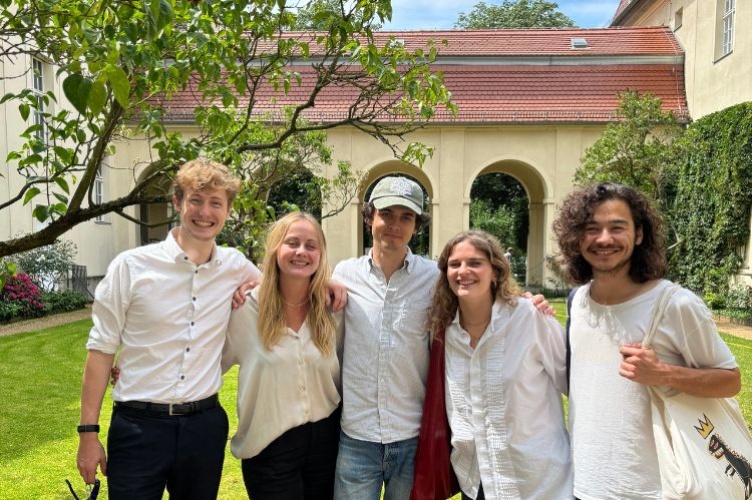
My group (Ines Lepeu, Pierre Delfour-Given, Louise Doncieux, Markus Wiehl, and myself) worked on the
domestic energy industry, encompassing energy production, distribution, supply, and consumption. We
had the great opportunity to visit trade shows, conferences for policymakers, interview members of
the local Berlin community and even visit an environmental house construction site and company
office in the UK.
For the second term, each group consolidated their research by identifying the pain points and
growth areas in the industry. Following this process, each group focuses on ideating potential value
propositions and builds a rough business model around them.
After selecting their primary business model, each group tests the idea and business model directly.
As some of these tests are validated, the idea becomes clearer. When some assumptions are tested and
found to be untrue, the process begins again. At the end of this term in Paris, each group presented
their business idea and the validation testing at the UNEP headquarters to receive their guidance
and feedback.
Why did you choose to work on energy for this topic?
Energy resonated with me because I worked in the solar panel industry during my gap year between high school and my bachelor’s degree. Working in the ‘residential energy’ space was immediately attractive and an area I know has great potential for impact.
What was your biggest challenge during the project?
The biggest challenge was realising, towards the end of term 2, that our business idea was better suited to commercial clients rather than residential. Having to pivot without much time and validate our assumptions in a completely new field required a lot of work and flexibility.
What was your biggest learning or takeaway?
I learned a lot about how to create a sustainable business venture, such as: design
thinking, Strategyzer business modelling, commercial ethnography, determining impact metrics, cash
management, pitching and more.
However, despite all the entrepreneurial skills I gathered, I think the biggest takeaway was how to
successfully navigate the interpersonal dynamics within an entrepreneurial team. Through working so
closely with my SLV group, you inevitably see how your teammates react to uncertainty,
high-intensity situations, celebrate big wins and move on after low points. Being able to
acknowledge our individual differences and produce the best work together as a team is something I
will take with me in my future career.
Campuses