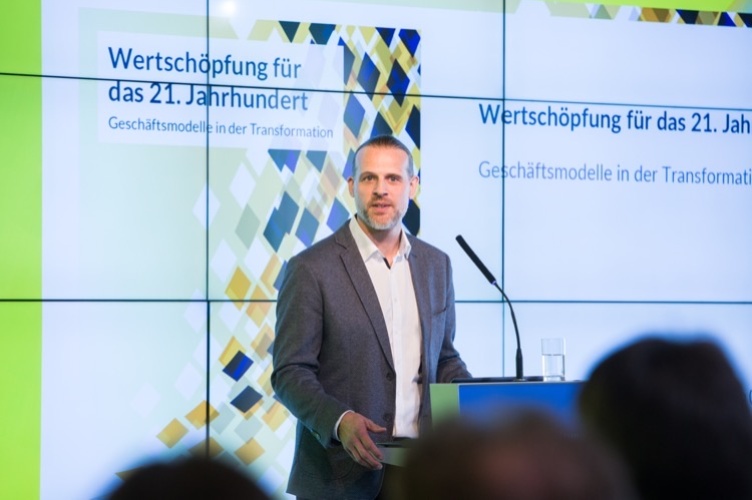
A new study by the Bertelsmann Stiftung and ESCP Business School shows that companies with more sustainable business models also rate themselves as more resilient and competitive. At the same time, German companies still have considerable ground to make up in all three areas.
Rising energy prices, climate change and artificial intelligence are reshaping the environment in which companies operate. A representative survey of 501 German companies shows that sustainability, resilience and competitiveness are closely connected.
Companies are changing their business models at different speeds
Almost nine in ten companies are currently changing their value-creation activities or business models. For 56 per cent, sustainability plays at least a partial role in this process.
At the same time, the gap between companies is widening. Sustainability is now the main driver of change for 16 per cent of companies, compared with 12 per cent three years ago. Meanwhile, the share of companies making little progress in transforming their business models towards greater sustainability has risen from 21 to 27 per cent.
Florian Lüdeke-Freund, Professor of Corporate Sustainability at ESCP Business School in Berlin, describes this development as a “double drift”: “While some companies are making substantial changes to their business models, others are barely moving forward. The differences are growing both in the speed of change and in the importance attached to sustainability.”
Many companies feel unprepared for the next crisis
Supply bottlenecks, staff shortages, cyber-attacks, power cuts and extreme weather events can seriously disrupt business operations. Nevertheless, many German companies feel insufficiently prepared for the next crisis:
- 50.5 per cent rate their preparedness as rather poor or very poor.
- Only 18.8 per cent consider themselves well or very well prepared.
- 53.4 per cent say they would be poorly or very poorly prepared for a situation involving the loss of a quarter of their workforce.
Although 54.8 per cent of companies say they have learnt from previous crises, dedicated budgets for crisis management, regular simulations and scenario exercises remain relatively uncommon.
Sustainable companies invest in their future competitiveness
The study also shows a link between sustainability and investment behaviour. Companies currently invest primarily in maintaining or replacing existing assets and capabilities. Sixty per cent make such investments. By comparison, 44 per cent invest in expansion, while only 26 per cent invest in research, development and innovation.
The more important sustainability is considered to be for the transformation of a company’s business model, the more strongly that company invests in its future and, consequently, its competitiveness.
At the same time, many companies remain optimistic about the future. Some 61.9 per cent expect to meet future customer requirements better than their competitors. Only 4.1 per cent anticipate performing worse.
Recommendations for companies and policy-makers
The study’s authors recommend that companies regularly reassess sustainability-related opportunities and risks, identify potential for change within their own business models and integrate lessons learnt from previous crises into their strategic planning. This could include conducting exercises and simulations, as well as setting aside dedicated budgets for crisis management.
Policy-makers should also strengthen demand for sustainable and resilient products and services, for example through public procurement, comparable product information and market-shaping standards. Support measures should reflect the different stages companies have reached in their transformation.
About the study
The research and consulting institute IW Consult surveyed 501 companies for the study. The sample was weighted to be representative of the German economy as a whole. Based on the companies’ responses, values were calculated for each company’s sustainable business model transformation, resilience and competitiveness.
The statistical analysis shows that these three values are positively and significantly correlated within the German economy.
Read the full study Wertschöpfung für das 21. Jahrhundert – Mit nachhaltigen Geschäftsmodellen zu mehr Wettbewerbsfähigkeit und Resilienz on the Bertelsmann Stiftung website.
Campuses