Participant Reflections from Silicon Valley
What does it take to lead, innovate, and create impact in an era defined by artificial intelligence and rapid technological change?
To explore this question, participants from ESCP Business School traveled to Silicon Valley for an immersive week of learning, discovery, and exchange at the heart of the world's most influential innovation ecosystem.
Through visits to leading technology companies, conversations with entrepreneurs and investors, and discussions on the future of business and AI, participants gained firsthand insights into the ideas and mindsets shaping tomorrow's economy.
Beyond the technologies themselves, the experience offered a deeper understanding of how innovation cultures are built, how bold ideas become reality, and how leaders can navigate uncertainty in a rapidly evolving world.
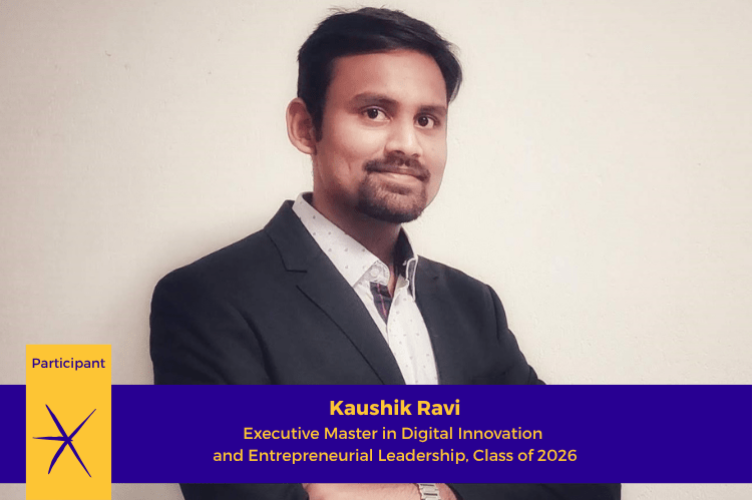
We asked participants to share the moments that challenged their assumptions, the lessons that resonated most strongly, and the insights they are taking back to their organizations and careers. Here is what Kaushik Ravi (EMDIEL Participant 2026) had to say.
1. What belief about innovation or entrepreneurship did you have before arriving in Silicon Valley that changed completely by the end of the week?
I arrived believing Silicon Valley wins because of technology and I came open to learn everything it had to offer on that front. By the end of the week, I realized how central the human factor is. What set the speakers apart wasn't their tech; it was their storytelling. Their way of communicating connected with every single one of us in the room. The technology gets you noticed. The story is what makes people care.
2. If you could bring back just one Silicon Valley mindset to your organization, what would it be?
It's hard to pick just one, because the mindsets reinforce each other: Speed: iterates faster than everyone else, because velocity is the standard, not perfection.
Storytelling: even the best idea goes nowhere if you can't make someone care about it in thirty seconds.
Failure: treat it as data, not shame. If it was in your control, keep working. If it wasn't, move on.
If forced to choose, I'd bring back the mindset that ties them together: run the business as a series of small experiments, and don't waste a single failure.
3. Which conversation stayed with you after the visit ended?
"Your network is your net worth." No matter how far technology advances, no matter what solutions AI proposes, the human remains at the center of everything. A network isn't a transaction or an exchange of favors; it's fundamental trust between people. That trust compounds quietly in the background, and everything else deals, opportunities, partnerships arrives later, almost as a side effect. That conversation reframed how I think about every relationship I build.
4. If you had to bet on one technology trend shaping the next five years, what would it be?
My honest answer is a contrarian one: "Look for secrets in the open, the things around us that nobody sees." The AI trend is absolutely worth observing, and I follow it daily. But precisely because everyone is looking at it, my bet is on what's being missed inside this trend: the overlooked problems, the unglamorous verticals, the assumptions nobody is questioning. The biggest opportunities of the next five years won't be in chasing the wave everyone sees. They'll be in the secrets hiding in plain sight beside it.
5. Which founder story resonated most with you, and why?
Mike Cassidy's journey resonated most with me. Look at his track record: telephony software, a search engine, a gaming platform, a travel startup, Google's Project Loon balloons beaming internet from the stratosphere and then satellite thrusters. Completely uncorrelated industries. No pattern in the domains at all.
And that's exactly the lesson. His success was never about being the deepest expert in one field. It was about a repeatable playbook: move with extreme speed, tell a story people can believe in, and be at the right time with the right people. The domain changes; the method doesn't.
It resonated because it challenged something I quietly believed that you must pick one industry and stay there for decades to succeed. Mike's story shows that speed, storytelling, and timing are transferable skills. Master the playbook, and you can run it anywhere.
6. What aspect of Silicon Valley's ecosystem would be hardest to replicate elsewhere?
The combination and more importantly, the connection. Other places have smart people. Some have great storytellers, fast movers, or bold risk-takers. What makes the Valley nearly impossible to replicate is having all of them in one place, one coffee away from each other, willing and able to work together as a single network. Any one ingredient can be copied. The compounding that happens when they all connect takes decades, and it can't be rushed.
Campuses