
Marketing Fundamentals—Strategies, Channels, Examples
Think about your favourite brands. Whether it is Apple, Nike, or Patagonia, they all excel at one essential function: marketing. Marketing is how businesses create awareness, attract customers, and build lasting relationships that support growth.
In competitive environments where digital channels evolve constantly, understanding the fundamentals of business marketing is essential. It provides organisations with the tools to stand out, adapt to changing customer expectations, and build sustainable success. This article explains what business marketing is, how it works, the main strategies and types, and how companies apply marketing in practice.
What is marketing?
A definition of marketing
Marketing ensures that the right product or service reaches the right audience at the right time. It begins with understanding customer needs and aligning a company's offering with those needs more effectively than competitors.
The American Marketing Association defines marketing as "the activity, set of institutions, and processes for creating, communicating, delivering, and exchanging offerings that have value for customers, clients, partners, and society at large."
Key components of a marketing approach
A strong marketing approach typically rests on four core building blocks:
- Research: understanding markets, customer segments, and competitors
- Strategy: defining positioning, value propositions, and brand messaging
- Execution: activating campaigns across selected channels
- Measurement: tracking performance and optimising results
Marketing is therefore an integrated system that influences everything from product design and pricing to customer experience and retention.
Business marketing vs consumer marketing
It is important to distinguish between business marketing (B2B) and consumer marketing (B2C).
Business marketing (B2B) focuses on selling products or services to other organisations. It usually involves longer sales cycles, higher-value contracts, and decision-making by multiple stakeholders.
Consumer marketing (B2C) targets individual customers. Campaigns are often emotion-driven, with shorter purchase journeys and mass targeting through retail, e-commerce, or digital platforms.
For example, Salesforce markets CRM software to enterprises through B2B strategies, while Nike uses consumer marketing to reach individuals through storytelling around sport and lifestyle. Both approaches rely on the same fundamentals—research, communication, and value creation—but differ significantly in execution.

How business marketing works
Marketing follows patterns that reflect how people and organisations make decisions. To understand how it works in practice, it helps to examine the buyer's journey, the relationship between marketing and sales, and the role of paid versus organic channels.
The buyer's journey and the marketing funnel
The buyer's journey describes the stages customers typically go through before purchasing:
- Awareness: recognising a problem or need
- Consideration: researching possible solutions
- Decision: choosing a provider or product
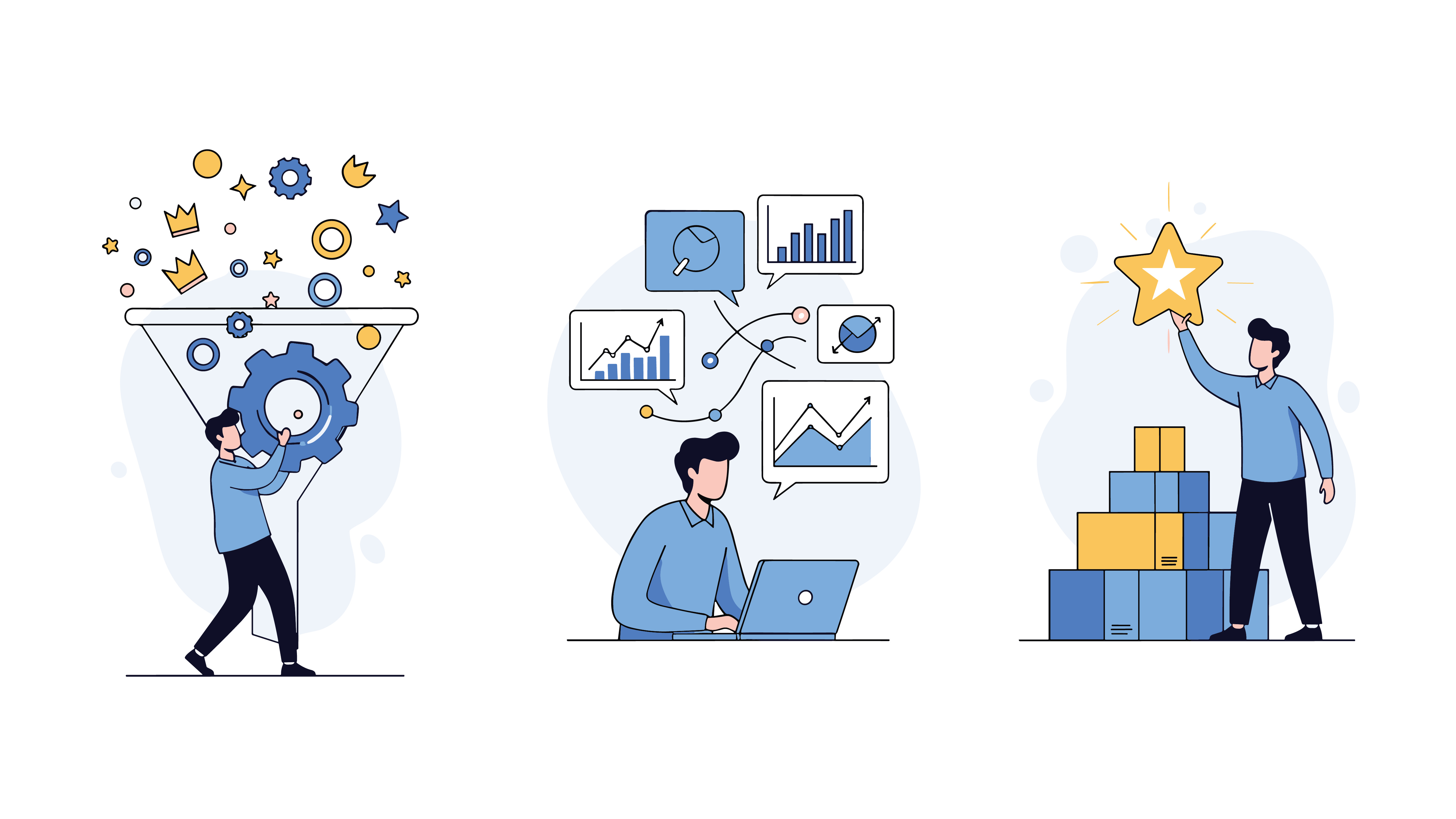
The marketing funnel aligns activities with each stage. Awareness efforts focus on visibility (advertising, social media, blog content). Mid-funnel activities nurture interest (white papers, webinars, demos). Bottom-funnel actions support conversion (case studies, trials, sales calls). Using the funnel helps businesses deliver relevant messages at the right moment and avoid wasted budget.
The 4 Ps of business marketing
The marketing mix—often called the 4 Ps—remains one of the most widely used frameworks. Originally proposed by E. Jerome McCarthy in the 1960s, it outlines the key elements a company must balance to succeed: Product, Price, Place, and Promotion. While digital transformation has added complexity, these pillars remain as relevant as ever.
Product
The product or service must solve a problem or deliver value in a distinctive way. Marketers define:
- the core benefit
- features and design
- differentiation from competitors
For example, Apple's iPhone is not just a smartphone: it's positioned as a lifestyle product that combines design, functionality, and status.
Price
Pricing reflects perceived value and market positioning. Businesses may use:
- Cost-based pricing (covering production + margin).
- Value-based pricing (what customers are willing to pay).
- Competitive pricing (relative to market alternatives).
Dynamic pricing models, such as those used by airlines, show how technology enables more flexible pricing strategies.
Place
Place refers to how products are distributed and accessed, whether physical locations (stores, warehouses) or digital channels (e-commerce platforms, mobile apps).
Marketers ask:
- Where do customers expect to find the product?
- Which distribution methods maximise reach and efficiency?
For instance, Nike sells through its own website, retail partners, and flagship stores, creating multiple touchpoints to reach different customer segments.
Nike, for example, combines direct-to-consumer platforms with retail partners to maximise reach.
Promotion
Promotion includes advertising, public relations, content marketing, social media, and sales incentives. With audiences exposed to constant messaging, effective promotion depends on relevance, creativity, and authenticity. Coca-Cola's mix of global campaigns and local activations illustrates this balance.
How marketing shows up in the real world
B2B example: Hero Packaging
Hero packaging, an Australian company, sells compostable packaging solutions to e-commerce businesses. Their marketing strategy focuses on education—through blogs, webinars, and detailed guides on sustainability—positioning them as thought leaders in eco-friendly packaging. By aligning their product with clients' sustainability goals, they've built strong credibility in the B2B space.
B2C example: Transformer Table
Transformer Table, a Canadian furniture brand, demonstrates the power of viral content. Their expandable dining tables went viral on TikTok and Instagram thanks to short, visually striking videos showing the product in action. This B2C strategy combined social proof and shareability to drive rapid growth and international sales.
Community-led example: Intelligent Change
Intelligent Change, the brand behind the Five Minute Journal, leverages community marketing. They share customer testimonials, encourage user-generated content, and focus on building a lifestyle community around mindfulness and productivity. This approach blends content marketing with emotional connection, fostering loyalty well beyond the initial purchase.
Types of business marketing
Businesses use different marketing types depending on objectives, audiences, and resources.
- Business-to-consumer (B2C) marketing: emotion-drive campaigns targeting individuals
- Business-to-business (B2B) marketing: content-led strategies addressing multiple decision-makers
- Content marketing: blogs, videos, and resources that build trust over time
- Influencer and affiliate marketing: partnerships that extend reach through credibility
- Field and experiential marketing: live or interactive brand experiences
- Account-based marketing (ABM): personalised campaigns for high-value B2B accounts
- Service marketing: trust-focused strategies for intangible offerings
- Social media and email marketing: direct, high-ROI communication channels
- SEO and SEM: organic and paid visibility in search engines
- SMS and direct marketing: targeted messages delivered directly to customers
Each type plays a different role within a broader marketing strategy.
Creating a business marketing strategy
Knowing the tools is not enough. Success depends on a clear, consistent strategy.
Step 1: Know your target audience
Businesses use research, surveys, and data analysis to create buyer personas. Understanding motivations and challenges shapes messaging, channel choice, and positioning.
Step 2: Choose the right channels
Not every channel suits every business. B2B firms may prioritise LinkedIn or webinars, while B2C brands often focus on visual or experiential platforms.
Step 3: Create content that converts
Content should inform, inspire, or entertain while guiding prospects through the funnel. Effective content combines storytelling with clear calls to action.
Step 4: Measure, analyse, and optimise
KPIs such as traffic, conversion rates, acquisition cost, and ROI help teams refine strategy. Marketing evolves with customer behaviour, technology, and market conditions.
A successful marketing strategy isn't static. It evolves with customer behaviour, industry trends, and technology—making adaptability as important as planning.
Benefits and challenges of business marketing
Why marketing drives growth
Marketing builds visibility, generates leads, and supports revenue growth. It also helps organisations adapt by revealing shifts in customer behaviour and market demand.
Common pitfalls to avoid
Poor targeting, unclear messaging, over-reliance on one channel, and lack of measurement can undermine performance. Consistency and data-driven decision-making are essential.
In summary: why business marketing matters
Business marketing is not simply about promotion. It is about understanding customers, delivering value, and building relationships that support long-term performance. Organisations that master marketing are better positioned to compete, adapt, and grow in dynamic environments.
Learning business marketing at ESCP
Why marketing matters for future leaders
In a global economy where customers expect personalisation, authenticity, and innovation, tomorrow's leaders must understand not only how to manage teams but also how to connect with audiences. Studying marketing provides that dual advantage: strategic insight and practical tools.
Programmes that build real-world marketing expertise
At ESCP, students can strengthen their expertise through specialised programmes such as the MSc in Marketing & Communication, the Master of Science in Marketing & Creativity and the MSc in Marketing and Digital Media, each designed to combine strategic insight with hands-on experience.
FAQ
Marketing connects businesses with customers by creating awareness, building trust, and driving sales. It ensures products and services are positioned effectively in competitive markets.
The most effective types vary by context, but digital channels like content marketing, SEO, social media, and email consistently deliver strong ROI. Combining these with traditional approaches creates a balanced strategy.
Begin by identifying your target audience, defining clear goals, and choosing the right channels. Then create consistent content, track performance, and adjust based on data.
Popular tools include Google Analytics for insights, HubSpot or Salesforce for customer management, and platforms like Canva or Mailchimp for content and campaigns. The right mix depends on your budget and objectives.
Relevant link
Campuses