
HR leaders explore how Executive MBA programmes must evolve to meet new corporate expectations
As part of EMBAC 2026, hosted in Turin, ESCP Business School brought together senior HR leaders for a focused roundtable on the future of executive education.
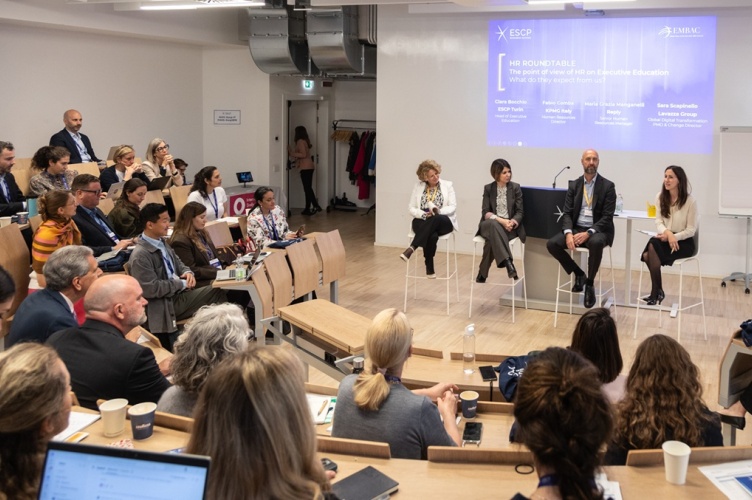
The Roundtable "The point of view of HR on Executive Education. What do they expect from us?" offered a corporate perspective on how Executive MBA programmes are evolving, highlighting shifting expectations around leadership, skills, and lifelong learning in a rapidly changing business environment.
A corporate view on executive talent
Moderated by Clara Bocchio, Head of Executive Education at ESCP Business School Turin, the discussion brought together Sara Scapinello, Global Digital Transformation PMO & Change Director at Lavazza Group, Fabio Comba, HR Director at KPMG Italy, and Maria Grazia Manganelli, Senior Human Resources Manager at Reply. Their exchange provided a clear picture of how organisations assess executive talent today and what they expect going forward.
A key message emerged: the profile of successful executives is changing. Beyond technical expertise, companies increasingly value leaders who combine strategic thinking, digital awareness and strong interpersonal capabilities. The ability to navigate complexity, understand artificial intelligence, and lead across cultures is becoming essential.
Rethinking the value of the Executive MBA
While Executive MBA programmes remain highly relevant, organisations are reassessing their role. They continue to be seen as powerful tools to broaden perspective and strengthen leadership, yet expectations are evolving in line with business transformation.
HR leaders pointed to the need for programmes that are more closely aligned with real-world challenges, particularly in areas such as AI and digital transformation. At the same time, generational change is reshaping leadership models, with younger professionals bringing new expectations around purpose, flexibility and continuous learning.
These shifts raise important questions for business schools: how to adapt curricula, formats and partnerships to remain impactful.
Strengthening dialogue between business and academia
The roundtable highlighted the importance of closer collaboration between companies and academic institutions. As executive roles evolve, so too must the way programmes are designed and delivered.
The discussion in Turin confirmed a clear trend: Executive MBA programmes are evolving alongside the leaders they aim to develop.
By strengthening ties with organisations and listening to their needs, Business Schools can shape executive education that prepares leaders to navigate complexity, drive transformation and create lasting impact.
EMBAC 2026
The Executive MBA Council (EMBAC) is a global association of business schools and universities delivering Executive MBA programmes. It provides a platform for academic leaders to exchange best practices and anticipate trends shaping executive education worldwide.
The EMBAC Europe / Middle East / Africa Regional Meeting 2026 marked a significant milestone: for the first time, the event was hosted at ESCP Business School, thanks to the leadership of Professor Francesco Venuti, Dean of ESCP's Executive MBA, and Michael Desiderio, EMBAC Executive Director, reinforcing the School’s role within the international executive education community.
For a broader overview of the event and key discussions:
For a focus on AI in Executive Education:
Campuses
Related stories
News 07/05/2026
Executive Education
EMBAC 2026: Turin hosts global EMBA leaders
EMBAC 2026 in Turin brought together global EMBA leaders to discuss AI, HR expectations, and the future of executive education.
Turin
News 08/05/2026
Executive Education
AI in Executive Education: EMBAC 2026 insights
At the EMBAC Regional Meeting 2026 in Turin, artificial intelligence took centre stage in discussions on the future of executive education. Bringing together global EMBA leaders, the event explored how AI is transforming programme design, assessment methods and digital learning environments.
Turin