Explore how AI is reshaping executive education, from programme design to assessment and digital learning innovation
At the EMBAC Regional Meeting 2026 in Turin, artificial intelligence took centre stage in discussions on the future of executive education.
Bringing together global EMBA leaders, the event, hosted by ESCP Business School’s Turin Campus, explored how AI is transforming programme design, assessment methods, and digital learning environments. Across dedicated sessions, a common theme emerged: innovation must go beyond tools and technologies to reinforce academic rigour and learning impact. From agentic AI to new assessment models and scalable digital formats, EMBAC 2026 highlighted how business schools are redefining executive education in a rapidly evolving landscape.
AI and programme design in the agents era
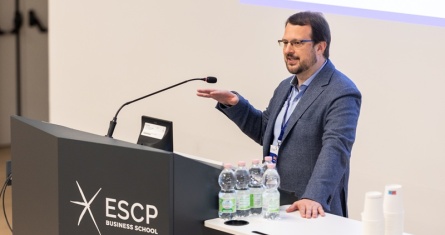
The opening AI-focused session featured Carlotta Reviglio (Strategic AI Success Engineer at OpenAI), who explored AI’s impact on executive learning and programme design. Her intervention highlighted a major shift: we are entering an agentic era, where AI systems no longer simply respond to prompts but can execute tasks, manage workflows and support complex decision-making processes.
For executive education, this evolution requires a redesign of institutional models. Reviglio emphasised the need to equip both participants and faculty with enterprise-level tools, fully integrated into learning environments. The challenge is no longer technological capability, but adoption—bridging the gap between what AI can do and how institutions effectively use it.
This perspective positions AI not as an add-on, but as a structural component of programme design, enabling more applied, efficient and personalised learning experiences aligned with real-world business practices.
Assessment in the AI era: from outputs to reasoning
The conversation then turned to evaluation, with Sonia Ben Slimane (Executive Director of ESCP Research Institute of Management at ERIM) addressing how assessment must evolve in an AI-enabled environment. As she outlined, participants already use AI extensively, while faculty practices remain heterogeneous—creating an urgent need for structured, institution-wide frameworks.
At EMBAC, the discussion underscored a clear paradigm shift in executive education:
- From knowledge recall to decision-making capability
- From outputs to learning processes
- From individual work to AI-assisted reasoning
- From standard exams to authentic assessment
Examples include oral defences, real-life business cases and assignments requiring students to justify their use of AI. This approach fosters critical thinking, transparency and professional readiness.
Rather than restricting AI, the objective is to integrate it meaningfully into assessment, aligning evaluation methods with the realities of modern managerial work.
Maintaining academic excellence in digital formats
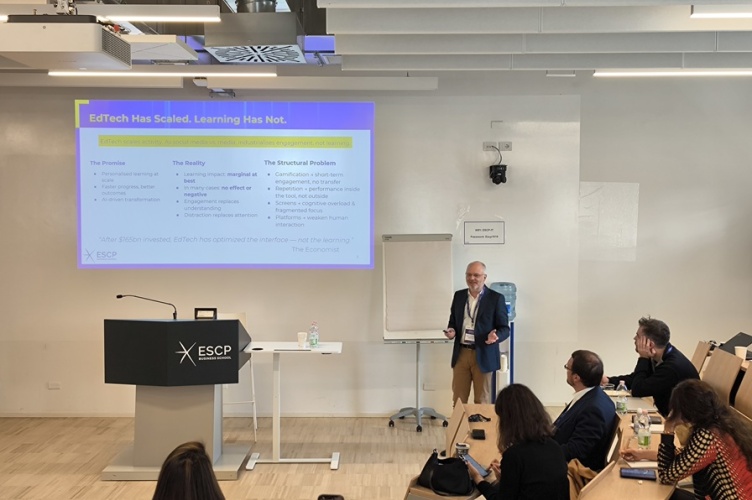
The final session focused on digital education, with Dimitri Champollion (Executive Director of Digital Education at ESCP Business School) examining how institutions can scale online learning without compromising quality.
The key message is clear: digital transformation must be guided by pedagogy. While edtech has successfully scaled access, its impact on learning outcomes remains uneven. As highlighted during the session, true innovation lies in designing learning experiences—not simply digitising content.
This translated into a strategic vision for executive education built on:
- Pedagogical excellence across formats (online, hybrid, on campus)
- Modular and stackable learning pathways
- Reusable, high-quality content design
- Seamless and intuitive user experience for executives
This approach reflects a broader shift from fragmented digital initiatives to integrated ecosystems, where learning design, technology and faculty engagement work together to deliver consistent academic value.
The AI and digital sessions at EMBAC 2026 in Turin confirmed a shared direction for executive education: transformation must be both technological and pedagogical. As business schools adapt to the rapid evolution of AI, the priority is not simply to adopt new tools, but to redesign learning, assessment and delivery models.
Across discussions, one idea stood out: the future of executive education will depend on combining innovation with academic rigour.
Held from 4 to 6 May at ESCP Business School in Turin, the EMBAC Regional Meeting EMEA brought together over 60 leaders from across Europe, the Middle East and Africa, creating a unique space for dialogue and collaboration.
The success of the meeting reflects the commitment of key contributors, including Francesco Venuti, who played a central role in bringing EMBAC 2026 to Turin, alongside Michael Desiderio, Executive Director of EMBAC.
For a broader overview of the event and key discussions:
Campuses