
Why a Top 3 Marketing Masters is doubling down on creativity in the age of AI
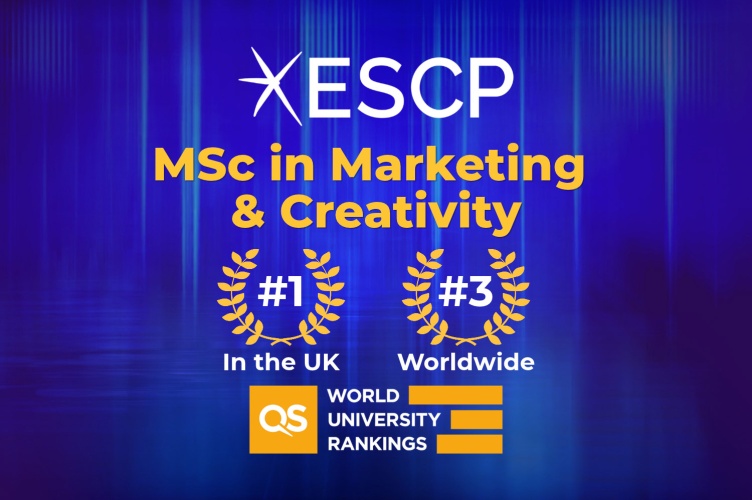
ESCP Business School’s MSc in Marketing & Creativity (MMK) has been ranked 3rd worldwide and 1st in the UK for the second year running in the latest QS Business Master’s Rankings for Marketing.
As artificial intelligence is slowly transforming the workplace, ESCP’s MSc in Marketing & Creativity remains amongst the world’s leading programmes while staying true to a principle that has long defined its vision: technology may change the tools marketers use, but creativity, agility, strategic thinking and human judgement remain fundamental to what sets them apart.
ESCP Business School’s MSc in Marketing & Creativity (MMK) has maintained its position as 3rd worldwide and 1st in the UK in the latest QS Business Masters Rankings for Marketing. The ranking draws on a global assessment that includes feedback from more than 37,000 employers and 43,000 academics. MMK also received top marks for student diversity, placed in the top 5 globally for employability and ranked 1st worldwide for Value for Money, based on payback period and return on investment.
Our no. 3 ranking remains a great source of pride and satisfaction, particularly at a time when the link between creativity and marketing is evolving fast in the context of AI.
 Prof. Marie Taillard
Dean of ESCP London
The ranking comes as ESCP has also been shortlisted for the Times Higher Education Business School of the Year 2026 award, recognising the School’s work across areas including AI innovation, entrepreneurship and real-world learning. In 2026, marketing jobs look noticeably different from even a few years ago. AI is now embedded across many of the tools and processes marketers use every day, changing not only how work gets done, but what organisations need from the people doing it.
As a programme that has placed creativity in its DNA since the start, these changes bring renewed relevance to a question MMK has long explored: what is the value of creativity in marketing?
What is the value of creativity?
The MSc in Marketing & Creativity has never defined creativity simply as the domain of traditionally “creative” roles in marketing and advertising. Since its first intake in January 2010, the programme has approached creativity as a way of thinking, of questioning assumptions, making unexpected connections, looking at problems from different perspectives and finding new ways forward.
AI can now do a lot of the work that once took marketers hours, from analysing data and synthesising research to producing first drafts and ideas. But having more and faster answers does not necessarily mean having better ones. Marketers still need to know which questions to ask, what to challenge, what is missing and when an idea needs to be taken in a different direction.
That ability to challenge, reinterpret and make unexpected connections is where creativity becomes a form of strategic problem-solving – and why it remains central to the way MMK approaches marketing education.
The skills employers are looking for point in a similar direction. The World Economic Forum’s Future of Jobs Report 2025 identified AI and big data and technological literacy among the fastest-growing skills, yet analytical thinking, resilience, leadership and creative thinking remain among the top capabilities employers value most.
A different approach to learning marketing
The MSc in Marketing & Creativity’s distinctive approach brings together marketing, analytics and tech, creativity and industry engagement, encouraging students to combine analytical and creative thinking with experimentation and practical application.
Its Not By The Book philosophy also applies creativity to the learning process itself. Through consultancy projects, creative seminars, case studies and direct industry engagement, students are constantly required to test their new knowledge and skills against real business challenges, often engaging up to 15 different companies throughout the course of their studies.
The applied learning experience then leads to improved employability outcomes, which is also evident in the latest QS ranking. Alongside its overall position of 3rd worldwide and 1st in the UK, the MSc in Marketing & Creativity ranked top 5 globally for employability.
Year on year, our partner organisations come back to us with live briefs and new industry challenges rather than tidy case studies. This provides an exciting and unique learning experience for our students. Such an exchange builds the strong employability track record of our MMK students, and as graduates leave having already been tested by industry, equipped with AI literacy as well as their own critical and creative thinking capabilities.
 Vanezza Scanlon
Co-Director of MSc in Marketing & Creativity
What does it take to prepare marketers for what comes next?
For students entering marketing careers in 2027 and beyond, understanding concepts and developing digital skills is only part of the equation. They also need to know how to apply what they have learned when the problem is ambiguous, the information is incomplete and the deadline for finding a solution is tight.
Working on real business challenges throughout MMK gives students experience navigating competing priorities, developing and testing ideas, and adapting what they have learned when textbook frameworks don’t quite fit the unexpected realities of business.
The programme’s international dimension adds another kind of challenge. Studying across London and Paris alongside classmates representing 25–30 nationalities exposes students to different markets, cultures and perspectives. An idea that works in one context may not work in another, and being challenged by people who see a problem differently is itself part of developing a more creative approach to marketing.
The biggest skill I developed at MMK was learning to see things from different perspectives. Being surrounded by an international cohort exposed me to different cultures, experiences and ways of thinking, which expanded how I approach creative problems. I learned to challenge my first instinct, explore different avenues and stay curious about where an idea could go. I draw on that mindset constantly in my work today, particularly as technology and AI evolve. While these tools can enhance and accelerate creativity, I believe the thinking should always remain human, and be rooted in curiosity, perspective, and meaningful insight.
 Maia Marquez
MMK Class of 2024 and Strategy Lead at SALT Global Marketing Consultancy
Where can this combination of skills lead?
The ability to combine creative thinking with analytical, strategic and digital skills is not tied to one career path. As roles continue to evolve – including into jobs that may not yet exist – a strong marketing foundation and an adaptable, creative mindset give graduates the ability to keep learning and adding new skills along the way.
Recent MMK Class of 2025 graduates have moved into roles across marketing, brand and product management, growth, innovation, strategy and consulting, while others have gone on to become founders. They have joined organisations including L’Oréal, Chanel, Adidas, Unilever, Danone, Dentsu and Landor.
The roles may look very different, but the underlying challenge is often similar: understanding a problem, making sense of the information available and finding a way forward when the answer is not obvious.
As marketing continues to change, preparing graduates to think beyond the tools they use may be one of the most valuable things a Marketing Masters can do.
Wondering if ESCP's MSc in Marketing & Creativity is the right programme for you and your career? Take our 4-minute quiz to find out.
Related stories:
- ESCP programmes rank among world’s best in QS 2027 Business Masters Rankings
- MMK ranks 3rd worldwide and 1st in the UK - September 2025
- 15 years of Marketing & Creativity at ESCP
- MMK students reach the L’Oréal Brandstorm UK & Ireland Finals
- MMK students take on 2026 L’Oréal’s Big Picture challenge
- ESCP granted full Degree Awarding Powers in the UK
Campuses