
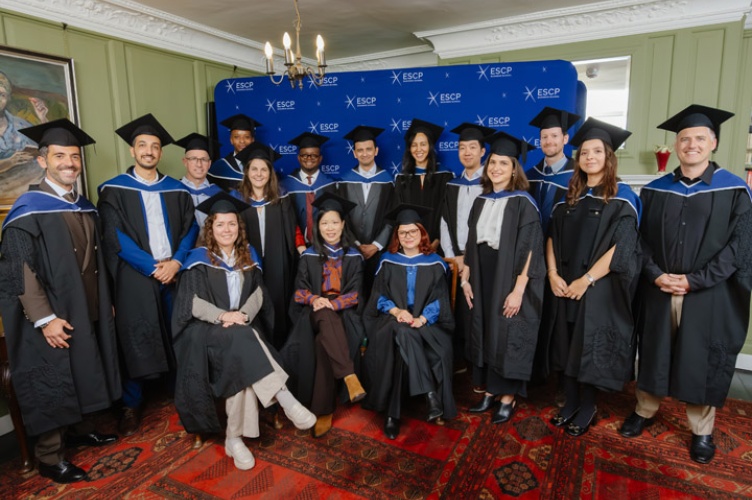
EMFE Class of 2026 marks the fourth graduating cohort of this successful executive education programme
ESCP’s Executive Master in Future Energy Class of 2026 celebrated the end of its 18-month programme, reuniting graduates from more than 20 nationalities in London for the Graduation Ceremony.
On Friday 16 October, ESCP celebrated the graduation of the Executive Master in Future Energy (EMFE) Class of 2026 at Burgh House, a historic venue in Hampstead, UK.
The ceremony marked the end of an 18-month academic journey for executives from more than 20 nationalities and a wide range of professional backgrounds. It also offered the cohort an opportunity to reconnect and reflect collectively on the challenges and opportunities shaping the energy sector.
Preparing leaders for a complex energy landscape
Opening the ceremony, Professor Marie Taillard, Dean of ESCP London Campus, highlighted the importance of the programme within ESCP’s Bold and United strategy. She emphasised the central role of alumni and the responsibility graduates now carry as leaders in a sector undergoing profound change.
The future of energy will depend on technology, regulation, policy and investment, but also on the people responsible for bringing these dimensions together. This is why programmes such as EMFE are so important: they bring different disciplines and perspectives into conversation and help develop responsible, accountable leaders. I am proud of our new EMFE graduates and the crucial role they will play in shaping a more sustainable future for us all.
 Prof. Marie Taillard
Dean of ESCP London
The keynote address was delivered by Temistocles Rojas, Principal Geoscience & Petroleum at Baker Hughes. Drawing on more than two decades of international experience in energy technology and innovation, Rojas examined the tension at the heart of the global energy trilemma: balancing energy security, affordability and environmental sustainability.
He noted that the energy transition requires an integrated approach rather than a shift from one energy source to another. The future is likely to involve the expansion and integration of multiple forms of energy, supported by technology, effective policy and professionals who can work across disciplines.
Highlighting the value of EMFE’s holistic curriculum, which connects governance, finance, technology, strategy and regulation, Rojas urged graduates to apply an integrated perspective to complex challenges throughout their professional journeys.
“You are entering this challenge at exactly the right moment,” he told the graduating class, encouraging them to act with integrity and recognise the far-reaching impact of their decisions.
Leading through uncertainty
Professor Spiros Papaefthimiou, Academic Director of EMFE, reflected on the distinctive context in which the graduates completed the programme.
They studied energy during one of the most turbulent periods in the sector’s recent history, influenced by geopolitical tensions, disruptions to global supply, and ever changing trading patterns, which have placed energy security back at the heart of the international agenda, alongside long-term decarbonisation and electrification goals.
As the graduates finish their ESCP journey, Papaefthimiou encouraged the cohort to continue combining their systems thinking and technical rigour with a global strategic mindset to face the operational reality of the energy transition, which requires pragmatic and forward-looking leadership.
I am particularly proud of this graduating cohort, as they have completed the programme during one of the most turbulent periods in the energy sector, transformed by geopolitics, abrupt changes in markets and renewed questions around security of supply. The energy transition is happening now, and our graduates are already living and leading it. I am confident they will be practical visionaries, bringing together different perspectives to shape the future of the energy sector.
 Prof Spiros Papaefthimiou
Academic Director of Executive Master in Future Energy at ESCP
A journey shaped by shared experience
Representing the graduating class, valedictorian Aziza Alaoui Kacimi, Chief Operating Officer, MENA at Aryam Adaptive & Regenerative Solutions, reflected on her transition into the energy sector after 15 years in asset management.
She described how her transferable analytical skills, combined with EMFE’s interdisciplinary framework, supported her move towards sustainable innovation and lower-carbon initiatives. She also praised the collaborative nature of the programme, where participants from engineering, finance, policy and management brought different perspectives to complex challenges.
Her co-valedictorian, Mouhamadou Fall, spoke about the social dimension of the energy transition and the role of energy access in economic development and reducing inequality. He described EMFE as a platform for high-level debate, professional growth and lasting relationships built around a shared sense of purpose.
After quite some time spread across screens and cities, reuniting with my cohort at the graduation ceremony was a real joy, with the connection just as strong as I remembered.
What I valued most about the EMFE experience, beyond the academic excellence, was building on our complementary life experiences and skill sets, with each of us bringing a piece of the puzzle. That came to life in our consultancy project, where our group’s varied backgrounds and disciplines enriched our approach to real-life, topical challenges.
The programme also deepened my conviction that the energy transition is key to a safe, affordable and sustainable future, while appreciating the need for pragmatic, innovative and context-specific solutions that leave no one behind.
As I continue my entrepreneurial journey at Aryam, where we use AI to support a regenerative and low-carbon economy, I look forward to putting the knowledge gained into practice. And, I have no doubt that my cohort and I will keep playing a part in each other’s lives as we work towards a more sustainable future.
 Aziza Alaoui Kacimi
Chief Operating Officer, MENA at Aryam Adaptive & Regenerative Solutions and ESCP EMFE Class of 2026 alumna
With their studies complete, the EMFE Class of 2026 now joins ESCP’s international alumni network of over 95,000 professionals, ready to lead sustainable change across the global energy value chain. Congratulations to all our graduates! Photos from the event are available here.
About the Executive Master in Future Energy
The Executive Master in Future Energy (EMFE) is an 18-month, part-time programme designed for professionals seeking to understand and lead change across the energy sector.
Delivered online or through a blended format, the programme combines academic expertise with practical industry insights, an international consultancy project and three European seminars in London, Berlin and Madrid. Its interdisciplinary curriculum covers energy technologies, markets, policy, strategy, governance and sustainability, helping participants develop the strategic and cross-functional skills needed to navigate the evolving energy landscape.
ESCP’s Executive Education Open programmes rank 25th globally in the 2026 Financial Times ranking, while its Executive MBA ranks fifth worldwide.
The next EMFE cohort begins in February 2027, and applications are currently open. If you are a mid-career or senior professional interested in developing the knowledge and skills to lead in the evolving energy sector, contact our EMFE Recruitment and Admissions Team today at ukenergy@escp.eu to discuss how the programme can support your professional objectives.
Campuses