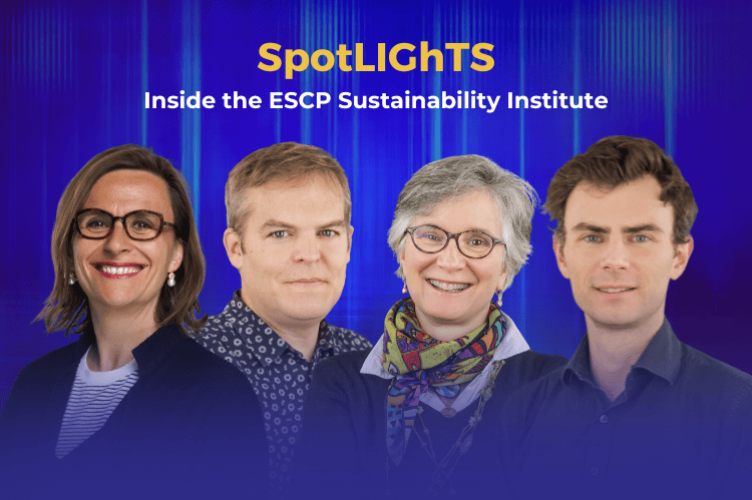
How ESCP’s Sustainability Institute engages students in navigating ecological limits, organisational realities and contested knowledge
On 24 January, the International Day of Education marks the role of education in peace and development. Since its proclamation by the United Nations General Assembly in 2018, the day has highlighted the importance of inclusive and equitable education in addressing structural inequalities and long-term societal challenges.
The theme of the International Day of Education 2026, “The power of youth in co-creating education”, draws attention to students and young people as active participants in shaping educational content, methods and priorities. In the field of sustainability, this theme raises an important question: how can education be co-created when ecological limits, social tensions and contested knowledge increasingly shape the conditions under which organisations and societies operate?
At ESCP Business School, this question lies at the core of the work carried out by the Sustainability Institute. Its research and teaching do not approach sustainability as an add-on to existing managerial frameworks. They start from the observation that climate change, biodiversity loss and social inequalities already structure organisational decisions, professional trajectories and public debate, often in ways that are uncomfortable, ambiguous and unresolved.
From Anthropocene to Organocene: organisations at the centre
Research conducted within the Sustainability Institute is grounded in a shared analytical perspective: ecological crises are inseparable from organisational forms. Professor Aurélien Acquier, Director of the Institute, has described this shift as a move from the Anthropocene to the “Organocene” — a way of emphasising how organisations, value chains and institutional arrangements actively shape planetary outcomes.
This perspective informs a wide range of research topics. Work on global value chains and supply networks, led in particular by Professor Valentina Carbone, examines how environmental and social impacts are produced, displaced or mitigated across interconnected organisations. Research on non-governmental organisations explores how mission-driven actors navigate tensions between values, funding constraints and operational demands. Studies on employee engagement analyse how ecological and social concerns are taken up within firms, and how organisational structures can enable or limit collective action.
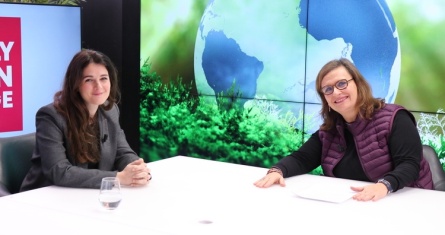
Professor Valentina Carbone discusses how sustainability education must evolve to prepare future leaders to operate within planetary boundaries, ten years after the launch of the UN Sustainable Development Goals.
Across these research streams, sustainability appears less as a technical problem to which clear solutions can be found than as an organisational challenge marked by trade-offs, power relations and competing interpretations of responsibility. This diagnosis directly shapes the Institute’s approach to education.
Teaching sustainability under physical and organisational constraints
One of the clearest illustrations of this approach is the long-standing course Energy – Business, Climate & Geopolitics, co-developed by Professor Aurélien Acquier and Associate Professor Pierre Peyretou. Delivered across several ESCP campuses, the course places energy systems and physical constraints at the centre of sustainability education.
Rather than starting from corporate commitments or policy targets, the course introduces students to the material foundations of economic activity: energy flows, emissions trajectories, geopolitical dependencies and climate scenarios derived from scientific assessments. Students work with concrete data, sectoral case studies and scenario analysis to understand what climate objectives imply in practice for industries such as aviation, mobility or construction.
This pedagogical choice is deliberate. As Pierre Peyretou has emphasised in both teaching and public work, sustainability education often remains disconnected from the physical realities that underpin economic systems. Confronting these realities can be destabilising for students, particularly when it reveals tensions between prevailing growth models and decarbonisation pathways. The aim is not to provide ready-made answers, but to establish a shared factual basis from which informed debate and critical reflection can emerge.
To extend this approach beyond the classroom, the course’s pedagogical materials have been made openly accessible through Commons for Future, an online platform curated by Pierre Peyretou. The initiative reflects a commitment to open knowledge and to recognising students, educators and practitioners as contributors to a collective learning process.
Learning through engagement, inquiry and emotion
Research on sustainability education carried out at ESCP shows that learning in this field involves more than cognitive acquisition. Professor Caroline Verzat’s work on impact pedagogy and emancipatory learning environments highlights the role of emotions, uncertainty and collective inquiry in changing mindsets and behaviours.
These insights inform pedagogical initiatives such as the Designing Tomorrow: Business & Sustainability seminar, which brings together large cohorts of students at the start of their studies. The seminar combines scientific input, encounters with practitioners and collective work on socio-technical controversies linked to climate change and social transformation. Students investigate concrete cases, conduct interviews and reflect on the organisational dynamics at play.
Rather than shielding students from complexity, the seminar exposes them to it. Feelings of dissonance or discomfort are treated as part of the learning process, provided they are accompanied by spaces for dialogue, reflection and collective sense-making. Students are encouraged to articulate their own questions and to contribute actively to the framing of problems, in line with the idea of education as a co-created process.
Other courses experiment with speculative and creative methods to complement analytical approaches. Design fiction projects, developed in collaboration with designers and researchers, invite students to construct plausible future scenarios grounded in scientific knowledge. These exercises do not aim to predict outcomes, but to make the implications of different trajectories tangible and discussable. They often raise questions about the future role of managers, organisations and institutions in contexts shaped by ecological limits.
Bridging research and action through partnerships
The Sustainability Institute’s mission explicitly emphasises the link between research, education and practice. This link takes concrete form through partnerships with companies, public organisations and civil society actors.
Programmes such as Adaptation(s), developed in collaboration with AXA Climate School, combine research, public conferences and executive education to explore how organisations respond to climate impacts that are already unfolding. Other initiatives focus on sustainable business model transformation, employee engagement or responsible innovation in different regional contexts.
Programme Adaptation(s), a joint initiative by ESCP Business School and AXA Climate, exploring how organisations adapt to climate change impacts already underway.
In these settings, students and young professionals often play an active role alongside researchers and practitioners. Their contributions reflect the Institute’s understanding of youth as agents of change, capable of questioning established practices and bringing new perspectives into organisational debates.
Education as shared responsibility
The International Day of Education underlines education’s contribution to peace, justice and inclusion. In the field of sustainability, this contribution depends on the ability of educational institutions to engage seriously with ecological limits and organisational realities.
At ESCP, co-creating education with youth means designing research and teaching that remain attentive to uncertainty, grounded in interdisciplinary work and open to critique. It also involves recognising students as participants in knowledge production, whose engagement shapes educational practices over time.
In a context where ecological and social pressures continue to intensify, sustainability education remains a demanding endeavour. It requires patience, collaboration and a willingness to work within constraints. On the International Day of Education, the work of the ESCP Sustainability Institute reflects a modest but concrete ambition: to equip current and future leaders with the capacity to understand complex systems, engage responsibly with organisational realities and contribute to collective efforts for a liveable and just future.
External link
Campuses