
As artificial intelligence accelerates and organisations face profound technological, environmental and geopolitical changes, future managers will increasingly be expected to navigate transformation.
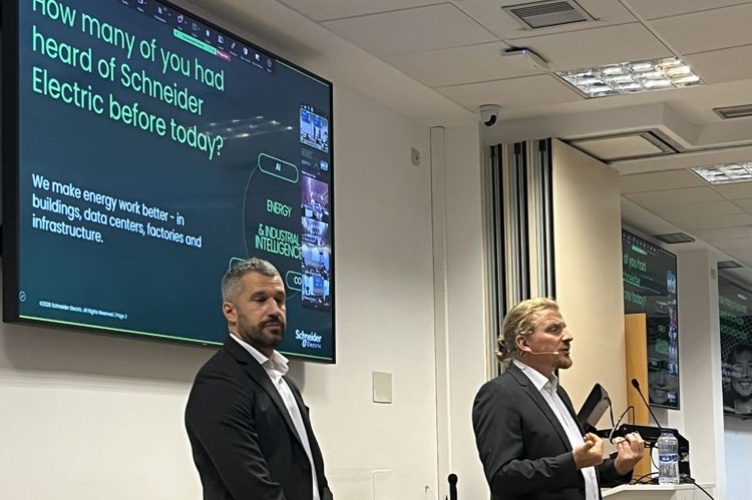
This was the starting point of Xavier Demilly’s intervention at ESCP’s Digital Spark seminar, led by Yannick Meiller, Associate Dean of the Master in Management. Xavier Demilly delivered his presentation live from the Madrid Campus, where the seminar was organised by Alberto Martinez, Academic Director of the Madrid Campus and Director of Studies of the Master in Management in Madrid.
More than 1,400 students were connected across ESCP’s European campuses and, for the first time, with CEIBS students in Shanghai, to explore the forces reshaping businesses and managerial careers.Drawing on his experience at Schneider Electric, Xavier Demilly invited students to look beyond the technology itself and focus on a more difficult question: how do you turn technological change into real transformation?
Technology × Adoption = Value
Schneider Electric offers a particularly relevant perspective on this question. Founded almost two centuries ago, the company has evolved through successive industrial eras, from machinery and electrification to automation, digitalisation and now artificial intelligence.
Today, Schneider Electric operates at the intersection of energy management and digital technologies, at a time when electrification, decarbonisation, renewable energy and the growth of AI and data centres are transforming the global energy landscape.
For Xavier Demilly, technology can change systems and processes can create consistency, but people are the ones who create value.
He summarised this idea through a simple equation: Technology × Adoption = Value
The multiplication sign is key. Even the most advanced technology creates little value if people do not adopt it.
This is particularly relevant with the rapid adoption of AI. Companies can provide employees with powerful new tools, but the real transformation occurs only when people understand how to integrate them into their work and change their behaviours accordingly.
For the students, Xavier Demilly translated this into an important leadership lesson: future managers will not be defined simply by the technologies they use, but by their ability to help people navigate change.
Transformation is a human challenge
Drawing on large-scale transformation at Schneider Electric, Xavier Demilly described technology as one layer of a much broader ecosystem, including processes, people and culture.
For a global organisation operating across numerous countries and sites, creating an alignment between this ecosystem’s components is a considerable challenge. Different teams may use different processes, systems and data, creating complexity and inefficiency. Technology can help address these issues, but it cannot create alignment on its own.
“The real unit of transformation,” Xavier Demilly explained, is ultimately changing people’s behaviour and transformation leaders may need to dedicate as much as 80% of their attention to people and alignment.
That requires understanding why people may resist change rather than simply imposing a new solution. It also requires bringing together executives, employees, customers, suppliers and other stakeholders whose priorities do not necessarily coincide.
What will matter in the age of AI?
The discussion also raised a question particularly relevant to students beginning their careers: if AI can perform more and more tasks, where will people continue to create value?
AI can already support research, summarise information, draft presentations, generate content and automate many routine activities. But efficiency is only one part of professional value.
Managers need to understand context: the pressures facing a colleague, the expectations of a customer, tensions within an organisation or the competing interests surrounding a decision. They also need to exercise judgement and remain accountable for the choices they make.
Artificial intelligence will not create artificial leadership, nor will there be an “artificial value” to manage it. AI can augment our capabilities, but leaders will remain responsible for aligning stakeholders, navigating competing interests and helping people adapt to new realities. Technology provides intelligence; leaders provide judgement, values, direction and accountability.
And there is another capability that technology cannot easily reproduce: influence. Transformation often requires managers to convince and mobilise people over whom they have no direct authority, across functions, hierarchies, countries and cultures.
Rather than trying to predict exactly which jobs AI will transform, Xavier Demilly therefore encouraged students to build a more durable professional toolbox around three capabilities: curiosity, judgement and influence.
From technology to leadership
Xavier Demilly concluded with a practical principle for anyone approaching transformation: start with the business problem, not the technology.
Instead of immediately launching large-scale solutions, organisations can start small, develop a minimum viable product, test it with users, learn, improve and progressively build alignment. Mistakes and iteration are not necessarily signs of failure; they are part of transformation.
His intervention at Digital Spark illustrates an important dimension of the partnership between Schneider Electric and ESCP Business School: connecting students with leaders directly involved in the transformations shaping businesses today.
And for the future managers in the room, Xavier Demilly left a message that extends well beyond any particular technology.
Digital tools will continue to evolve. AI capabilities will continue to expand. But successful transformation will still depend on the ability to understand people, exercise judgement, create alignment and lead change.
Technology enables transformation. People make it happen.
Campuses