
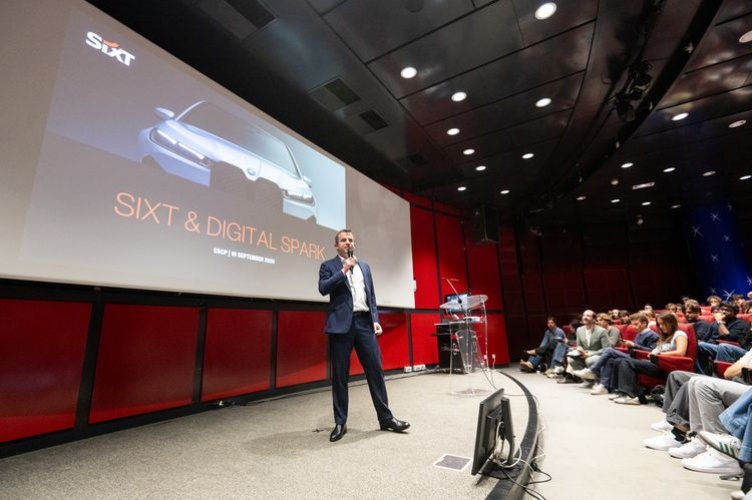
Today, digital transformation goes beyond being a question for technology specialists alone, playing an essential role in reshaping businesses, industries and managerial careers, and making it a key topic for future leaders.
This was the setting for Jean-Philippe Doyen’s intervention at ESCP’s Digital Spark seminar, led by Yannick Meiller, Associate Dean of the Master in Management. More than 1,400 students connected across ESCP’s European campuses and, for the first time, with CEIBS students in Shanghai, to explore the forces reshaping businesses and managerial careers.
From rental cars to a global mobility platform
SIXT has expanded from its roots as a car rental business into a broader mobility provider, offering customers different ways to access transportation through a single digital ecosystem. This evolution has enabled the company to grow significantly while maintaining its distinctive premium positioning.
Traditional car rental remains at the core of the business, but customers can increasingly access other services through the SIXT platform, including flexible vehicle subscriptions and car-sharing solutions.
For Jean-Philippe Doyen, this evolution reflects a broader change in how people think about mobility.
Customers do not necessarily want to own a car; they want access to the right mobility solution when they need it. Digital technology makes that increasingly possible, allowing different services and experiences to be brought together in a single platform.
Digital at the heart of the customer experience
SIXT has long positioned itself as a technology-driven player within the mobility industry. Jean-Philippe Doyen highlighted the company's early adoption of digital channels, from being among the first in its sector to launch a website and an iPhone application, to its current platform integrating multiple mobility services.
Today, customers can use the SIXT app to manage an increasingly frictionless journey, from booking and accessing a vehicle to discovering other mobility options. The experience is designed around the expectations of a generation accustomed to managing almost everything from a smartphone.
But digital transformation at SIXT goes much further than simply putting the customer journey online.
Artificial intelligence and data are increasingly being integrated at different touchpoints, from personalised recommendations and fleet management to demand forecasting and dynamic pricing.
The objective is to make the right vehicle available at the right place, at the right time, while offering customers a smoother and more personalised experience.
AI beyond the customer journey
One of the strongest points of Jean-Philippe Doyen’s intervention was that AI is not only about improving customer-facing services. It is also being used to transform the way SIXT operates internally.
The company uses digital tools and AI for activities such as vehicle damage assessment, demand forecasting, revenue management and fleet optimisation. Automated image analysis, for example, can compare vehicles at the beginning and end of a rental, helping identify potential damage more quickly and efficiently.
But perhaps more importantly, SIXT is encouraging its employees themselves to make use of AI.
Jean-Philippe Doyen explained that employees across the company have access to an internal AI platform, allowing them to use the technology in their daily work, not simply to save time, but also to experiment and develop new ideas.
Faster decisions, better decisions
At SIXT, AI can help employees process customer feedback in real time, identify areas for improvement and provide managers with information they can act on immediately.
Jean-Philippe Doyen also described how AI has become part of strategic discussions at executive level. When considering a strategic question, the leadership team can use AI to challenge its own thinking by presenting the situation and asking for an independent recommendation.
The aim is not to outsource decision-making to technology. Instead, AI becomes another source of information, one that can challenge assumptions, accelerate analysis and help leaders make faster and better-informed decisions.
This illustrates an important shift in the role of technology: AI is becoming not just a tool for automation, but a tool for augmentation and decision support.
Mobility at the intersection of major transformations
The automotive sector is moving towards greater electrification and lower emissions, while digital technology is changing how vehicles are accessed and used. Customers increasingly expect mobility to be seamless, flexible and personalised. For SIXT, these trends are closely connected.
The company is continuing to expand the presence of electric vehicles within its fleet while using digital technology to create more personalised experiences and improve operational efficiency.
Talent and entrepreneurship at the centre
Technology may be transforming SIXT, but Jean-Philippe Doyen repeatedly returned to one essential ingredient: people.
A company pursuing digital transformation needs the skills to build and operate new technologies, but it also needs people willing to experiment, challenge existing ways of working and take ownership of new ideas.
The competitive advantage created by technology, he explained, ultimately depends on having the right people capable of turning it into something meaningful.
Campuses