
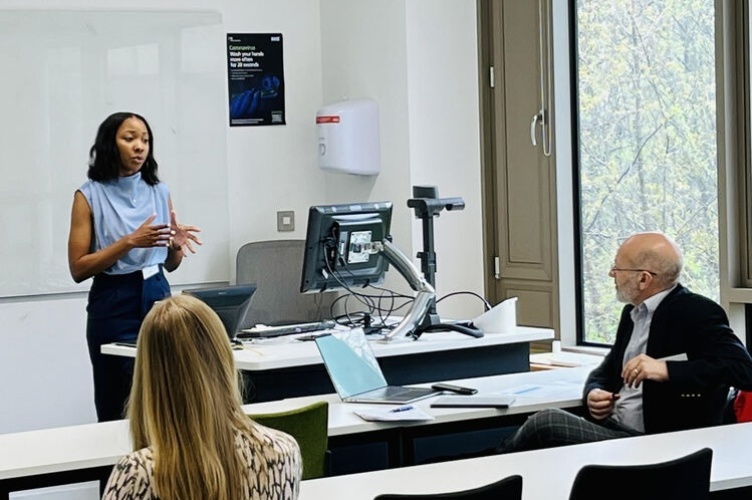
A study of The Bahamas' public healthcare system explores how digitalisation could create social value in Small Island Developing States, while tracing a research collaboration that began in an ESCP Master's classroom and evolved into an international peer-reviewed publication.
What does digital transformation actually mean for a healthcare system spread across multiple islands?
In The Bahamas, geography shapes almost every aspect of public healthcare. Patients and healthcare professionals are dispersed across an archipelago, resources and specialist staff are limited, and hurricanes and other natural hazards create additional vulnerabilities. In this context, digitalisation is not simply a question of replacing paper with screens. It could change how healthcare professionals communicate, how knowledge travels, how scarce resources are used and how patient information is protected.
A study published in Information Technology for Development by Phylicia Babb, PhD Research Fellow at the University of Agder and ESCP graduate, and ESCP’s Professor Petros Chamakiotis examines precisely this question.
Drawing on 21 interviews with healthcare professionals and administrators in The Bahamas, the researchers identify five tangible forms of social value that digitalisation could enable: interconnectivity, effective communication, standardisation of knowledge, capacity maximisation and data security. Their analysis connects each of these possibilities to concrete problems experienced within the Bahamian public healthcare system, from geographical dispersion and fragmented communication to limited resources and the vulnerability of physical patient records.
But the publication also has another story behind it. It began as a Master's thesis at ESCP.
Bringing healthcare and digital transformation together
Before joining ESCP's MSc in Digital Project Management & Consulting , Phylicia had spent more than seven years preparing for a career in healthcare through her studies and internships.
Her growing interest in technology and project management eventually led her in a different direction. When the time came to choose a Master's thesis topic, she saw an opportunity to bring the two worlds together.
“My experience across the public and private healthcare sectors, combined with my knowledge of digital transformation, presented an opportunity to merge my professional background with my future ambitions.”
Choosing The Bahamas was equally deliberate. As a Bahamian herself, Phylicia was conscious of how difficult it could be to find research reflecting the realities she knew.
“As an undergraduate student, I remember writing papers about The Bahamas but finding very little context-specific research that could support or challenge my understanding. Research on The Bahamas and the wider Caribbean remains limited, particularly within this field.”
That gap became part of the research question itself. Small Island Developing States face a particular combination of geographical remoteness, small markets, environmental exposure and constrained resources. Yet much of the literature on digital transformation and healthcare has historically been developed in very different settings.
For Petros, who supervised the thesis, this was one of the things that immediately made the project interesting.
“The academic literature is dominated by studies of the Western world and the Global North. Having conducted research in African contexts myself, I was naturally curious to understand how digital technologies play out elsewhere in the wider Global South. The fact that Phylicia is herself from The Bahamas made the study even more meaningful.”
He had already seen Phylicia's potential as a researcher through her contributions in class. When she approached him about supervising a thesis on digital health, the collaboration developed naturally.
When a Master's thesis becomes something more
Phylicia's original thesis received a distinction, the highest grade in her cohort. A shorter version of it was presented at the UK Academy for Information Systems conference in Kent in 2023. Following feedback there, the researchers decided to collect additional data and develop the study further. The eventual research included two phases of interviews and became substantially more ambitious than the original Master's project.
The process also changed how Phylicia understood academic research.
An important turning point came after feedback encouraged the authors to move beyond simply identifying "social value" and ask a more difficult question: what would that value actually look like in practice?
“It shifted our focus from simply identifying social value in the data to understanding its tangible forms, or affordances. This was also when I began to appreciate the importance of theory as a tool for uncovering new knowledge. Applying an affordance lens encouraged a deeper level of analysis and critical questioning.”
For Petros, this was the moment when the paper's distinctive contribution became clear.
“The moment when I thought, ‘we have something here’, was when we began to understand what changes digital technologies could bring about on the ground.”
Those changes became the study's five affordances: interconnectivity, effective communication, standardisation of knowledge, capacity maximisation and data security.
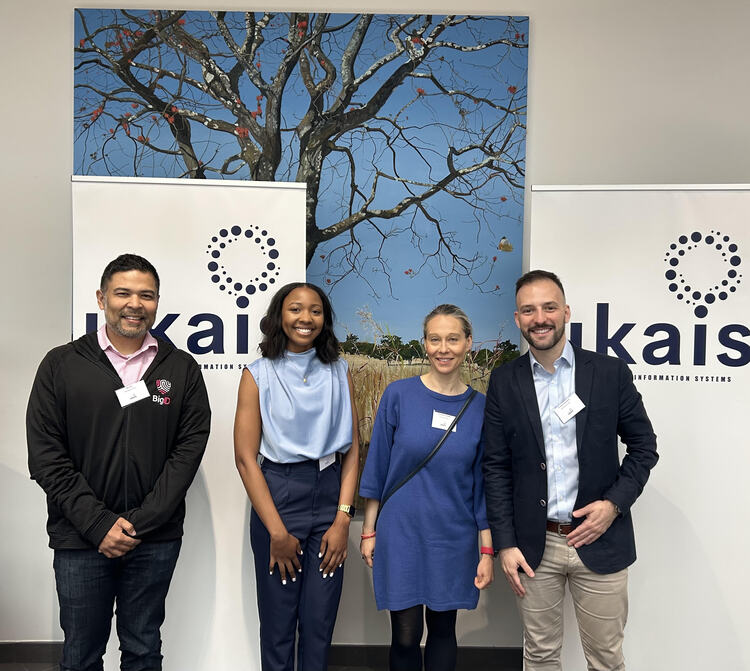 Phylicia Babb and ESCP Professor Petros Chamakiotis presented their research on digital transformation in healthcare at the UK Academy for Information Systems conference in 2023.
 What does social value look like in a healthcare system?
One of the study's central arguments is that the value of digitalisation should not be understood solely in financial or organisational terms.
In an archipelagic healthcare system, for example, interconnectivity could allow healthcare facilities and professionals separated by water to work through a more integrated system. Effective communication could make information exchange across departments and islands faster. Better collection and centralisation of data could support the standardisation of knowledge, helping healthcare professionals develop shared protocols and make more informed decisions.
Digitalisation could also help maximise limited capacity by reducing duplicated work and making existing resources easier to coordinate. And data security has a particular meaning in a country exposed to hurricanes and flooding, where physical medical records can be damaged or lost.
Together, the five findings provide a more concrete way of thinking about social value, which identifies the specific possibilities it create in response to particular local problems.
That contextual dimension matters. As Petros explains:
We often think of value as economic or financial value benefiting organisations. In my work, including my collaboration with Phylicia, I have been explicitly interested in social value: the value digital technologies can create for people and their communities.
The findings may therefore be relevant beyond The Bahamas, particularly for other Small Island Developing States and geographically dispersed healthcare systems facing similar constraints.
Research in a context where research is difficult
Producing the study was not straightforward. For Phylicia, the hardest part was collecting the dataset itself. Conducting qualitative research within a relatively small professional community creates particular challenges around trust and anonymity.
“Recruiting participants and conducting interviews can be difficult for any researcher, but this was notably challenging in a context where research is not widely normalised and the risk of identification is high. Individuals were often hesitant to participate or openly share their perspectives, despite recognising the relevance of the topic.”
The experience became part of her development as a researcher. What began with an MSc dissertation eventually took Phylicia from Master's student to published co-author and, subsequently, to a Marie Skłodowska-Curie PhD Research Fellowship at the University of Agder in Norway.
For Petros, watching that progression has been one of the most rewarding parts of the collaboration.
“Her growth during this process is unquestionable: from an MSc student experimenting with qualitative research in a challenging context to being accepted to undertake her PhD at the University of Agder. Throughout our collaboration, I have seen Phylicia take on increasingly significant parts of the research while I have also learnt how to improve my own approach as a supervisor, mentor, co-author and collaborator.”
Phylicia describes the relationship in similar terms.
“Petros gave me the space to develop and express my ideas while grounding them academically. He taught me the importance of balancing openness to critique with confidence in defending my research. Through this experience, I have become a more confident and mature researcher.”
The publication therefore shows how Master's research can develop when a promising question, access to an under-researched context and a sustained collaboration continue beyond the dissertation itself. For Phylicia, however, the most important lesson remains the subject that started the project in the first place.
“The major takeaway is the societal transformative potential of digitalisation in public healthcare. Digitalisation is often viewed primarily through efficiency, alongside concerns about job insecurity. Our findings highlight its broader potential to empower practitioners, ease pressure on limited resources and enable more collaborative ways of working.”
From a Master's thesis in Madrid to conference presentation, further fieldwork and eventually peer-reviewed publication, the project has also demonstrated something else: research can create value not only by studying overlooked and under-researched contexts, but also by giving researchers with direct knowledge of those contexts the opportunity to ask the questions that matter there.
Campuses