

Companies tend to judge AI against the problem they bought it to solve: productivity, efficiency or cost. But some of its most important social and environmental effects may sit outside the original business case. Researchers at the ESCP Tech Institute are developing a new way to make that value visible.
When organisations invest in artificial intelligence, they generally know what they want from it. A manufacturer may use AI to anticipate equipment failures; a retailer may want better demand forecasts; a professional-services firm may deploy generative AI to automate routine tasks or improve productivity. The investment is then judged against those objectives: did costs fall, did processes become faster, did output improve?
The problem is that this way of judging AI captures only part of its impact. Better forecasting can reduce wasted materials. Predictive maintenance may extend the working life of expensive equipment. A system introduced to streamline a service may, in practice, allow many more people to access it. These effects may have little to do with the original business case, yet they can carry significant environmental or social value.
The difficulty is that organisations are not always equipped to see the benefits new systems bring.
It is this gap that researchers at the ESCPTech Institute are seeking to address. Companies are investing heavily in AI at the same time as they face growing pressure from investors, regulators and other stakeholders to demonstrate meaningful progress on sustainability. Yet digital transformation and sustainability are still often managed as separate agendas. The result is that organisations may measure quite carefully whether an AI application achieved its intended economic or operational objective, while overlooking other forms of value that emerged once the technology was in use.
Research by Ali Haidar, Hector Gonzalez-Jimenez and Frédéric Fréry suggests that AI applications can create possibilities that extend beyond the objectives that originally justified their adoption. Technologies acquired for efficiency or cost reduction may also produce environmental or social benefits, but organisations currently lack a consistent way to identify and compare those effects.
Looking beyond the original business case
The researchers are developing the AI Sustainability Index (AIS) to provide a more consistent way of measuring these effects.
Rather than asking whether an AI application is “sustainable” in the abstract, the Index examines the capabilities associated with its use. It captures both the benefits organisations intended when they adopted the technology and those that emerged later.
AIS groups these capabilities into six areas. Its environmental component covers energy management, resource use and waste reduction, and the working life of physical assets. Its social component looks at workforce productivity, health and safety, and access to services.
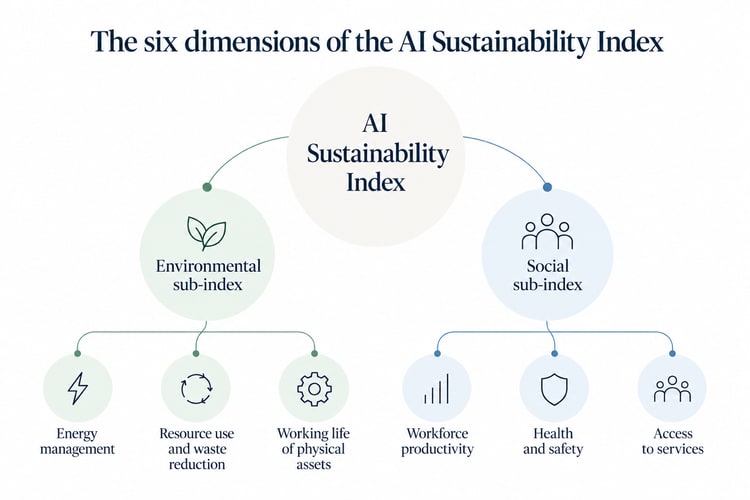
The distinction matters because AI rarely fits neatly into a single category of organisational value. A technology introduced to improve efficiency may also reduce resource consumption; one designed to improve productivity may have implications for workplace safety or service access. AIS is intended to make those different effects comparable rather than leaving them scattered across separate operational, sustainability or reporting systems. Thereby, the Index is intended to broaden the way the organisational value of AI is understood.
Measuring AI while adoption is still young
The Index is currently being developed and validated using survey data from 529 organisations across different countries, industries and company sizes. This gives the researchers a varied base on which to test a measure intended to work across organisational contexts, rather than within a single sector or type of AI use.
The sample also shows how recent AI adoption still is for many firms: in the current AIS sample, 71% of organisations have been using AI for less than three years.
The technologies in use are changing quickly as well. Among respondents who reported the types of AI they use, 64.1% cited company-specific generative AI and 61.6% publicly available generative AI, compared with 27.7% using predictive machine learning. The picture is therefore one of rapid adoption, but not necessarily mature measurement.
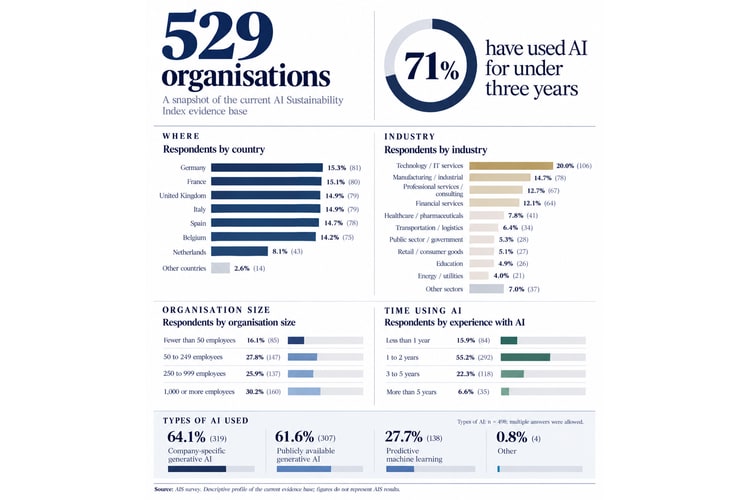
That creates an unusual situation. Organisations are being asked to understand the wider consequences of technologies that many of them have only recently begun to deploy. In that sense, the challenge is to establish whether AI can contribute to sustainability as well as to develop the systems needed to distinguish measurable effects from assumptions, aspirations or good intentions.
From technological performance to organisational value
For managers, this could change the way AI investment is assessed. A system introduced to achieve one objective may turn out to generate value in several others. Making those effects visible could influence where organisations invest next, what they choose to monitor and how they judge the performance of technologies already embedded in their operations.
AIS is ultimately intended to allow organisations to benchmark their results against peers in the same industry, country and size category. That could reveal areas where a company performs strongly, but also capabilities that remain underdeveloped or simply overlooked. As further rounds of data collection are added, organisations should also be able to track how their position changes over time.
The implications of the study will be useful across different organisational units. Sustainability teams could gain clearer evidence of how AI contributes to corporate commitments; investors and regulators could gain a more consistent basis for comparison; and researchers could gain a common measure for studying the social and environmental contribution of AI across organisations.
More broadly, the project points to a limitation in the way technological performance is often understood. Companies are generally good at asking whether a technology has solved the problem it was purchased to solve. They are less accustomed to asking what else changed because it was introduced. As AI’s embeddedness into everyday operations becomes more widespread, that distinction may become harder to ignore.
Building the benchmark
The ESCPTech team is now validating the Index and its environmental and social dimensions against the initial dataset. The first results will examine which capabilities organisations’ AI applications currently exhibit and how they differ across peer groups.
Future rounds of data collection will broaden the evidence base and strengthen the shared benchmark. The longer-term ambition is to develop a tool that could allow organisations to assess their own position against the AIS.
Organisations interested in contributing to future data collection can register to participate in the AI Sustainability Index.
Readers can also sign up to receive the first AIS findings as they are released.
Campuses