

ESCP is helping students engage with AI’s promise — and its limits
AI offers enormous potential but also poses significant environmental challenges. Our position on AI and sustainability engages with this complexity – embracing technology and innovation while critically examining its environmental and ethical implications, risks, and limitations. We believe our students should do the same.
Artificial Intelligence has rapidly become one of the defining technologies of modern business. From accelerating research and automating routine tasks to optimising logistics and analysing vast amounts of data, AI is increasingly linked to productivity, innovation and efficiency. Yet alongside its enormous potential lies another reality: the technology’s growing environmental footprint and the broader ethical questions surrounding its use.
For business schools, this poses a challenge that is difficult to ignore. How should institutions prepare future leaders for a world in which AI is both transformative and resource-intensive? How do you encourage innovation while teaching students to engage critically with the technology’s wider consequences?
At ESCP, the response has been to adopt what Louis-David Benyayer, Associate Professor and AI Initiatives Coordinator, describes as a “double approach”, meaning “full engagement with technology, but also a critical perspective on its risks and limits.”
That balance lies at the heart of ESCP’s evolving approach to AI and sustainability. ESCP faculty and sustainability teams believe students must learn to navigate both realities simultaneously. This philosophy is shaping ESCP’s approach to AI across teaching, governance, sustainability initiatives, and experimentation.
Why AI and sustainability are increasingly linked
The complex relationship between AI and sustainability is easy to illustrate but difficult to resolve. On the one hand, AI technologies can help address environmental challenges. Benyayer points to applications in electricity management, resource optimisation, and logistics flows as examples of how AI can support more efficient systems and improve decision-making at scale.
Yet efficiency gains do not automatically translate into sustainability gains.
“There are rebound effects,” he explains. “Progress is undermined by an increase in the total volume of units consumed. Because we optimise, we end up consuming more. For example, because logistics is optimised, we move more parcels over more kilometres.”
The point is significant because it pushes the debate beyond simplistic assumptions that technological optimisation alone will reduce environmental impact. In reality, systems adapt. Increased efficiency can reduce friction, accelerate consumption and ultimately increase overall demand.
At the same time, the infrastructure underpinning AI carries its own environmental costs. “The direct environmental footprint of AI is massive,” says Benyayer, citing device manufacturing, network operations, and data centres. The difficulty is that this footprint and the impact of everyday use is not readily apparent.
Making AI’s environmental footprint visible
One of the challenges in AI sustainability, says Gorgi Krlev, Associate Dean and Full Professor of Sustainability at ESCP, is that much of the technology’s environmental impact remains invisible to users. AI often feels frictionless and immaterial, even though it relies on energy-intensive infrastructure operating behind the scenes.
“I think we still lack information on that, and we lack a lot of awareness on the side of users,” he says.
To make these impacts more tangible, ESCP is developing a footprint calculator to give students, faculty and staff a clearer understanding of the environmental implications of different forms of AI use.
“We are also thinking about making it publicly available so that people really get sensitised to what it actually means. Because I think it’s very abstract for most.”
At ESCP we take a “double approach”: full engagement with technology, but also a critical perspective on its risks and limits.
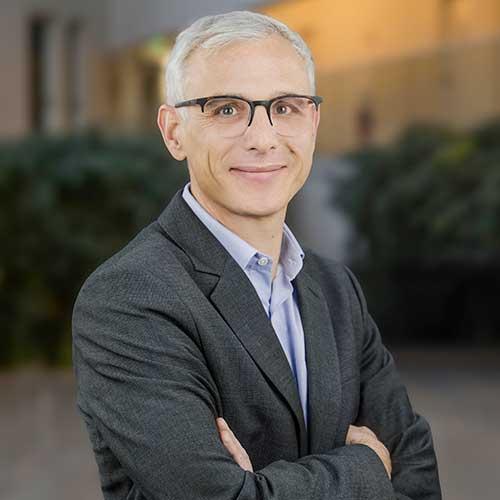 Louis-David Benyayer
Associate Professor and AI Initiatives Coordinator
Educating leaders for responsible innovation
The footprint calculator reflects a broader effort within ESCP to move the conversation about AI beyond debates about whether the technology is inherently “good” or “bad”. Instead, the focus is increasingly on helping students understand the trade-offs, consequences and practical realities surrounding its use.
That includes encouraging more conscious and efficient use of AI. As Krlev explains, part of the challenge is helping users think more critically not only about when they use AI but also about how they use it.
“Choose a lean model. Think about how you can work more quickly. How can you work in a more goal-oriented way?”
The wider goal is not to discourage students from using AI tools altogether, but to encourage more thoughtful engagement with them. “Use AI,” says Krlev, “but only where it enhances your learning, rather than just using it because it’s there and available.”
For Gabrielle Tremblay, Ecological Transition Project Manager within ESCP’s federal sustainability team, this approach reflects a broader understanding of responsible AI.
“Leading the AI transformation with responsibility means measuring more than productivity gains,” she says. “It means ensuring that humans remain at the centre. That is why we teach our students to approach AI through frugality, using it only when it is needed, and efficiency, making every resource count.”
Embrace and examine — in practice
This emphasis on thoughtful AI use is reflected in ESCP’s wider approach. Across teaching, institutional initiatives and experimentation, the School is working to ensure that engagement with generative AI is accompanied by critical reflection on its environmental, social and ethical implications.
Through its strategic collaborations with OpenAI and Hugging Face, ESCP students, faculty and staff have access to generative AI tools, allowing the School to explore their potential in business education in a structured way.
At the same time, initiatives such as La Fresque du Numérique workshops help students understand the environmental impact of digital systems, while a mandatory GenAI course integrates questions of sustainability into students’ understanding of the technology.
Alongside the AI footprint calculator, ESCP is developing resources like an “AI for Good” framework to make responsible AI use more concrete across the School.
Integrating ethics, AI, and sustainability in management education
That balance between adoption and critical engagement increasingly shapes ESCP’s broader approach to AI education. Rather than treating sustainability as a separate discipline, the school is exploring ways to embed environmental and social questions more deeply across teaching and institutional practices.
One example is what Krlev describes as a “curriculum revolution” – rethinking how subjects such as finance, marketing and accounting are taught through a sustainability lens, rather than simply adding sustainability as an additional topic alongside them.
AI is being used to accelerate that transition. ESCP is developing AI-supported tools to help faculty integrate sustainability topics into existing courses and to help students better navigate sustainability-related learning pathways across the school.
Yet ESCP’s approach remains deliberately cautious about presenting AI as a simple solution. Questions about transparency, measurement and accountability remain unresolved across the wider sector.
“The problem is that the sources and data on actual consumption are deliberately vague, making estimates difficult,” says Laurena Proust, AI Project Manager at ESCP, who is working with the sustainability team on its evolving AI framework.
That uncertainty, however, is only one part of the wider challenge facing higher education institutions. The rapid adoption of generative AI is also prompting universities to rethink how students learn, how knowledge is assessed and how responsible AI use should be governed more broadly.
AI is a governance problem first
At ESCP, governance and AI literacy have become central themes in the school’s evolving approach. In the ABC Framework for AI-ready universities, developed by Benyayer and ESCP Assistant Professor Alara Tascioglu, the starting point is clear: institutions should “treat AI adoption as a governance problem first.”
Rather than focusing solely on introducing new tools into the classroom, the framework argues that universities must consider how AI is reshaping learning, assessment and decision-making. “When answer production becomes trivial,” say Benyayer and Tascioglu, “education must shift from evaluating outputs to cultivating and assessing process, reasoning, and judgment.”
For ESCP, this ultimately means preparing students not only to use AI but also to engage with it responsibly – understanding both its possibilities and its consequences.
It’s not easy being green – or responsible
The relationship between AI and sustainability is unlikely to become simpler in the years ahead. The technology will continue to evolve rapidly, while questions about energy consumption, governance, transparency and responsible use remain unresolved.
But perhaps that is precisely the point. Future leaders will increasingly need to make decisions in environments characterised by uncertainty, trade-offs and competing priorities. The challenge for business education is not to offer simplistic answers but to equip students with the judgement and critical perspective needed to navigate complexity responsibly – to wholeheartedly embrace and interrogate the technologies of today and tomorrow.
Related links
Campuses