
How the case method sharpens judgment, sparks discussion, and prepares leaders for uncertainty
Every year on World Case Teaching Day, business schools around the globe celebrate case-based learning — a pedagogy that develops leadership skills by confronting students with ambiguity, disagreement, and real decision-making.
At ESCP Business School, the case method has long been central to how students learn to think and lead in uncertain contexts. Few people are better placed to reflect on its power and evolution than Martin Kupp, Associate Professor of Entrepreneurship at ESCP.
Over the past two decades, Kupp has written and taught award-winning cases, trained educators worldwide, and been recognised by The Case Centre for his outstanding contributions to case teaching. He recently distilled this experience intoThe Ultimate Guide to Case Teaching and Writing, a book he co-authored that provides a practical resource for educators.
We spoke with him about what the case method develops, how it is evolving, and why it matters now more than ever.
Learning to decide in times of uncertainty
For Kupp, the enduring strength of the case method lies in what it forces students to confront. “The case method uniquely develops students’ ability to deal with ambiguity, incomplete information, and competing interpretations,” he says. “It forces them to combine analysis with judgment — to articulate, defend, and revise their positions in dialogue with others.”
This mirrors the reality of managerial and entrepreneurial life, where decisions are rarely made with perfect data or in isolation. “Through discussion and social interaction, students learn that intelligent people can reasonably disagree — and that decisions still have to be made,” Kupp adds. “That cannot be meaningfully taught with lectures or slides alone.”
A pedagogical tool that evolves with its environment
While the principles of the case method remain stable, Kupp is clear that the way cases are taught cannot stand still. “The fundamentals haven’t changed: it’s still about how discussions are orchestrated, how participants are engaged, and how learning happens through interaction,” he says. “But the learning environments and the tools we use absolutely have changed.”
From multimedia cases and live simulations to new digital and hybrid formats, experimentation has become part of the method’s evolution. “It’s a flexible pedagogy,” Kupp explains. “Whatever formats or technologies help participants engage with all of their senses, we should embrace and test them.”
This flexibility places particular demands on those leading the classroom. For Kupp, great case teaching is not about performance or expertise. “It’s not about delivering expertise. It’s about orchestrating learning. The best case teachers create safety, ask great questions, and trust students to bring value. They don’t try to ‘win’ the discussion — they try to make the discussion worth having.”
What AI changes and what it doesn’t
As generative AI enters classrooms and organisations, questions naturally arise about its impact on learning. Kupp sees AI not as a threat to the case method, but as a reminder of its relevance.
“Generative AI can reinforce, rather than undermine, the value of the case method,” he says. “While AI can generate analyses or options instantly, the case method ultimately is about defending your analysis, convincing in real time, disagreement, ethical reflection, or human judgment under uncertainty.”
These are precisely the capabilities leaders need in a world where information is abundant but clarity is not. “AI may be great at solving the case, but arguing with 40 opinionated students in real time is where the true value of the case method is,” Kupp adds. “Cases increasingly shift the focus from ‘What is the answer?’ to ‘How do we get to an answer?’”
In this sense, the classroom becomes a space to practise sensemaking, responsibility, and decision-making under pressure. “The anchor of case learning is social interaction,” he says. “That’s what enables students to link their own experiences to theory and frameworks. They learn by speaking, listening, disagreeing and being challenged by their peers.”
Strengthening case-based learning at ESCP
As technology reshapes how knowledge is accessed and complexity accelerates, Kupp believes the case method is becoming more, not less, relevant. “What the case method does better than anything else is help students practise thinking,” he says. “It’s not about having all the facts. It’s about navigating complexity, asking better questions, and making sound decisions with others. That’s what the world needs more of.”
At ESCP, this conviction has increasingly been translated into institutional action. In recent years, the School has strengthened its commitment to case-based learning through the Case Project (CaP), which supports faculty across all six campuses with editorial guidance, peer review, and funding to develop high-quality teaching cases.
The result is a growing portfolio of ESCP-authored cases taught worldwide and distributed through platforms such as Harvard Business Publishing and The Case Centre. The recent launch of ESCP’s dedicated Case Collection on The Case Centre platform further consolidates this effort, making the School’s pedagogical contributions more visible to educators globally.
On World Case Teaching Day, the celebration is ultimately of a shared commitment: teaching students how to think, decide, and lead together, especially when the answers are anything but obvious.
What the case method does better than anything else is help students practise thinking. It’s not about having all the facts. It’s about navigating complexity, asking better questions, and making sound decisions with others. That’s what the world needs more of.
 Prof. Martin Kupp
Campuses
Related stories

News 05/02/2025
Case Teaching
World Case Teaching Day: ESCP's Commitment to Excellence in Case-Based Learning
Discover how ESCP Business School’s commitment to case teaching is preparing future business leaders. Learn about the Case Project (CaP), award-winning cases, and how faculty are innovating case-based learning.
News 30/10/2025
Ranking
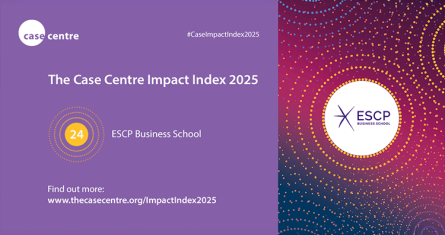
ESCP ranks among the world's top business schools in the Case Centre's Impact Index 2025
ESCP Business School ranked 24th in the 2025 Case Centre Impact Index, a seven-place rise from the previous year and our first entry into the global top 25. This year’s ranking coincides with the official launch of ESCP’s institutional Case Collection on The Case Centre platform.