
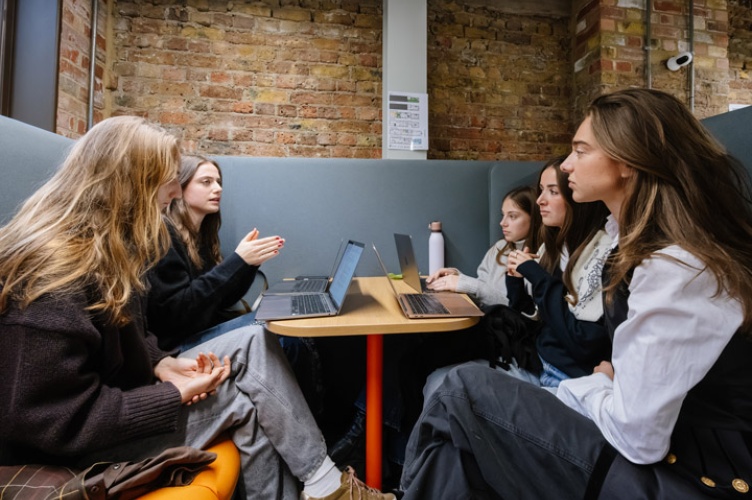
Students Develop 11 Sustainable AI Solutions
The first ESCP London Green & AI Hackathon showed how responsible AI, co-creation and practical learning can accelerate sustainable innovation.
Bringing together 59 students, entrepreneurs and AI experts, the one-day event showed how interdisciplinary co-creation, responsible AI and no-code tools can turn sustainability challenges into practical solutions with entrepreneurial and intrapreneurial potential.
Artificial intelligence is transforming how organisations innovate, make decisions and develop new products and services. But the value of AI does not lie in technology alone. It depends on how people apply it, the problems they choose to solve and the judgement they use to assess its impact.
This idea was the core focus of ESCP London’s first Green & AI Hackathon, held on 12 October 2026 at Encode Hub, co-organised by ESCP’s London AI team, London Green & Impact Office and Blue Factory business incubator. The event welcomed 59 students from across the London Campus programmes to explore how AI could be used to address sustainability challenges through practical, collaborative problem-solving.
Students were asked to form teams, identify a real-world problem, develop an AI-enabled solution and present their idea to a panel of judges - all within one day.
Throughout the day, entrepreneurs, AI specialists and mentors supported the teams through a keynote and reverse pitch, a Responsible AI workshop, and practical guidance on using AI and no-code tools. This enabled students with different levels of technical experience to contribute to problem definition, business thinking, creativity, design, prototyping and presentation, while lowering the technical barrier to turning their ideas into working concepts.
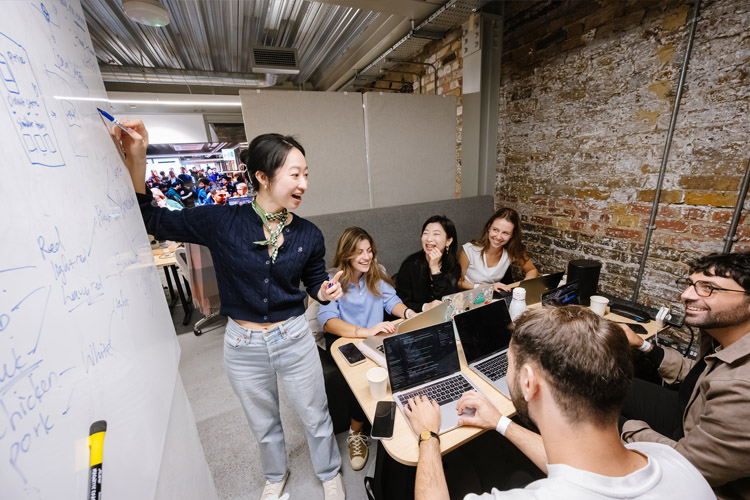
From Sustainability Challenges to AI Solutions
By the end of the event, the teams had developed 11 sustainable AI solutions. Their ideas ranged from energy management and carbon-aware computing to circular fashion, climate-risk intelligence, food waste and community energy.
The solutions included:
- Green Campus, A B2B AI platform that analyses campus classroom energy data to identify avoidable consumption, recommend actions such as reducing HVAC demand and estimate potential savings.
- GreenWindow, a carbon-aware scheduling tool that forecasts grid carbon intensity and automatically recommends lower-emission times to run flexible workloads such as AI training, backups and data processing.
- HedgeRow, a farm risk-check tool that uses a farm’s location and basic information to identify and rank weather-related risks, then provide practical actions to reduce crop loss and resource waste.
- Jökull Atlas, a climate-risk intelligence platform for hydropower operators, developers and infrastructure investors, helping them understand how changing glaciers and mountain water systems could affect assets, generation and long-term resilience.
- Re-Look, an AI buying copilot for secondhand fashion that lets shoppers upload a photo or product link and find, compare and assess resale alternatives.
- Rethread, a circular sourcing platform that uses AI to organise and match recovered textile components, such as zips, buttons and labels, with fashion SMEs looking for traceable materials.
- Ridy, a cycling companion that recommends routes using local crime, road and bike-parking data, helping riders choose journeys and parking options with greater confidence.
- Solmate, a community-energy platform that uses AI forecasts of local electricity supply and demand to help residents share, sell and use renewable energy at fairer prices.
- StockSavr, an AI-enabled retail and shopping platform that helps retailers make smarter inventory decisions while helping customers find and compare products, with the aim of reducing food waste.
- Upgr8, a tool for commercial property owners that assesses building energy-performance ratings and identifies the upgrades needed to keep inefficient offices compliant and rentable.
- LooVin, an AI-powered wine marketplace that matches consumers with surplus wine based on their taste, helps vineyards sell stock before it is distilled and rewards customers for returning bottles for reuse.
Team Solmate won the hackathon and received the £500 prize. The team included five MSc in Digital Transformation Management & Leadership students: Marie Groeller, Elia Hamouche, Stans Van Der Ploeg, Claire Arsene and Julie Zohlen.
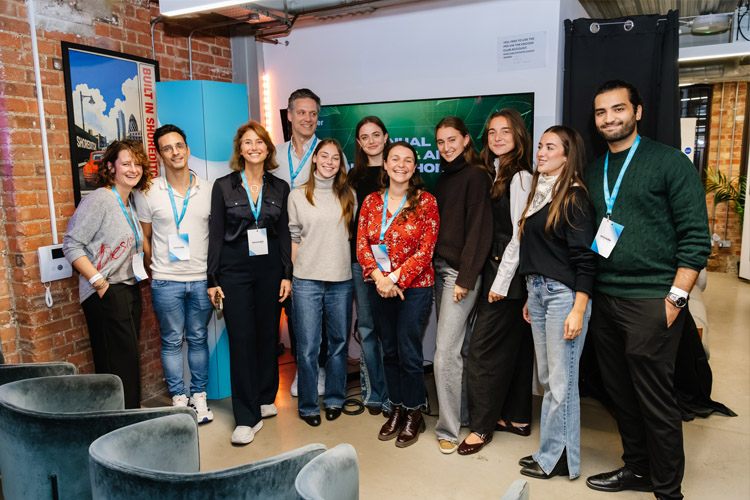
Student feedback on practical AI and sustainability learning
The post-event survey found that 89% of respondents found the hackathon inspiring and motivating, while a separate 89% said they felt proud of their team’s solution. A further 81% said they learned valuable new tools, technologies or concepts, and 76% said the event increased their interest in using AI to address sustainability challenges.
Students also praised the value of the practical format, where they were not simply discussing the future of AI or sustainability, but had to put both into practice within a real-time constraint, while collaborating with unfamiliar peers and testing their thinking with experienced practitioners.
What can one hackathon teach us about the future of work?
The Green & AI Hackathon was co-organised by Christina Bartholomew, London Green & Impact Office, Audrey Picard, London AI Coordinator and Alice Ivanoff, London Blue Factory Lead, who together brought sustainability, AI and entrepreneurship into one learning experience.
We asked each organiser the same question: What is one lesson this hackathon taught you?
The Hackathon’s biggest lesson for me was that AI can be a powerful enabler and accelerator when applied to sustainability challenges. The most meaningful innovation emerged from giving students the time and collaborative environment to focus on impact, learn from one another and prioritise human interaction. With technology supporting their ideas, students were able to turn collective creativity into practical solutions for good.
 Christina Bartholomew
London Green & Impact Office Lead at ESCP
What was most visible to me was not how technology was used but the people behind it. Moving between teams, I witnessed frustration, resilience, creativity and the challenge of navigating different perspectives and cultures, all in pursuit of positive impact.
The energy and enthusiasm during the final pitches were truly uplifting. It was a powerful reminder that AI is only a tool; it is human ingenuity, collaboration and purpose that give it meaning. Seeing our students embrace these challenges gave me real hope for the future they will help shape.
 Audrey Picard
London AI Coordinator at ESCP
The biggest lesson is that you must always come back to the problem you’re trying to solve and focus on what the customer needs before jumping in and building. That’s what makes the difference between successful projects and winning pitches. We live in an era where building is widely accessible, so to truly innovate, you must be ready to do the legwork. That’s what will set you apart!
 Alice Ivanoff
London Blue Factory Lead at ESCP
Although the organisers approached the hackathon through different lenses, their reflections point to a unanimous shared lesson: preparing talent for the future of work requires more than teaching new technologies or sustainability practices in isolation. It means creating opportunities for people to apply and test them together, question assumptions, be willing to make bold decisions and remain accountable for the outcomes.
Event Media
Photos from the 2026 ESCP London Green & AI Hackathon are available here.
Campuses