
From CV collection to employer-student conversations
ESCP London’s largest annual careers fair to date gave employers and students the opportunity to connect through open conversations, alumni insight and professional networking.
University careers fairs are changing as employers place greater emphasis on critical thinking, adaptability, communication, cultural intelligence and long-term potential.
Many employers will agree that the graduate recruitment challenge has evolved beyond finding enough applicants. Companies increasingly prioritise identifying people with the judgement, adaptability, diverse perspectives and ability to contribute quickly, while also creating the work conditions that persuade them to stay.
The role of the traditional higher education Careers Fair is also evolving beyond companies delivering presentations and collecting CVs. The event is becoming a space for employers and prospective talent to assess whether there is a good fit, exchange ideas and understand what a future working relationship might look like.
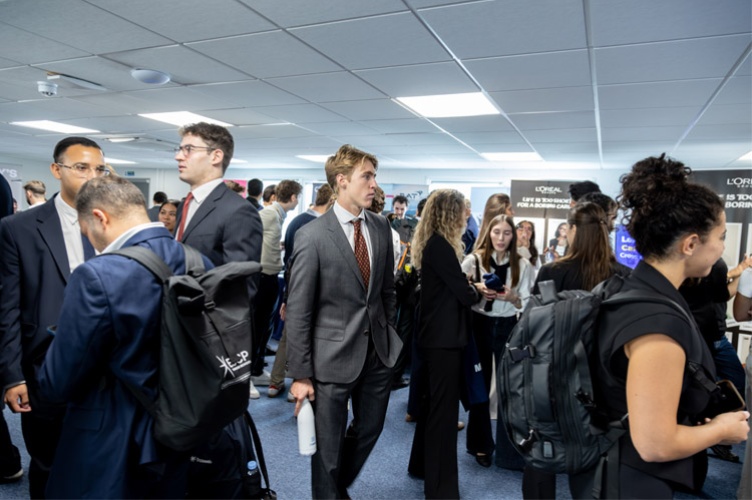
On Thursday, 1 October, ESCP hosted its London Annual Careers Fair 2026 - its largest event to date. The event welcomed 33 companies, 63 company representatives, including 16 ESCP alumni returning to represent organisations they now work for, and more than 500 student attendees.
ESCP London Careers Fair 2026 at a glance
- 33 participating companies
- 63 company representatives
- 16 ESCP alumni representing their employers
- More than 500 student attendees from Bachelor in Management (BSc), Master in Management, MSc in Energy Management, MSc in Economics & Policy for Business, MSc in Marketing & Creativity and MSc in Product Management for Technology programmes
- Alumni panel, networking and employer discussions
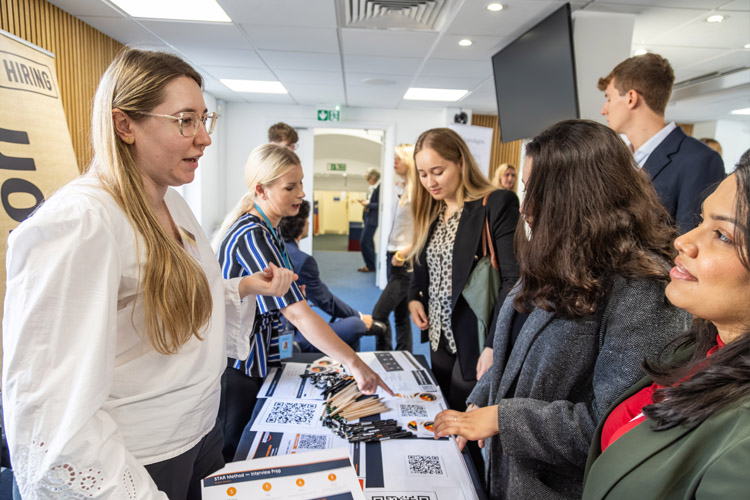
Beginning with an Alumni Panel and Networking session, the event moved into afternoon breakout discussions with participating employers, replacing traditional one-way presentations with valuable two-way dialogue between companies and future talent.
This year, we shifted the format of the fair because the dynamics of graduate recruitment have fundamentally changed. Employers need more than CVs - they are looking for cultural fit, solid critical thinking and long-term potential. We wanted to give companies an opportunity to evaluate these complex human skills in real time, while showing the next generation of talent exactly how they can grow within their organisations; and, at the same time, provide an opportunity for our international students to develop their networks earlier into the academic year.
 Rohan Malhotra
Associate Head of Careers & Corporate Relations at ESCP London Campus
The value of alumni in graduate recruitment
Inviting alumni to university careers fairs allows companies to showcase life at the organisation beyond the initial recruitment process. Alumni who once attended these same ESCP events offer invaluable, first-hand accounts of transitioning from business school to professional life - from navigating applications to progressing and taking on more responsibilities. This authentic perspective is crucial today, especially as employers focus heavily on early-career retention.
Students are also no longer simply looking for a first job. They also want to know whether they will have opportunities to learn, contribute and develop after joining a company. Research from ESCP’s Gen Z Observatory suggests that younger employees tend to value meaningful projects, continued learning and managers who invest in their development. Because accepting a role no longer guarantees long-term loyalty, employers must actively demonstrate how they invest in their people from day one.
Alumni can explain how progression works, what support they received and what their day-to-day experience is like. Simultaneously, this transparency offers students a first-hand chance to understand whether a company’s culture and approach to development truly match their professional goals.
The informal setting also makes it easier to ask direct questions. What is the first year really like? How quickly can responsibilities grow? Which skills are most useful? How would they describe the culture?
It’s the first year I’ve attended the career fair on campus and I’ve been truly impressed. The format of the event allowed for me, as an alumna, to exchange with many students who had a very proactive approach with specific questions. The discussions were engaging throughout. I have also been able to share some of my professional career experience and provide some guidance, as they approach the start of their next opportunity searches! I wish them the best of luck in the exciting world that awaits.
 Julia Blumenthal
Senior Manager - Group Marketplace Transformation at Kingfisher plc & ESCP MMK Class of 2018 alumna
Seeing future skills in action
The fair also gives companies a direct view of the capabilities they increasingly need to develop. The future of work is placing greater emphasis on AI literacy, critical thinking, communication, cultural intelligence and the ability to combine human judgement with new technologies.
These qualities are difficult to assess through an application form alone. They emerge through discussion: how a student approaches an unfamiliar problem, makes connections between markets or perspectives, challenges an assumption or proposes a different way forward.
ESCP’s international student body adds another dimension. Students study in at least two, and in some cases up to four, countries. Their experience gives them exposure to different markets, institutional environments and ways of working.
For large organisations, this can provide insight into cultural and contextual intelligence. For smaller and growing companies, it can introduce perspectives that challenge established assumptions about products, services and customers.
Consequently, networking transforms into a form of informal market research. Employers leave the event with a clearer understanding of how young, internationally-minded consumers view their brand, what questions future employees are asking, and exactly where this fresh thinking can help address active business challenges.
A more focused route into recruitment
As graduate recruitment becomes increasingly selective, careers fairs help companies focus and streamline their search process. When a single graduate vacancy can attract hundreds of digital applications, meeting candidates in person allows employers to build brand recognition early, clarify their requirements, and pinpoint individuals whose skills and interests truly align with the business.
That early contact may be particularly valuable for companies that are less familiar to students. Visibility is not only about filling an immediate vacancy; it is about building a talent relationship. Simultaneously, students actively use these events to evaluate employers, understand different career pathways, and learn how to position their experience.
ESCP's experiential learning model gives its students a distinct advantage. By tackling internships, company consulting projects, and applied coursework, they graduate with proven experience solving real-world business challenges. Furthermore, many MSc candidates join the programme with two to three years of prior professional experience and a global outlook shaped by studying across at least two countries. This gives corporate partners immediate access to high-calibre candidates who can contribute from day one.
As the graduate market changes and employers face new challenges in attracting and retaining early-career talent, opening a two-way conversation with future employees is more important than ever. Students can bring fresh thinking and new perspectives into the workplace.
If your organisation is interested in exploring how to engage with ESCP students, please contact Rohan Malhotra.
- [PHOTOS] The 2026 ESCP London Careers Fair
- [VIDEO] The European Careers Centre at ESCP London
- [VIDEO] ESCP’s MSc in Marketing & Creativity – Company Consultancy Project with Sixième Son
Frequently asked questions
What is a university careers fair?
A university careers fair is an event where students meet employers to learn about career opportunities, recruitment processes and workplace culture.
Why are careers fairs important for graduate recruitment?
Careers fairs allow employers to meet potential candidates before the formal application process and learn more about their communication, critical thinking, motivation and interests.
How can employers engage with ESCP students?
Employers can engage with ESCP students through careers fairs, networking events, alumni activities, company presentations, internships, consulting projects and applied case studies.
What do employers look for in business school graduates?
Employers increasingly value critical thinking, communication, adaptability, cultural intelligence and the ability to combine human judgement with new technologies, including AI.
How does ESCP prepare students for international careers?
ESCP students study across an international, multi-campus environment and gain experience through internships, company consulting projects and applied learning. This helps them develop an understanding of different markets and working cultures, as well as practical experience relevant to the graduate and early-career job market.
Campuses