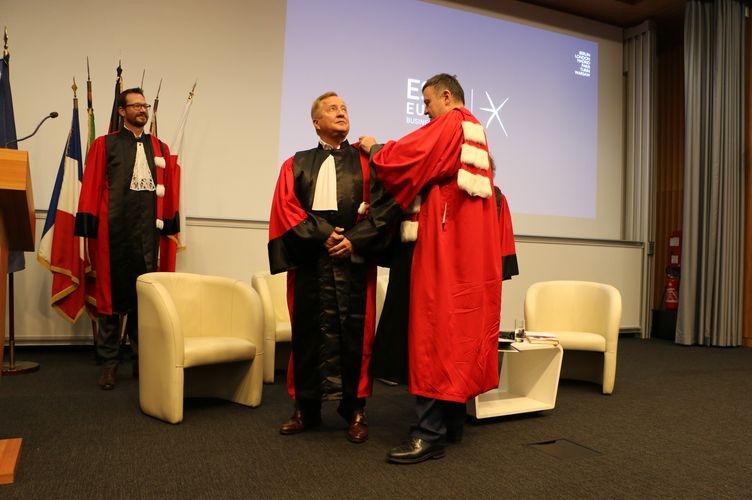
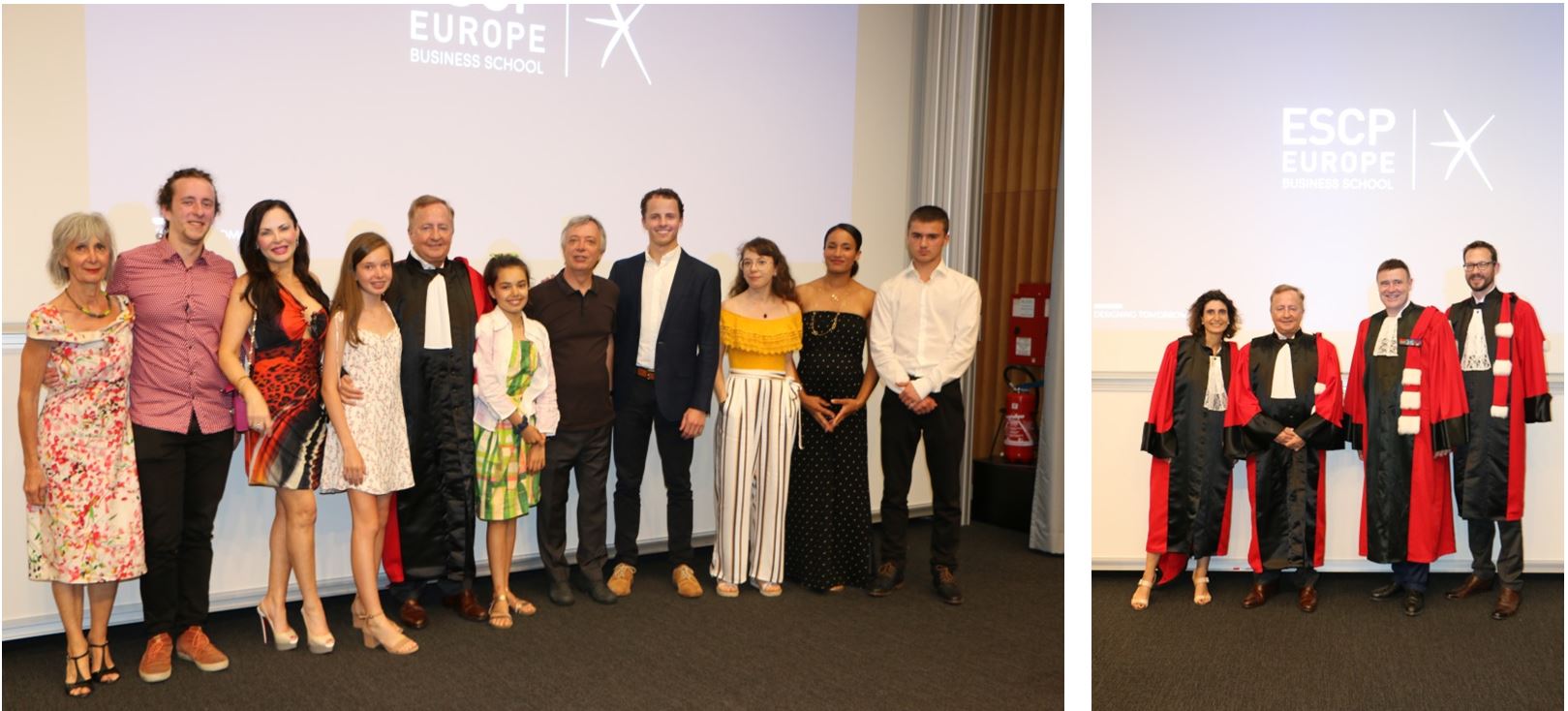
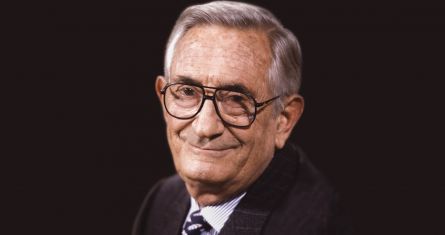
Jeudi 27 juin 2019, Frank Bournois (Executive President & Dean) et Valérie Moatti (Dean of Faculty) ont remis le tout 1er diplôme de Docteur Honoris Causa à un Alumnus ESCP.
Jean-Jacques Bienaimé, promotion 1976 et CEO de BioMarin pharmaceutical
Jean-Jacques Bienaimé (76), CEO de BioMarin pharmaceutical, a reçu ce diplôme pour son engagement auprès de l’École et pour son parcours professionnel remarquable dans le secteur de la santé et des biotechnologies. Le succès de BioMarin a d’ailleurs fait l’objet d’une étude de cas publiée quelques semaines auparavant par les professeurs ESCP Martin Kupp et Robert Sheldon, pour inspirer et faire réfléchir des générations d’étudiants.
Jean-Jacques a démarré sa carrière dans la santé en 1981 chez Ciba-Geigy, aujourd’hui Novartis, en France puis aux Etats-Unis dès 1984. Il rejoint ensuite plusieurs groupes de l’industrie biotechnologique majeurs aux USA et devient CEO de BioMarin en 2005. Ce groupe créé en 1997 et basé en Californie, est une Biotech spécialisée dans les maladies rares, les maladies délaissées par l’industrie pharmaceutique car estimées non rentables.
En quelques années, Jean-Jacques Bienaimé a relancé BioMarin et lui a donné une envergure mondiale. La société compte aujourd'hui 60% de son activité hors USA et sa valeur est passée de 450 M$ en 2005 à plus 15 milliards $ en 2019! Dans ce secteur exigeant, BioMarin est aujourd’hui une référence mondiale et durable avec 8 médicaments destinés au traitement de maladies génétiques orphelines et une véritable spécialisation sur les désordres génétiques affectant principalement les enfants. Au-delà des chiffres et des réalisations BioMarin et ses employés sont portés par une véritable culture patient-centrique. Pour encourager ses employés dans les moments de doutes et de difficultés, Jean-Jacques n’hésite pas à leur rappeler : « Remember they still need us ».
Toute la communauté ESCP peut être très fière de compter Jean-Jacques Bienaimé parmi ses Docteurs Honoris Causa !
Campuses
An Extraordinary Path
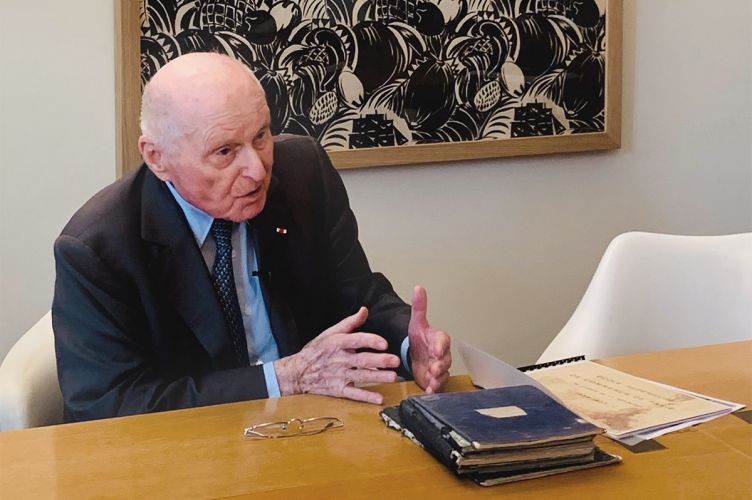
Out of all our graduates, Léon Cligman stands out because of his age (he was born in 1920) and also because of his out of the ordinary background.
Born in Moldava in 1920, he entered the Ecole Supérieure de Commerce de Paris at the age of 15, where he acquired the building blocks to become one of the leaders in the French textile sector.
His Career
He first became president of Indreco (Newman, Mendès…), and then took over Devanlay, which included Lacoste, Scandale, Jil and Orly.
In addition to being a major contributor to the development of the textile and clothing sector, Léon Cligman and his wife, an artist, are also avid art collectors.
Léon Cligman and his Love of the Arts
In 2020, he and his wife will sponsor the inauguration of a modern art museum at the Abbaye Royale de Fontevraud, which will house about 900 works of art (paintings, drawings, sculptures, antique objects, etc.), all from the Cligman collection.
Souvenirs
Léon Cligman will keep in his archives, on the other hand, some of his school notebooks and documents that he still has in his possession. These regularly written notebooks and papers, covered with the upstrokes and downstrokes of pen and ink, chart the history of a period when students learned chemistry, geography, as well as how to draw up a balance sheet.
Campuses
Related stories
News 12/06/2019
Bicentenary
Antoine Riboud, from the bottom of the class to a pioneer career
Antoine Riboud was born in 1918, died in 2002 and graduated from ESCP in 1942.
Paris

News 06/06/2019
Bicentenary
The School’s Students’ Association was created: 1872
The school was founded in 1819, but the Student Union for the students and alumni of Ecole Supérieure de Commerce de Paris was only created in 1872.
Berlin
London
Madrid
Paris
Turin
Warsaw
News 20/06/2019
Bicentenary
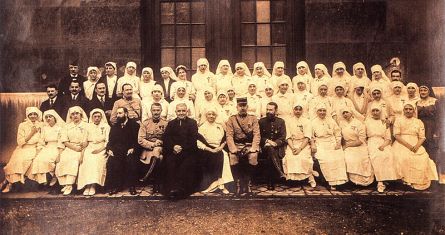
When the school transformed into a hospital
Although Europe commemorated the centenary of the end of World War I last year, 11 November 1918 did not mark the end of this dark era in our school’s history.
Paris
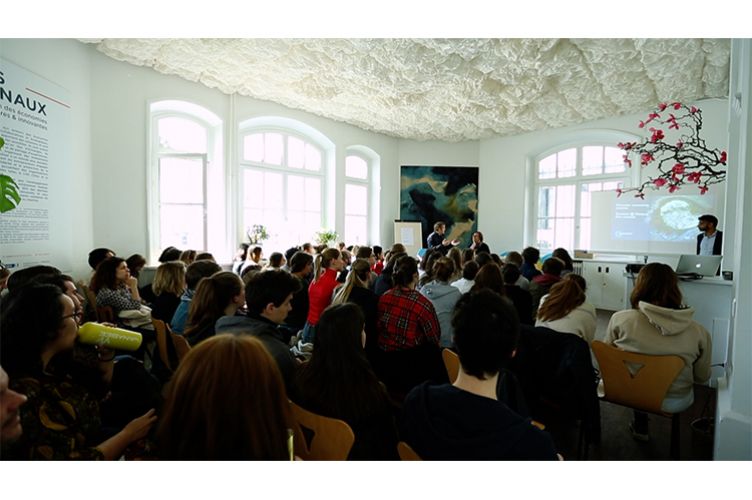
According to the Scientific co-directors of the ESCP - Deloitte Circular Economy & Business Sustainable Models Chair, business schools have a key role to play in this transformation. ESCP has already initiated many innovations in this field, and in particular created a chair dedicated to this subject to promote the circular economy in society and facilitate its appropriation by companies.
According to the 2019 Circularity Gap Report, more than 90% of the raw materials we use are not re-injected into the economy: our planet is under enormous pressure on its natural resources and the climate, which must be quickly relieved.
The circular economy is a concept aimed at rethinking the economy, to produce goods and services while limiting the consumption and waste of raw materials, water and energy sources. It is a new economic model that aims to protect companies from the consumption and exploitation of natural resources. Companies, which hold the keys to their business model, are therefore obviously at the heart of the system.
ESCP has already initiated many innovations in this field: we have been teaching circular economics for more than four years in the school's various programmes, notably in our Master of Science (MSc) in International Sustainability (Paris - Berlin programme). The school also organizes the annual Conference for Sustainable Innovation on the Berlin campus. And during the next academic year, the 400 students of the Master in Management's new class will participate in a cross-curricular seminar devoted to the ecological and social transition.
An accelerator of innovation for the transition to the circular economy
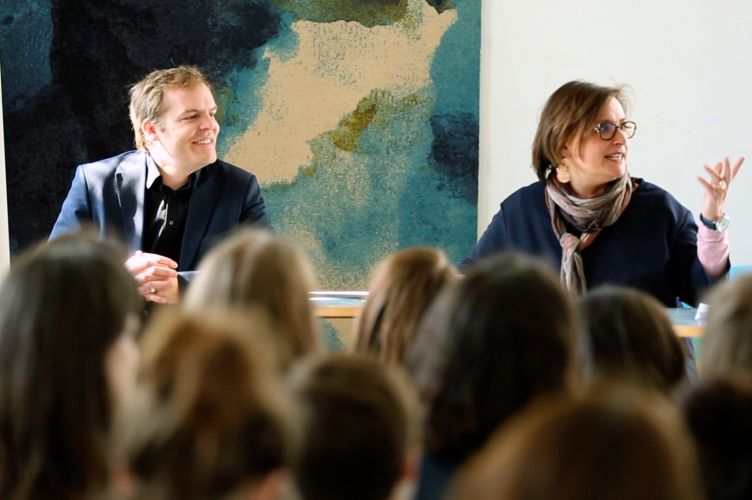 To continue and strengthen this movement, we have created the ESCP - Deloitte in "Circular Economy & Business Sustainable Models" Chair. It seeks to study, identify and explain the levers and locks of the circular economy, wishing to position itself as an accelerator of innovation for the transition to the circular economy. Its fields of action concern research, teaching and the dissemination of good practices in the managerial world.
Our conviction is that the circular economy must be thought of in a collaborative way. While the invention of these new models is now a major challenge, the transition to the circular economy is a complex process, requiring concerted action and a joint effort by a range of stakeholders: companies, investors, public actors, citizens, think-tanks and experts, etc. As a result, our courses are built in partnership with entrepreneurs but also with public and institutional actors.
The circular economy is a managerial change but also a cultural one that transforms our relationship to value creation, progress and consumption patterns. This change implies a leadership role on the part of companies but also of business schools. For us, the circular economy challenges all of the company's activities and is located at the intersection between the roads of strategy, supply chain management, entrepreneurship, the environment, accounting, marketing, law and product design. It is also a fundamentally interdisciplinary issue, which leads business schools to open up to other fields such as engineering, natural sciences, political science or philosophy.
Campuses
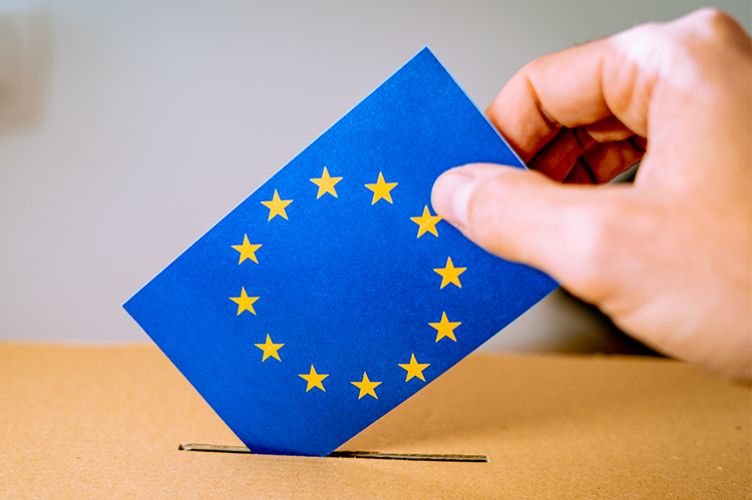
As the United Kingdom continues its slow and time-consuming exit from the European Union, ESCP's Dean and Executive President considers it essential not to lose sight of the strong and compelling need to rethink Europe’s ambition in order to better relaunch its construction. The world will not wait!
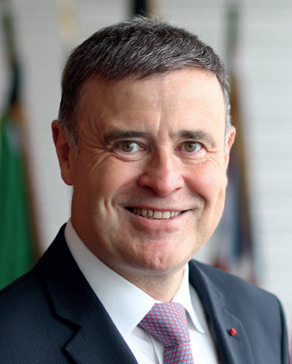 For those who interact daily with economic and institutional decision-makers around the world, it is striking to see how no one can seriously consider a world in which Europe has no place, for one simple reason: who would want the rebirth of a bipolar world?
Current economic debates underline that the relaunched economic war between the United States and China combined with the emergence of their digital champions, industrial giants of the 21st century, is not sustainable for the emergence of a stable world where prosperity would be fairly shared.
The world therefore needs Europe as much as the other way around. A Europe in which the Union would be a driving but not necessarily exclusive pillar. As such, I am firmly convinced that the United Kingdom will have to find a way of remaining European one way or another: a Europe deprived of this great nation would be a historical nonsense.
Europe is needed in several respects. First of all, it is still one of the main economic forces combined with a strong culture. Although it recently became the world's third largest economic power (it was the first one less than 10 years ago), it is still the leading exporter of goods and services ahead of the United States. The voices of its main countries are still heard on the international scene. Its main languages are vectors of economic, diplomatic and cultural exchanges in vast parts of the world.
Only these assets are in no way guarantees for the world to come. No one will be grateful to us for having invented capitalism, modern science, or even democracy if we can only be satisfied with our past successes.
In this context, Europe needs to be put at the forefront, not the remnant of our concerns, and at the heart of our actions. Europe was built to offer our weakened and devastated continent a new lasting peace, and it achieved this feat. It must now find a sanitized relationship with the notion of power.
If the industrial revolution is drawing its strength from knowledge and data, then let us invest massively in education, research and training, like China and the United States. Not only through bureaucratic projects involving only a minority of actors, but by promoting the creation of European champions through both public and private funding. Every trip to China is an opportunity to see that a new university has come into existence! We know about the billions invested by the major American universities, both public and private.
We should not be satisfied with national actors competing with each other. The debate is the same as the one that recently agitated the Commission with the merger between Alstom and Siemens: is it better to cultivate competition at all costs and let national players fall prey to non-European champions? Or promote the emergence of new institutions capable of expanding into the world?
It is not just about competing with the rest of the world. It is also about promoting a new European perspective on the two major challenges facing humanity today:
The first challenge is technological. Can we be satisfied today with two hegemonic powers (digital, but also biotechnologies, artificial intelligence...) colonizing the world according to their views? Does Europe have nothing to contribute, both in terms of innovation and respect for mankind in the face of these upheavals (private life, bioethics, etc.)? Before speaking on these subjects, it is therefore necessary to be a champion in this field, with its extraordinary potential for knowledge, skills, and jobs! Otherwise, we will transform into the Greeks when they were overtaken by the power of the Romans.
The second is related to corporate responsibility: environmental, societal and social. Far from restricting performance, taking into account these imperatives is critical, as they are essential to the harmonious articulation of the economy and society. And who can deny that Europe would have much to contribute against Trump's America and a China that is still not very aware of these issues?
While the political debates in the forthcoming elections are once again in danger of becoming bogged down in strictly national approaches, it is time for the guardians of the future, namely the new generations and all those who educate and train them, to take the lead in truly launching a European Renaissance. After all, European academia emerged and shone when the nation states that make it up today did not even exist!
Campuses
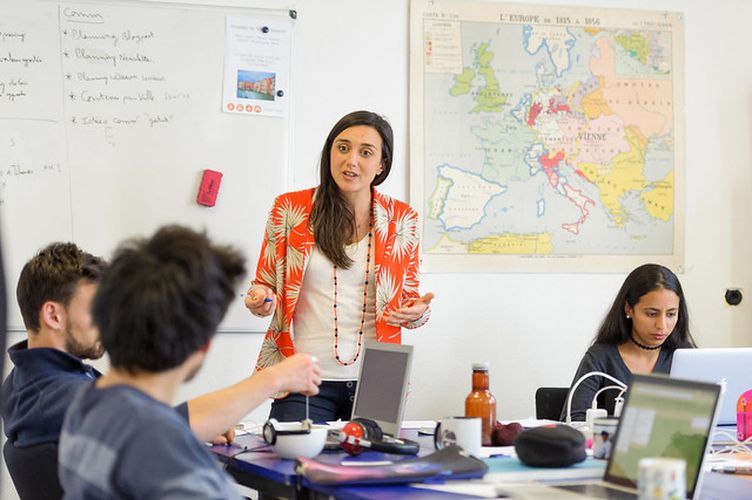
La Blue Factory recherche actuellement sa nouvelle promotion du programme Seed. Dédié aux entrepreneurs qui se lancent sur leur marché, le programme Blue Factory SEED propose un accompagnement personnalisé auprès d’une dizaine d’équipes.
Vous avez un projet et vous souhaitez être incubé dans une grande école, rejoignez le programme Blue Factory SEED de ESCP !
Le programme SEED c'est :
- Un an d’accompagnement personnalisé avec 1 mentor-entrepreneur et plus de 50 experts
- Des ateliers collectifs réguliers aux côtés de 9 autres entreprises
- Un accès privilégié à l’écosystème de la BlueFactory ESCP (événements et réseau)
- Des locaux partagés et un accès à l’ensemble des espaces de ESCP
Ce programme est fait pour vous si :
- Votre produit ou service est lancé ou prêt à être lancé
- Vous cherchez un accompagnement enrichissant et personnalisé et êtes prêt à vous développer au sein d’un collectif solidaire
- Une personne au moins de votre équipe fondatrice est liée à ESCP, ou issu d’une école partenaire : ESCP, ENSCI, 42, Epitech, Epita, Strate, école de Design,Polytechnique, Telecom,Université Paris 1 Panthéon Sorbonne
- NB :Si votre projet propose une innovation sociale, vous êtes éligible à la Bourse Malakoff Médéric Humanis. (Voir modalités ici)
FAQ Blue Factory SEED : On vous dit tout!
Pour la première fois, la Blue Factory ESCP s’associe à Malakoff Médéric Humanis, leader de la protection sociale en France afin d'offrir un accompagnement à deux entreprises qui apporteraient une solution à destination de salariés en entreprise en situation de fragilité (situation de handicap, monoparentalité, aidant, personne atteinte de maladie grave, ...).
Appel à projet ouvert jusqu'au 28 mai :
=> Inscription ICI
=> Bourse Malakoff Médérc Humanis: Inscription ICI
Campuses
Le Workshop Hosted, organisé par ESCP et FERRANDI Paris, a pour ambition de contribuer à la réflexion sur les grandes problématiques de l’industrie hôtelière.
Ce workshop se déroulera sur le site de Montparnasse et est destiné aux professionnels de l’hôtellerie, de la restauration et du tourisme ainsi qu’aux enseignants et chercheurs.
Cet événement unique en France aura plusieurs moments forts :
- l’intervention de Patrick Hayat, Fondateur de Patrick Hayat Hotels qui présentera sa vision des enjeux actuels et futurs de l’hospitality en France ;
- une table-ronde réunissant des spécialistes sur les enjeux du revenue management et de la gestion des coûts;
- des ateliers recherche qui aborderont des thématiques clés telles que le développement durable, la création d’entreprises dans le secteur, des représentations sociales et l’open innovation.
- enfin, la présentation par les étudiants du Master of science en Hospitality de FERRANDI Paris des derniers travaux de l’Observatoire des marchés et des tendances de l’hôtellerie internationale.
Programme du workshop :
- 13h30 : Ouverture du colloque par Bruno de Monte, Directeur général de FERRANDI Paris
- 14h00 : Intervention de Patrick Hayat de Patrick Hayat Hôtels
- 15h00 : Table ronde : « Coût de distribution et Revenue Management en Hôtellerie », avec Jean-Michel Chapuis et Emmanuel Parisot
- 16h00 – 16h30 : Pause networking
- 16h30 : Ateliers recherche
Atelier 1 : Les stratégies de développement durable des acteurs de l’hôtellerie et de la restauration

Animé par Ophélie Mugel, enseignante chercheuse en marketing à FERRANDI Paris, PhD in Marketing
Atelier 2 : Créer des entreprises de restauration avec l’effectuation

Animé par Nathalie Sarrouy-Watkins, enseignante à FERRANDI Paris et chercheur en entrepreneuriat
Atelier 3 : les représentations sociales du secteur Hôtellerie Restauration Tourisme et leur possible impact sur les politiques managériales et RH des entreprises

Animé par Christophe Loué, enseignant chercheur en gestion de ressources à FERRANDI Paris.
Atelier 4 : Hospitality et open innovation

Animé par Damien Forterre, professeur associé à ESCP en Business Development et Achats
- 17h30 : Présentation des travaux de l’Observatoire des marchés et des tendances de l’hôtellerie internationale par les étudiants du Master of Science Hospitality de FERRANDI Paris
- 18h00 : Cocktail et networking
Téléchargez ici le programme détaillé
Location
Organiser: ESCP et FERRANDI Paris
Paris, Montparnasse - France
MapDate
Start date: 17/06/2019
Start time: 1:30 PM
End time: 8:00 PM