
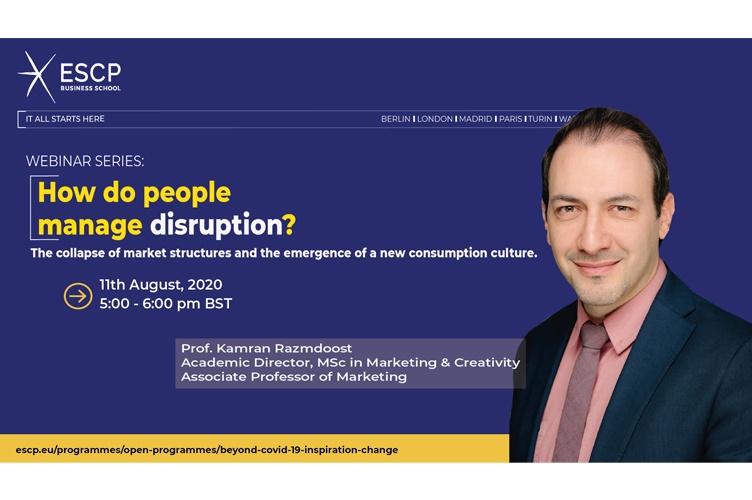
Prof. Kamran Razmdoost offers us a lively discussion looking at disruption, the collapse of market structures and the emergence of a new consumption culture.
The COVID-19 crisis has disrupted our way of living and our consumption practices. We have adapted our routines based on the available products and resources (e.g. using shower gel to wash our hands!) and created new routines replacing the old ones (e.g. dining at home instead of going to a restaurant). This has resulted in the collapse and recreation of structures upon which markets are constructed.
In this seminar, we will review how consumers generate consumption culture in response to disruption and discuss the role of brands in facilitating (or impeding) this journey.
Agenda
Discussion: 17:00 - 17:30 BST
Q&A: 17:30 - 18:00 BST
Participants

Prof. Kamran Razmdoost
Associate Professor of Marketing
Location
Organiser: ESCP London Campus
Online - Worldwide
MapDate
Start date: 11/08/2020
Start time: 5:00 PM
End time: 6:00 PM
![© Ruth Enyedi - Unsplash [copyright]](/sites/default/files/styles/event_news_une/public/2020-07/Troege_debt.jpg)
Campuses
2020 marked the 8th year of the Jean-Baptiste Say Entrepreneurship Festival for ESCP, but the event on 26th May was the first time it ran entirely virtually. Despite all the ongoing challenges caused bt Covid-19, 15 teams of students from the MSc in Marketing & Creativity (MMK), MSc in Marketing & Digital Media (MDM) and the MBA in International Management pulled together and showed remarkable innovation.
Teams were given four weeks to come up with a business solution, build a value proposition, create a website and video, test demand, design a Minimum Viable Product, experiment, and present their idea. At a regular ESCP Entrepreneurship Festival, student teams host a stand at an on-campus fair, handing out promotional materials and explaining their business to guests and fellow students. But how could this operate virtually? Well, teams organised two-hour “virtual stands” via Zoom, using different functionalities such as breakout rooms, virtual branded backgrounds, step-by-step QR code journeys, and more.
Almost 600 people registered to attend. After visiting the stands, attendees were asked to vote on each idea, identifying themselves as a customer, industry expert or investor. They were asked to highlight anything they’d change about the idea, what was most unique about it, and rate it on a scale of 1-10 of how likely they were to recommend the idea to a friend or colleague.
Once the two hours were up, each team had to pitch their idea in under four minutes to an online audience of over 300 people, with three additional minutes for questions. After all 15 teams had presented, a panel of 17 judges took some time to deliberate, compile their votes from the virtual stands, and decide on four winners: one from each participating Master programme, and an overall winner.
The overall winner was Hobbiz, a platform app connecting consumers with creators who have a hobby that they want to turn into a business. The app would give consumers access to top quality, locally-made products, while supporting the small businesses of local creators. Ciara, Kanika, Neïla, Mariela and Giulio, the team behind Hobbiz and students on the MSc in Marketing & Creativity programme, found the experience extremely rewarding: “You get to see your idea come to life more and more each day.”
The MMK prize went to Kidpsace, an online learning platform that gives parents a break while kids acquire different skills in a fun and exciting way. Its founders, Isabella, Aasit, Pam, Chiedozie and Leonie knew they wanted to tackle a real, current problem and found it “gratifying to work on a university project with the potential of becoming a real business”.
Another MMK-led idea, Amla Club, is a platform that connects users with personal trainers. For their virtual stand, Vasiliki, Miguel, Alexandra, Mirjana and Stephanie used unique QR codes that attendees could scan to be guided through a series of demos, videos and brochures on Amla Club.
Despite the additional challenges of a constrained time frame (the challenge is usually spread across eight weeks, rather than the four weeks available in 2020) and working entirely virtually, the standard of projects was excellent.
ESCP’s Professor of Entrepreneurship Davide Sola said: “Entrepreneurial spirit, resilience, adaptability and great creativity were all on show this year. Teams showed how entrepreneurial thinking and problem solving can be applied to the ‘new normal’ that will emerge from the pandemic, building customer-centric sustainable value propositions.
“As co-lead of the course, I could not be prouder of the outcomes of these projects and I wish that some of them could become reality.”
Christian Linder, Associate Professor of the module, was delighted at the “level of creativity and energy”, especially given the “unprecedented circumstances of online delivery and the fact that participants cooperated in teams from all over the world”. He was impressed by the students’ output and felt that “we have seen truly brilliant start-ups”.
The level of effort and dedication required to simply validate a business opportunity is immense; it’s common knowledge that the failure rate of start-ups is extremely high. But this can predominantly be attributed to commercial failure, further reinforcing the paramount necessity to understand your market inside and out before major investments should be made. The knowledge and both theoretical and practical skills learned from this experience will surely aid any future entrepreneurs who took part in improving their ability to reflect and question their own project, and to make it attractive and relevant for each stakeholder.
Ciara is an MSc in Marketing & Creativity student. Feeling inspired by her blog? To follow in her footsteps, check out ESCP Business School and its Marketing & Creativity programmes:
MSc in Marketing & Creativity
Creative London Summer School
Campuses

The MSc in Digital Transformation Management & Leadership admissions workshop, organised by ESCP Business School London Campus, is a great opportunity for you to talk all things admissions with our recruitment team.
You will get the answers to the "When? What? How? and Where?" types of questions you might have if you are considering applying to this programme!
Register your place now to learn more about:
- Entry requirements: step by step guide and explanation
- Application Portal Overview: answering application questions
- CV & Cover Letter: Dos and Don'ts
- What to do if you are missing some documents?
- What to expect from an interview?
- and more...
Your questions will be answered live by our Recruitment Team!
Participants

Viktorija Nikitina
Marketing & Recruitment Manager

Alberto Fanelli
Recruitment Executive

Emma Lauder
Admissions Coordinator
Location
Organiser: ESCP London Campus
Online - Worldwide
MapDate
Start date: 08/07/2020
Start time: 5:30 PM
End time: 6:30 PM
![© Open Access Government [copyright]](/sites/default/files/styles/event_news_une/public/2020-06/factories-2-1068x707.jpg)
Campuses

- An interview with Prof. Dr. Kerstin Alfes, ESCP Berlin's Academic Director of the MBA in International Management. Here is what she had to say about careers, how they have changed and her impression of MBA students. -
Due to the dynamic nature of today's job market, it's undeniable to say that our notion of the word "career" is changing. Have you experienced this?
We are definitely moving further away from traditional career concepts. To say that the traditional concept of a career is obsolete may be too extreme, but nowadays, professionals, especially students, are having a different experience than professionals did many years ago. Large companies known for their tall, multi-layer, functionally organised structures are adjusting themselves to become more agile and dynamic and the individuals who work there have had to adapt as well, accepting increased responsibilities and reduced promotional opportunities. Due to this, more and more professionals are moving towards taking charge of their own career rather than being dependent on traditional organisational career arrangements.
Many professionals switch companies in hopes of jumping on a fast-track to the top jobs. Does this work?
According to research, the answer is no. Research by Prof. Monika Hamori has shown that CEOs from top companies in Europe and the U.S. have been with just 3 companies on average. Prof. Hamori found similar results for non-CEO executives. Her research compared the effectiveness of inside and outside moves and it essentially revealed that inside moves produce more and faster-paced promotions.
As an Academic Director, but also as a professor, what kind of students do you come in contact with?
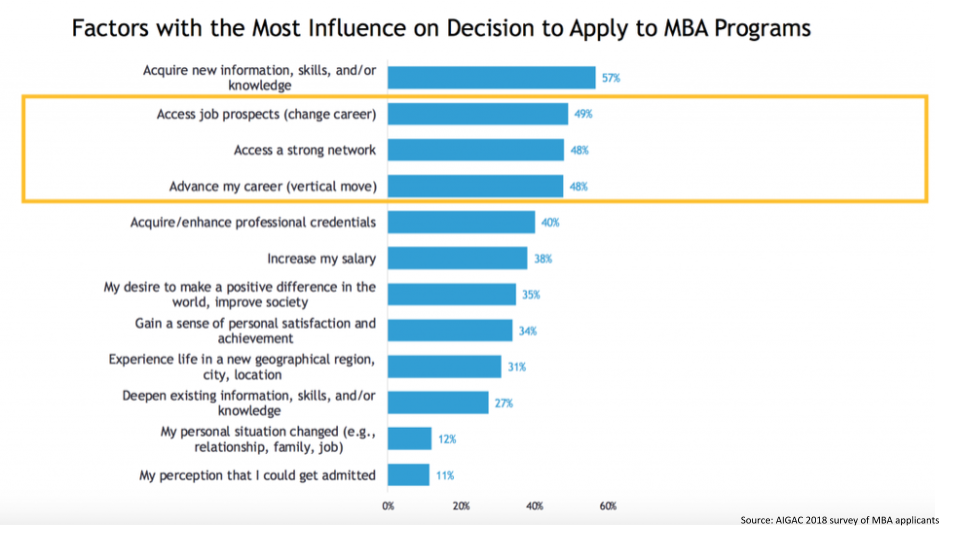
In my years of being Academic Director, I have come across some of the most motivated and determined-to-succeed young professionals. I think that very often there is a certain stereotypical view when it comes to business and management students. Usually it plays with the image of these students being only money-focused. However, I have experienced the MBA students here at ESCP as being thoughtful, innovative, informed and with a concern for social issues in business. Most students have solid work experiences and they are now looking for change in their career, either by switching to a different field or industry, or by accelerating their upward movement. You can see that as a general trend with MBA students below in the 2018 AIGAC survey of MBA applicants. The numbers speak for themselves in terms of what most influences young professionals to apply for an MBA programme.
Why ESCP's MBA in International Management?
Personally, the biggest plus in ESCP’s MBA in International Management programme is the number of electives that we offer in the second semester. There are more than 20 options, and students choose 4, which gives them a huge variety and flexibility to "design their own curriculum". They can decide to focus the electives on a specific area (such as finance) or stay more general in their choice. They can also do the electives on one campus or do each elective in a different location, benefitting from the European spirit.
The second advantage is the huge ESCP alumni network. Our alumni have been very helpful in giving advice to the MBA students and helping them with questions related to career development or finding a job. This is definitely a valuable resource.
Lastly, I think that the company consultancy projects (CCPs) we offer are amazing. The companies are spread across different industries, there are big companies and small start-ups and the projects are real-life challenges. Every year some of our graduates get job offers from their CCP company, so it's definitely a great springboard for students' careers.
Campuses
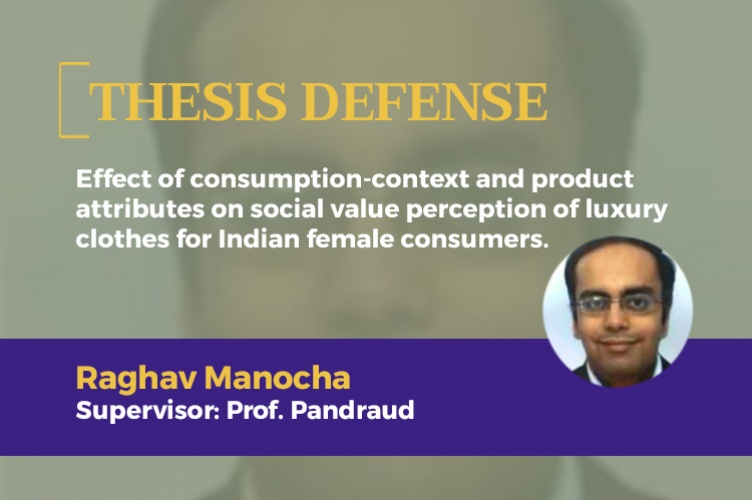
Thesis Defense
Effect of consumption-context and product attributes on social value perception of luxury clothes for Indian female consumers.

Raghav Manocha, Ph.D candidate in the PhD program ESCP publicly defendes his PhD thesis in Management Sciences.
29 June 2020
ESCP Business School Campus République
Abstract
The study analyzes the perceived social fit of a luxury dress as a function of two factors: First, a context-related factor comprises the type of event (traditional or modern), and the people who are present at the event (peers or elders).
Second, an attribute-related factor refers to the perceived design origin (Indian or Western or Indo-western), and the modesty of the dress (modest or revealing). As a result of collectivistic orientations of Indian society, wearing a contextually-fit luxury dress helps earn more prestige in one’s group and will help gain high social value.
The literature review analyzes the importance of the perceived social value for a luxury outfit in India, in the Indian context of luxury apparel, evolving along traditional design and global influence. In the Indian collectivist culture, Indian females give priority to the usage context when they choose a luxury garment. We propose a conceptual framework derived from the literature.
In the empirical work, we started analyzing 24 semi–structured interviews of young Indian females. This qualitative study helped to better understand the choice process of a luxury garment.
Next, an experiment was carried out with 994 Indian females. In this within-subjects experiment, each subject had to assess the social fit of six dresses, for each of four representative events of Indian society. The six dresses varied in design (Indian, Indo-western, Western) and in modesty (modest or revealing). The four events varied in modernity (traditional versus modern) and in company (with peers, or with elders).
Many main effects are significant. For example, Indian dresses have higher perceived social fit than Indo-western and Western dresses; Indo-western dresses have higher perceived social fit than Western dresses; and modest dresses have higher perceived social fit than revealing dresses.
Among interaction effects, for an event with elders, an Indian dress has a higher perceived social fit than Western and Indo-western dresses, whereas for an event with peers, a Western luxury dress has a higher perceived social fit. During a modern social occasion, a revealing luxury dress has a higher perceived social fit than a modest dress, whereas during a traditional event, a modest dress has a higher perceived social fit than a revealing dress. Unexpectedly, Indo-western dresses score higher in perceived social fit than Western dresses for a modern social occasion.
The research suggests a number of managerial implications. Western luxury houses should take into account the context in which the dress will be worn. For example, in a so called “modern” event, we suggest to infuse Western elements in Indian dresses. Western houses can also tailor Western dresses, to Indian dress attributes such as modesty (i.e., respecting the parts of body that should be hidden in India), and textiles and colors liked in India. Indian designers should hold on to and strengthen their forte – traditional craftsmanship and dress-materials. However, they may innovate by infusing selected Western elements in their Indian models.
Jury
Supervisor:
- Mme Raphaëlle PANDRAUD,
Professor, ESCP Business School
Referees:
- M. Gilles LAURENT,
Research Fellow, ESSEC, Professeur Emérite, HEC - Mme Liselot HUDDERS,
Assistant Professor, Ghent University
Suffragants:
- Mme Sandrine MACE,
Professeure, ESCP Business School - Mme Anne MICHAUT,
Professeure Associée, HEC
Campuses

On 11th June 2020 an article on international student mobility (ISM) written by the Dean of ESCP's London Campus, Professor Simon Mercado, was published in AACSB International's BizEd magazine.
An earlier version of the article was published as an in-house impact paper as a part of the ESCP Impact Papers 2020 project.
Professor Mercado’s article highlights that the Pandemic has caused disruption in international student mobility, with its consequences likely to have impact on business schools and higher education sectors worldwide. The article predicts a bounce back in ISM flows but a transition towards a “responsible mobility future” in which traditional physical mobility coexists with virtual mobility. Such a future he argues would make international experiences more impactful and accessible. The next era says Mercado, should capitalise on digital acceleration and help to address some of the concerns about traditional international student mobility, including its carbon footprint. It should not however see an abandonment of physical mobility options which deliver tangible personal and economic benefits.
Sharing various research findings, Professor Mercado supports the reasons for maintaining study abroad opportunities and experiences, which help students to develop a number of skills essential to business success. These include:
- Problem solving and autonomous decision making
- Adaptation and agility
- Multiculturalism or cosmopolitanism through exposure to foreign cultures
- Language skills and cross cultural awareness
Professor Mercado, who is the newly elected Chair of the International Committee of the Chartered Association of U.K. Business Schools (CABS), adds that promoting, diversifying and quality-assuring international student mobility is one of the biggest issues facing higher education providers.
Evidence shows that universities and business schools rely heavily on inbound and outbound mobility, which takes different forms. CABS has long campaigned to create the right conditions for international student mobility including access to the U.K. for international students seeking to study and work here. More information on its work can be found here.
Campuses

The MSc in Energy Management admissions workshop, organised by ESCP Business School London Campus, is a great opportunity for you to talk all things admissions with our recruitment team.
You will get the answers to the "When? What? How? and Where?" types of questions you might have if you are considering applying to this programme!
Register your place now to learn more about:
- Entry requirements: step by step guide and explanation
- Application Portal Overview: answering application questions
- CV & Cover Letter: Dos and Don'ts
- What to do if you are missing some documents?
- What to expect from an interview?
- and more...
Your questions will be answered live by our Recruitment Team!
Participants

Viktorija Nikitina
Marketing & Recruitment Manager

Alberto Fanelli
Recruitment Executive

Emma Lauder
Admissions Coordinator
Location
Organiser: ESCP London Campus
Online - Worldwide
MapDate
Start date: 06/07/2020
Start time: 5:30 PM
End time: 6:30 PM
![© Adobe Stock - MQ-Illustrations [copyright]](/sites/default/files/styles/event_news_une/public/2020-06/Libor.jpg)
In his latest scientific publication, Professor Michael Tröge and his co-author studied Libor, a widely-used interest rate benchmark. Their key contribution is to demonstrate how a market benchmark that does not rely on market data, but on non-verifiable “cheap-talk” announcements can function well and even improve the functioning of the “over the counter” interbank markets. But not in the advent of a crisis… which helps understand its woes and could contribute to a deeper understanding of other market benchmarks, some of which have also come under scrutiny.
The London Interbank Offered Rate (Libor) is an interest rate benchmark that is supposed to reflect the borrowing conditions in the interbank market. These benchmark rates are used widely as reference rates for financial contracts. For example, interest rates on student loans and mortgages as well as loans to small businesses and large corporations often depend on Libor.
Libor has had its fair share of controversies, including a major scandal of rate rigging following the publication by the Wall Street Journal of a study suggesting that banks might have understated borrowing costs they reported for Libor during the 2008 credit crunch. The ensuing scandal was one of the primary reasons why its administration was shifted from the British Bankers' Association to Intercontinental Exchange in 2013. It will be abandoned in 2021…
Non-verifiable information can and did improve the functioning of interbank markets
But for Prof. Tröge, the surprising fact is not so much that Libor was manipulated, but rather that Libor functioned so well for such a long time. “We studied the Libor benchmark setting mechanism, which like other interbanking rates was until recently based on judgmental estimates of borrowing costs,” he explains. It is not obvious why in this type of situation, banks should truthfully reveal their true borrowing costs, given that lying was difficult to prove and penalise. “We constructed a model of this setting as a search market where banks communicate non-verifiable information about their opportunity cost to potential counterparties, interpreting it as a cheap-talk game.”
Cheap-talk games were developed in game theory to analyse “communication between players that does not directly affect the payoffs of the game.” In these models, one actor has information and can choose strategically what to say and what not to say, the other one has the ability to act upon this information. In cheap-talk games, information can only be transmitted if the sender and receiver of the information have overlapping interests.
In the article they published in The Review of Financial Studies, Michael Tröge and Durham University Business School’s Prof. Ángel Hernando-Veciana show that this is true for the interbanking market under normal market conditions. Non verifiable signals such as the estimates of borrowing costs in the Libor mechanism can then contain true information, and lead to a welfare-maximizing equilibrium where banks truthfully disclose their borrowing cost in order to obtain the optimal loan offers from the lenders.
Unfortunately, in times of financial stress, the interests of borrowers and lenders in the interbanking market differ. In this case, cheap-talk communication breaks down as lying becomes now profitable. If the difference between what borrowers and lenders want to achieve does not become too large, only “coarse” information survive where instead of precise numbers only approximate intervals are indicated. This could be the reason why the Libor mechanism failed during the financial crisis between 2008 and 2011.
A deeper understanding of market benchmarks for better reforms?
Professors Tröge and Hernando-Veciana explain that their model predicts a number of patterns in the precision of the banks' submissions that can be identified in the data and seem difficult to explain otherwise. They argue that submitting rounded numbers is a simple and intuitive way to implement “coarse” cheap-talk equilibria that their model predicts in a crisis. “We tested our model’s empirical implications with data from the Libor benchmark setting process (each bank's individual submissions), showing that it can explain a number of so far undocumented patterns in the precision of the Libor submissions: banks round more frequently if the risk of the bank increases. Rounding is also more frequent for the more liquid short-term rates and certain benchmark maturities,” add the ESCP Business School Professor of Finance and his co-author.
They think that their search model is a reasonably realistic approximation of how Libor worked in the early days. It explains why the surprisingly informal Libor mechanism largely performed well and allowed Libor to become a widely followed benchmark. “We hope that beyond the insight generated about the Libor process, our model will contribute to a deeper understanding of other market benchmarks and benchmark setting mechanisms. Market benchmarks are used in many illiquid OTC (over the counter) markets, and the calculation of benchmarks in these markets is based on a bewildering range of different mechanisms involving past transactions, binding or partially binding quotes and pure cheap-talk signals,” they explain.
Following the Libor investigations, a number of these other market benchmarks have come under the suspicion of manipulation: in addition to interest rate benchmarks such as ISDAfix, RONIA and SONIA foreign exchange benchmarks such as the WM/Reuters FX rates as well as commodity benchmarks such as the Gold/Silver Fixings and energy benchmarks such as the Platts, ICIS and Argus have recently been investigated. Their results should help reforming these benchmarks in a way that preserves their efficiency-enhancing properties…
Campuses