
The MSc in Digital Transformation Management & Leadership online information session is a great opportunity for you to learn more about the programme and discover how it may help achieve your career objectives.
Register your place now to discover:
- The programme curriculum and the key skills, competencies and knowledge you will obtain
- The relevance of the programme's curriculum to the future job market and why you should consider joining this master
- The projects you will be working on
- What to expect on the admissions day and useful tips for your online application
- Information on fees and scholarships
Your questions are answered live by the Programme Director and Recruitment team!
This event takes place on Monday, 27th July at 5pm (BST). Register your place
Participants

Dr. Terence Tse
Academic Director

Viktorija Nikitina
Marketing & Recruitment Manager
Location
Organiser: ESCP London Campus
Online - Worldwide
MapDate
Start date: 27/07/2020
Start time: 5:00 PM
End time: 6:00 PM
Thesis Defense
Essays on Financial Analysts
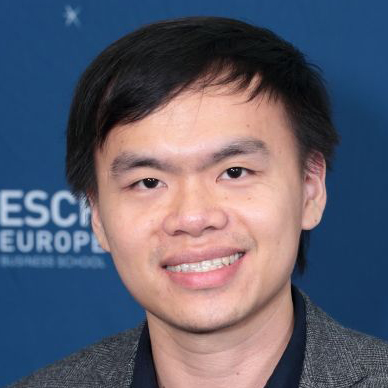
Mahn Hiep Nguyen, PhD candidate in the PhD programme ESCP, publicly defended his PhD thesis in Management Sciences.
10 July 2020
ESCP Business School Campus République
Abstract
Thus, understanding their behavior has important implications for firms, investors, and policy makers. Despite decades of work, there are still many open questions regarding how financial analysts produce and how these reports are influenced by their working environment.
In this dissertation, we attempt at contributing to the literature of analyst behavior and its effects on the capital market by addressing several new research questions. The first two papers of this thesis try to better understand the incentives behind the well-known analyst bias and identify new soucres of bias. The third paper extends into an analysis of corporate governance and the role of financial analysts in alleviating information asymmetry.
The first paper compares analysts affiliated with debt underwriters to analysts affiliated with equity underwriters. We focus on the differences in target prices and recommendations and demonstrate that while equity underwriter analysts are significantly more optimistic in their target prices and recommendations, analysts affiliated with debt underwriters do not exhibit the same bias. While the prominent view in the literature is that equity underwriter analysts are more optimistic to nurture business relationships with the followed firms, the finding that analysts affiliated with debt underwriters behave differently is not consistent with this hypothesis and sheds new light on the different conflicts of interest that influence stock analysts' reporting behavior.
In the second paper, we show that analysts whose employers own a stake in the followed firms issue significantly more optimistic target prices and recommendations. Their recommendation upgrades underperform those of their peers by 0.8% in a two-month window. The difference in optimism between owner and non-owner analysts are even larger in the times of market downturn. These results highlight the conflicts of interest inherent in the analysts whose employers own the followed firms’ stocks.
The third paper looks more closely at the quality of corporate governance and the mediating effect of analyst coverage. We show that excessive compensation of outside directors is associated with bad-news hoarding and stock price crash risk. This relationship is largely attributed to excessive stock-based compensation, but not cash compensation. These findings cast doubts on the effectiveness of stock-based compensation in aligning the incentives of directors with shareholders' interest. In addition, we find that firms followed by more analysts have lower risk of stock price crashes associated with bad-news hoarding.;
Jury
Supervisor:
- Mr Michael Troege,
Professor, ESCP Business School
Referees:
- Mrs Édith Ginglinger,
Professor, Université Paris Dauphine - PSL - Mrs Anne-Gaël Vaubourg,
Professor, Université de Poitiers
Suffragants:
- Mrs Alberta Di Giuli,
Professor, ESCP Business School - Mr Joël Metais,
Professor Emeritus, Université Paris Dauphine - PSL
Campuses

The MSc in Energy Management online information session is a great opportunity for you to learn more about the programme and discover how it may help achieve your career objectives.
Register your place now to discover:
- The unique curriculum and why it is particularly relevant to the current and, most importantly, future energy-related job markets
- Projects students are working on throughout their three terms in London & Paris
- The employment opportunities upon graduation
- What to expect on the admissions day and useful tips for your online application
- Information on fees and scholarships
Your questions are answered live by the recruitment team!
This event takes place on Tuesday 28th July at 5pm (BST). Register your place
Location
Organiser: ESCP London Campus
Online - Worldwide
MapDate
Start date: 28/07/2020
Start time: 5:00 PM
End time: 6:00 PM
Interested in the ESCP MSc in Energy Management but curious what the programme's Alumni really think?
Organised by ESCP's London Campus, this online event is a great opportunity for you to learn more about the programme direct from MEM Class of 2019 graduate Christos Zisakis!
He will share both his study experience and career progression, as well as answering any questions you might have there and then.
Participants

Christos Zisakis
MSc in Energy Management - Class of 2019
Location
Organiser: ESCP London Campus
Online - Worldwide
MapDate
Start date: 29/07/2020
Start time: 1:00 PM
End time: 2:00 PM
![© Chaiwat Chaythawin [copyright]](/sites/default/files/styles/event_news_une/public/2020-07/dreamstime_l_183642205-1068x659.jpg)
Campuses
![© Ecosphere [copyright]](/sites/default/files/styles/event_news_une/public/2020-07/EcospherePeru.jpg)
Campuses
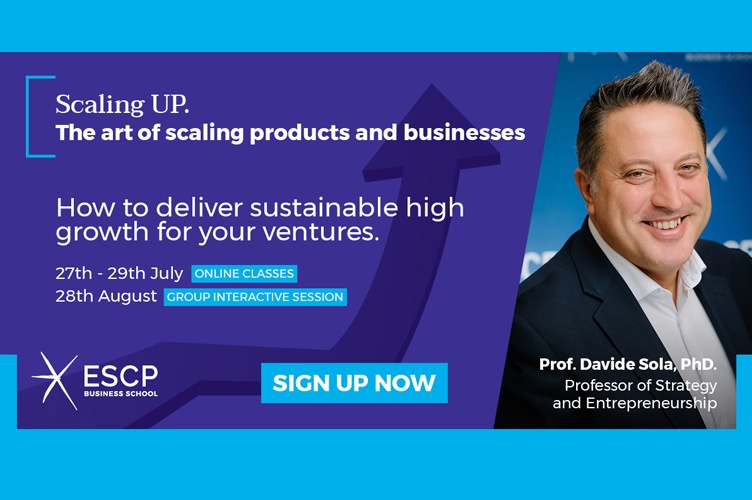
What is required to create or better build an organisation that stands the test of time?
Delivered by:
Davide Sola PhD
- Professor of Strategy & Entrepreneurship
- Director of ESCP's HMI - Healthcare Management Institute
Prof. Davide Sola discusses why enterprise and entrepreneurial activity are key to the economic recovery in Britain.
- LIVE Session and Interaction
- 4-Day Course running on 27th, 28th & 29th July and 28th August 2020
This course examines the theory and practice of entrepreneurship in order to increase the likelihood of success for an existing firm beyond the initial success of its value proposition (The Start-Up phase). It explores successful frameworks, strategies, funding techniques, business models, risks and barriers that will allow entrepreneurs to sustainably Scale Up their enterprise.
Topics include: Scale Ups, Exponential Organisations, Exponential Technologies, Disruptive Business Models, leading in an entrepreneurial environment, organisational design for growth, finance for growth, how to decide whether to retain or sell an organisation, process improvement, performance measurement, change management in particular around how to build a culture that goes beyond the founder.
Who should attend?
This course is designed for participants from rapidly growing ventures, or those who plan to join or evaluate such ventures through the lens of principal investing, with a particular emphasis on scaling new ventures in technology sectors or where technology can disrupt existing industries.
Fees
Early Bird: £550 + VAT
General Fee: £650 + VAT
ESCP Alumni get a special discount. Please contact ukexeced@escp.eu to learn more.
BOOK YOUR PLACE
About the Professor
Dr. Davide Sola is Associate Professor of Strategy and former Director of ESCP London Campus. His teaching is in the organisational and strategy area - in particular, business strategy, change management and organisational design - for both graduate and postgraduate courses.
Dr. Sola’s research interests are in corporate transformation, strategic renewal, entrepreneurship and applied enterprise economics (in particular, the application of Austrian principles in the corporate world). He is the author of articles, policy papers, book chapters, case studies and papers presented at international research conferences (Academy of Management, SMS, EIASM, etc.).
Participants

Prof. Davide Sola
Professor of Strategy & Entrepreneurship
Location
Organiser: ESCP London Campus
Online - Worldwide
MapDate
Start date: 27/07/2020
Start time: 9:00 AM
End date: 29/07/2020
End time: 5:00 PM
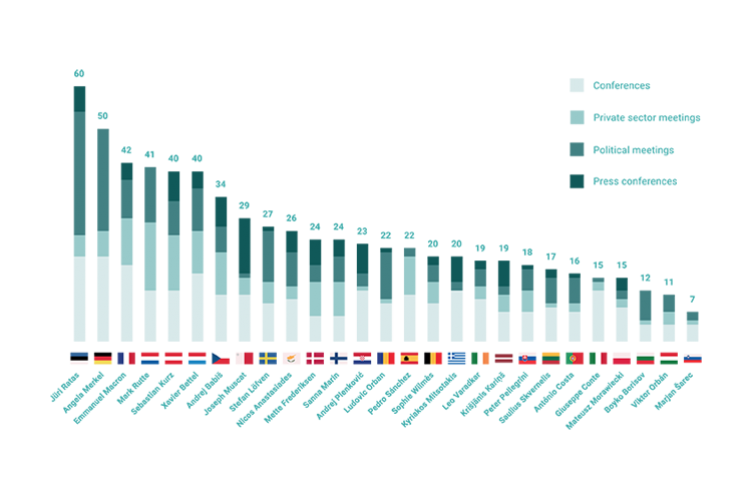
European heads of state and governments’ approach to digitisation varies widely. This is one of the main findings of the first ever Digital Engagement Report, an in-depth analysis of all 27 European leaders’ digital priorities published by ESCP’s European Center for Digital Competitiveness.
The aim of the Digital Engagement Report is to highlight the importance of European leaders in the digital transformation of their countries, as well as to investigate which digitalisation issues they address.
The first ever report of this kind, it shows that European heads of state and governments approach digitalisation with very different priorities: Estonia, Germany, France, the Netherlands and Luxemburg have the most active leaders while Poland, Italy, Bulgaria, Hungary and Slovenia have the least active.
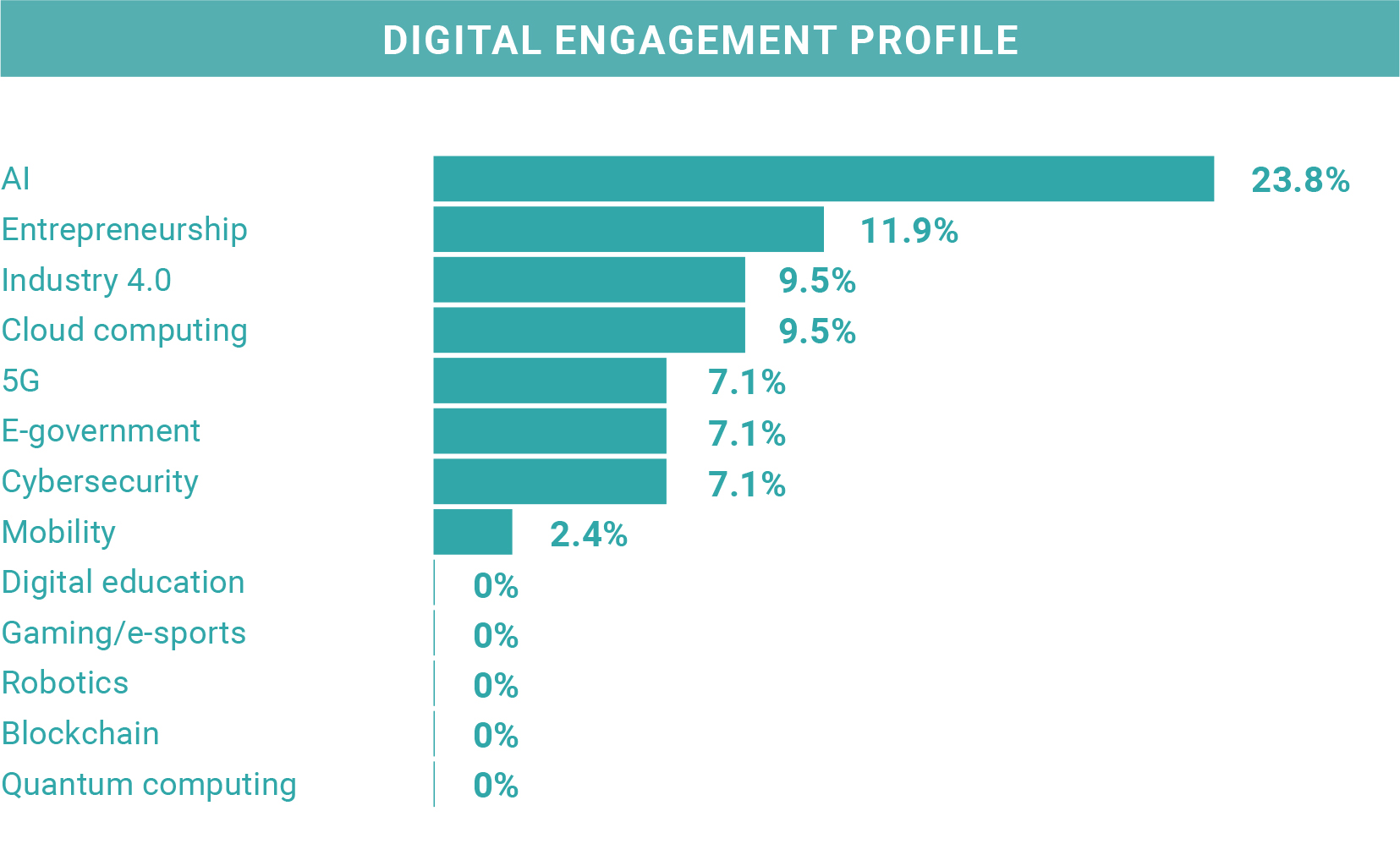
The Digital Engagement Report also shows that digital technologies have varying importance throughout Europe: In 2019, Estonia’s Jüri Ratas spent over five times more time on the topic than Slovenia’s Marjan Sarec or Hungary’s Victor Orbán. Also, there is no harmonized European approach to digital technologies, with every country setting its own agenda. Key future technologies, such as quantum computing and robotics, are disregarded by most European heads of state and governments.
European leaders have clear topic-focused profiles
Detailed engagement profiles for each European leader, which are available here as well as a summary of the Digital Engagement Report, show for instance that Angela Merkel focuses mostly on digital infrastructure while neglecting the topic of entrepreneurship. Emmanuel Macron, on the other hand, puts artificial intelligence and entrepreneurship in the spotlight.
Europe needs a common strategy for digital technologies
“Digitisation in Europe is still like a patchwork quilt,” explains European Center for Digital Competitiveness by ESCP Business School Founder & Director, Professor Philip Meissner. “How well Europe is able to position itself in terms of digital technologies will determine its future economic power and geopolitical position. We need a uniform and powerful approach to drive this topic throughout Europe. In a nutshell, we need a digital strategy for Europe with key elements like entrepreneurship and digital education.”
“Given the size of the challenge and the speed of technological progress, we need uniform European priorities to finally enable large-scale investments in future technologies,” adds fellow European Center for Digital Competitiveness Founder & Director Christian Poensgen. “Europe must act now.”
The Digital Engagement Report is based on a Digital Engagement Index, which evaluates European leaders’ digital activities in 2019. The Digital Engagement Index is compiled from a variety of publicly available information from governments themselves, from the press and personal reports on the Twitter social media platform. These digital activities were then classified according to the type of interaction (conferences, private sector meetings, political meetings and press conferences) and according to their focus (5G, artificial intelligence, Blockchain, cloud computing, cyber security, digital education, e-government, entrepreneurship, gaming/e-sports, industry 4.0, mobility, quantum computing and robotics).
Campuses
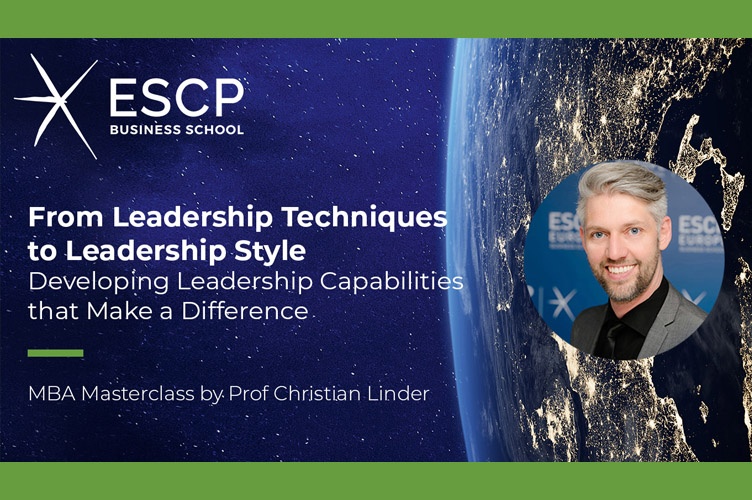
Join our MBA masterclass delivered by Prof Christian Linder who will talk us through the different leadership techniques and styles, as well as their impact on one's success as a leader.
Leadership techniques can be seen as useful toolkits for addressing leadership challenges in daily business life. Typically, such toolkits answer the question on what to do in a given situation. As every technique, leadership techniques can be taught and learned easily. Thus, the standards leadership techniques are widely known and often applied. Leadership style, however, is a personal expression of values involving elements of taste and aesthetics. Style is a pattern on how things are done.
This masterclass will argue that leadership techniques are necessary to survive in a leadership role, but they are not sufficient to be successful. It is a unique and distinct leadership style that will determine one's leadership success.
This masterclass will also provide a further overview on leadership style elements and how to develop them in professional life.
Agenda:
- ESCP's MBA programme at a glance: 17:00 - 17:05 (BST)
- Masterclass Discussion: 17:05 -17.35 (BST)
- Q&A: 17.35 - 18:00 (BST)
About the Speaker: Christian Linder is an Associate Professor of Strategy and Leadership at ESCP Business School. He also is the Academic Director of the MBA in International Management for the London Campus.
Participants

Prof. Christian Linder
Associate Professor of Strategy and Leadership
Location
Organiser: ESCP Business School
Online - Worldwide
MapDate
Start date: 16/07/2020
Start time: 5:00 PM
End time: 6:00 PM

Thesis Defense
Luxury Consumption Practices in the Digital Age:
Prosumers and Lurkers on Visual Social Media.

Marina Leban, PhD candidate in the PhD programme ESCP, publicly defended her PhD thesis in Management Sciences.
8 July 2020
ESCP Business School Campus République
Abstract
The liquidification of society thus allows for new forms of status games and distinction that are not necessarily tied to family history or level of education. Indeed, this can be seen in the rise of a ‘new elite’, who, contrary to the old elite that was primarily defined by their economic capital, is defined by the acquisition of knowledge and culture.
To this end, research still needs to be done to uncover new forms of luxury consumption practices in a digitalized and liquid society, taking place on social media platforms. To address this gap, this thesis therefore looks at the luxury consumption practices of the specific segment of high-end luxury consumers (prosumers), as well as their social media. Specifically, it looks at how these define, display and consume luxury on the visual social media platform called Instagram.
Article 1 explores, through a content analysis and netnography, how wealthy micro-celebrities use personal branding strategies to create and display luxury meaning on Instagram.
Article 2 further explores findings from Article 1, by interviewing and analyzing Instagram data of wealthy social media influencers, to understand how they now view luxury and what kind of strategies they use on Instagram to justify their luxurious lifestyle as being ‘ethical’ – as opposed to other influencers who exhibit unethical consumer behavior by displaying an overly conspicuous, wasteful form of luxury.
Article 3 takes a different approach by investigating how lurkers, as opposed to prosumers (Article 1 & 2), digitally and virtually consume luxury related content on Instagram.;
This thesis by articles has a threefold contribution to the literature:
- (1) to expand theoretical understanding of new conspicuous consumption strategies of upperclass (or elite) consumers in asserting their social status and distinction online,
- (2) to better understand the dematerialization of luxury and stressing how consumption experiences, rather than the ownership of products, are thus considered to be status symbols,
- (3) to highlight the contribution to growing literature on morality in luxury consumption, showing that old elite individuals pursue both distinction-seeking, and at the same time authenticity-seeking when portraying themselves publicly.
Jury
Supervisor:
- Mr Benjamin G. Voyer,
Professor, ESCP Business School
Referees:
- Mrs Delphine Dion,
Professor, ESSEC Business School - Mrs Margherita Pagani,
Professor, EMLyon Business School
Suffragants:
- Mr Yuri Seo,
Associate Professor, University of Auckland - Mr Luca M. Visconti,
Professor, Università della Svizzera Italiana
Campuses