
A study published in PLOS ONE uses artificial intelligence to analyse nearly 1,500 ESG reports, revealing which corporate sustainability narratives are linked to measurable environmental performance and showcasing how an ESCP Master's thesis became published research.
Every year, Europe’s largest companies publish thousands of pages describing their environmental ambitions. Investors read them. Regulators rely on them. Companies use them to demonstrate their commitment to sustainability. Some ESG reports are so extensive that they are longer than War and Peace. Faced with documents running to hundreds of thousands—or even more than a million—words, traditional manual analysis quickly reaches its limits.
And how can we tell whether companies are genuinely improving their environmental performance or simply trying to make an impression that they are green?
A new study published in PLOS ONE set out to answer that question by combining artificial intelligence with environmental performance data. The research analysed nearly 1,500 ESG reports from companies across the STOXX Europe 600, examining whether the issues companies choose to emphasise are associated with measurable improvements in their environmental performance.
What makes the publication particularly notable for ESCP is where the study began.
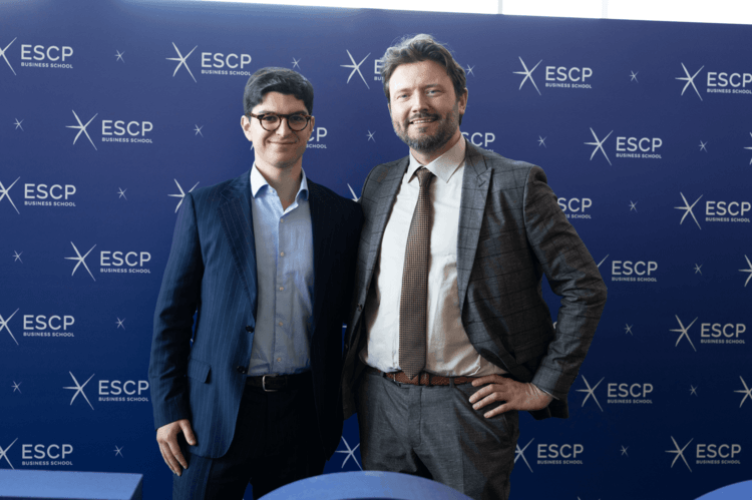
The study grew out of the Master’s thesis of Mateo López Carel, completed under the supervision of Professor Ivan Savin at ESCP. The thesis evolved into a collaborative research project, culminating in a peer-reviewed publication co-authored with Eva Schlindwein of Bern University of Applied Sciences.
For Mateo, there was no single moment when he realised the thesis had the potential to become a journal article.
“It built up gradually. Early on, Ivan kept pushing me to be much more rigorous than a typical Master’s thesis requires, and at some point I realised he genuinely thought the data and the research question were strong enough to go further. It really materialised after the thesis presentation, when he told me he wanted to submit the paper for peer review.”
For Ivan, the collaboration began even earlier. Knowing Mateo wanted to strengthen his quantitative research skills, he suggested applying computational text analysis, covered in his Machine Learning course, to corporate ESG reports. Access to a unique dataset through ESCP’s research community helped transform the initial idea into an ambitious study.
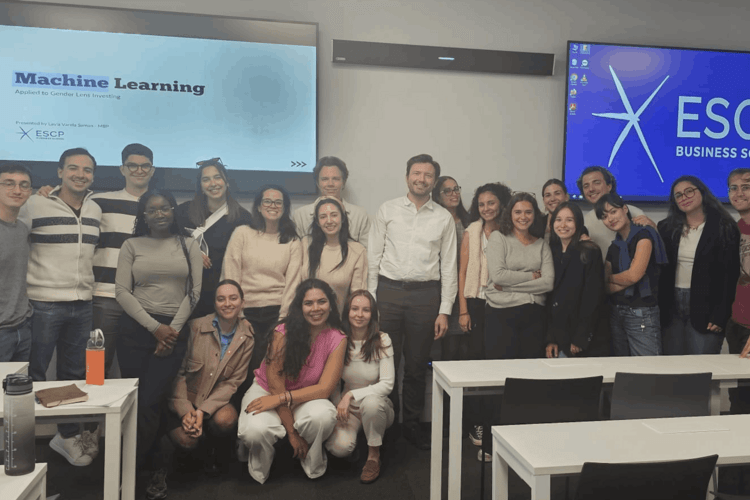 Professor Ivan Savin with students from his Machine Learning course at ESCP, where the research project began as a Master's thesis before becoming a published PLOS ONE study.
 Personally, I found the topic fascinating from the beginning, so I invested considerably more time than I normally would in supervising a Master’s thesis. For me, it quickly became more than a supervision project. Fortunately, Mateo was equally enthusiastic, which made the collaboration very enjoyable and productive.
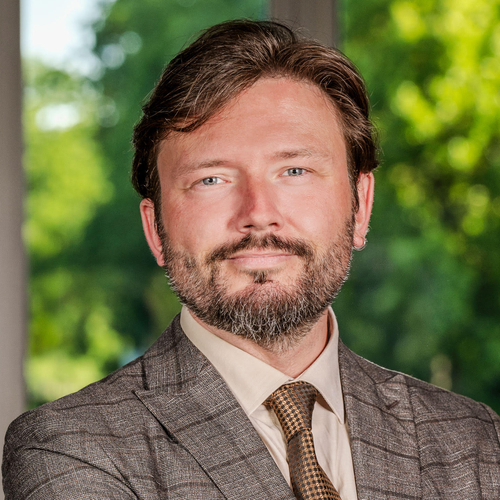 Ivan Savin
Associate Professor of Quantitative Analytics
Using structural topic modelling, an AI-powered natural language processing technique, the researchers identified 34 recurring themes across ESG reports published between 2010 and 2023.
They then compared those communication patterns with environmental indicators, including emissions, energy use and environmental innovation.
Rather than asking whether ESG reporting is credible in general, the paper poses a more nuanced question: which sustainability topics are actually associated with measurable environmental progress?
The answer is that not all environmental narratives carry the same weight. Companies that devoted greater attention to themes such as renewable energy and sustainable value chains were more likely to show improvements in environmental performance, while discussion of other topics, for instance, emissions or electric vehicles, showed no consistent relationship with measurable outcomes.
The findings also changed the way Mateo thinks about ESG reporting.
“Before this project I thought of ESG reports mostly as compliance documents. Seeing how much the topics and depth of disclosure vary and how weakly some of that actually correlates with real environmental performance made me much more cautious about taking ESG disclosures at face value. One thing that really surprised me was that companies genuinely investing in a particular environmental area tend to be much more specific about what they’re doing and how they’re doing it.”
The journey from thesis to publication was also an education in how research itself is done.
For Mateo, one of the biggest challenges was learning a new level of scientific precision.
“Ivan pushed the level of precision well beyond what I’d expected from a typical thesis, questioning the exact wording, eliminating ambiguity and making sure every claim was as precise as possible. It was demanding, but it taught me a level of rigour that I still rely on today.”
For Ivan, the challenge extended well beyond analysing the data.
“Applying natural language processing and statistical methods to hundreds of ESG reports took considerable effort, but translating the results into a coherent scientific story that would satisfy reviewers was even more demanding.”
The project also left a lasting impression on how Mateo approaches AI.
“It gave me a lasting appreciation for what computational methods can reveal that manual reading simply can’t. That’s stayed with me well beyond the thesis, including in how I think about AI applications in my current work.”
As sustainability reporting becomes increasingly central to European regulation through frameworks such as the Corporate Sustainability Reporting Directive (CSRD), the findings offer a new way of thinking about corporate disclosure. Rather than treating ESG reports as a single measure of corporate commitment, the research suggests that what companies choose to discuss may be just as important as how much they report. As sustainability reporting continues to expand under the CSRD, methods capable of analysing millions of words objectively will become increasingly important—not only for researchers, but also for investors, regulators and companies themselves.
The collaboration has also come full circle. Ivan will include the newly published article as a case study in his Machine Learning course, showing students how a Master’s thesis can develop into published research.
“You never know when a student project might eventually become a peer-reviewed publication. It’s a reminder that genuine research contributions can emerge when curiosity, persistence and collaboration come together.”
Campuses