
When ethical responsibility is translated into tools, metrics and legal safeguards, what changes in organisations?
Professor Wafa Ben Khaled studies how organisations define responsibility. More specifically, she looks at what happens when ethical principles are translated into tools, metrics and compliance systems.
In February 2026, she received the Journal of Business Ethics’ R. Edward Freeman “Philosophy in Practice” Best Paper Award for her article “Ethical Tools and the Legalization of Ethical Responsibility in Organizations” co-written with Mattia Anesa (open access through March 2026). The paper builds on her doctoral work and examines how companies design and implement ethics programmes.
For Ben Khaled, the award is meaningful because research presented in the article draws on work she began years ago. Seeing it recognised now, she says, feels like “closing a long chapter”.
However, simultaneously, it reasserts the underlying commitment of her entire research career that seeks to answer the question: what changes when ethics is managed through compliance?
When ethics becomes a system
As she explains to me, most large and medium-size organisations nowadays rely on codes of conduct, reporting mechanisms, training sessions and audit processes to demonstrate their ethical commitments. These tools are often presented as evidence of social responsibility but the real question is what these tools actually do in practice.
In her Journal of Business Ethics article, she shows how ethics programmes can gradually shift towards a legal logic. Responsibility becomes framed in terms of risk management and liability. The key question is no longer simply “Is this right?” but “Are we legally covered?”
This does not mean that such ethical tools are irrelevant. As the paper demonstrates, they often create an architecture of responsibility, codes, hotlines, training modules, audits, which is crucial for upholding norms. But when these tools are designed primarily around legal risk, the central question becomes one of compliance rather than principle. In her words, the danger is that ethics turns into a matter of “being covered”, narrowing moral reflection to procedural correctness.
Unboxing corporate legal violence
Another strand of her research explores what she calls “corporate legal violence”. Instead of focusing on individual wrongdoing, she looks at how organisational structures can produce harm while remaining legally defensible.
Across these studies, her focus is on power. Legal and organisational frameworks do not just set boundaries; they decide who carries the consequences. “There are always those who have power and those who have not.” Ethics, in this sense, is inseparable from that imbalance.
Asked what draws her to difficult topics such as discrimination, harassment or structural inequality, Ben Khaled’s answer may seem surprising
Once you start seeing how power operates in organisations, it becomes impossible to look away
 Wafa Ben Khaled
Associate Professor of Business Ethics and Management Control at ESCP
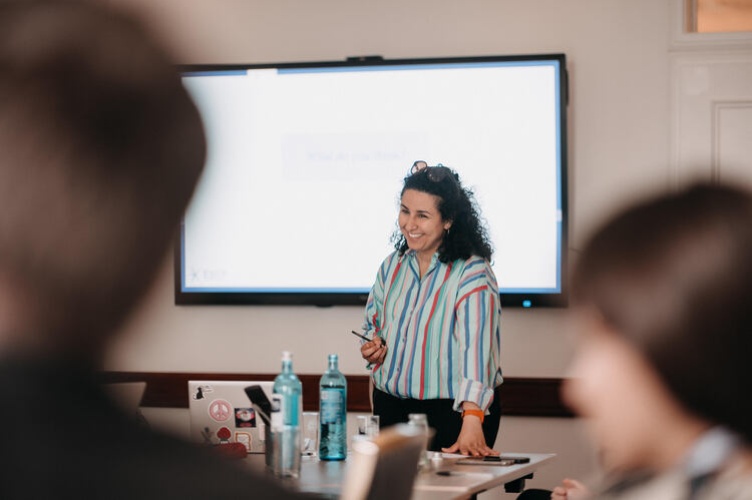
 Professor Wafa Ben Khaled presents her research on corporate legal violence at the 85th Academy of Management Annual Meeting (AOM 2025), Bella Center, Copenhagen.
She describes the moment when everyday situations begin to appear differently. You notice who is listened to and who is dismissed. You see how legitimacy is attached to certain profiles and denied to others. You recognise how institutional structures can normalise unequal treatment.
This way of seeing did not emerge overnight. She credits encounters with other critical and feminist critical scholars with sharpening her understanding of power and gender in everyday academic and organisational life. Their work, and their willingness to challenge conventional research formats, encouraged her to question not only what organisations do, but how knowledge itself is produced.
This awareness shapes how she reads corporate initiatives, from diversity metrics to ethics programmes. The question, she says, is always the same: is this about real change, or about virtue signalling?
Her work does not aim to denounce for the sake of it. It aims to understand how systems function so that responsibility is not reduced to a checkbox, but allowed to function meaningfully.
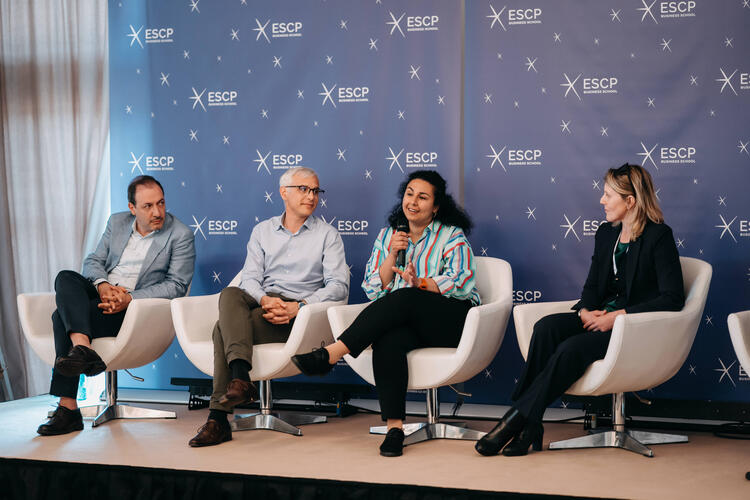 Professor Wafa Ben Khaled speaks during the panel discussion “From Ideas to Action: AI, Sustainability, DEI and Beyond” at the ESCP Full Faculty Reunion 2025 in Potsdam, alongside Professor Kamran Razmdoost, Professor Louis-David Benyayer and Professor Alberta Di Giuli.
 Ethics, in this sense, is political. Its evolution depends as much on public contestation as much as it does on policy.
Advice to early-career scholars
For young scholars, particularly those researching power and inequality, her advice is practical.
Find a community. Academia can be demanding, and working on sensitive topics can be isolating. Having colleagues who are intellectually rigorous but personally supportive makes a difference.
Wafa Ben KhaledAssociate Professor of Business Ethics and Management Control at ESCP
She also emphasises patience. “Recognition takes time. Research trajectories are rarely linear. The important thing is to remain clear about why the questions you ask matter.”
At its core, her work returns to a simple but uncomfortable point. Legal conformity does not automatically equal ethical responsibility. When ethics becomes compliance, the focus moves from judgement to protection. The question is no longer what is just, but what is defensible. Her research asks what that move obscures, and whose experiences become easier to overlook.
Related News

R. Edward Freeman Journal of Business Ethics Philosophy in Practice Best Paper Award
Campuses