

Key Insights from the Women in Sustainable Fashion Event
As industries face growing pressure to innovate in a rapidly changing world, an important question remains: how can innovation also be sustainable?
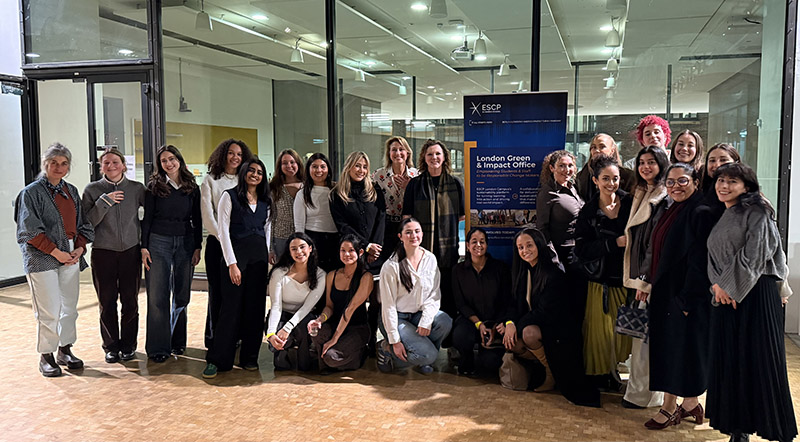
Earlier this month, ESCP Business School and Central Saint Martins co-hosted a panel discussion and networking event on Women in the Business of Sustainable Fashion, supported by ESCP Business School’s London Campus Green & Impact Office.
Held during International Women’s Day week, the event welcomed experts from academia, law, and industry, each with a global perspective, to explore how sustainable innovation is transforming the future of fashion.
While fashion is often perceived as a female-led industry, its leadership structures and supply chains still reflect significant gender imbalances and systemic challenges. The event, therefore, focused on featuring women at the forefront of sustainable fashion, sharing insights from their experience navigating the industry and their vision for its future.
The discussion highlighted a key reality facing the sector today. Fashion is both a global economic powerhouse and an industry under increasing scrutiny for its environmental and social impact. With sustainability becoming a growing global priority, the industry is under pressure to rethink how products are designed, produced, and consumed. Business schools and creative institutions also play an important role in this transformation, helping translate sustainability ambitions into practical action for future industry leaders.
Women driving the conversation
The event opened with welcome remarks from Christina Bartholomew, Sustainability Lead at ESCP Business School London, who also organised the event as part of the School’s activities marking International Women’s Day.
The panel was moderated by Carole Collet, Professor of Design for Sustainable Futures and Director of Maison/0 at Central Saint Martins, who guided the discussion across themes ranging from circular design to regulatory change.
The speakers included:
- Kate Goldsworthy, Professor of Circular Design and Innovation at the University of the Arts London, who shared insights on how academia can collaborate with industry to accelerate sustainable textile innovation and circularity.
- Olivera Medenica, IP and advertising law attorney specialising in the fashion and luxury industry, discussed the role of regulation and the evolving legal landscape that influences sustainability adoption across North America and Europe.
- Sanjana Sheth, a sustainability reporting analyst and systems-thinking expert, who highlighted the importance of understanding fashion as a complex global system in which innovation must take place across the entire value chain.
The future of fashion will be shaped by those who can connect creativity with accountability. By bringing together business and design students, we create opportunities for collaboration that turn sustainability from an aspiration into a practical, scalable reality. This is especially important when we recognise that women make up around 80% of the global garment workforce, yet are still underrepresented in decision-making roles. Centering female perspectives is therefore not only equitable, but essential to building a more responsible and resilient industry. International Women’s Day provides a timely moment to elevate these voices and recognise the critical role women already play in driving sustainable change across fashion.
 Christina Bartholomew
Sustainability Lead at ESCP Business School London Campus
Key drivers for the future of sustainable fashion
Throughout the discussion, speakers identified several factors that will shape the next phase of sustainable innovation in the fashion sector:
1. People and the circular economy
The transition to circular fashion must begin with rethinking how products are designed and how materials flow through the whole system. Thus, the people making decisions across the value chain play the most important role in this transformation. Choosing a circular approach means creating products that can be reused, recycled or regenerated from the beginning, not something that comes as an afterthought.
Start by viewing fashion through a circular lens, where sustainability is not about solving isolated problems but rather about designing systems that function sustainably from the start. This shift opens the door to the true potential of innovation, with opportunities across materials, production processes, and business models.
2. Collaboration across a global industry
Fashion is a highly globalised sector, with supply chains, from raw materials to production and distribution, often extending across multiple continents. Design, branding and consumer markets are often concentrated in what is known as the Global North, while much of the manufacturing and textile processing takes place in the Global South.
This structure means that seemingly small regulatory decisions and sustainability initiatives from specific regions/countries can potentially have more significant consequences across global supply chains. The panel emphasised the need for stronger partnerships between brands and suppliers to ensure sustainability efforts are both effective and unbiased.
Ultimately, for lasting change to occur, we will need to move from competition to cooperation, with brands, manufacturers, policymakers, and researchers working together to rethink and redesign the system, with a voice given to suppliers in the Global South.
3. Regulation as a catalyst for innovation
Regulation will also play an increasingly important role in shaping the industry. While sustainability priorities may vary across governments, new regulatory frameworks are increasingly influencing how companies operate.
All brands need to navigate the evolving compliance requirements, as well as the legal and reputational risks of greenwashing, where companies make misleading or exaggerated claims about the environmental impact of their products or practices. Regulatory pressure, particularly from the European Union, is already driving companies worldwide to rethink product transparency and sustainability claims. For example, initiatives like the EU Digital Product Passports already provide greater visibility into how products are made and their environmental impact.
At the same time, companies operating globally must adapt to multiple regulatory environments. Even in markets with less developed regulations, international supply chains often require alignment with stricter standards elsewhere.
Transparency and consumer education
As companies increase transparency about their sustainability efforts, another challenge emerges: ensuring consumers understand the information they share.
For example, many brands now disclose their carbon emissions or environmental metrics for their products. However, without broader education around climate impact and sustainability terminology, these figures can be difficult for consumers to interpret. A product labelled as having “30% lower emissions” may appear more sustainable, but without context, such as what it is being compared to, over what lifecycle stage, or whether industry standards are being applied, the claim can be misleading or misunderstood. Similarly, terms like “circular,” “biodegradable,” or “net-zero” are often used inconsistently, leaving consumers unsure of their real meaning or impact.
The panel highlighted the importance of education across the entire value chain, from producers and brands to consumers. Transparency alone will only get you so far if it is not paired with clear communication and greater public understanding.
The next generation of sustainable fashion leaders
For students and entrepreneurs interested in entering the sustainable fashion sector, the speakers emphasised the importance of building strong relationships across the supply chain and developing a deep understanding of how the industry operates globally.
Events like this create opportunities to connect ideas, people and expertise from across different disciplines and parts of the value chain. These conversations are essential for tackling the complex sustainability challenges facing the fashion industry today.
Ultimately, progress will require honesty, transparency and collective action. A more sustainable fashion industry will only be possible through coordinated collaboration among consumers, brands, regulatory bodies, and the wider supply chain.
Looking to contribute to this transformation? Now is the time to engage with the wider ecosystem. Understand who the key players are, participate in industry events, build new connections and speak with as many people as possible to help turn your ideas into action.
Find out more about ESCP’s sustainability initiatives:
Campuses