
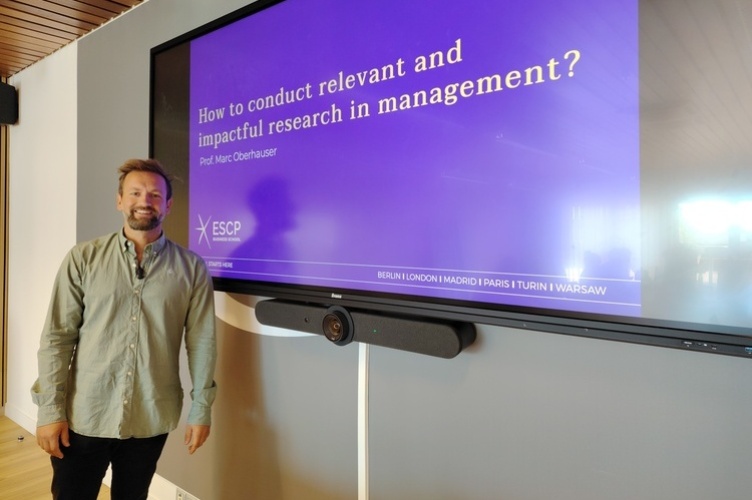
From value chains to geopolitics, his research traces how responsibility moves through complex systems rather than single firms.
In Marc Oberhauser’s research, familiar elements of global business, such as supply chains, multinationals, and sustainability, become the starting point for a larger inquiry. He asks what happens to responsibility when harm is produced not by one firm, but by the structure of the system itself.
Marc Oberhauser, an Associate Professor of International Business at ESCP Business School in Madrid, explains that this perspective now connects two strands of his work. “I’m building a second pillar of research that looks more directly at geopolitics, sanctions, and corporate power,” he says. In his view, responsibility in global value chains cannot be understood without also considering the political pressures shaping how firms operate today.
Beyond the corporation
According to Marc, International Business as a discipline largely remains company-centric: “We know a lot about managers, CEOs, and corporate strategies. What interests me more are the actors around them, such as civil society organisations, local communities, and governments, and how their interactions shape what global business becomes.”
His research seeks to understand how responsibility is negotiated across vast networks of actors, not contained within a single firm. His studies of human rights and sustainability in global value chains reveal how easily good intentions dissipate once they travel through the intricate circuitry of subcontractors, suppliers, and intermediaries.
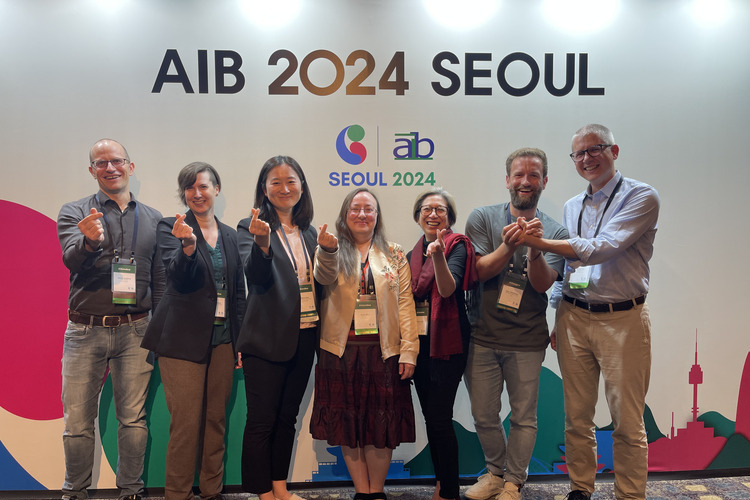 Marc Oberhauser with colleagues from the AIB Sustainability SIG at the 2024 Academy of International Business conference in Seoul, South Korea.
In interviews with civil society organisations across Africa, Asia and Latin America, he found that collaboration on the ground often bears little resemblance to the glossy agreements announced at corporate headquarters. “When a multinational and a global NGO sign a partnership, we imagine something is happening. Unfortunately, very often, it doesn’t reach those most affected, that is, the people whose rights are actually at stake.”
Real accountability, he argues, depends on transnational networks linking global, national, and local civil society groups. “You can’t rely on one level alone. Local organisations may distrust corporations; global NGOs may be too far removed. It’s when they work together that information starts to flow back to the company, and change becomes possible.”
Opacity and its discontents
The word that keeps returning in Marc’s research is opacity. Global value chains, he says, were designed for efficiency and cost optimisation, not transparency. The result is a system in which even the most responsible companies often have no clear view of what happens at the far end of their supply networks. “We heard repeatedly that firms don’t even know when their suppliers subcontract to others. Even companies with the best intentions simply don’t know.”
One example he admires is Tony’s Chocolonely, a Dutch chocolate company founded to combat child labour in the cocoa industry. “They say it’s not bad if we find child labour, it’s bad if we don’t,” Marc explains. “They reward suppliers for identifying problems because that’s the only way to address them. They also work closely with local partners on the ground. That’s what many multinationals can’t do anymore because their chains are too large, too fragmented.”
The problem, he adds, is not just moral but structural. Globalisation’s architecture itself was built with different aims. “Human-rights issues in value chains are unintended consequences of how we designed them. You can’t simply retrofit ethics into a system engineered for extraction.”
During our conversation, I catch myself noticing how easily we default to top-down stories, where responsibility rests with a single leader or a single company. Marc disagrees with the simplicity of that view. “That’s common in research and politics,” he tells me. “But real systems are more tangled. You need to see all the actors involved, and the contradictions too.”
Responsibility without illusion
A recurring feature of Marc’s work is that it avoids the usual binaries; he is neither cynical about global systems nor naïve about their constraints. He sees the value in individual ethics: he is vegetarian, but he notes with a laugh that he is realistic about his limits. He notes that individual choices still matter, but only up to a point. The contrast is stark: recent estimates suggest that Elon Musk’s private jets alone emit around 5,500 tonnes of CO₂ a year, more than eight centuries’ worth of emissions for the average person globally. “It puts our individual efforts into perspective and shows why systemic change is imperative.”
For him, change happens through coalitions. Civil society groups, he points out, have their own interests too. “We frame them positively, but of course they have agendas. You have to keep that dialectic in mind.” Still, he finds reasons for hope: “You don’t need half of society to change things. Ten per cent is often enough to reach a tipping point.” There’s a quiet pragmatism in that idea. Responsibility isn’t a moral destination but a process of coordination, between firms, citizens, and institutions, that can slowly rewire how systems work.
From ethics to geopolitics
In his newer research, Marc scales that question up: what happens when multinational corporations themselves become geopolitical actors? “We call it quasi-sovereign corporate power,” he explains, referring to a concept he developed with his doctoral student Ziqiao Wang. “Companies like SpaceX or TSMC are no longer just businesses; they make decisions with geopolitical consequences.”
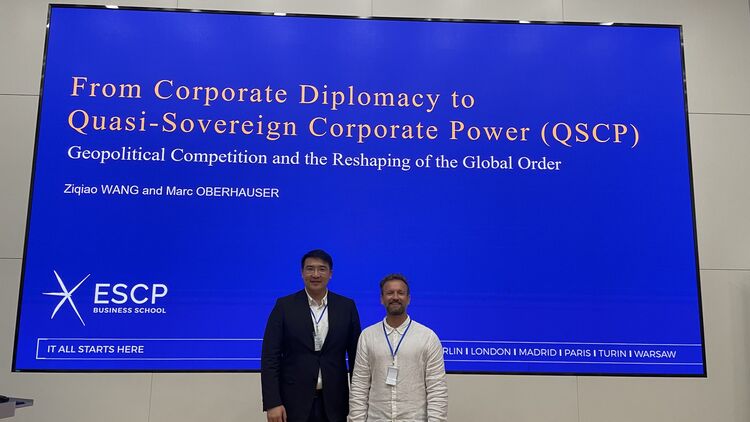 Marc Oberhauser and Ziqiao Wang presenting their work on quasi-sovereign corporate power at the World Business Ethics Forum in Macau.
When SpaceX provides satellite services to Ukraine, it effectively becomes part of the conflict. When TSMC, the world’s key chip manufacturer, anchors its production in Taiwan, it acts as a “silicon shield”, shaping the island’s strategic significance. “These companies and their CEOs are operating in spaces that used to belong to states. It’s a fundamental shift in where political power sits.”
This marks his second research pillar: how multinational enterprises navigate and sometimes create geopolitical tensions. One current project examines how firms respond to sanction regimes and policy fragmentation, showing that corporate strategy is now inseparable from global governance.
Europe at a crossroads
Nowhere is this tension more visible than in Europe. In his recent scenario work, Marc and his co-authors outline four possible futures for European multinationals, shaped by both global and intra-European dynamics: fractured regionalisation, fractured globalisation, reinforced globalisation, and reinforced regionalisation. ”
He sees the most likely outcome as fragmentation on both fronts, that is, within the EU and across the global system. “Politicians don’t manage to speak with one voice,” he says. “If Europe could get beyond that, it could become the third major power next to the US and China, stronger even in purchasing power. The problem is unity.”
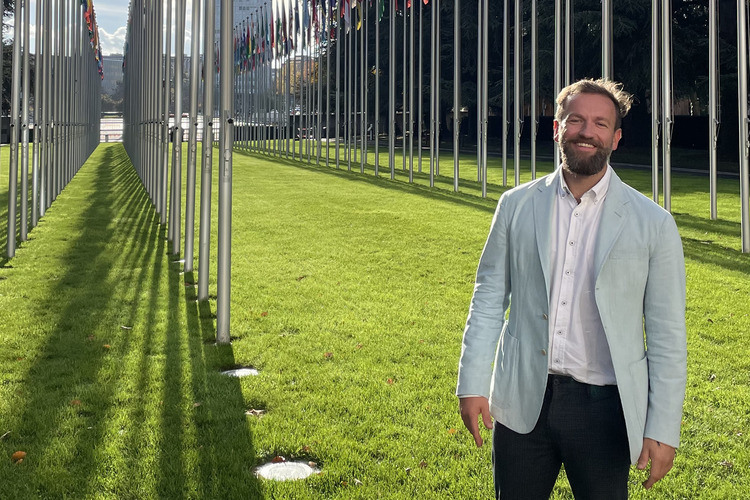 Marc Oberhauser at the United Nations Forum on Business and Human Rights in Geneva, where global stakeholders discuss accountability across international value chains.
 Marc is cautious about nostalgia for the old model of globalisation. What concerns him more is the mismatch between the short-term rhythms of democratic politics and the long-term commitments sustainability requires. It is a structural tension, he believes, and one that shapes how far collective responsibility can realistically go.
Responsibility in an age of power
Even though Marc’s work moves between disciplines, from business ethics, to international management, to political science, its through-line is remarkably consistent. It’s about how power circulates through systems, and how legitimacy is built when no single actor is in control. From companies apologising for misconduct to civil society networks uncovering hidden abuses, from cocoa farmers in Ghana to semiconductor giants in Taiwan, he traces the shifting boundaries between moral intention and political reality.
Marc often describes his approach as “lifting the view away from the corporate”, widening the frame to include the network of actors that shape responsibility. As we finish our conversation, I mention how difficult it can feel to imagine large-scale change in such a fragmented world. He acknowledges the challenge, but stays steady: meaningful shifts, he suggests, rarely begin with a majority. What matters is how actors coordinate across different parts of the system.
For him, the sense that progress depends less on sweeping transformation and more on how different groups, even small ones, align their efforts underpins the way he thinks about responsibility in global systems.
This article is based on a conversation between Marc Oberhauser and Kristina Vlasova held in November 2025.
Why global supply chains need adaptive, local governance to improve human rights
Campuses