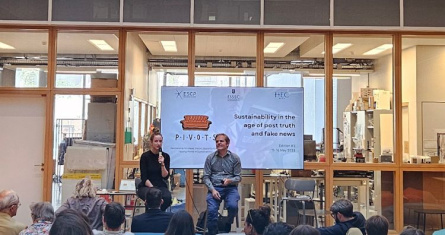
For its third edition, PIVOTS brought together 120 students from ESCP Business School, ESSEC Business School and HEC Paris to imagine how sustainability and business could evolve in an age of geopolitical disruption.
On 28 and 29 May 2026, ESCP Business School welcomed students from ESSEC Business School and HEC Paris to its Paris Montparnasse Campus for the third edition of PIVOTS: Partnership for Ideas, Vision, Opportunities and Tipping Points in Sustainability.
Each year, PIVOTS brings together students from the three institutions to work on a major sustainability challenge. This year’s theme, “Sustainability and Business in the Age of Geopolitical Disruption”, invited students to examine how business models, resources and risks may evolve in a world marked by uncertainty, volatility and shifting power dynamics.
“This year, we chose to focus on geopolitics and how it interacts with, and is completely linked to, sustainability topics,” said Prof. Aurélien Acquier, ESCP Professor of Sustainability and co-organiser of PIVOTS.
Building scenarios for uncertain futures
The workshop combined analysis, exploration, creativity and strategic thinking. The objective was to help students identify possible futures, understand what they could mean for companies, and turn these insights into concrete strategic recommendations.
Students worked across five “universes” guided by committed facilitators and partners: Energy, IT & Media, Mobility, Agriculture, and Construction & Real Estate.
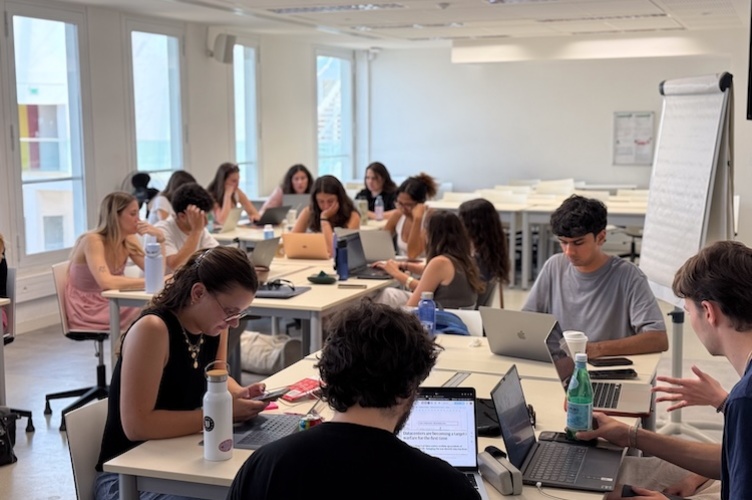
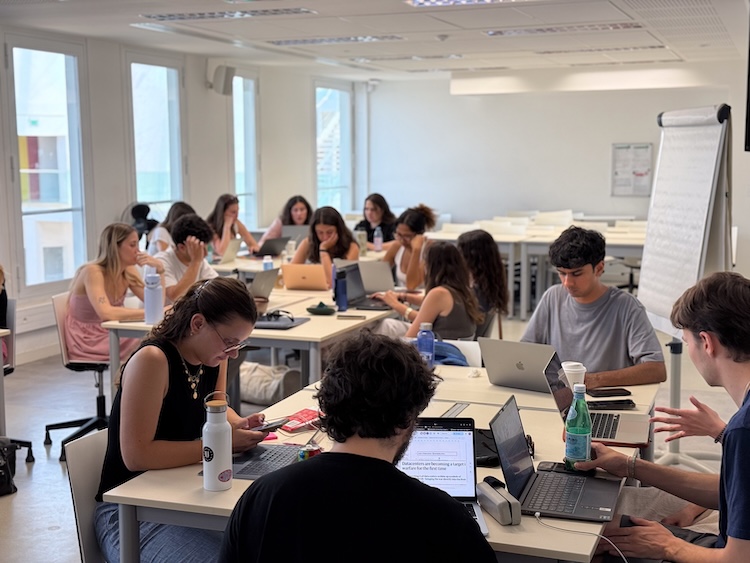 Students hard at work on the first day of PIVOTS
Working in mixed teams, students analysed their sector through a systemic lens. They investigated weak signals and explored “seeds of change”: early signs that may seem marginal today but could become decisive by 2035. These included things like changing digital behaviours, new patterns in infrastructure use, climate-related migration, resource tensions and long-term policy decisions.
As members of the Mobility team explained: “Our scenario focuses on climate migration and how we are going to adapt transport to the influx of people and climate change, while mapping potential political consequences. Above all, adaptation is the keyword.”
From analysis to design fiction
A distinctive feature of PIVOTS is its use of design fiction, a method that helps participants imagine and test possible futures through credible storytelling.
Over the two days, students moved from research and analysis to storytelling. Their task was to produce scenarios that were both creative and credible, and to translate uncertainty into recommendations that businesses could discuss, challenge and refine.
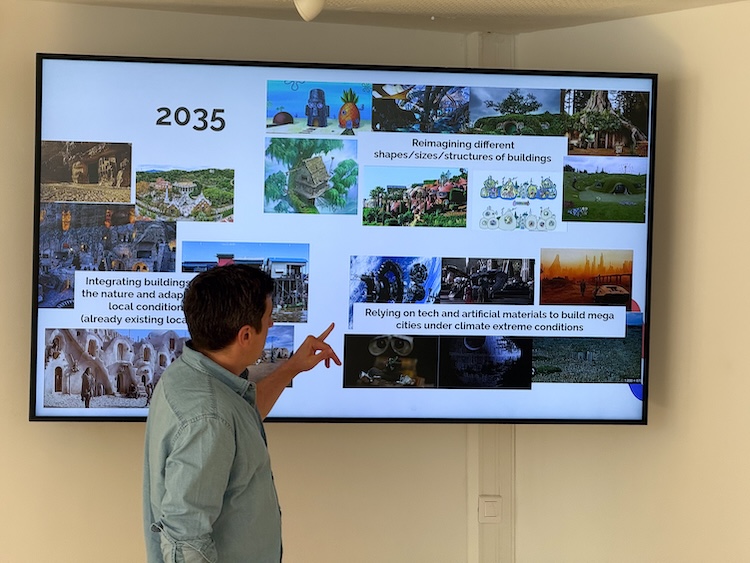 Imagining the future
Students were encouraged to draw from science fiction, literature and cinema to understand how the critical variables they had identified might reshape business and society. They then used these references to build narratives grounded in evidence, while leaving room for imagination.
After a first day of exploration, students attended an inspiring company roundtable with representatives from Orange, Bonduelle and Nexans, titled “From stability to scarcity: how corporates and public authorities are redefining power, resources and risk in an era of systemic uncertainty.”
The winners of PIVOTS 2026
On the second day, the students presented to a panel of judges.
First place was awarded to the Energy team composed of: Skylar Strange from ESCP Business School, Leyna Calderon from HEC Paris, and Maxime Nguyen van Mai and Alexia Hugues from ESSEC Business School.
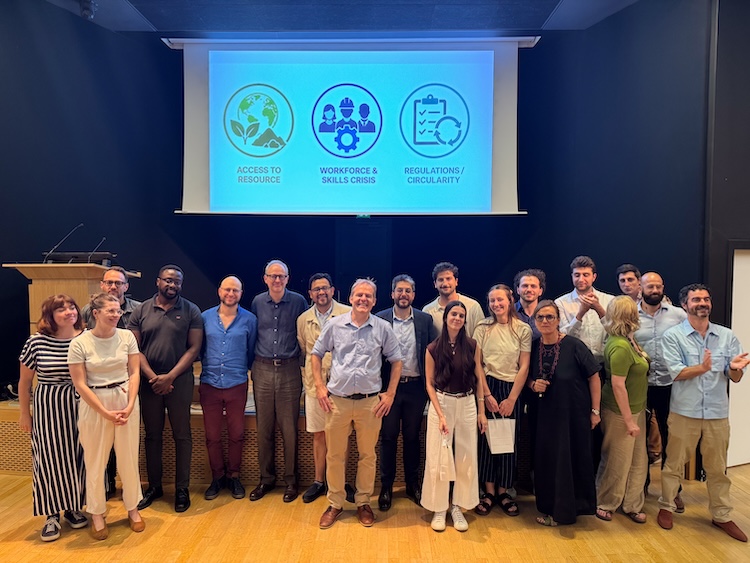 Celebrating the winners
The Creativity Award went to the Mobility team composed of: Max Wünnemann and Amedeo Ruscalla from ESCP Business School, Shaune Hickson and Nathan Arlandis from HEC Paris, and Bahia Diop and Mathilde Colas des Francs from ESSEC Business School.
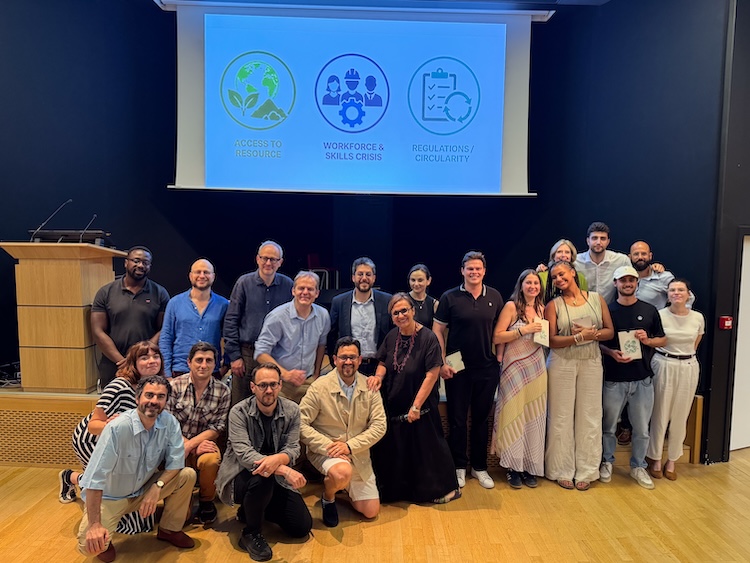 Applauding creativity
Learning across schools, disciplines and perspectives
The collaborative structure of PIVOTS remains one of its defining strengths. By bringing together students from ESCP Business School, ESSEC Business School and HEC Paris, the workshop breaks down silos between schools and creates space for shared knowledge and learning.
The 2026 cohort included students enrolled in sustainability-focused programmes, including the ESCP MSc in International Sustainability Management, the ESSEC Master in Sustainability Transformation and the HEC Paris Climate & Energy Transition Certificate.
The best part of this experience is that we can bring together students from three leading business schools. We can see different points of view on the same issues, and this complements each other’s knowledge through discussion. For a field such as sustainability, which is still emerging and developing every day, this kind of exchange is fundamental.
 Ema Matias
MSc International Sustainability Management student at ESCP
Preparing future leaders to work with uncertainty
At a time when sustainability is increasingly shaped by geopolitics, technology, migration and social change, PIVOTS 2026 gave students a practical framework for working with uncertainty.
By combining foresight methods, sector analysis, design fiction and collaboration across schools, the workshop encouraged students to step back from immediate constraints and consider how today’s choices could shape the business models of 2035.
For ESCP Business School, ESSEC Business School and HEC Paris, PIVOTS reflects a shared ambition: to prepare future leaders to analyse complexity, imagine alternatives and build responsible strategies across disciplines and perspectives.
Campuses