
Executive Master in Digital Innovation and Entrepreneurial Leadership (EMDIEL)
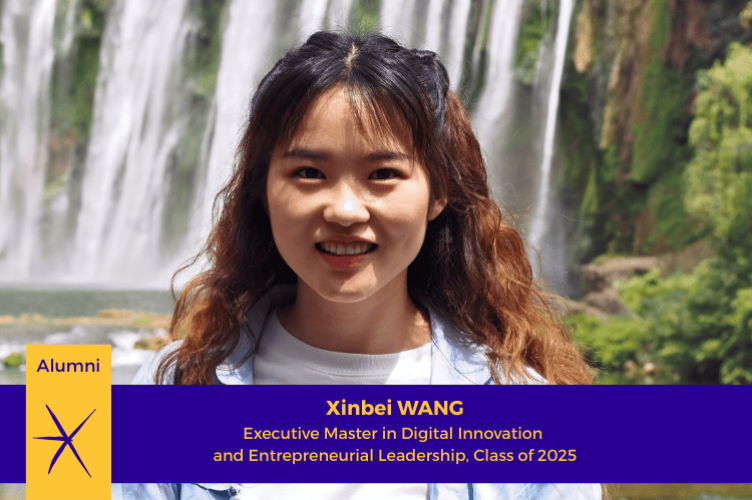
Meet the Alumni: Xinbei Wang, Class of 2025
 Xinbei Wang is a digital product leader currently working as a Tech Product Owner and leading multiple cross-border digital initiatives. Operating at the intersection of technology and leadership, she brings a hands-on, execution-driven perspective shaped by complex international project environments. She joined the ESCP Executive Master in Digital Innovation and Entrepreneurial Leadership (EMDIEL) to broaden her strategic and innovation mindset beyond technical delivery. As a woman in tech, the programme has enabled her to apply new perspectives on leadership, innovation, and value creation directly within her teams — introducing more holistic, business-driven thinking into predominantly technical contexts, while exploring future possibilities in both corporate digital innovation and entrepreneurship.
What motivated you to choose the EMDIEL programme at ESCP?
Before joining EMDIEL, I was already working in technology- and product-driven, cross-border environments, leading international initiatives and delivering complex digital solutions. While this experience allowed me to grow as an execution-focused leader, I began to feel a limitation in perspective — not in how to deliver effectively, but in how to step back and assess what truly matters to pursue.
I increasingly felt the gap between technology and business, and between execution and strategy. I wanted to move beyond “doing things well” toward developing the ability to judge which problems are worth solving and why. This shift in mindset was a key driver behind my decision to pursue further education.
EMDIEL stood out to me because of its unique combination of digital innovation, leadership development, and entrepreneurial thinking. It is neither a purely technical programme nor a traditional MBA, but one that brings together diverse international perspectives and encourages critical reflection on real-world digital challenges.
Through the programme, I hoped to explore new possibilities — from driving digital innovation within large organizations as an intrapreneur, to developing a more mature leadership approach and, potentially, exploring entrepreneurial paths in the future.
What key skills or ways of thinking did you develop through the EMDIEL programme?
One of the most important shifts through EMDIEL was how I approach uncertainty and experimentation. During the San Francisco module, I was inspired by entrepreneurs and innovation practitioners who emphasized rapid testing, learning from failure, and acting without waiting for perfect conditions.
What resonated with me was realizing that this mindset is equally relevant in large organizations, where experimentation often carries less risk than expected. It encouraged me to try new approaches in my daily work and to treat experimentation as a learning process rather than a success-or-failure outcome.
At the same time, the programme strengthened my focus on identifying fundamental problems instead of optimizing existing processes. I became more inclined to question underlying assumptions and explore alternative ways of addressing recurring challenges — an approach that later shaped my master’s thesis.
Overall, EMDIEL helped me move from an execution-oriented mindset toward a more exploratory and learning-driven approach to digital leadership.
Can you share a project or assignment that significantly shaped your thinking?
My master’s thesis became a defining project in shaping how I approach digital product challenges. Rather than starting from existing processes, I focused on a recurring pain point I observed in my work: repeated rework in agile digital product delivery, particularly around UI/UX decisions.
The project, “AI-Driven UI/UX Validation to Reduce Rework in Agile Digital Product Delivery,” explored how earlier, AI-supported UX validation could improve decision quality and alignment in agile teams. Instead of treating rework as an operational issue, the research challenged when and how validation should take place.
What made the project impactful was its practical relevance. It encouraged me to rethink established ways of working and reinforced my belief that meaningful digital innovation often comes from reframing decisions and addressing uncertainty earlier.
This experience continues to influence how I lead digital initiatives, shifting my focus from optimizing solutions to asking better questions.
What about the structure of EMDIEL made the learning feel different from other programmes you’ve experienced?
What stood out to me about EMDIEL was how intentionally the programme is structured around relevance, immersion, and real-world application.
The curriculum is continuously adapted to reflect current developments in digital innovation. For example, courses on no-code platforms were closely aligned with the rapid evolution of AI, fundamentally reshaping how I approach problem-solving and solution design. In addition, the requirement for each participant to complete a substantial individual project ensured that learning was not merely theoretical. It pushed me to deliver outcomes I would not have imagined at the beginning of the programme, reinforcing a strong sense of application, ownership, and impact.
The programme’s global format also made the learning experience distinctive. Studying in locations such as London, Berlin, Shanghai, and San Francisco allowed us to engage deeply with local innovation ecosystems rather than learning about them in abstraction. Each location offered a different perspective on digital transformation, entrepreneurship, and leadership, while strong academic and administrative support made it easy to stay connected to the programme regardless of location.
Equally important was the intensive on-site format. The one-week, in-person modules created a truly immersive learning environment, particularly well-suited to professionals working full time. Stepping away from daily work and routines enabled deeper focus, reflection, and meaningful exchange with peers and faculty.
What advice would you give to someone considering the EMDIEL programme?
I would encourage future participants not to wait until everything feels clear or perfectly planned. EMDIEL is especially valuable for those who are curious, open to questioning their assumptions, and willing to explore new ways of thinking through real experimentation. The programme rewards engagement, reflection, and ownership far more than having predefined answers.
Campuses